Lazy Preaching? – Part 2

Well yesterday’s post stirred more response than usual!  Andy Stanley stated his point in strong terms, which probably sparked some response.  While as an Englishman I might state the same point in a slightly more understated way, I do urge people who attend my preaching courses to stick in their primary passage most of the time.  Naturally people ask for exceptions to that suggestion.  I have two main exceptions in my own thinking.  Let me share those with you and then ask what other exceptions you might add to the list.  As I wrote yesterday, there are fewer legitimate reasons to use multiple cross-references than we tend to think.

1. When the idea of the primary text does not sound biblical.  If you preach a passage and clarify the point, but people internally react with a metaphorically raised eyebrow.  “Is that biblical?”  In this instance I might run through a series of other passages very quickly that support the same idea.  In this situation I am not developing each cross-reference in detail, or going topical for multiple points, but simply allowing the weight of evidence to underline the biblical nature of what the primary text is saying.

2. When the primary passage leans heavily on another biblical passage.  For example when preaching the middle of 1Peter 3 recently, I was very aware of how much Psalm 34 was influencing Peter’s thought at that point, so I took some time to go back there during the sermon.  Again, not a topical approach, but supportive of the primary passage.

I can imagine one or two other reasons to go to other passages that may be legitimate too, but these are the main two in my thinking.  I’d love to hear more interaction on this subject.

I think we should be wary of anything that sounds like “memory trigger cross referencing” (you won’t find that in any book, I just made up the label!)  So you’re preaching through a passage and a word or phrase triggers your memory of another (perhaps more familiar) passage . . . so you go over there for a moment.  Carrying on you find numerous opportunities to go on a safari through the canon.  Often there is no scriptural reason for doing so, no awareness of what texts influence which writers, no awareness of specific contexts and meaning, and no genuine purpose for the excursions in respect to the specific purpose of the primary text and the sermon.  Memory trigger cross referencing is indeed very easy, all you need is a concordance, or a few favorite passages.  Surely we would agree that is lazy preaching?  But when should we consider going elsewhere in the Bible?  The lines are open  . . .

Lazy Preaching?

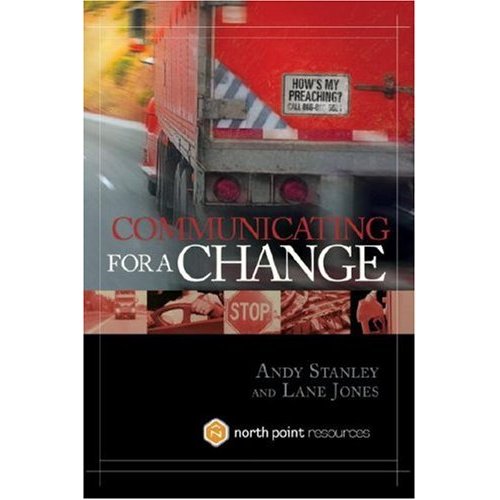
Andy Stanley, pastor of North Point Community Church, made a passing comment about lazy preaching in an interview with Preaching magazine.  He was talking about his desire to come up with a statement, a takeaway point in a sermon.  His stated goal was that a listener could come back to the same passage of Scripture later and say, “I know what that means.  I know what that’s about.”  Because of that goal he does not like to say, “Paul said” and “John said that again” and so on.  Here are his words, reprinted in Preaching with Power edited by Michael Duduit:

I hate sermons like that.  When I listen to them, I just turn them off.  I think just one passage that says it is all we need.  Just help me understand the one passage – please don’t proof text every point with a verse.  I think that’s lazy preaching.  It would be easy to develop sermons like that.

I tend to agree.  There are reasons to go to other passages, but far fewer legitimate reasons than many of us think.  When we have the opportunity to preach a passage, let’s do the hard work and really preach that passage.  It’s easy to skip all over the canon, but if there isn’t a genuine reason for doing so, it’s lazy preaching.

Getting to Grips with the Genres

Imagine a history teacher that teaches history like it is fiction. Imagine a poetry teacher that teaches poetry like it is math. To do this would be absurd. History is not fiction and poetry is not math. Each subject functions differently. History functions through names, dates, and other facts whereas fiction functions through plot. Poetry functions through imagery, meter, and rhyme whereas math functions through logic, rules, and order. Principle: to appropriately teach these subjects the teacher must let each subject speak.

This principle applies to homiletics. Different genres fill the pages of Scripture. In the Lord’s sovereignty, he chose to use narrative, prophecy, gospel, epistle, apocalyptic, etc. to communicate specific truths. If we use the same sermon form without considering the genre then we mash unique kinds of literature into foreign forms. As preachers, we must allow Biblical genres to speak and even form our sermons.

In following posts over the next few weeks, I will attempt to accomplish two things. First, I will highlight how different Biblical genres function. Second, I will highlight the distinct rhetorical impact different Biblical genres intend.

Do We Pray Too Small?

In a world that is highly charged, energized and empowered, somehow life can be such a draining experience. In the busy-ness of life it is easy to lose track of the space necessary for thinking, for communing, for dreaming. I’ve written about the critical importance of our personal walk with Christ. I’d like to consider a related concept. Over time we too easily lose the capacity to dream. What I mean by that is “sanctified big praying.”

At the end of Ephesians 3 Paul tells us that God is able to do immeasurably abundantly more than we ask or even imagine. I suspect that with many Christians, God is not feeling stretched. If we don’t imagine big, then we don’t ask big. God can do more than we ask or imagine, but too often we make fulfilling that Scripture far too straightforward for our Lord. Let’s not only approach the throne of grace with the jaded requests of a tired minister. As preachers who seek to stir the faith of others, let’s take some time and dare to dream big dreams.

Perhaps you dream of bigger crowds in your church, large numbers of local folk captivated and drawn in by the power of the gospel? Perhaps you dream of bigger life change in your listeners – John who sits in the second to last row over to the left and seems to be going through the motions year after year . . . imagine his life set on fire by the truth of God’s Word. Perhaps you dream of specific situations transformed for the glory of God? That family breakdown still under wraps but known to you. How about your own ministry? While holding on to humility is it possible to dream of your own ministry breaking into new areas, utilizing different media to reach more people, doors opening that would really mean a lot to you? Perhaps your imagination moves toward key relationships that could help your ministry – a mentor, someone to mentor, a support team who would diligently pray and help your preaching in practical ways?

The great thing about turning on our imagination is that God can filter what actually wouldn’t help, or what we couldn’t handle. But praying bigger prayers is ultimately a statement of absolute dependence on the power of God in your ministry. Perhaps we should make sure we incorporate prayers as big as we can imagine . . . not that they will cause our infinitely powerful God any stress or sweat, but they may well stir a smile from Him.

Strive to be an Expert in This

One more thought from the life and ministry of Jonathan Edwards. Piper states that Edwards probed the workings of the human heart and gained a profound understanding of it. He did not achieve this by “hobnobbing with the Northampton parishioners,” but by three things:

1. Diligent reading and contemplation of his own heart. Perhaps this was typical Puritan introspection, but he knew that his own heart was the one human heart he could inspect most closely. He sought out all the “subtle subterfuges” of his heart, appetites and thoughts.

2. The necessary sorting of the wheat and chaff in the religious experiences of his people. While it may be tempting for us to bemoan the lack of a great awakening in our day, perhaps we would do well to give serious thought to the experience of religion among our people anyway. In Edwards’ time there was both the genuinely Spiritual and deeply discouraging self-deception. Perhaps if we look we will see the same today, and in doing so we might get a fuller understanding of the workings of human hearts and affections.

3. Passionate pursuit of the teaching of God’s Word. This is not last in importance, but last for emphasis. To be a genuine “surgeon of souls” like Edwards, we must pursue years of serious study in God’s Word. The heart and affections of humanity, and their primary role in spirituality are foundational aspects of biblical teaching. With our eyes open we will discover that the heart is one of the most neglected, overlooked and yet prevalent teachings in the canon.

As preachers we are often more aware of our inadequacies than any sense of expertise. Yet with all the aspects of ministry clamoring for our focus, perhaps we should give thought to striving for greater understanding, perhaps even expertise, in the workings of the human heart. If we don’t, who will?

First Things First

While I add a lot of posts on this site that are somewhat technical in nature, the foundation of effective preaching has to be our personal walk with the Lord. As good stewards we must do everything we can to be the best that we can, but none of that can replace the fundamental reality of a close personal relationship. I appreciate this quote from Jonathan Edwards reflecting on his early years in ministry:

“I spent most of my time in thinking of divine things, year after year; often walking alone in the woods, and solitary places for meditation, soliloquy, and prayer, and converse with God; and it was always my manner, at such times, to sing forth my contemplation. I was almost constantly in ejaculatory prayer, wherever I was. Prayer seemed to be natural to me, as the breath by which the inward burnings of my heart had vent.”

For many of us the danger of busy-ness and distraction is higher than it has ever been. Let’s be sure to turn off the mobile, the email, the internet, etc., and deliberately make time to think, to pray, to stir the burnings of our heart. Our listeners will benefit greatly, but that is secondary. First things first . . . you and God.

Surrogate Sermons – Part 2

Continuing on with Dwight Stevenson’s list from yesterday . . . “surrogate sermons” we should be avoiding:

Palace propaganda – Catering to the specific audience in a church by giving exactly and only what they want to hear (often determined by their socio-economic class, race, etc.)

Theological lecture – We must be able to give reason for our faith, but that does not mean we substitute dogma for faith in preaching.  Preaching can be doctrinal without sounding doctrinaire.  Preach the inspired text, not only a system.

Argumentation and debate – We are called to be Christ’s witnesses, not his lawyers.  It is easy to level our guns at a theological position, or a moral concern, but let us be careful not to breed counterattack, controversy and division.

Eulogy – A syrupy diet of simplistic non-answers to life’s realities that sound acceptable because they elevate Christ continuously.

Ecclesiastical commercial – The promotional work for the programs of the church can be done effectively and creatively outside of the sermon.

Monologue and soliloquy – Communication that is effectively the act of hearing one’s own voice, because the preacher is unaware of the internal and explicit reactions of the listeners.

Surrogate Sermons

It is easy to preach something less than a sermon.  We thought of one example yesterday – the curiosity satisfier.  Today I’d like to list a few from a list by Dwight Stevenson (published in A Reader on Preaching).  His goal is to help us spot sermon replacements and erradicate them from our ministry.  Here are his titles with brief explanations:

Moralistic harangue – The exhorting, punishing or whipping of our people because they are not living up to their obligations.  Many people seem to appreciate receiving these bashings.  Why?  Perhaps because they don’t like themselves much anyway, feel guilty and appreciate taking their medicine.  “It is a fine way of paying for sin without repenting of it.”

Aesthetic artifact – The carefully produced work of art that one hopes will be a blessing to behold for generations, rather than carefully designed nourishment for these people now.

Pontifical pronouncement – The preaching of one who seeks to do the thinking for the people, standing in authority for the immature who find security in such “assistance.”

Museum lecture – Often the best one can hope for is mildly interesting and informative, but often becomes dull and boring, and is almost always irrelevant.

Palliative prescription – As we run from moralistic harangue we are always in danger of falling into cheap grace, easy assurance, repentance free pardon and superficial pain-relief.

That’s enough for today.  It’s only half his list, but that’s enough.  Again, these examples of surrogate sermons remind us of the importance of the Bible in expository preaching.   The Bible does not merely give a starting point, or illustrative material, or a stamp of approval.  The Bible has to be in charge of the message – the idea, the content, the relevance, the mood, the goals.

Preach to do More Than Satisfy Curiosity

The Bible was not given to satisfy curiosity.  It is truth that always intersects life in some way.  Consequently as preachers we must not pretend that arms-length analysis is sufficient.  We have to wrestle with how to help our listeners experience the truth that is being preached.

Haddon Robinson has pointed out that for many people, most of the preaching they have heard has satisfied only to the level of meeting some level of curiosity.  Sadly many in our churches have had years of Bible studies that are not dissimilar to filling out a crossword or Sudoku puzzle.  You get all the parts in the right place, get the thing completed and then feel satisfied.  But the Bible does not work merely at a curiosity level.  It digs deeper, intersects more fully with life.

Haddon was interviewed in 2001 by Preaching magazine.  In his words, “I think God’s truth is always designed to challenge us and change us.”  Let us pray that we never settle for satisfying curiosity when we have the privilege of being involved in transforming lives.

Don’t Shoot the Wheel-Nut

Today in the news there is a story of a man who got frustrated trying to loosen the wheel-nut on his car and decided to try blasting it from close range with a shotgun. The ricochet of buckshot and debris peppered him from ankle to abdomen.

While not wanting to make light of his severe injuries, I would like to draw an analogy for our thinking as preachers. Use as much force as necessary to achieve each goal in a sermon, but don’t exert excessive force that will backfire on you. Here are some examples of backfiring preaching techniques:

* Overstating the introduction. Don’t promise to solve all the problems of the world in your introduction if your message only addresses some of the problems. If the goal is modest, then strive to create a thirst for the message, but a thirst that will be quenched. It is easy to take onboard the importance of surfacing a need and then over-promise. It will backfire.

* Overbearing illustrations. Perhaps you come across a moving story, or have a powerful experience that fits with your message. Be careful it is not too powerful or you might overwhelm the message. Illustrations and stories should drive the idea forward, not overtake it. Even if it happened to you, even if it is all true, even if it agrees with the text . . . if it is too strong it may backfire.

* Over-the-top word choice. Sometimes shocking a congregation can be effective, but you must plan carefully. Just because Tony Campolo once swore at a congregation does not mean we should all try it. For effect or shock value or even for a laugh, it is tempting to go too far. Don’t. It will backfire.

Peter has responded to a comment on this post.