Easter As Gory Story?

If you are preaching in the next few days then I would hope Easter is in the mix.  Of course the cross of Christ is at the very centre of global history and God’s salvation plan.  A question we face as preachers is just how gory does the presentation need to be?

Crucifixion was incredibly graphic and deliberately so.  In a culture where people killed their dinner, and where blood flowed freely in the temple courts, in a culture so far removed from the clean and sanitized version of life that we enjoy today, crucifixion was still a massive visual deterrent.  While some today might not fear a few months in prison for committing a crime, the Roman cross was massively feared.

So should we seek to paint the power of the deterrent by the words we use to describe what Christ went through?  Different preachers might lean in different directions.  Some seem to delight in the opportunity to make people squirm, describing in graphic detail just what the nails did to the wrists and feet, the agony of every breath, the ultimate cause of death, etc.  Others go to the other extreme and paint a picture as beautiful as the stained glass windows where Jesus seems barely marked by the whole process.

The truth is that if we saw what Christ went through at the hands of the mocking soldiers and then at Calvary, I suspect we would all feel sick to the core.  But is that the point of our preaching?

Perhaps it is a good idea to stun and shock people out of a religious view of the crucifixion.  Or perhaps it is better not to overwhelm people with gore so they miss the real issue.  A few brief thoughts:

1. Who are your listeners?  What do they need?  What would be most effective for them?  Might they feel like they experienced something unexpected and before any watershed times that may still exist on TV?  It is possible to be deeply moved by the cross without being made to feel ill.

2. What is the text?  Remember you are preaching the text or texts, so what is emphasized there?  It is too easy in “familiar” bits of Bible history to leap from the text to preaching the event itself.  Maybe in this case that is legitimate, but don’t give up the distinctive value of each inspired text too easily.

3. What is your purpose?  Remember that there is more to preaching the cross than stirring a gut reaction to the brutality of what Christ went through for us.  At the same time, perhaps you prayerfully decide that the offense of the cross is needed by those to whom you will be preaching.  No hard and fast rules here, just a plea for prayerful sensitivity to God and those present.

Add to FacebookAdd to DiggAdd to Del.icio.usAdd to StumbleuponAdd to RedditAdd to BlinklistAdd to TwitterAdd to TechnoratiAdd to Yahoo BuzzAdd to Newsvine

The Power of Vivid Description

As you preach a text of Scripture, look for ways to help listeners see what it is saying.  Too often our preaching is merely propositional.  That is, we trade in truth statements.  But God knows that the truth enfleshed is what will transform us.  This is why He sent the prophets.  This is why He sent His Son.

This is not to suggest that there is somehow a different message that is “enfleshed” as opposed to “truthful” – that may be the case with some, but I certainly don’t advocate that.  What I am suggesting is that verbal constructs will often pass by the listeners without really registering.  Take that same truth and help people to see it in action.

This can be in historical action – i.e. the world of the text.  Tell a story so it can be seen on the internal screen of the heart.  Preach a poem so the visual imagery is powerfully presented.  Present a discourse passage in the narratival tension of its original occasion.

Also this can be done in applicational colour.  That is, help people to see in vivid everyday terms how this passage’s truth will look when it is worked out in daily life and experience.  This doesn’t require to do lists, but it does require vivid description.

I’m convinced that one of the key ingredients for effective preaching is effective and vivid description.  Practice it.  Learn it.  Dip into the descriptive communication of effective preachers, or storytellers, or novels.  Do what it takes to better engage your own imagination, and then the imagination of your listeners.  Truthful preaching is vitally important.  Truthful preaching enfleshed in vivid description is massively powerful.

Add to FacebookAdd to DiggAdd to Del.icio.usAdd to StumbleuponAdd to RedditAdd to BlinklistAdd to TwitterAdd to TechnoratiAdd to Yahoo BuzzAdd to Newsvine

Opaque or Lens?

Opacity is worthy of our consideration.  The contrast between being opaque and being a lens was suggested last week in conversation.  That is, does the preacher act as a lens through which I see Christ, or as an opaque presenter through which I see little?  It may be hard to quantify, but as listeners I think we know the difference.

When the opaque preacher preaches, we receive information and ideas, maybe even illustrations and anecdotes, perhaps applications, and even apparently effective delivery.  Technically the sermon might tick all the standard boxes.  Faithful to the text, relevant to the audience, clear in presentation.  But obviously not clear in the sense we mean in this post.  Because for all the good that’s there, the sermon event feels opaque.

So what is it that turns the opaque preaching into a lens through which the person of Christ is seen, through which the grace of God can shine into our lives?  I suspect it isn’t primarily about technique, since great preparation and delivery skill can still lead to opaque messages.  Perhaps it’s something along the lines of …

A sermon will act as a lens to the extent that the preacher relationally engages both God and the listeners as true personalities.

That could be better stated, but it will do for now (comment freely and offer better statements!)

1. If God is viewed as a distant, unknowable, cold deity who has left us with a set of data encoded in an anthology we call the Bible, then the preacher won’t engage Him.  But if God is known personally, through the Word, through prayer, through a living and vital and covenantally loyal love relationship; and if God is an active participant in the life of the preacher; and if the preacher genuinely loves and likes God . . . then we may be onto something special for preaching.

2. If the listeners are viewed as an amorphous group of punters who have chosen to attend a presentation in which they (the seated ranks of unknowns) get to hear me (the preacher), then the preacher won’t engage them effectively.  But if the people matter, and are cared for and prayed for and are important to the preacher (even if he is visiting), and if he seems to not only care enough to give tough medicine, but loves enough to make it palatable, and likes enough to smile . . . then we may be onto something special for preaching.

Opaque or lens?

Add to FacebookAdd to DiggAdd to Del.icio.usAdd to StumbleuponAdd to RedditAdd to BlinklistAdd to TwitterAdd to TechnoratiAdd to Yahoo BuzzAdd to Newsvine

Pulpit Talk Is Never Nothing

When you preach, what you say may or may not be biblical, accurate, helpful, engaging or even Christian.  But one thing it can’t be is nothing.  There is no neutral.

1. Poor handling of the Bible is not nothing. Some preachers may read the text and then say whatever they want, failing absolutely to communicate the meaning, the intent or the relevance of the text.  But they aren’t doing nothing.  You can’t judge dismiss it and say, “Oh, that’s just so and so, we know what he’s like…”  Truth is that such poor handling leaves an impression on the impressionable, it trains the incompetent to greater incompetence in Bible handling, it adds fuel to the fire of the skeptic who silently evaluates and concludes that there really is no substance to Christianity.  It may be damaging, but it is never nothing.

2. Improper application of the Bible is not nothing. It’s amazing what some people will seek to apply to the listeners.  The disciples met with the risen Jesus in the evening, so we should be sure to attend the evening service at church.  How is this any better than reading Noah and conclude the spiritual and godly are the few still prepared to throw birds through windows?  Whatever might be said of this kind of applicational tripe, you cannot say, “Oh, that’s just preacher so and so, we know what he’s like…”  Truth is that such improper application is harmful both in its impact and in its failure to impact.  People whose lives are in need of the balm of the Word, in need of the conviction of the Spirit, in need of the wooing of Christ, in need of encouragement, of soul care, of love . . . these people get only guilt, pressure, nonsense, harm and damage.  Whatever this type of application may be, it is never nothing.

I suppose I could list all manner of other things here . . . unthought-through illustrations, inaccessible explanations, anecdotal content that serves the main idea not one whit.  The preacher preaches and there is no sense in suggesting that every word that proceeds is automatically a fruit of time spent with the Lord.  Some words spoken are not befitting for the Christian pulpit.  Yet no words spoken are merely nil.  Each word, each sound, each expression, each detail . . . it all does something.  Let’s be sure to make it all count for eternity.

Add to FacebookAdd to DiggAdd to Del.icio.usAdd to StumbleuponAdd to RedditAdd to BlinklistAdd to TwitterAdd to TechnoratiAdd to Yahoo BuzzAdd to Newsvine

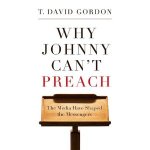
Review: Why Johnny Can’t Preach, by T.David Gordon

It’s a short book,108 pages, but it packs quite a punch.  T.David Gordon wrote Why Johnny Can’t Preach during a year of treatment for cancer.  Given only a 25% chance of survival, he found his focus clear and the desire to compromise his message absent.  The book is hard-hitting, but I found the tone entirely appropriate and not harsh despite the subject matter.

The writer is a media ecologist – that is, one who studies the effects of the change of media forms on the culture.  Taking his title from two books in the 1960’s on the growing inability of students to read and write, this book focuses on why the present state of preaching is so dire.

The first part of the book sets out his evidence for his claim that preaching is ordinarily poor.  While admitting freely that his first line of evidence is merely anecdotal, I found the presentation of evidence hard to argue with (not that I’m inclined to argue since my experience largely reflects the author’s).  Yet Gordon’s evidence is not merely subjective.  He goes to some pains to make clear that there are some objective measures of sermon quality that can be used to identify problem preaching.  It is too common to hear “that is just your opinion” if a sermon is ever questioned or critiqued.

The author’s argument culminates with the almost total absence of the annual review, not missing in any other profession, but indicative that all sides know there is an issue.  Gordon doesn’t blame seminaries for this state of affairs.  In his perspective they haven’t changed, but the calibre of incoming student certainly has.  What has changed?  Because of the change in media forms, Johnny is no longer able to read, nor write, nor discern the significant, and hence he can’t preach either.

True preaching requires close examination and study of a quality text, something non-readers have no experience of today.  People don’t study classical languages.  They don’t read literature.  They aren’t equipped to really study a text.   People read for content, but don’t learn to look at how a text communicates.

True preaching requires careful composition.  But people don’t write letters anymore.  They talk on the phone. Instead of careful composition, we live in a day of easy and cheap talk.

True preaching requires a sensibility of the significant.  But the only way to watch hours of television is to turn off such sensibility, so most do.

A once-common sensibility (close reading of texts) is now uncommon, and a once-common activity (composition) is now comparatively rare.  A once-common daily occurrence (face-to-face communication allowing us to “read” the unstated feelings of another) has been replaced by telephone conversation in which visual feedback is absent.  A once-common sensibility, the capacity to distinguish the significant from the insignificant, is becoming rare.  For a minister today to preach a basic average sermon by early-twentieth-century standards would require a lifestyle that is significantly countercultural.

The book is not solely concerned with capacity to study and compose.  The fourth chapter looks at the content of sermons and gives a fine rebuttal of four contemporary approaches – moralism, how-to, introspection and “so-called culture wars” . . . helpful content that I will come back to in other posts.

At certain points I would suggest that the author’s view of Christian preaching is a little narrow.  There is more to an inherently relational faith than merely submitting our will to God’s will.  Perhaps the Bible text, if read carefully, might present the heart of God such that our hearts might be changed in response.

Nevertheless, even taken on the author’s terms, the book’s message is important and needs to be considered.  All of us live in a fast-paced world that simply doesn’t allow for careful reading of God’s heart in His Word.  Perhaps it is time we were more counter-cultural in order to be able to read the text well.

Thankfully, T. David Gordon is still alive and serving the church through his teaching and writing.  We should be grateful for this little gem of a book.  Buy this book, perhaps even pass on a copy to someone else!

(If you are in the UK, click here to buy.)

Add to FacebookAdd to DiggAdd to Del.icio.usAdd to StumbleuponAdd to RedditAdd to BlinklistAdd to TwitterAdd to TechnoratiAdd to Yahoo BuzzAdd to Newsvine

There It Is!

Perhaps you have sat in Bible studies where this has happened.  The text being studied might be something like Ephesians 2:21.  The next question in the booklet asks something about the term “temple.”  It also has a string of cross-references with it.  So the leader assigns references to different ones in the group.  One by one these are read out.

“Ok, I’ve got Matthew 12:6, ‘I tell you, something greater than the temple is here.’ Yep, temple, ok.”

“Ok, I’ve got Revelation 7:15, ‘They are before the throne of God and serve him day and night in the temple’ – yep, temple, there it is.”

“Ok, I’ve got Acts 2:46, ‘And day by day, attending the temple…” – ok, yep, temple!”

“Ok, I’ve got John 2:14, ‘In the temp…’ there it is!”

These may have been carefully selected cross-references to provide helpful insight into the meaning in Ephesians 2:21, but they have served no purpose other than giving people a chance to practice finding Bible references and play a game of word recognition.

Maybe, like me, you have found yourself sitting through moments like this, wondering what the point of it all is?

Where does this come from?  Let us assume for a moment that the person who wrote the Bible study questions had a plan in their selection of cross-references (this is an assumption).  Then surely the value will come from taking at least a moment or two to recognize more than just the presence of the word?  Surely it should involve some thought as to the use of the term in that context and how that might influence our understanding of the focus text for the evening?

So where does this practice come from?  Is it, perhaps, the example of preachers who use cross-references essentially as time-fillers, failing to make any sense of why they have gone to the verses or what differences they make to the understanding of the target text?

As I have written before, there are not too many reasons to go to other passages when preaching.  (Here is my low fence post, and here is part 1 and part 2 of a post on cross-referencing.)

When you do go to another text, make sure it is clear what you are looking at and why.

Add to FacebookAdd to DiggAdd to Del.icio.usAdd to StumbleuponAdd to RedditAdd to BlinklistAdd to TwitterAdd to TechnoratiAdd to Yahoo BuzzAdd to Newsvine

The War of the Words

Ever since the beginning, everything seems to be about words in conflict.  After all, God’s creation was all good, until a little conversation in chapter 3.  What was the core of that conversation? “Did God really say?” The serpent questioned God’s words, and questioned whether or not those words could be trusted.  He offered an alternative, “you won’t die” as opposed to “don’t eat or you will die.” Tragically, they went for it.

So, history is all about Adam’s “dead” offspring.  Oh, and about a God who captures the hearts of this spiritually dead humanity by offering his words again, “believe in me and you will have life!”

Sometimes we crave direct and exciting intervention from God, if only we could see His angels all the time, or miracles immediately after every prayer.  But the vast majority of the time, even in Bible times, God is more indirect. He gives His word and He asks us to trust Him.

In the book of Genesis, once the war of the words becomes clear, the foundation is laid.  Then the story shifts to focus on one man, Abram, and God’s plan.  God’s word to Abram at the start of Genesis 12 really sets the direction for the rest of the Bible.  We get to watch Abram growing in his trust in God’s word.  Just like us, he didn’t get it all at once.  Just like Abram, we need to listen carefully to what God says and trust Him.

The Bible goes on like this for three-quarters of a million words.  Our lives go on like this for even more words.  As preachers we stand and preach in this war of words, and the words we preach matter.

The war of the words still rages, let’s make sure we’re listening when we open God’s word.  Let’s be sure we’re preaching our hearts out whenever we get the chance.  Because for the rest of the day, the rest of the week, there will be plenty of alternative words trying to capture all of our hearts!

Add to FacebookAdd to DiggAdd to Del.icio.usAdd to StumbleuponAdd to RedditAdd to BlinklistAdd to TwitterAdd to TechnoratiAdd to Yahoo BuzzAdd to Newsvine

Preaching in the Presence of Lists

At various times you will be preaching in the presence of lists.  Not the to-do lists that are manically collected by some church-goers, bursting out of their Bibles’ strained clasps.  The lists that God inspired.

It may be tempting to just skip them or dismiss them (easy to make disparaging remarks that we don’t really mean).  But if you aren’t preaching the list, and it is in sight, what to do?

Help people, even in passing, to know why it is there.  It isn’t there to put off Bible readers in their cyclical reading aspirations.  It isn’t there to tempt people to put a new spin on received pronunciations.  It is there for a reason.

Let’s take the descendants of Esau in Genesis 36 as an example.

Why is it there? It’s good to remember when these books were written and for whom. Whether Genesis was written or compiled by Moses, it was part of the five books which were for the Israelites as they entered into the promised land. It was important for them to know where they had come from, their history, God’s promises and so on.

One of Moses’ (and God’s) concerns was that they not mingle with the inhabitants of the land or near neighbours, in such a way as to become disloyal to the one true God. This chapter, with all its people and connected place names, would be a helpful reminder to them of where some of these other people came from. Certainly the chapter keeps pointing out that Edom was from the “unchosen” line of Esau – and Israel would often have issues with Edom later on!

It probably seems obvious to you, the studied preacher, to consider when the list was written and for whom.  I suspect that might never enter the minds of some of your listeners.  Unless you point it out, of course.

(And then encourage people that they don’t have to pronounce every name if they are on a fast read through – it’s amazing how people appreciate permission to press on in their Bible reading!)

Add to FacebookAdd to DiggAdd to Del.icio.usAdd to StumbleuponAdd to RedditAdd to BlinklistAdd to TwitterAdd to TechnoratiAdd to Yahoo BuzzAdd to Newsvine

The Obvious Early Connection

The more traditional approach to preaching was apparently to do all the explanation and then ask where the truth might connect to listeners’ lives at the end.  Actually, good preachers have always made their listeners feel connected to the message much earlier than that.  There is one point of early connection between listeners and Bible text that is usually fairly obvious.

Ever since Genesis 3 we have all lived in a fallen world.  Abram did.  David did.  Paul did.  You do.

This means it shouldn’t be too hard to find a connection between text and world.  The people in the text are fallen people in a fallen world.  So are we.  So unless your study and preparation is taking you down a fruitful pathway other than this, it is probably worth asking what is the fallen world issue in the text?  Is it rebellion?  Is it doubt?  Is it suffering?  Is it fear?  Is it self-love?

Once you can see what the tension is in the text, brought about by the Fall, then you can probably make a connection to today.  So far, so good.  But don’t miss the next step.

Make that connection overt.

It is no good knowing it and assuming others spot it.  Make it clear.  Evident.  Stated.  It is easy to have this kind of “fallen condition focus” (as Bryan Chapell calls it) in our minds, but then fail to say so in our sermons.  You start into the context, tell a bit of historical background, explain a bit culturally, dive into the text, explain freely and before you know it you are almost out of time and start to make some sort of application.  Oops.  You just did what we said it was better to avoid.  Why?  Because if a sermon feels like a historical lecture, your listeners won’t, well, listen.

Look for point of connection.  Make clear point of connection.  And do it early.

Add to FacebookAdd to DiggAdd to Del.icio.usAdd to StumbleuponAdd to RedditAdd to BlinklistAdd to TwitterAdd to TechnoratiAdd to Yahoo BuzzAdd to Newsvine

Notes on Reviewing Experience

I’ve just finished a series of messages at my home church.  Each message was recorded and I took the time to listen to them again.  This allowed me to edit start and finish, as well as any particularly disturbingly loud sneezes from folks in the congregation.  It also allowed me to review my messages.  One thing stands out – my mental review and my audio review were different.  For example:

1. After preaching certain elements seemed big in my memory, but were minimal in the audio. That is, a passing comment that took three seconds in reality actually became a thirty second major issue in my mental recollection of the message.  When we look back on a message and one comment or detail stands out, let’s not assume it was “as bad” or “as major” as our minds might tell us.

2. After preaching my overall impression of the message could be very different from reality. For instance, I might look back and think, “that was rushed.”  However, in review of the audio it might sound anything but rushed.  This kind of thing happened several times in this series.

3. There is much to learn from both kinds of review. While I am saying we shouldn’t trust our mental review too much, it is good to take stock and learn from the experience of preaching a message.  At the same time, let’s not miss the opportunity to learn from the experience of hearing that same message.  Preaching and hearing are different experiences.  Learning from both will aid our preaching.

Do you review your preaching?  By memory?  By audio?  By video?  By feedback?

Add to FacebookAdd to DiggAdd to Del.icio.usAdd to StumbleuponAdd to RedditAdd to BlinklistAdd to TwitterAdd to TechnoratiAdd to Yahoo BuzzAdd to Newsvine