Going Beyond the Text?

When we preach a Bible passage, we need to preach the text.  That may sound obvious, but many don’t do it.  Some preachers use the text as a launching point – they read the text and then preach an associated thought from their own thinking or theology.  Others bounce briefly off the text and then preach other passages with some perceived connection. 

God is the best communicator, so as preachers, we want to reflect his communication as best we can.  When you are preaching a passage, really try to preach it.  That includes helping your listeners to see what is there, to understand what is there, and to feel the force of what is there.  To really preach a passage is not simply to educate listeners in the meaning, although that is a good start.  It is to get them into the text and get the text into them, and it is to introduce the God who is revealing himself through the text so that they experience the transformative power of a personal encounter.  The preacher is not merely teaching, but introducing, match-making, and fanning the flames of the relationship between listeners and God.

If we commit to truly preaching a passage, then we will come up against the challenge of saying more than the text says.  That is, if we are really committed to a high view of the biblical text, are we straying if we add any detail not overtly stated in the passage?  If we have a biblical narrative, are we restricted in telling the story so that we cannot fully tell it, but instead end up preaching theological points connected to it?  Are we trying to cram a 100-word reading into a 4000-word speech without really saying anything beyond the 100 words of the passage?

Here are five thoughts that may help when it comes to the subject of “adding to the text.” 

1. Think about the “informing texts” – As well as the passage you are preaching, there will be other passages that inform the content of your preaching passage.  Any passage quoted, or alluded to, or that provides the relevant history (think Acts for some of the epistles) should be considered as fair game for helpful content as you preach your passage.

2. Consider “related texts” – This is more subjective, but some passages are more related to your preaching text than others.  The same author or the same time period will tend to be more related than a distant author and era (unless the era is earlier and may have informed your writer, but then we are back to number 1: informing texts).  Related texts can be helpful, but don’t lean on them so much that your preaching passage is lost in the process.

3. Make plain “assumed knowledge” – When the Bible writers wrote, they were not thinking of readers in a different culture, language, location, and historical era.  So there is a lot of background information that is assumed.  The author might assume the reader knows who the Pharisees were, named individuals, cultural events, or societal norms.  Geographic descriptions weren’t needed for the original readers, but they might be highly helpful for modern listeners to make sense of the setting of a passage.  It is not going beyond the text to state overtly what is implicitly assumed within the text.  Study the background, the culture, the geography, etc., and help people to understand, visualize, and feel the impact of the passage as you preach.

4. “Imagined” thoughts and feelings in a passage can be shared honestly – We don’t know what was going through a character’s mind, or even what was happening in their life around the events of a story.  Where we use our imagination to help bring a passage to life, be sure to help listeners know that you are not asserting divine revelation.  I was listening to a Haddon Robinson sermon recently, and he said something like, “I’m not sure he said this, but I know we do…”  It was a helpful way to connect the real-life aspects of the story to the real-life experiences of Haddon’s listeners.  “I can imagine how Peter may have felt…” is a perfectly legitimate statement because your listeners know you are using your imagination.

5. Only “assert what the text asserts” – While sanctified, humble, and informed imagination can be helpful, it should never be the substance of your preaching points.  Let the thrust of your message, both at the level of the main idea and the main points, come from the passage.  Do not make assertions based on assumptions, imagination, or guesswork.  An example comes from Psalms where the historical setting is not stated but only guessed, and then the preacher makes a point that depends on a guessed historical setting.  Let the text drive the points you are making.  Use your imagination to help proclaim the passage.

Seasoned preachers know that the bigger challenge will always be what to leave out, rather than what to add to a message.  But in some settings, people have an overly restricted view of what should be said in a sermon.  They fear saying anything more than the passage itself states overtly.  That can restrict effective preaching. 

Let’s make it our goal to plumb the depths of our passage, to proclaim it as fully and engagingly as possible, and to make sure that it does its work in bringing listeners into an encounter with the God who reveals himself through the Word. 

________________________________________________________________________

Here is last week’s podcast episode on this subject:
Getting Stuck in Sermon Prep (Podcast Post 7)

I was chatting about preaching with a friend on Sunday after preaching in his church. We talked about ways we sometimes get stuck.

Sometimes, the outline won’t quite work, and we keep looking at the text until eventually something clicks. Once it clicks, we can’t understand how we could not see the passage’s logic before.

Sometimes, the details of the message are the issue. What illustrations would work? How can I introduce the sermon? And so on. Again, the breakthrough moment is always a real relief and cause for rejoicing.

Sometimes, everything seems jammed up, and we simply can’t get the sermon to work.

In the latest episode of the podcast, Mike and I discuss seven specific logjams and offer some ideas that might help you break through the next time you get stuck.

But here is a thought: let’s be careful not to see the ideal as a jam-free future. While logjams can feel like hard work, there is also a blessing in them. Without the logjam, there might not be the desperate prayer. Without prayer, there would not be sweet moments of answered prayer as God lifts us in preparation for Sunday.

Transitions Matter! (Podcast Post – Episode 4)

Is there a small detail in your preaching that would yield disproportionate fruit if you gave it some attention?  Maybe even a “non-content” element of preaching that would make your biblical content land with more precision and penetration?  The answer is, yes, absolutely.  Give some thought to your transitions!

As I listen to sermons in the classes I teach, it is often the transitions between points that either let a sermon down or help a sermon land with force.  Each transition is an opportunity to give breathing space (for fast-paced preachers), or assurance of progress (for more ponderous presenters), as well as a re-entry point for distracted listeners, and an opportunity to restate the main idea at a key moment in the sermon.  Then, of course, there is the main function of a good transition: to set up the next point in the sermon!

Transitions are small moments with big impact. In sporting terms, transitions provide assists so that the sermon points can score goals. Every coach knows the person giving the assist will get less glory but is critical to the team’s success.

So, hopefully, I have convinced you that transitions matter.  Feel free to go to your next sermon and think through how each transition could be most effective.  Or, if you want five specific suggestions on how to transition well, please check out this Bitesize episode on The Biblical Preaching Podcast!

Please do follow the podcast on your preferred podcast directory, or subscribe to the YouTube channel. Thank you for helping get the word out about the podcast!

7 Defining Moments in Your Sermon – Part Four

We have thought about two moments before the sermon starts, two in the introduction and two in the body of the sermon. 

What about the conclusion?  Let’s go there for the final defining moment:

7. The landing – We know the end of the message is important.  During preparation, we might have prayed and dreamed of a huge revival breaking out.  During delivery, we might just be desperate to be finished and away from the microphone.  But between those two extremes we can see that the conclusion does matter.  There is both the quality of the landing and the fact of the landing.  The quality is determined by both tone and content.  It is a chance to review the main points of the message, to restate the main idea again, and to bring a sense of conclusion to the whole.  The tone can be encouraging, upbeat, hopeful, and faith-stirring rather than critical, harsh and guilt-trippy.  As well as the quality, there is also the fact of landing.  Arrive.  Get there.  Stop talking.  Don’t elongate the message in the hope that your fourth attempted landing will prove to be better than the first three.  Robinson used to say that it is best to end a sentence or two before people expect you to end. Review, encourage, finish. 

So there we go, seven defining moments of the sermon.  But I need to add one more:

Bonus – Clearly stating the main idea.  Of course, no matter how hard I try to point away from the obvious moments to some that people may not be aware of, I still feel the need to underline the importance of a well-defined main idea in the message.  Too many preachers preach without it.  The main idea needs to be clarified by the preacher, otherwise it will be hastily cobbled together in the minds of your confused listeners.  It is your job to make sure the message is coherent.  Nothing holds a message together so well as an accurately defined main idea.

What would you add to this list?  What are the defining moments in a sermon?

7 Defining Moments in Your Sermon – Part Three

We have thought about the pre-sermon moments that impact the preaching event and considered a couple of aspects of the introduction.  Now, let’s consider a couple of moments that can define the impact of the message from within the body of the sermon.  Obviously, the points are important, the text’s explanation is critical, and so on, but that is what we tend to focus on.  Here are two surprisingly significant moments to consider:

5. Every transition – It could be argued that transitions separate good communicators from average ones.  It is natural to focus on the content of the points, but it is a step up to be aware of how you move from one to the next.  It is like having a passenger riding behind you on a motorcycle.  They will tend to stay with you in a straight line, unless you accelerate too fast.  But you really need to slow down through the turns.  The same is true when you preach.  A good transition can achieve so many good things: a review of what’s been said, an encouraging conclusion to a point, a reminder of progress in the message, a preview of what is to come, a chance to re-engage for the distracted listener, an opportunity to reinforce the main idea, a moment of pause for an overwhelmed listener, and so on.  Or you can clumsily jump into your next point and leave people confused as to what happened to the other point, why you are talking about this, how it relates, and so on.  Pay attention to every transition; your message will be more helpful for more people.

6. The Interruption or Surprise – We do not preach in a vacuum-sealed box that can be completely controlled.  It is an environment with many variables.  Let’s categorise them as either public or private.  The public ones interrupt everyone’s experience.  The phone ringing, the child crying, the jackhammer starting, the gunshot (hopefully not).  Some are minor, some are more significant.  You have to decide at the moment how to handle it.  Be careful not to draw attention to someone feeling awkward about their phone or baby or to press on through something worthy of a pause.  I’ve seen a preacher totally undermine his credibility and sermon by a harsh and unkind response to an accidental interruption.  I’ve also seen a preacher try to press on, oblivious to the passed-out person being carried out of the congregation.  The first should have been more gentle, the second would have done well to notice, pause and pray for the person.  I don’t remember either of the sermons, but years later, I remember the interruptions and the response from the preacher.

Then there are the private interruptions.  That is the thought that suddenly presents as you are preaching.  Maybe a new illustration.  Maybe a warning flag about using a planned illustration.  Perhaps an extra thought that could be added, or a new direction for the application.  A beginning preacher may not be able to imagine any internal dialogue while preaching because the whole experience is so consuming and overwhelming.  But actually, there can be quite a wrestle going on inside a preacher while the sermon continues to be preached.  Don’t automatically discount every thought and press on through the notes.  Neither should you take every thought as a Spirit-led and anointed change of direction.  You have to prayerfully and humbly process as you go.  You won’t always get it right, but you will do well to lean towards the love of God and others in every decision you make (and keep an eye on the clock, too, as an act of love for the children’s workers and people who brought a first-time guest!)

7 Defining Moments in Your Sermon – Part Two

As we work through this list of seven defining moments in the sermon, we have so far thought only about the unseen preparation of all involved and the first impressions before the sermon really starts.  Now let’s consider two that are part of the introduction to the message:

3. The motivation to listen – Most sermons will have the same elements: a beginning, a middle, an end, a Bible passage explained and applied, and some illustrative material to help communicate.  Now, all of these standard elements can be better or worse.  But they tend to be present.  However, the motivation to listen is by no means guaranteed.  It is not guaranteed from the listener’s side, and it is not guaranteed in the details of the sermon.  How could it be missed?  Easily.  Too many preachers assume that their listeners are interested in Elijah’s encounter with a widow or Paul’s answer to the church’s question.  And too many introductions offer something less than motivation. 

We can easily settle for familiarity or interest.  Familiarity introductions are the ones that refer to something we all experience – you know, going upstairs and forgetting what you went up to get.  Everyone smiles and relaxes a bit.  Then, the message continues as if that connection is enough.  Or interest introductions are the ones that raise eyebrows with an interesting tidbit – you know, that it is impossible to lick your own elbow.  Some knew that, some didn’t, some try it, etc.  And the message moves on.  Familiarity introductions and interesting introductions are probably better than just launching into 1 Kings 19 and its background, but better by far would be an introduction that makes listeners want to hear what is coming. 

Inasmuch as you are able, motivate listeners to listen.  Robinson used to talk about surfacing a need in your listeners that the passage would then be able to address.  Use your introduction to grab their attention, convince them that they need what this passage is going to show them, and win their hearts to be open to you as you lead them into the passage.

4. The overview – At the end of the introduction, it is easy to skip the overview.  Generally, you should not skip it.  Give people a sense of the shape of the message.  We are going to see the problem described, and then the solution.  Or Paul gives three truths that we will look at together.  Or the passage comes to us in two chunks, verses 1-5 and verses 6-9.  Or we will see the transformation we need is coming, the triumph over death is certain, and the therefore that changes how we live – the transformation, the triumph, and the therefore.  The overview can be detailed or a very high-level glimpse, but if it is missing, the listeners are slightly in the dark as to where the message is headed.  If your message is an inductive shape, then make sure the question that is going to be answered is clear: what is the critical ingredient that we need if we are to have a ministry like the master?

Feel free to comment about introductions – what works well?  What do you hear that doesn’t connect or help the listener?  Introductions are critical to the effectiveness of a sermon.  Next time, we will look at two more defining moments in the sermon.

8 Reflections on Preaching Through 1 Peter

In our church, we have just completed an eight-week series in 1 Peter. Here are some brief reflections that may be helpful:

1. This epistle is relevant. I know that is not breaking news to you, but it bears underlining. 1 Peter speaks to people that felt like oppressed outsiders in the society in which they lived. It did then, and it does now.

2. Suffering may be necessary. We have lived through decades of relatively little suffering, but times seem to be changing. Suffering is not permanent, “now for a little while.” And suffering may be part of the plan, “if necessary.” In 1 Peter 1:6 we are introduced to the possibility that suffering is not the result of bad luck, but divine providence. As we come towards Easter we have the ultimate example of deliberate and planned suffering.

3. Biblical background helps. There is the situational background of the readers, forcibly moved from Rome and repatriated to these five regions of modern Turkey. There is the historical background of Peter’s life and experience. Keeping that in mind, as he would have done, is helpful to shine a light on his call to be prepared (3:15), to stay humble and to resist the devil (5:6-9), etc. Then there is the textual background of Peter’s biblical awareness as he wrote. For instance, the situation behind Psalm 34 seems to be shining a light on much of Peter’s writing in this epistle.

4. Difficult texts still have simple points. Preaching the end of 1 Peter 3 and the start of 1 Peter 4 is not easy territory to navigate. There is the timing, location and content of Jesus’ preaching in 3:19; then the reference to Noah in 3:20; followed by the awkward reference to baptism in 3:21. It is exegetical difficulty piled on exegetical difficulty. I chose to give some minutes to explain that complexity, but not before I emphasised the simple point of this section: Jesus suffered and Jesus was victorious. It helps to keep a clear picture in mind when trying to make sense of the complex.

5. The letter has a strong DNA. God’s pattern is for suffering now to be followed by glory later. It was true for Jesus, it was true for Peter’s readers then, and it is true for Peter’s readers now. Suffering and then glory: this idea works its way through the entire letter.

6. Variation can help a series work well. We had a team of preachers on this series. One of the messages was preached in first-person. It came in the middle of the series and really helped the series to not feel monotonous in style. Different preachers helped the series, although it was important to make sure we were preaching a coherent series.

7. Non-Suffering forms of Christianity lead to harm. We seem to live between two extremes. One is the fatalistic idea that disaster is coming no matter what. The other is the idealistic idea that we should always be healthy, and wealthy and travel in a private jet. What is the healthy middle ground? It is not a gentle form of health and wealth – that is, things should generally go well for us if we simply trust, pray and obey. Many Christians seem to want to live with their basic orientation towards good circumstances. No, the reality is that we live in a fallen world filled with suffering. So let’s turn from gentle forms of health and wealth, and let’s engage a fallen and sin-marred world with our hope reaching out beyond this suffering to the glory to come. Our hope is not in our experience but in the character of our good God and his plan.

8. 1 Peter should prepare us for difficulty, but stir us to trust! Every problem we face in this world is a problem that exists within creation. 1 Peter urges us to look beyond this realm to the eternal realities. We look outside of this realm to the God who is so much bigger, the God who cares for us. “The dog bit me,” ~ yes, but God is bigger. “But it was a big dog,” ~ so what, God is bigger. “But it was a lion,” ~ it doesn’t matter, God is bigger. “Actually it was a killer whale.” ~ Ok, but God is still bigger than any problem we can face in this realm. What’s more, he already came and suffered, and is now sitting in victory. So we can be humble, be watchful, and be hopeful. We get to stand in the true grace of God whatever may come our way.

There are plenty more thoughts generated by two months in 1 Peter. But hopefully this list is a motivational starter for now…

____________________________

I have a series of videos on 1 Peter 2:1-10 that focus on the interpretation phase of Bible study. You can find them in this playlist:

That Succinct Single-Sentence Summary

What is the difference between one sentence and half an hour? That is a key question in preaching.

We work hard to understand a biblical passage. We look at the context, wrestle with the flow of thought, analyse the details, and work out what the author was trying to communicate. Our end goal in studying the passage is to summarize the passage with a succinct single sentence.

However, when we preach, we don’t just say a sentence and sit down. So what makes up the difference? Let’s assume that the single sentence is an accurate summation of the passage. As we prepare the message (the second half of the preparation process), we essentially have two options:

Option 1. We carefully plan how to land that main idea in the hearts of our listeners. What form of introduction will best draw people into the message, making them thirsty for the passage and eager to hear the main idea? When should we present the main idea in the message? Should we repeatedly drive it home using the movements of the message to repeat the presentation of the idea? Or should we create greater anticipation so that once it is stated it will hit deeper? To put that another way, will the main idea be like a series of well placed sniper shots, or will it hit home like a bunker-busting missile? How will we explain the text, prove the points, and apply the truth in ways that reinforce the main idea of the message? In every aspect of content creation, structural formation, and delivery nuance, we seek to make that main idea so clear, transformative, evident from the text and applicationally earthed, that we will genuinely have preached the text before we sit down.

Or . . .

Option 2. We fill the half hour with material that will drown out the main idea. This is where we instead choose to fill the time, not to support the main idea, but at the cost of the main idea. We provide a series of informational segments, background descriptions, vaguely connected cross-references, somewhat amusing anecdotes, random highlights from our exegesis, favourite soapbox digressions, and illustrations that may or may not be well-suited to this particular moment. While most of these could be helpful, if we are not careful they can end up putting down a cover of smoke to keep the main idea from landing. Or we might hide the main idea beneath three or four points that tie to the text, but do not hold together effectively. The listeners will have an array of mini messages from which to select their favourite, but they are unlikely to have noticed the main idea.

While we probably would not consciously opt for option 2, we do so inadvertently when we embark on planning a message without crystallising our main idea first. After all, if you don’t have a sniper bullet or a bunker-busting missile ready to go, surely a random spray of machine gun rounds might hit home?

Moving from the passage to a single sentence is the first half of the preparation process. Moving from a succinct single-sentence summary to a fully formed message is the second half of the process. Let’s be sure to take option 1 as our approach to preaching.

_______________________________________

Have you subscribed to our YouTube channel where we are sharing videos to help with Bible reading and Bible study? This will be a key resource for preachers and those we preach to in our churches. Click here to go to the channel and subscribe.

John Wesley’s Advice – Part 4

The final part of the list of John Wesley’s advice to preachers.  Points 1-2, and 3-5, and 6-8 are already covered.

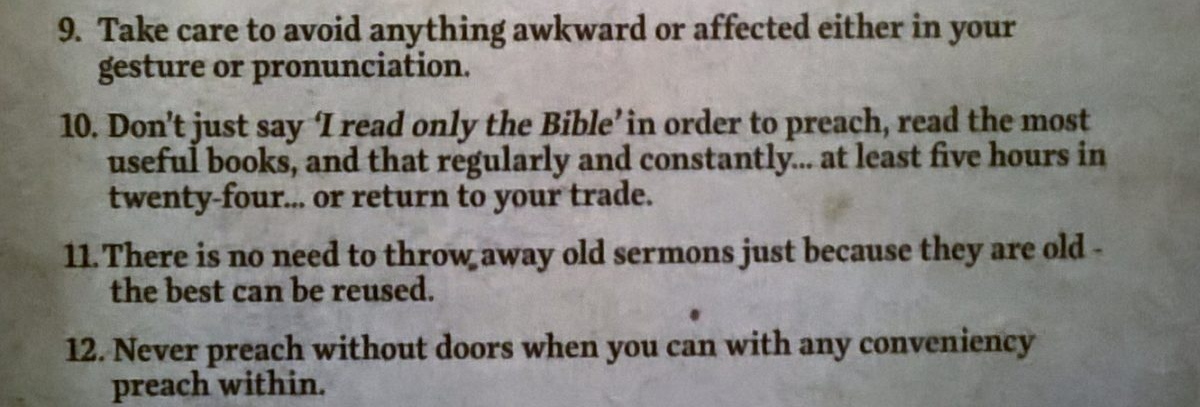
9. Take care to avoid anything awkward or affected either in your gesture or pronunciation.  It is interesting to see this from Wesley.  I tend to think of affected pronunciation as being related to vocal projection in vast unamplified venues – a concern that we no longer have.  But that would not be the only reason for it.  There is the awkwardness that comes from feeling self-conscious, or from attempts to be theatrical, or from a learned “pulpit voice” that attempts to sound more “hallowed.”  To connect with coal miners on Hanham Mount in the 18th century, or normal people anywhere today, it is better to communicate naturally and authentically.  Nobody likes listening to an actor.  Actually, the reason real actors are so good at what they do is that they convey that natural communication as someone they are not.  As preachers, our only goal is to convey natural communication as someone who we are!

10. Don’t just say ‘I read only the Bible’ in order to preach, read the most useful books, and that regularly and constantly… at least five hours in twenty-four… or return to your trade.  Can I be brief on this one?  I don’t know, but I suspect he wouldn’t include social media surfing in that at least five-hour goal.  Once we limit this to book reading, then it does feel like a big ask for many today.  Perhaps we should take this away and ponder it.  Are we neglectful of our calling, responsibility and opportunity to not give ourselves to as much reading as we should?  (And if you are a “lay preacher” – you can determine the appropriate goal for your circumstance.) 

11. There is no need to throw away old sermons just because they are old – the best can be reused.  I agree.  I would add that when reusing a sermon, it is helpful to spend some time refreshing it and making sure that it is current in your heart and not just present in your notes.

12. Never preach without doors when you can with any conveniency preach within.  This is the advice that probably needs the most pondering.  For Wesley, his move to preaching outdoors was radical and had huge implications for his church relationships.  But once he got known for it, it is intriguing to think about this advice.  Maybe the point for us is not so much about whether we preach indoors or outside.  Perhaps the point is to not allow anything we do to become a gimmick.  Don’t get known for something and then keep working that thing to the detriment of what really matters.  Be a preacher of the Word.  End of.  Once you get known for a specific type of sermon, a particular location(!), a specific type of biblical text, or even a specific subject, then you have to reckon with this point of advice from John Wesley.  What does this mean for you and me?  Maybe nothing at the moment, but it is a good one to prayerfully ponder.

There we go!  All done.  I have enjoyed thinking through these brief thoughts.  I hope that has been helpful for you, too.

John Wesley’s Advice – Part 3

Continuing our walk through twelve points of advice from John Wesley.  So far we’ve looked at numbers 1-2, and numbers 3-5.  Let’s move on…

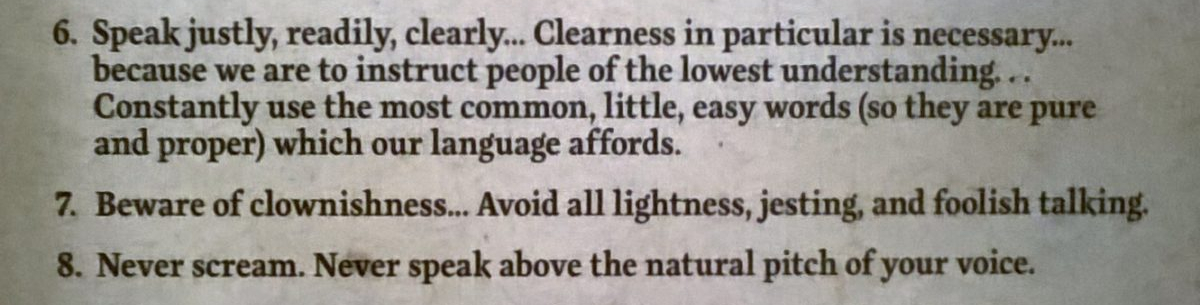
6. Speak justly, readily, clearly… Clearness in particular is necessary…because we are to instruct people of the lowest understanding… Constantly use the most common, little, easy words (so they are pure and proper) which our language affords.  Most of us are not preaching to uneducated miners like Wesley did, but don’t let out-of-date phrasing obscure the point he is making.  Our job as preachers is to communicate, not to show off.  If you don’t have a theological and grammatical terminology that is higher than your preaching vocabulary, then you are either aiming too high with your words, or you are too weak in your study.  Say the profound things that the Bible says.  And say those things in the simplest way possible.  Even if ten PhD’s walk into your church, you still need to preach so that people with the least understanding (by means of their education, church being an alien environment, English not being their first language, or whatever) will be able to understand what you are saying.  Be clear.  Simple.

7. Beware of clownishness… Avoid all lightness, jesting, and foolish talking.  Again, good advice.  There is a place for humour in preaching, but we do need to be very wary of entertaining or making the sermon about us.  I suspect that if we avoid jesting and foolish talk, as well as clownishness, then we are on safe ground.  We don’t have to come across as sombre in every moment, but we should speak as if we have a very important message to convey – which we do if we are preaching the text properly.  We need to be wary of inappropriate formality.  Just as wearing a tuxedo can feel out of place, so can a strange and affected formal tone or a presentational gravitas that is not consistent with our personality and natural demeanour.  In our fear of jesting, let’s not come across as unloving, lacking in warmth, or out of touch with the room.  

8. Never scream.  Never speak above the natural pitch of your voice.  This was probably a greater concern before amplification equipment.  Nevertheless, this point still applies.  There is a natural upper limit to your pitch, your power, and even your pace.  Don’t go above that level to achieve some kind of emphasis.  The screamer seldom communicates anything other than a loss of control.  In fact, it is good to consciously work on going down instead of up for emphasis.  Down in pitch.  Down in power.  Slow down the pace.  Emphasis sounds very natural in the opposite direction, but it takes unnatural work to develop the skill!  And even more foundationally, your emphasis and impact is not ultimately determined by your vocal delivery, but by God’s Spirit bringing conviction to your listeners.

Next time we will finish the list.