Mentored by the Text

I recently had the privilege of speaking at the Josiah Venture Spring Conference.  What a joy to spend those days with great people in a beautiful place, enjoying an excellent Bible book!  In light of that time, I have been pondering the idea of being mentored by the biblical text.

To begin the series of messages, I suggested that if we could time travel, we would be changed by spending half an hour watching Jesus, Moses, Daniel, Paul, or whoever.  If we could just be there and see them in action, we would be mentored by the experience.  But we have the Bible!  So why not allow the experience of the text to mentor us?  Time spent watching Jesus (in this case) should surely mark our lives in significant ways.

Here are some thoughts on “Preaching as Biblical Mentoring” –

1. The move from then to now is essential, but the move from text to sermon can be overdone.  I have seen sermons so crafted that listeners may marvel at the sermon construction but lose the passage.  Maybe our sermonic work of art is not as valuable as the inspired text.  After all, whatever we can do with the text is not as good as what God did when He inspired the text.  So perhaps we need to consider how to let the passage drive the message more in our preaching. 

2. Overly crafted wording can hide rather than reveal the inspired text.  In the detail of the sermon, do we demonstrate our linguistic skill rather than elevating the text itself?  Our wordcraft may impress listeners, but is our goal to impress them?  Surely our pastoral goal should be for them to encounter God Himself in His word?  Let us make it our goal to communicate rather than to exhibit our craftsmanship.

3. The shape of an overly crafted sermon can hide rather than reveal the shape of the text.  I remember one moment as a student in a class.  I was the member of our group who went up to write our outline on the whiteboard.  “That is incorrect,” the teacher declared, “you have to make all the points parallel.”  I was taken aback and responded, “But, isn’t that the shape of the passage?”  The teacher looked at the Bible.  “Yes, it is the shape of the passage, but your outline has to follow the rules of rhetoric, so it is wrong.”  I politely pointed out that Haddon Robinson (who was in charge of the preaching department at that seminary for many years) had taught us to reflect the shape of the text in our sermons.  It became clear that there was a point of difference between these two excellent teachers.  I’m with Haddon.  Let’s aim for sermons that reflect the shape of the text rather than squeezing the text to fit our rhetorical expectations and standard sermon shapes.

4. Overly crafted rhetoric can hide rather than reveal the experience of the text.  As we preach, we should communicate clearly, with good organisation and a thought-through structure.  But sometimes, our sermons can hide the text and keep listeners from experiencing the tensions and contours of a passage.  So let’s use whatever skill we can, but remember that our goal is not to present the work of art that is our sermon.  No, our goal is to bring our listeners into a rich experience of the passage and, in doing so, to encounter God as He reveals Himself there.

5. We should preach so listeners can “see” the movie projected in their hearts.  I find it helpful to imagine every listener with a movie screen in their hearts.  If I prayerfully and carefully present the message to them, a movie should form on that screen.  It is easy to offer theological insights and speak theoretical truths.  But those screens will remain blank.  However, suppose I can effectively describe what is on the page.  In that case, my prayer is that they will not only understand it but also experience it.  And when they experience it, it will change their lives.  It can be like being mentored through the text by God revealing Himself in that passage.

I am sure there are more angles to consider on this subject.  Perhaps too much of our ministry uses the Bible, begins with the Bible, or connects to the Bible, but what people really need is to experience what God has given us in the Bible.  Supremely, the Bible reveals Him.  Let’s prayerfully shape our ministries so that people can encounter Him and not simply learn theological truth at arm’s length.

____________________________________________________

Please check out The Biblical Preaching Podcast, on YouTube (click image below), or on any podcasting platform (Spotify, Apple, etc.)
Getting Stuck in Sermon Prep (Podcast Post 7)

I was chatting about preaching with a friend on Sunday after preaching in his church. We talked about ways we sometimes get stuck.

Sometimes, the outline won’t quite work, and we keep looking at the text until eventually something clicks. Once it clicks, we can’t understand how we could not see the passage’s logic before.

Sometimes, the details of the message are the issue. What illustrations would work? How can I introduce the sermon? And so on. Again, the breakthrough moment is always a real relief and cause for rejoicing.

Sometimes, everything seems jammed up, and we simply can’t get the sermon to work.

In the latest episode of the podcast, Mike and I discuss seven specific logjams and offer some ideas that might help you break through the next time you get stuck.

But here is a thought: let’s be careful not to see the ideal as a jam-free future. While logjams can feel like hard work, there is also a blessing in them. Without the logjam, there might not be the desperate prayer. Without prayer, there would not be sweet moments of answered prayer as God lifts us in preparation for Sunday.

7 Defining Moments in Your Sermon Preparation – Part Two

While the whole preparation process will shape your message, some defining moments will fundamentally change the outcome of the process. We started with two related to starting preparation. Now let’s think about two that tie into the transition between passage study and message formation:

3. The decision to transition from passage study to message formation.  The first half of the preparation process focuses on understanding the passage.  The second half involves formulating and writing a message.  The shift between these two phases is critically important.  If you shift too early, then you will be working on the message without really grasping the meaning of the passage.  If you shift too late, then you will have plenty of exegetical insight to share, but little time to craft a message that lands in real life.  Do you tend to fall in one direction or the other?  It is hard to see a lack of understanding in the mirror – we all tend to think we have a good grip on a passage when it may only be a superficial sense of the meaning.  Or you may be in a rut of sharing exegetical nuggets without crafting a message that is shaped to speak into real life.  And some, sad to say, neither know the joy of being gripped by a passage, nor the pleasure of crafting a sermon that hits home – they just use a passage as a launch point for some standard favourite content.  If that could be you, then it may be time for some candid conversations with some listeners, and for radical surgery on your ministry.  It will be worth it.

4. The realization of who will be listening.  At one level, this moment is fairly straightforward, as long as it happens.  That is to say, after studying the passage to understand the author’s meaning as accurately as possible, then you consciously introduce your listeners into your thinking as you move to crafting the sermon for their benefit.  You don’t want to be thinking too much about your listeners when you are studying the passage, because your concern is the original audience of the text.  Neither do you want to not be thinking about your listeners when shaping the message, because your concern has to be for them as the audience of the sermon.  That moment of introducing conscious consideration of your listeners should be a standard point in the process every time (and essentially the same moment as number 3 above).  But then there will be some sermon-specific moments in this category too.  You might realise how the message could hit very close to home for someone in your congregation.  You might be told that a certain person is going to be present.  You might be at church when someone walks in that you were not expecting (and you realise your message requires some tweaking for their sake – either to be more accessible, less provocative, or whatever.)

As this list continues to build, what defining moments do you recognize in your sermon preparation?

Applicational Preaching

So many people seem to want to listen to preaching that is “applicational.” I understand the impulse. After all, who would want to listen to non-applicational preaching? That sounds like preaching that is not relevant to my life and will not make a difference.

Actually, if we are talking about preaching that is relevant to life and genuinely transformative, then I am completely on board with that desire. The problem is that when we talk about “applicational preaching” it can fall short of what we really need. Here are some of the potential weaknesses:

1. Applicational preaching can place emphasis on action points and to-do lists. Now, there is certainly a place for knowing what is expected of us at the end of a sermon. If a passage gives an instruction that applies to us, then we should certainly note it and look to obey it. However, is the Bible primarily an instruction list for life? Some sermons give that impression, but perhaps that is missing something of the richness and purposefulness of God’s revelation.

2. Applicational preaching can point the listener in the wrong direction. When our preaching emphasizes what we must do, then the focus will tend to move toward our own willpower. Sermons that point the listener to their own discipline, their own choices, their own efforts, etc., are not the best sermons. And I don’t just mean they are not the most theologically impressive sermons. I also mean they are not the most effective sermons. Lives are not transformed by to-do lists. They can help, but they remain mostly on the surface. God is in the business of transforming lives from the inside out.

In order to see the full potential of any preaching or teaching ministry, I would encourage you to think about the ABCs of Application. Here is a brief explanation:

8 Reflections on Preaching Through 1 Peter

In our church, we have just completed an eight-week series in 1 Peter. Here are some brief reflections that may be helpful:

1. This epistle is relevant. I know that is not breaking news to you, but it bears underlining. 1 Peter speaks to people that felt like oppressed outsiders in the society in which they lived. It did then, and it does now.

2. Suffering may be necessary. We have lived through decades of relatively little suffering, but times seem to be changing. Suffering is not permanent, “now for a little while.” And suffering may be part of the plan, “if necessary.” In 1 Peter 1:6 we are introduced to the possibility that suffering is not the result of bad luck, but divine providence. As we come towards Easter we have the ultimate example of deliberate and planned suffering.

3. Biblical background helps. There is the situational background of the readers, forcibly moved from Rome and repatriated to these five regions of modern Turkey. There is the historical background of Peter’s life and experience. Keeping that in mind, as he would have done, is helpful to shine a light on his call to be prepared (3:15), to stay humble and to resist the devil (5:6-9), etc. Then there is the textual background of Peter’s biblical awareness as he wrote. For instance, the situation behind Psalm 34 seems to be shining a light on much of Peter’s writing in this epistle.

4. Difficult texts still have simple points. Preaching the end of 1 Peter 3 and the start of 1 Peter 4 is not easy territory to navigate. There is the timing, location and content of Jesus’ preaching in 3:19; then the reference to Noah in 3:20; followed by the awkward reference to baptism in 3:21. It is exegetical difficulty piled on exegetical difficulty. I chose to give some minutes to explain that complexity, but not before I emphasised the simple point of this section: Jesus suffered and Jesus was victorious. It helps to keep a clear picture in mind when trying to make sense of the complex.

5. The letter has a strong DNA. God’s pattern is for suffering now to be followed by glory later. It was true for Jesus, it was true for Peter’s readers then, and it is true for Peter’s readers now. Suffering and then glory: this idea works its way through the entire letter.

6. Variation can help a series work well. We had a team of preachers on this series. One of the messages was preached in first-person. It came in the middle of the series and really helped the series to not feel monotonous in style. Different preachers helped the series, although it was important to make sure we were preaching a coherent series.

7. Non-Suffering forms of Christianity lead to harm. We seem to live between two extremes. One is the fatalistic idea that disaster is coming no matter what. The other is the idealistic idea that we should always be healthy, and wealthy and travel in a private jet. What is the healthy middle ground? It is not a gentle form of health and wealth – that is, things should generally go well for us if we simply trust, pray and obey. Many Christians seem to want to live with their basic orientation towards good circumstances. No, the reality is that we live in a fallen world filled with suffering. So let’s turn from gentle forms of health and wealth, and let’s engage a fallen and sin-marred world with our hope reaching out beyond this suffering to the glory to come. Our hope is not in our experience but in the character of our good God and his plan.

8. 1 Peter should prepare us for difficulty, but stir us to trust! Every problem we face in this world is a problem that exists within creation. 1 Peter urges us to look beyond this realm to the eternal realities. We look outside of this realm to the God who is so much bigger, the God who cares for us. “The dog bit me,” ~ yes, but God is bigger. “But it was a big dog,” ~ so what, God is bigger. “But it was a lion,” ~ it doesn’t matter, God is bigger. “Actually it was a killer whale.” ~ Ok, but God is still bigger than any problem we can face in this realm. What’s more, he already came and suffered, and is now sitting in victory. So we can be humble, be watchful, and be hopeful. We get to stand in the true grace of God whatever may come our way.

There are plenty more thoughts generated by two months in 1 Peter. But hopefully this list is a motivational starter for now…

____________________________

I have a series of videos on 1 Peter 2:1-10 that focus on the interpretation phase of Bible study. You can find them in this playlist:

7 Ways to Mishandle a Bible Story

The Bible is full of stories.  And we preachers are full of ways to mishandle them.  God has richly blessed us with the stories in the Bible.  Each one reveals God’s heart and character. Each story is designed to point our hearts to Him and to stir our faith in His word and character. So, how can we go wrong?

Here are seven ways to mishandle a Bible story:

1. Skip – This is the assume-and-ignore approach.  We can easily assume that everyone knows the story and so we skip the chance to tell the story.  Instead, we put our homiletical energy into preaching about the theological ponderings triggered by the story.  Why do we assume that everyone knows the story?  Actually, why do we assume that what we have to say about it is of more value than what it actually says?  Even if people do know the story, tell it anyway, and let God’s word work in your listeners.

2. Flip – This is the heretical approach.  We can easily misdirect our listeners and end up preaching heresy inadvertently.  Take the story of Zaccheus in Luke 19:1-10 for an example.  It is easy to put all the initiative in Zaccheus’ commitment in verse 8.  Then his salvation is affirmed by Jesus in verse 9.  Voila, we are saved by our own commitment to Christ!  Except, we are not.  Jesus had already taken the initiative in verse 5.  Jesus had already rescued Zaccheus.  The exuberant generosity of verse 8 is a response to God’s grace, not a prerequisite for it.

3. Moralise – This is the fleshly approach.  Since everyone naturally tends toward the notion of earning something with God, we can always and easily jump to what Bryan Chapell calls the “Deadly Be’s” – be like, be good, be disciplined.  So with Zaccheus’ story?  In verse 7 the crowd grumbled.  Let’s not be like them, let’s not grumble.  That verse is in the passage for a reason, but that little life lesson is not the reason.  It is there to emphasize the wonder of what Jesus did for Zaccheus.  It is not there to nudge us towards better behaviour.

4. Lecture – This is the historical-and-cultural-lecture approach.  Use cultural and historical insights to bring the story to life, not to cut the story to death.  How did the tax system work at that time?  How might middle eastern hospitality respond to Jesus’ passing through the town?  Where were sycamore-fig trees in relation to Jericho?  Shine a light on the story and keep telling it, don’t end up giving a series of historical lectures trigged by the details in the story.

5. Over-reveal – This is the punchline-first approach.  So with Zaccheus, you might state the first point as, “Jesus came to save the lost, verses 1-4.”  Oops.  In the passage, verse 10 comes as a surprise.  The whole text has worked to point the reader to Zaccheus’ efforts to see Jesus.  Then in the end it turns out Jesus was the one doing the seeking and the saving.  Why give it away at the start?  Do what the text does.  Don’t “tell the punchline before the joke.”

6. Flatten – This is the lifeless-outline approach.  Again, with the Zaccheus story, your points could be mind-numbingly flat: Jesus seeks the lost, Jesus rescues the lost, and Jesus reassures the lost.  Honestly, I’m bored just writing that outline, even if it is fairly accurate.  While it is true that the story develops in movements, it does not mean that the sermon has to sound like a logical progression through completely parallel points. That outline could work, but it needs a serious injection of energy.

7. Lose – This is the too-many-stories-along-the-way approach.  The story of Zaccheus is a gripping little narrative if it is told well.  But if you use every trigger point to tell another story, you will lose it.  I once knew a tax collector . . . I had a short friend once . . . I have a fun tree-climbing story . . . I remember a grumbling crowd in 1987, etc.  Let other illustrative materials be fairly succinct so that the focus remains on the main narrative of the sermon.

How else might we mishandle a Bible story? Biblical narratives are a dream for us preachers – let’s learn to handle them well so that they can do their mighty work in our hearts and those who will hear us!

________________________

Click on this image to see the YouTube playlist of videos on Bible handling:

John Wesley’s Advice – Part 3

Continuing our walk through twelve points of advice from John Wesley.  So far we’ve looked at numbers 1-2, and numbers 3-5.  Let’s move on…

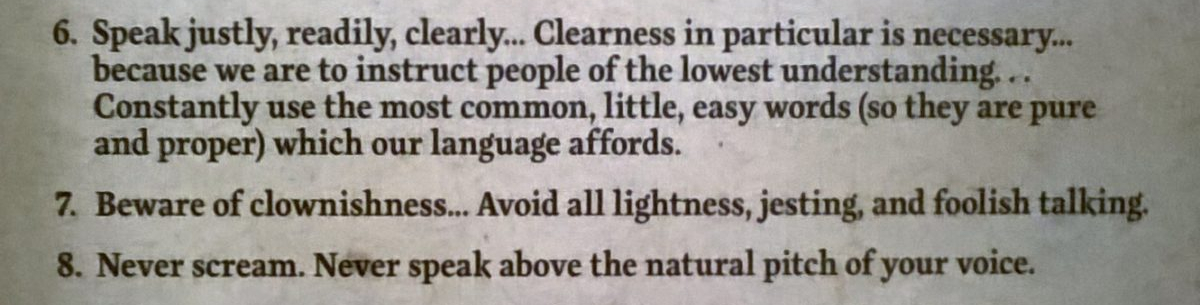
6. Speak justly, readily, clearly… Clearness in particular is necessary…because we are to instruct people of the lowest understanding… Constantly use the most common, little, easy words (so they are pure and proper) which our language affords.  Most of us are not preaching to uneducated miners like Wesley did, but don’t let out-of-date phrasing obscure the point he is making.  Our job as preachers is to communicate, not to show off.  If you don’t have a theological and grammatical terminology that is higher than your preaching vocabulary, then you are either aiming too high with your words, or you are too weak in your study.  Say the profound things that the Bible says.  And say those things in the simplest way possible.  Even if ten PhD’s walk into your church, you still need to preach so that people with the least understanding (by means of their education, church being an alien environment, English not being their first language, or whatever) will be able to understand what you are saying.  Be clear.  Simple.

7. Beware of clownishness… Avoid all lightness, jesting, and foolish talking.  Again, good advice.  There is a place for humour in preaching, but we do need to be very wary of entertaining or making the sermon about us.  I suspect that if we avoid jesting and foolish talk, as well as clownishness, then we are on safe ground.  We don’t have to come across as sombre in every moment, but we should speak as if we have a very important message to convey – which we do if we are preaching the text properly.  We need to be wary of inappropriate formality.  Just as wearing a tuxedo can feel out of place, so can a strange and affected formal tone or a presentational gravitas that is not consistent with our personality and natural demeanour.  In our fear of jesting, let’s not come across as unloving, lacking in warmth, or out of touch with the room.  

8. Never scream.  Never speak above the natural pitch of your voice.  This was probably a greater concern before amplification equipment.  Nevertheless, this point still applies.  There is a natural upper limit to your pitch, your power, and even your pace.  Don’t go above that level to achieve some kind of emphasis.  The screamer seldom communicates anything other than a loss of control.  In fact, it is good to consciously work on going down instead of up for emphasis.  Down in pitch.  Down in power.  Slow down the pace.  Emphasis sounds very natural in the opposite direction, but it takes unnatural work to develop the skill!  And even more foundationally, your emphasis and impact is not ultimately determined by your vocal delivery, but by God’s Spirit bringing conviction to your listeners.

Next time we will finish the list.

Say It

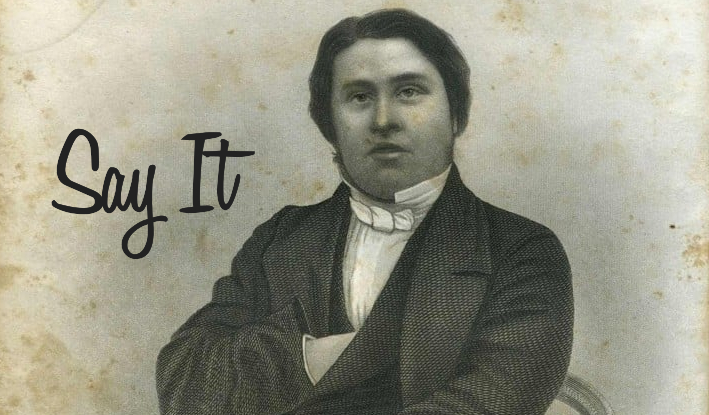
CH Spurgeon’s conversion is one of the great conversion stories in church history. Feeling under heavy conviction and longing to find out how to be saved, he set off for church one January Sunday morning (172 years ago tomorrow, in fact). The weather was atrocious and he couldn’t make it to his intended destination, and instead slipped into a small chapel where about a dozen people were attending. Their preacher had also been thwarted by the weather, so eventually, a thin man stood up to preach. Some have said it was the wrong preacher, in the wrong church, in the wrong weather, with the wrong congregation. Whatever, God is still God!

Spurgeon himself said, “Now, it is well that preachers should be instructed, but this man was really stupid. He was obliged to stick to his text, for the simple reason that he had little else to say.”

Of course, the story continues. The text was from Isaiah. “Look unto Me, and be ye saved, all the ends of the earth.” And the message was on target for young and troubled Spurgeon, “there was a glimpse of hope for me in that text.” So the thin-looking preacher restated the text every way he could manage for about ten minutes, and then told the young guest at the back that he looked miserable and needed to look to Jesus to be saved. And Spurgeon was born again. Spurgeon often told the story and it is well worth reading.

But let’s just ponder that earlier point. “He was obliged to stick to his text, for the simple reason that he had little else to say.”

Three points to ponder:

1. Our job as a preacher is to say what the text says.

2. Our education does not give us something better to say than what the text says.

3. God once spoke through a donkey, so humbly say what the text says.

Looking back on that moment, Spurgeon quoted words you may have sung:

E’er since by faith I saw the stream
Thy flowing wounds supply,
Redeeming love has been my theme,
And shall be till I die.

To read a slightly fuller version of the story, click here. (And if you want to sing the song, I enjoyed this!)

Vary the Crescendo

I remember sitting high up in the Royal Albert Hall for a schools concert some years ago. Impressive venue, electric atmosphere, and stunning music. All of the music was very good, but there is something unique about the 1812 Overture once the cannons are fired up in the rafters – it was so fun to watch the children’s faces (they didn’t know it was coming!) I am no classical music fan, but that always feels like a high point in any concert.

The thing is, music can’t all be a thrilling crescendo. And the musical impact is not all achieved by crescendo. There are variations of melodic themes woven together, changes from major to minor key to influence the mood, variations in rhythmic intensity, and so much more. It would not make for great music to simply string together and elongate every possible crescendo (or add cannons to every piece)!

The same principle is true in preaching. There are various ways in which we can start to lean on a powerful crescendo too much, and thereby weaken our preaching. Here are a few examples:

Your Voice – Undoubtedly you can run into a crowded room and get everyone’s attention by screaming. That doesn’t mean you should scream your way through a sermon. Naturally, when we are excited about what we have to say, our voice will tend to climb upwards. It will go up in pitch, up in volume, and up in pace. And the ability to pause meaningfully? That will go up in smoke! As a preacher, you will do well to learn the benefit, and the skill, of going down for emphasis too. You can go down in pitch, down in volume, and down in pace – all for a non-crescendo variation on emphasis. And bring the skill of pause back down to earth too, it really can help!

Your Points – It is so easy to find a formula that works for a point in a message and then find yourself repeating that same formula for each point. Perhaps the flow moves from stating the point to explaining it textually and then applying it with an exhortational forcefulness that works well in point 1. That does not mean that point 2 must also have the same crescendo at the point of application. Be sure to look at how your points serve each other. Sometimes a point works better without forcefulness – let it fulfil its function in the message.

Your Support Material – It is always tempting to think that a certain type of “illustration” will always work well because one particular example did. Maybe your sermon seemed to soar when you recounted the moving story, shared the humourous anecdote, or let rip with the fiery rebuke (you know your tendency in terms of preferred “illustrations!”) Great. Be thankful that it worked. But don’t start to lean on that type of material to the exclusion of others. People grow tired of perfectly placed emotional stories, side-splitting humour, or repeated rebuke. The repetition will not achieve greater impact but will move listeners to start to see your preaching as manipulative, your goal as to entertain, or your pastoral concern as haranguing.

Your Series – Last Sunday I was preaching the passage after God rescued Isaac on Mount Moriah. That had been a crescendo message in an Abraham series stretching back for many weeks. People commented and appreciated and responded to the emotional impact of that sermon. So what to do the week after? It was tempting to try to continue the crescendo. Why not keep up the same emotional pitch for maximum personal impact? Instead, I chose to deliberately preach in a much more relaxed “teaching” style that allowed us to consider the new passage before us. I think it was the right choice. There was still some emotional impact, but it was not through the perpetuation of the crescendo. The message was in a different key, the music made its own impact, and it didn’t try to roll out the cannons again.

Where else can we find ourselves leaning on crescendo to the exclusion of other helpful options?

_______________________________

Your Job is to Make Words Clear

When I used to live close to London I sometimes visited the British Library. There you can see some amazing treasures, such as Codex Sinaiticus and Codex Alexandrinus.  It is amazing to see such ancient books, but they are not the easiest things to read and understand. For one, they were written in uncials: ITISNOTEASYTOREADTEXTWITHOUTGAPSORPUNCTUATION.  Oh, and they are in Greek, just to add to the challenge.

Thankfully we don’t have to read Greek text written in uncials (unless we want to, then praise God that we can access so much!) We are blessed to have the Bible very accurately translated into our language and readily affordable (or free online). They even add in spaces, lower case letters, punctuation, etc. How blessed we are! I suppose I should also mention the chapter and verse divisions, which save a lot of time. And there are the somewhat and sometimes helpful section headings.

But remember that to many people in our churches today, the text feels as inaccessible as an ancient uncial codex! To many, it feels like a big block of text with thousands of words running into each other.

And so the preacher goes to work each week, diligently studying a passage in order to first understand it, and then to preach it. That work moves from the initial simplicity of familiar words, through the complexity of trying to grasp an author’s flow of thought, and out into the warm sunshine of studied simplicity. Hopefully, the preacher is then in a place to make sense of the flow of thought, to identify the major thoughts and to see the supporting role of each subordinate thought. The passage no longer feels like a random set of instructions and assertions.

When we preach our task includes the need to make a string of words clear.  We don’t have to start with an uncial script, but to all intents and purposes, we practically are.  Listeners hearing a string of verses often grasp very little during their first exposure. As we preach we look for ways to emphasize the main thoughts, we look for ways to demonstrate how the “support material” in the text explains, proves and/or applies the main thoughts.  Without technical jargon, our preaching needs to verbally achieve the formation of something like a clausal layout in the minds and hearts of our listeners.  Certainly, by the time we are done preaching, they should not see the text as a string of random words or thoughts . . . it should be much clearer than that!

Preaching goes way beyond clarification of the meaning of a string of words. But preaching won’t go anywhere good if it bypasses this critical element of the task.