Preacher’s Log – 2

Following on from yesterday’s post . . . Sunday is getting ever nearer!

Tuesday to Thursday before – I am busy all day each day with Cor Deo training, so don’t have time for sermon preparation, but am chewing over the passages and their implications during spare moments, praying for Sunday’s messages to go well.  I’m also pondering again the people to whom I’ll be preaching these passages, wanting God’s best for this church.

Friday before – Key preparation day.  I work on outline of the text, main idea of the text, and prepare to form the main idea and outline/strategy of the sermons.  I check a couple of commentaries.  Actually, three.  I check RT France’s NIGTC commentary, particularly to interact with some key sections of Greek exegesis (I simply haven’t had time to work through the whole section of Mark in Greek, but I do check a few key verses and decide whether I want to change anything based on his input).  I check Rikki Watts’ focused presentation of Mark’s reliance on Isaiah’s “new exodus” motif (this was massively helpful in some sections of Mark, less so in others).  I check Donald English’s very accessible BST (very good on seeing the big questions of Mark and the larger flow of the text).

Prayerfully thinking about the people to whom I am preaching on Sunday, I think through my strategy (outline) and message idea for Sunday’s messages.  I would have liked to get to the details of how I will explain, any illustrative/applicational elements, but have run out of time.

Saturday morning – I have an hour and so can try to catch up a bit and think through the details of the messages.  Actually, Sunday morning’s message comes first and so gets the attention.

Saturday evening – I don’t have time during the day (family are important ministry too), but in the evening I take some time and preach through Sunday morning’s message.  Couple of things need to change, so I make a couple of notes, then head to bed (better to have slept than to have worked through the night striving for a better message!)

Sunday morning early – I pray and preach through the morning message.  It is very hard to think about the evening message with the morning one looming.

Sunday afternoon – I take a couple of hours to look at my notes for the evening message on Mark 10, and then preach it through.  Couple of tweaks, but time runs out.

Message is preached.

Monday after the message – I listen through both messages as I prepare the files to put them online.  This is a chance to evaluate and also to be thankful to God for His help.  I think back on the feedback received and process that before the Lord in prayer.

I was very happy with the Mark 10 message.  Wasn’t perfect, they never are, but I am thankful for how that went.

Add to FacebookAdd to DiggAdd to Del.icio.usAdd to StumbleuponAdd to RedditAdd to BlinklistAdd to TwitterAdd to TechnoratiAdd to Yahoo BuzzAdd to Newsvine

Preacher’s Log

A friend asked me to offer something of a mini-log of a sermon preparation.  Here goes:

Several weeks before – So I know I’m going to preach on Mark 10 in a few weeks time.  I don’t have much time now, but I grab a few minutes to read it through and make a list of initial observations or questions about the text.  I also make the time to read the whole book of Mark (both because I’m preaching a series, and because I need that for understanding chapter 10).  I start outlining the series so I know which passage will be preached on which Sunday.  The calendar dictates Good Friday’s text, and Easter Sunday morning, and Palm Sunday, but otherwise I have some flexibility.

10 days before – I’m in the thick of preparing messages for the Sunday before, but I take a few minutes to look ahead at the passages coming up the following Sunday.  Again, just make the odd note, and pray for clear understanding and application of the passage (I’m starting to feel quite convicted as I see the contrast between Jesus’ resolute journey to the cross, and the disciples’ continual pyramid-climbing attitude – is that true of me, too?)

Monday before – Now that the previous two messages are done, I am more free to think and plan for this coming Sunday.  Spent some time outlining the text and looking at how the content flows together.  Am contemplating how to preach the passage around 8:27-30 in the morning, and then the third passion prediction in chapter 10, with the passage around it.  I’m pondering whether I should use the three passion predictions in the evening message, but also deal with the first passion prediction in the morning.  I feel I have to do that in both cases (no extra sermons to deal with other content in this section, unfortunately…looks like the transfiguration isn’t going to feature this time, shame).

Now it would be nice to have the rest of the week free to prepare the messages for Sunday.  No such luxury.  It will be Friday before I can give the messages any real attention again.

Add to FacebookAdd to DiggAdd to Del.icio.usAdd to StumbleuponAdd to RedditAdd to BlinklistAdd to TwitterAdd to TechnoratiAdd to Yahoo BuzzAdd to Newsvine

Images Right Before Your Eyes

Most preachers don’t aspire to being dull and lifeless, bland and black and white.  We want to preach vivid, full-colour, living messages from a truly living Word of God.  So why are we so quick to look beyond the Bible for every image and illustration in a sermon?  Sometimes it seems as if we have been preconditioned to believe the Bible itself is boring and dull, so part of our work is to find lively little pithy anecdotal marshmallows to make the Bible palatable.  Before we look outside the Bible (which is a legitimate option, of course), let’s be sure to check our passage carefully:

When preaching from biblical poetry – such as a psalm, the writer will usually give us some very helpful images.  Why go hunting for new images when the psalm provides a resting child, restless hours fretting in bed, God lifting His face toward us, climbing the mountain toward Jerusalem, entering the city gates in procession, etc.  We need to work on relevance and be sure to handle the imagery appropriately, but handle it, it is right in the passage.  It would be a shame to waste the head-start we are given right on the page.

When preaching a biblical narrative – such as a parable or event, then the passage itself is an image!  Too often I’ve heard preachers at pains to explain the story, but the preaching lacks zing because they forget to actually tell the story.  Don’t dissect a story to death, allow it to live in front of people and let them observe its power.  Be sure to explain and apply, of course, but don’t let the vivid imagery of the story itself get lost in your study.  Bring the story to the people.

When preaching biblical discourse – such as an epistolary paragraph, then you may have extra work on your hands.  Often the passage will be very effective and logical explanation, or even direct application.  But it may be so direct that it lacks imagery.  This will not be the case in most of James, but is true in parts of Paul.  Just because it is prose and perhaps plain in presentation, do not fail to look for images that will help the truth stick in the hearts and minds of your listeners. Sometimes alertness to word-study will help, other times simply reading the text carefully will do the job. Be a shame to preach a “put off, put on” passage and not utilize the visual impact of that imagery, or to preach a “love one another” and not paint the picture of what that looks like in vivid terms.  Abstractions don’t do the same work as concrete descriptions, so be sure to preach what it is saying in specifics so listeners can “see” what you mean.

Add to FacebookAdd to DiggAdd to Del.icio.usAdd to StumbleuponAdd to RedditAdd to BlinklistAdd to TwitterAdd to TechnoratiAdd to Yahoo BuzzAdd to Newsvine

Exegesis and Application

I’ve recently been reading student responses to Fee and Stuart’s book How to Read the Bible for All Its Worth.  This is a rare book, a hermeneutics book that has sold massive numbers.  If you haven’t read it, you probably should.  That doesn’t mean it is perfect though, there may be much in it that you might quibble with (it may be the willingness to take positions on issues that makes the book such a bestseller).  One point that struck me as I looked at it again is the unfortunate decision to define hermeneutics as the follow on step after exegesis.  I know I’m not the only one that doesn’t see these terms as sequential steps in a process.  (They even acknowledge this is not the normal use of the term.)

I would agree with their definition of exegesis as “the careful, systematic study of the Scripture to discover the original, intended meaning.”  But surely the following step, thinking about the significance and potential impact of the passage in contemporary terms should be called application?  And hermeneutics?  Well, that refers to the guidelines that enable both exegesis and application to be done effectively.

This is especially important for preachers (and then, by extension, to all believers).  As I wrote on here some years ago:

The difference between a true expository sermon and an interesting biblical lecture is often the speaker’s awareness of sermonic purpose. As Bryan Chappell wrote (Christ-Centered Preaching, p52) “Without the ‘so what?’ we preach to a ‘who cares?’” In his own way Haddon Robinson has put it like this, “Preaching can be like delivering a baby, or like delivering a missile – in one your goal is to just get it out, but in the other your goal is to hit the target!”

Perhaps the problem goes deeper though. While it is true that we must think through the purpose for a sermon before preaching it, there seems to be an issue at an earlier stage in the process. Are we saying that it is possible to study a passage, but not follow through and consider its application? Hermeneutical purists argue about whether application is a part of the hermeneutical process.Yet as preachers our concern is not academic wrangling, but bringing the Word of God into the lives of His people, by the power of His Spirit, to see His purposes worked out. May we never fall into the trap of studying a passage, determining the author’s intended meaning, but failing to consider the contemporary application of that passage in our own lives.

Perhaps a lack of application in the pulpit is the fruit of a lack of application in personal study. The implications are frightening.

Add to FacebookAdd to DiggAdd to Del.icio.usAdd to StumbleuponAdd to RedditAdd to BlinklistAdd to TwitterAdd to TechnoratiAdd to Yahoo BuzzAdd to Newsvine

Preach the Passage

Easter Sunday offers us all a temptation as preachers.  Whatever the passage being preached, we’re all tempted to actually preach something else.  For example, let’s say your passage is in Luke’s gospel.  Will you preach the pairs of witnesses that Luke scatters liberally throughout the passage from the death of Christ on?  Or will you just read that and preach 1Cor.15?

What if you are preaching Mark, as I am this weekend (short ending).  Will you preach Mark with his brief message of the resurrection, pointer back to Galilee where the ministry all began in 1:14-15, and the fear of the first followers?  Or will you read it and flee to 1Cor.15?

What if you are preaching John?  Will you preach the questions of Thomas and Jesus’ response to Thomas, and the uniquely Johannine commissioning of the disciples and the climactic statement of Thomas?  Or will you read it and essentially preach 1Cor.15?

Actually I have no problem with 1Cor.15.  It is familiar territory and that is why many of us easily end up there whatever text we think we are preaching.  If we are preaching 1Cor.15, then please let’s preach it in all its power.  But if we are preaching something else, let’s not miss what God inspired the writer to include.

Obviously there are other passages too, many in fact, from which to preach the risen Christ (obviously Matthew, but also Acts, numerous other epistles, earlier predictions of Christ, etc.)  Let’s be sure to let people benefit from whichever passage we are preaching this Sunday.  All Scripture is God-breathed and is useful!

Add to FacebookAdd to DiggAdd to Del.icio.usAdd to StumbleuponAdd to RedditAdd to BlinklistAdd to TwitterAdd to TechnoratiAdd to Yahoo BuzzAdd to Newsvine

Opaque or Lens?

Opacity is worthy of our consideration.  The contrast between being opaque and being a lens was suggested last week in conversation.  That is, does the preacher act as a lens through which I see Christ, or as an opaque presenter through which I see little?  It may be hard to quantify, but as listeners I think we know the difference.

When the opaque preacher preaches, we receive information and ideas, maybe even illustrations and anecdotes, perhaps applications, and even apparently effective delivery.  Technically the sermon might tick all the standard boxes.  Faithful to the text, relevant to the audience, clear in presentation.  But obviously not clear in the sense we mean in this post.  Because for all the good that’s there, the sermon event feels opaque.

So what is it that turns the opaque preaching into a lens through which the person of Christ is seen, through which the grace of God can shine into our lives?  I suspect it isn’t primarily about technique, since great preparation and delivery skill can still lead to opaque messages.  Perhaps it’s something along the lines of …

A sermon will act as a lens to the extent that the preacher relationally engages both God and the listeners as true personalities.

That could be better stated, but it will do for now (comment freely and offer better statements!)

1. If God is viewed as a distant, unknowable, cold deity who has left us with a set of data encoded in an anthology we call the Bible, then the preacher won’t engage Him.  But if God is known personally, through the Word, through prayer, through a living and vital and covenantally loyal love relationship; and if God is an active participant in the life of the preacher; and if the preacher genuinely loves and likes God . . . then we may be onto something special for preaching.

2. If the listeners are viewed as an amorphous group of punters who have chosen to attend a presentation in which they (the seated ranks of unknowns) get to hear me (the preacher), then the preacher won’t engage them effectively.  But if the people matter, and are cared for and prayed for and are important to the preacher (even if he is visiting), and if he seems to not only care enough to give tough medicine, but loves enough to make it palatable, and likes enough to smile . . . then we may be onto something special for preaching.

Opaque or lens?

Add to FacebookAdd to DiggAdd to Del.icio.usAdd to StumbleuponAdd to RedditAdd to BlinklistAdd to TwitterAdd to TechnoratiAdd to Yahoo BuzzAdd to Newsvine

Hear the Text Here

When we read a Bible text, do we really read it?  Do we really read it?  Two important and slightly distinguished questions…

1. Do we really read it? Everyone assumes that we read it if we run our eyes over it and notice what is there.  The reality is that most of the time we don’t really look carefully at the text and notice what is there.  We miss biblical quotations and allusions, we miss details in the text, we miss the flow of the text, we miss the mood of the text, etc.  As Gordon writes in his book, we are not in a culture that trains us to be close readers of quality texts anymore.

2. Do we really read it? That is, we have a tendency to not only not read very well, but to excuse poor reading of this text because of a wider understanding of the whole Bible.  Of course we should read every passage in its context in the Bible.  We must have a Bible wide theology, and a Bible defined theology.  Yet it is so easy to impose a theological position on a text so that the text itself is not heard.  I observed this recently when one line in a Psalm triggered a theological thought for one person, so that he argued against the surrounding text in order to underline his own theological position.  He would say he was being biblical, but his theological position was overriding his reading of this particular text.

This post is cast in a negative tone, but the goal is positive.  Let us be careful readers, and careful readers of each text.  Surely that will help us be better preachers.

Add to FacebookAdd to DiggAdd to Del.icio.usAdd to StumbleuponAdd to RedditAdd to BlinklistAdd to TwitterAdd to TechnoratiAdd to Yahoo BuzzAdd to Newsvine

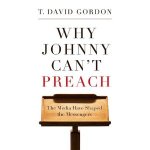
Review: Why Johnny Can’t Preach, by T.David Gordon

It’s a short book,108 pages, but it packs quite a punch.  T.David Gordon wrote Why Johnny Can’t Preach during a year of treatment for cancer.  Given only a 25% chance of survival, he found his focus clear and the desire to compromise his message absent.  The book is hard-hitting, but I found the tone entirely appropriate and not harsh despite the subject matter.

The writer is a media ecologist – that is, one who studies the effects of the change of media forms on the culture.  Taking his title from two books in the 1960’s on the growing inability of students to read and write, this book focuses on why the present state of preaching is so dire.

The first part of the book sets out his evidence for his claim that preaching is ordinarily poor.  While admitting freely that his first line of evidence is merely anecdotal, I found the presentation of evidence hard to argue with (not that I’m inclined to argue since my experience largely reflects the author’s).  Yet Gordon’s evidence is not merely subjective.  He goes to some pains to make clear that there are some objective measures of sermon quality that can be used to identify problem preaching.  It is too common to hear “that is just your opinion” if a sermon is ever questioned or critiqued.

The author’s argument culminates with the almost total absence of the annual review, not missing in any other profession, but indicative that all sides know there is an issue.  Gordon doesn’t blame seminaries for this state of affairs.  In his perspective they haven’t changed, but the calibre of incoming student certainly has.  What has changed?  Because of the change in media forms, Johnny is no longer able to read, nor write, nor discern the significant, and hence he can’t preach either.

True preaching requires close examination and study of a quality text, something non-readers have no experience of today.  People don’t study classical languages.  They don’t read literature.  They aren’t equipped to really study a text.   People read for content, but don’t learn to look at how a text communicates.

True preaching requires careful composition.  But people don’t write letters anymore.  They talk on the phone. Instead of careful composition, we live in a day of easy and cheap talk.

True preaching requires a sensibility of the significant.  But the only way to watch hours of television is to turn off such sensibility, so most do.

A once-common sensibility (close reading of texts) is now uncommon, and a once-common activity (composition) is now comparatively rare.  A once-common daily occurrence (face-to-face communication allowing us to “read” the unstated feelings of another) has been replaced by telephone conversation in which visual feedback is absent.  A once-common sensibility, the capacity to distinguish the significant from the insignificant, is becoming rare.  For a minister today to preach a basic average sermon by early-twentieth-century standards would require a lifestyle that is significantly countercultural.

The book is not solely concerned with capacity to study and compose.  The fourth chapter looks at the content of sermons and gives a fine rebuttal of four contemporary approaches – moralism, how-to, introspection and “so-called culture wars” . . . helpful content that I will come back to in other posts.

At certain points I would suggest that the author’s view of Christian preaching is a little narrow.  There is more to an inherently relational faith than merely submitting our will to God’s will.  Perhaps the Bible text, if read carefully, might present the heart of God such that our hearts might be changed in response.

Nevertheless, even taken on the author’s terms, the book’s message is important and needs to be considered.  All of us live in a fast-paced world that simply doesn’t allow for careful reading of God’s heart in His Word.  Perhaps it is time we were more counter-cultural in order to be able to read the text well.

Thankfully, T. David Gordon is still alive and serving the church through his teaching and writing.  We should be grateful for this little gem of a book.  Buy this book, perhaps even pass on a copy to someone else!

(If you are in the UK, click here to buy.)

Add to FacebookAdd to DiggAdd to Del.icio.usAdd to StumbleuponAdd to RedditAdd to BlinklistAdd to TwitterAdd to TechnoratiAdd to Yahoo BuzzAdd to Newsvine

Life’s Too Fast To Preach

We don’t always realize just how fast our fast-paced lives are.  We live in an age of flashing images that rush by at frantic pace.  As the book I’m currently enjoying points out, “we become acclimated to distraction, to multitasking, to giving part of our attention to many things at once, while almost never devoting the entire attention of the entire soul to anything.” (p50)

But preaching a biblical text demands that we slow down and focus.  We must concentrate fully on the text.

1. Poetry – “the rhythms and cadences, the music of the language, cannot be experienced at all by scanning.” (p.50).  Indeed the dense line by line nature of poetic art demands focused reading if we are to glimpse the gold that is there.

It is not just poetry though, we must also slow for:

2. Narrative – it takes focused concentration for the imagination to engage, for the images to form, for the tension to be felt.  Characters have to be met, tension faced, resolution experienced.  Narrative will only yield superficial and petty sermon outlines if it is not engaged slowly.

3. Discourse – it takes focused concentration to follow the intricate composition of an epistle or recorded speech.  How does the thought flow?  What is the main thought?  How is it developed?  Again, discourse will preach after a superficial glimpse, but it will be poor!

Slow down.  Read the text.  Then maybe you can preach it.

Add to FacebookAdd to DiggAdd to Del.icio.usAdd to StumbleuponAdd to RedditAdd to BlinklistAdd to TwitterAdd to TechnoratiAdd to Yahoo BuzzAdd to Newsvine