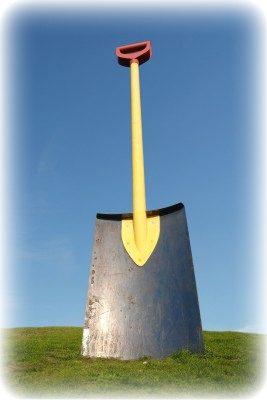
Look Wider to See Deeper and Higher

Interesting comment today.  After interacting with students’ sermon outlines on a passage I got the privilege of preaching the passage.  One participant observed afterwards, “we were looking at this passage on a very human level, but you went deeper to show us God and how He sees us, which made it so much more powerful.”  

Very encouraging feedback, but my point is actually this: they were looking at a list of instructions in an epistle.  I probably did dig a little more than they could in the passage itself.  But the God vision came from a wider lens, not a bigger shovel.  I looked at the passage in its context and saw God at work.  They looked at the instructions and felt pressure to obey.  I looked at God’s work and saw a privilege to participate in.

Sometimes we need to dig deeper in the text (actually, always).  Sometimes we need to look wider at the context (actually, always).  Always we need to make sure we are preaching God and not just human.

Add to FacebookAdd to DiggAdd to Del.icio.usAdd to StumbleuponAdd to RedditAdd to BlinklistAdd to TwitterAdd to TechnoratiAdd to Yahoo BuzzAdd to Newsvine

Extended Sermonic Incubation

I’ve been struck again recently by the challenge of regular preaching.  Sometimes regular preachers might look with envy at those who only get to preach every two or three months.  Weeks on end to ponder a passage before preaching it.  For too many of us, the sermon for next Sunday is not really considered until the Tuesday before (and for some, later than that).

A friend recently suggested that without enough incubation time, the preacher will end up preaching while they have a mass of information accumulated, like a firework box of ideas going off all over the place.  Better to give it the necessary time for your heart and mind to stabilize and settle on the main idea of the passage.  Amen.

Then there’s another reason for preparing over a longer period of time.  It simply takes time for passages to work in our lives, as God’s Spirit moves in us using that Word on which we are dwelling.  So if you start your preparation on Saturday night, there is no time for the passage to be truly owned, because it has really gripped you.  It hasn’t.  You may be excited to preach it, but it hasn’t got hold of you and worked itself out yet.  So five days is better than one.

But ten days is better than five.  Haddon Robinson advocates the notion of doing the first day’s worth of passage reading and study in the Thursday of the week before you start preparing the sermon (day’s worth may not equate to eight hours, of course, it may only be one or two).  Then you press on with this week’s sermon prep, before returning to it the following Monday or Tuesday.  Perhaps refer to yesterday’s PEPPERS approach to reviewing the text for added blessing!

Several weeks are better than ten days.  As well as the above approach, I really appreciate knowing what passage I’ll be preaching on in a month or two or even longer.  Knowing that I’ll be preaching on Mark, or Acts, or Proverbs, or whatever, allows me to pick at the text and gradually accumulate over the course of time – accumulating not only helpful resources, articles, illustrations, etc., but accumulating the experience of that text starting to work in my life.

Add to FacebookAdd to DiggAdd to Del.icio.usAdd to StumbleuponAdd to RedditAdd to BlinklistAdd to TwitterAdd to TechnoratiAdd to Yahoo BuzzAdd to Newsvine

Personally Engaged Preaching Passage Easy Review System (PEPPERS)

It sounds like an acronym from NASA, something with a massive federal budget and cosmic goals.  Actually I just made up the acronym, it requires the smallest budget, but it does have eternal goals.

Most preachers don’t have great blocks of time in which to prepare their messages.  Even if we did, it would still be good to spread the preparation out over at least five days, if not more.  Taking small bits of time and working on a passage allows it to work on us (this is why more than five days is even better).  Part of that process is getting the passage into us as we get into it.

A friend was recently describing his habit of seeking to memorize the passage he is going to preach.  This is a great habit and I commend it, although I don’t tend to memorize the next passage I’ll be preaching.  But his suggestion sparks one from me.  One of the best ways I have learned to review and potentially memorize a passage.  To live up to our image for the day, let’s call it the PEPPERS project (ok, could have gone with the vegetable look, but didn’t.)

Typically we tend to read and re-read a passage when reviewing it or memorizing it.  I have found it very helpful to write out a set of acronym style notes instead.  So for verse 1-2 of Psalm 1, for example, I would have on the page (this is NIV in case you look it up):

1. Bitmwdnwitcotw, ositwos, ositsom,

2. bhdiitlotL, aohlhmdan.

I follow the capitalization and keep the punctuation, but only put in the first letter of each word.  Then when I want to review the passage, it forces me to engage my mind, instead of simply scanning over words while thinking of something else.  It allows for a small card or note to be carried, instead of a lengthier piece of paper.  This note would be a very useful way to engage quickly, but effectively with a passage in the days of preparation, during those times when you have to be doing something else.  In the line at the bank, pull out the notecard.  Waiting for a haircut, pull out the notecard.  You get the drift.

Add to FacebookAdd to DiggAdd to Del.icio.usAdd to StumbleuponAdd to RedditAdd to BlinklistAdd to TwitterAdd to TechnoratiAdd to Yahoo BuzzAdd to Newsvine

Guardrails and Bridge Width

Some time ago I referred to Timothy Warren of DTS who used the analogy of guardrails for guarding the application of a message from straying off target.  I’d like to use the same analogy with slight modification in respect to preaching a text.

The preacher builds a bridge between the Bible text in its world and the listeners in theirs.  It may be helpful to imagine a guardrail either side of this road.  One guardrail is the intended audience, the other is the purpose of the communication.  On the Bible side of the bridge, the intended audience were the church or individual receiving the inspired text (i.e. the churches of Galatia).  The purpose was specific in terms of Paul’s intent for those churches.

By the time the preacher gets over to today, he is also thinking of an intended audience (the congregation of Community Church this coming Sunday) and also has a purpose in preaching this text to them on this occasion.

Now if the audience this Sunday shares significant characteristics and cultural experiences with the original audience, then the guardrail comes straight across the bridge.  And if the purpose for the sermon matches Paul’s purpose for his letter, then that guardrail also comes straight across.

But what if the audience is different (perhaps they haven’t gone after another gospel), and therefore the purpose is slightly different (encouragement with some warning, rather than open rebuke), then I imagine the guardrails shifting the road direction slightly (think of how your lanes are changed when there is construction on the motorway/freeway).  The message of the text is not significantly changed (there are limits), but the sermon is adjusted from what the original did.

If this were applied to preaching a passage from Leviticus, then I imagine the considerable change in audience and purpose would be reflected in the less direct application of the text (a six-lane road narrowing to a two-lane road since we can’t apply it freely and directly), yet the road remains the same.

You cannot preach any truth from a particular passage.  You can only preach the truth of that passage.  However, the ease of transfer depends on the consistency of audience situation and sermonic purpose.  Adjusting these guardrails will adjust the message (but the message must still be the message of the passage).

Add to FacebookAdd to DiggAdd to Del.icio.usAdd to StumbleuponAdd to RedditAdd to BlinklistAdd to TwitterAdd to TechnoratiAdd to Yahoo BuzzAdd to Newsvine

Tranlsation Error? Sure?

I’ve mentioned this before, but let me drop it in again.  Be very careful before you tell a congregation their Bible translation is wrong.  I was in a church a while back where somebody corrected the translation with the comment, “the NIV committee pulled a fast one here.”  Very unhelpful.  Whatever decisions they made that we might disagree with, I doubt they “pulled a fast one.”  What’s more, it was clear from the explanation given that the person commenting didn’t know his Greek almost at all. 

1. The notion of word for word direct equivalence is naïve.  Each word in the Greek has its own semantic domain (essentially a range of potential nuances/connotations/senses and potentially appropriate glosses or equivalents in English).  So word X might be translated as A or B (to keep things simple).  Word Y might be translated as C or sometimes B.  To say the translation is wrong because they translated Y as B when you think it can only be C would be naïve and unhelpful.

2. Listeners are naïve.  Generally speaking, when the speaker makes some judgment of the translation or comments on the Greek, the listeners will mostly assume they have someone with some level of expertise before them.  This is massively naïve.  I tend to see those who are very capable in the Greek barely letting it show in any overt way, while those who refer to it often are desperately lacking in Koine competence.

3. Preach your passage.  Does your passing comment about the translation really help people understand the passage?  Really?  Is it worth undermining their confidence in the translation for that insight?  And honestly, although this is hard to answer, do you have enough competence in translating the Greek to make your critique (or second-hand critique) stand up with integrity?

Tempting as it may be, for several reasons, to correct the translation you are preaching from, it is typically better to avoid overt critique and simply allow your insight to shape your explanation of the text.

Add to FacebookAdd to DiggAdd to Del.icio.usAdd to StumbleuponAdd to RedditAdd to BlinklistAdd to TwitterAdd to TechnoratiAdd to Yahoo BuzzAdd to Newsvine

Comments on God Speaking and the Bible – Be Careful

Does God speak through the text, as distinct from analyzing and understanding it?  Is it that when the Bible speaks, God speaks, or when the Bible speaks, God also speaks?

It is true that there is more to understanding a Bible passage than just analyzing the technicalities of the propositions the grammar.  However, let’s be careful not to create a notion of exegetical accuracy versus some supra-biblical revelation.  This notion can come from well-meaning comments like “we can study what the text means, but let’s be open now to hearing what God has to say.”

I heard of a song leader who struck up a chord after the message with the comment, “now let’s hear what God has to say.”  Unfortunate, albeit amusing in some ways.

But the same separation can occur within the preaching.  The preacher can give the sense that there is the meaning of the text, and then there is God speaking to us as we look at the text.

Cold non-relational exegesis is certainly problematic.  But so is supposedly relational non-exegetical Bible reading.  Let’s not offer the notion of non-exegetical devotional Bible reading, nor the notion of non-devotional exegetical Bible reading.  Whether our goal is personal devotional reading, or technical pre-teaching study, let us be sure to keep together the relational aspects of reading God’s Word with the technical aspects of studying God’s Word.

Add to FacebookAdd to DiggAdd to Del.icio.usAdd to StumbleuponAdd to RedditAdd to BlinklistAdd to TwitterAdd to TechnoratiAdd to Yahoo BuzzAdd to Newsvine

Using Used Outlines – Part 2

Continuing the list of suggestions for the pressured preacher who feels he has to use used outlines in order to be ready to preach . . .

4. Don’t move on too quickly.  Most sermons take too long to finish, but then are finished with too soon.  While I’m not advocating preaching longer for most preachers, I would say that once the sermon is done, it may well not be done, and might bear the weight of another visit next time.  Doubling up exegetical work by preaching the same passage more than once is worth considering.

5. Don’t pressure yourself.  There are several problems with borrowing sermon outlines.  One is that you might borrow junk and therefore offer junk to your listeners (it is amazing how much poor preaching is offered through the internet!)  On the other hand, you might get into the habit of borrowing a standard you find intimidating and can therefore never live up to.  Don’t pressure yourself.  Your listeners will appreciate a simpler sermon that is truly owned, they don’t need you to pretend to be him (whoever he is).

6. Don’t starve yourself.  Another issue with borrowing sermon outlines is that you are cutting yourself off from one of the greatest delights of preaching – the wrestling with a text so that it marks your life.  Even if you can’t give 20 hours a week to a sermon (few can), you will do much better to have wrestled for two hours than none.

7. Generate time from elsewhere.  Do you create a powerpoint when you preach?  Don’t bother, save the time.  The powerpoint may or may not be helpful, but if it is powerpoint time or passage time, it should be passage time every time.  Do you spend half an hour picking songs for the service?  Ask someone else to do that.  Do you search the internet for pithy introductory anecdotes?  Save the time and get into the Word.  Do you scratch your head for illustrations?  Look at the text more carefully and describe the images or story in the passage.

More thoughts and ideas?

Add to FacebookAdd to DiggAdd to Del.icio.usAdd to StumbleuponAdd to RedditAdd to BlinklistAdd to TwitterAdd to TechnoratiAdd to Yahoo BuzzAdd to Newsvine

Using Used Outlines

Earlier this week Tom wrote:

Good morning! I just found your blog and read the post on stage 1. It looks like you are addressing preachers who are full time. I am a “part-time” pastor-I have to work another job to make ends meet. Do you have any advice for someone like me? So far (I have only been at this for 3 years), I rely heavily on outlines someone has already done. I would like to get away from this, but do not feel I have the luxury as yet to do this.

I understand the pressures of preaching while holding down other full-time employment (plus the pressures of marriage, parenting, crisis management, etc.)  I suppose that using outlines from others does give a pretty significant boost toward being ready to preach.  But the challenge with this is whether you are really ready to preach if you haven’t wrestled with the text yourself.  It does seem to undermine the whole notion of the truth of God’s Word coming through a personality that has been marked by it first.

Rather than just making pressured preachers feel bad, I would offer the following suggestions:

1. Try to wean yourself off using the outlines of other preachers.  Initially move to seeing them as conversation partners and try to adapt and improve what they offer by making it more your own.

2. Don’t go for overkill on your preaching preparation.  That is, don’t leave “borrowed” outlines in order to try to preach self-studied extended and tricky passages.  Choose easy to preach passages.

3. Don’t bite off too much each time.  Whenever possible, try to preach a shorter passage (still making sure it is a legitimate unit).  Andy Stanley makes the insightful comment that most sermons should really be series.  Why try to cover massive chunks of text if your preparation time is limited.  The same must be said of multiple passages (why preach three passages in a message when you could do better with one?)

I’ll finish the list tomorrow…

Add to FacebookAdd to DiggAdd to Del.icio.usAdd to StumbleuponAdd to RedditAdd to BlinklistAdd to TwitterAdd to TechnoratiAdd to Yahoo BuzzAdd to Newsvine

Overemphasized Misrepresentation

Preaching is a balancing act.  You are always in danger of overemphasizing some element in a text so that you misrepresent the whole.  For example:

1.    A theologically weighty word can send you up like a rocket.  For example, I was working with a group of preachers looking at Ephesians 1:3-14.  We observed features of the text, including the references to God and the relationships within the Trinity, we saw the amount of grace, love, lavished, blessing language.  We saw all that God has done for us, in Him.  But then we saw the word that might light the fuse and obliterate everything else – predestined!  It would be so easy to take off and end up with a message bereft of intra-trinitarian relationality, stone cold and lacking in loving grace toward us, with some personal hobby horse message on predestination (in favour or against, depending on your position).  Of course one should preach about predestination in the course of preaching this passage, but not to the exclusion of all else that is so richly interwoven!

2.    A seemingly misplaced verse can take over the passage.  For example, we were looking at Ephesians 2:1-10.  Verse 10 is intriguing.  Should it be seen as part of what Paul is saying in 8-9, or does it stand alone?  Various groups processed the passage in different ways.  Those that included 10 with 8-9 seemed to recognize it as a sub-point (i.e. after affirming that we are not saved by works, Paul does cover himself in case any miss his point and neglect good works altogether, but the focus is on God’s saving grace).  Those that separated out verse 10 seemed to end up seeing the whole passage as culminating in the good works of believers, the goal of all that God did in our salvation.  In one approach the verse was a passing, albeit important sub-point.  In the other approach, it became the goal of all.  I’m not affirming one or either of these here, I’m just making the point that how we see a verse working with those around it will determine our understanding and explanation of the whole.

3.    A vivid image in a text can overwhelm the whole.  So there’s a term in your passage that is particularly vivid and preaches so well in terms of visual imagery.  Be careful that it doesn’t take over the message and end up becoming the dominant motif for the whole passage, when in reality it is a small part of a much bigger whole.

Understanding a passage is so much more than simply checking what words mean in a biblical dictionary and breaking the passage down into sections.  The whole issue of relative weight and flow of thought is a massively important element in studying a biblical passage.

Add to FacebookAdd to DiggAdd to Del.icio.usAdd to StumbleuponAdd to RedditAdd to BlinklistAdd to TwitterAdd to TechnoratiAdd to Yahoo BuzzAdd to Newsvine

Control Checkpoints

During the sermon preparation process there are several control checkpoints.  These are points at which we get to check the text yet again and make sure our grasp of the text is accurate.  Here are some of them:

1.    Writing the summaries of the sections within the passage. 

When you force yourself to distill the details in a section of the text into a single complete sentence, it forces you to check that your summary is actually reflecting the details in the text.

2.    Distilling all the study into a summary of the whole passage.

When you force yourself to distill the details of the whole text into a single complete sentence, it forces you to check that your summary is reflecting the important content discovered in the outlining of the passage structure.  Are the key details showing in your summary? (Your statement of the passage idea)

3.    Checking the commentaries

Once you have thoroughly studied the passage for yourself, it is good to check with a learned conversation partner or two.  If I’m preaching Romans I’d like to interact with Doug Moo, Tom Schreiner, brother Cranfield.  If I’m studying Hebrews I’d like to interact with George Guthrie, Paul Ellingworth, Craig Koester, etc.  That’s why commentaries exist.

4.    Testing the sermon idea

When I start planning the message and shape the main idea of the text into the main idea of the message, then I need to test that I’ve built the bridge effectively.  Part of that includes a look back toward the text to see if the message idea still reflects the uniqueness of the text.  I sometimes talk about the Bible Expert test.  That is, if I phoned someone who really knew their Bible, and quoted my message idea, would they be able to identify the passage based on my message idea?  If not, maybe my message idea has grown too generic and lost the specificity needed to really preach this passage.

5.    Listening to the message pre-preached

Sometimes it is not until you stand and preach through the message that you hear with your own ears that it actually doesn’t convey the meaning of the text effectively.  That is why it is better to preach it through ahead of preaching it publically (better to discover a weakness before Sunday morning).

Add to FacebookAdd to DiggAdd to Del.icio.usAdd to StumbleuponAdd to RedditAdd to BlinklistAdd to TwitterAdd to TechnoratiAdd to Yahoo BuzzAdd to Newsvine