Mentored by the Text

I recently had the privilege of speaking at the Josiah Venture Spring Conference.  What a joy to spend those days with great people in a beautiful place, enjoying an excellent Bible book!  In light of that time, I have been pondering the idea of being mentored by the biblical text.

To begin the series of messages, I suggested that if we could time travel, we would be changed by spending half an hour watching Jesus, Moses, Daniel, Paul, or whoever.  If we could just be there and see them in action, we would be mentored by the experience.  But we have the Bible!  So why not allow the experience of the text to mentor us?  Time spent watching Jesus (in this case) should surely mark our lives in significant ways.

Here are some thoughts on “Preaching as Biblical Mentoring” –

1. The move from then to now is essential, but the move from text to sermon can be overdone.  I have seen sermons so crafted that listeners may marvel at the sermon construction but lose the passage.  Maybe our sermonic work of art is not as valuable as the inspired text.  After all, whatever we can do with the text is not as good as what God did when He inspired the text.  So perhaps we need to consider how to let the passage drive the message more in our preaching. 

2. Overly crafted wording can hide rather than reveal the inspired text.  In the detail of the sermon, do we demonstrate our linguistic skill rather than elevating the text itself?  Our wordcraft may impress listeners, but is our goal to impress them?  Surely our pastoral goal should be for them to encounter God Himself in His word?  Let us make it our goal to communicate rather than to exhibit our craftsmanship.

3. The shape of an overly crafted sermon can hide rather than reveal the shape of the text.  I remember one moment as a student in a class.  I was the member of our group who went up to write our outline on the whiteboard.  “That is incorrect,” the teacher declared, “you have to make all the points parallel.”  I was taken aback and responded, “But, isn’t that the shape of the passage?”  The teacher looked at the Bible.  “Yes, it is the shape of the passage, but your outline has to follow the rules of rhetoric, so it is wrong.”  I politely pointed out that Haddon Robinson (who was in charge of the preaching department at that seminary for many years) had taught us to reflect the shape of the text in our sermons.  It became clear that there was a point of difference between these two excellent teachers.  I’m with Haddon.  Let’s aim for sermons that reflect the shape of the text rather than squeezing the text to fit our rhetorical expectations and standard sermon shapes.

4. Overly crafted rhetoric can hide rather than reveal the experience of the text.  As we preach, we should communicate clearly, with good organisation and a thought-through structure.  But sometimes, our sermons can hide the text and keep listeners from experiencing the tensions and contours of a passage.  So let’s use whatever skill we can, but remember that our goal is not to present the work of art that is our sermon.  No, our goal is to bring our listeners into a rich experience of the passage and, in doing so, to encounter God as He reveals Himself there.

5. We should preach so listeners can “see” the movie projected in their hearts.  I find it helpful to imagine every listener with a movie screen in their hearts.  If I prayerfully and carefully present the message to them, a movie should form on that screen.  It is easy to offer theological insights and speak theoretical truths.  But those screens will remain blank.  However, suppose I can effectively describe what is on the page.  In that case, my prayer is that they will not only understand it but also experience it.  And when they experience it, it will change their lives.  It can be like being mentored through the text by God revealing Himself in that passage.

I am sure there are more angles to consider on this subject.  Perhaps too much of our ministry uses the Bible, begins with the Bible, or connects to the Bible, but what people really need is to experience what God has given us in the Bible.  Supremely, the Bible reveals Him.  Let’s prayerfully shape our ministries so that people can encounter Him and not simply learn theological truth at arm’s length.

____________________________________________________

Please check out The Biblical Preaching Podcast, on YouTube (click image below), or on any podcasting platform (Spotify, Apple, etc.)
Getting Stuck in Sermon Prep (Podcast Post 7)

I was chatting about preaching with a friend on Sunday after preaching in his church. We talked about ways we sometimes get stuck.

Sometimes, the outline won’t quite work, and we keep looking at the text until eventually something clicks. Once it clicks, we can’t understand how we could not see the passage’s logic before.

Sometimes, the details of the message are the issue. What illustrations would work? How can I introduce the sermon? And so on. Again, the breakthrough moment is always a real relief and cause for rejoicing.

Sometimes, everything seems jammed up, and we simply can’t get the sermon to work.

In the latest episode of the podcast, Mike and I discuss seven specific logjams and offer some ideas that might help you break through the next time you get stuck.

But here is a thought: let’s be careful not to see the ideal as a jam-free future. While logjams can feel like hard work, there is also a blessing in them. Without the logjam, there might not be the desperate prayer. Without prayer, there would not be sweet moments of answered prayer as God lifts us in preparation for Sunday.

7 Defining Moments in Your Sermon Preparation

As you prepare your sermon, there are numerous defining moments.  That is to say, pivotal decisions that will impact the essential nature of the sermon.  The whole process is important, and every little detail of your preparation will build the character of the message.  But the defining moments will fundamentally change the outcome of your process.  Therefore, it is helpful to be especially aware of these key points in the process.

Here are seven defining moments in your sermon preparation:

1. The choosing of the passage.  If we genuinely believe in expository preaching, then the choice of passage will always be a key moment in our preparation.  Why?  Because that passage will be the boss of the message.  We cannot say whatever we want using any passage.  Some preachers do.  We must not.  If it is a series from a book, then the moment will primarily be the selection of the series, although the length of the next section to be covered will also matter.  If it is a one-off message, then the choice of the passage matters for the content of the sermon.  And also the timing of that choice will matter for how much time we can give to the preparation.  Some preachers make a good choice, but they make it so late that the preparation is adversely impacted by lack of time. 

2. The decision to start preparing.  If you have a tendency to procrastinate, and many of us do, then deciding to start preparing is important.  If your routine is established and it works well, then this may not be a key point for you.  However, if you find that life often presses in and the week is often eaten up before you even start the process, then this point is for you.  Decide to start early.  Just the first step.  For me, that means pasting the passage into a document and starting to recognize the shape of the passage.  Once you have started, even if only just, then the brain starts to collect and sort exegetical information, and the heart starts to bow to the truth of the text.  Some helpfully choose to get started, even if only just, more than a week before preaching.  Some even take some time to get started on every series, and even every passage, months before the time comes to preach.

In the next post we will continue the list of seven defining moments in the preparation of a sermon.

Bible Reading Basics – Part 2

If you have a good Bible reading and study plan that works well, that’s great.  But what if you don’t?  What if others don’t get on with your approach?  Well, for you, or for someone else, this video might be helpful.  It shares a reading and study approach that I believe has a lot to commend it. 

There is flexibility – you choose what time to give to it. 

There is motivation – you choose where to put your energy. 

There is potential – I’ve not found a plan that seems more likely to build solid Bible-shaped believers.

One of the challenges of Bible reading is maintaining momentum. There are a number of momentum killers, like long lists of names and unpronounceable places. What should we do?

One way to evaluate your Bible times is by checking in on what is happening in your mind and heart the rest of the time. What does it mean to meditate on God’s Word day and night? Check out this video for more:

The question that I hear more than any other is this, “what should I do when I don’t feel like reading my Bible?” It is an important question. We all need a decent answer that can help us when we inevitably get those days. Here is a video that may be helpful.

Please click here to subscribe to the YouTube channel – thanks!

John Wesley’s Advice – Part 2

So last time we started this list of 12 points of advice to preachers from John Wesley.  Let’s keep going!

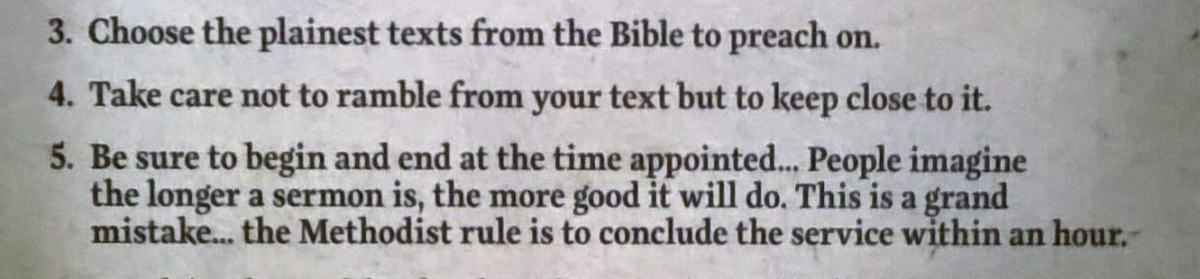
3. Choose the plainest texts from the Bible to preach on.  Again, if I were purely speaking to non-believers then I would completely concur.  However, in a typical church setting, we will be speaking to both Christians and non-Christians.  A steady diet of the same evangelistically oriented passages will lead to some malnourishment among God’s people.  I think it is good to help our churches experience the full breadth and scope of God’s Word.  You might preach more from the New Testament than the Old, but if they never hear the Old Testament preached, why would they read it?  And if they don’t read it, what a vast vista of theological truth is lost.  Different types of text are also important for the health of the church.

So on the one hand, I would agree that every passage has a redemptive force that should be brought out because believers never move beyond the need to hear the gospel being applied to their lives.  On the other hand, while every passage is useful, not every passage is equally useful on every occasion.  Don’t be stubbornly preaching through Jeremiah when people are coming for a Christmas Carol Service.  Bottom line?  Be selective and choose what you are going to preach appropriately for the listeners and the occasion, but in a church choose from the whole Bible because people need more than your favourite five passages.

4. Take care not to ramble from your text but to keep close to it.  Can I just say I agree and move on?  Of course not, otherwise this would be a “Quote” rather than a “Blog!”  It is quite remarkable how little weight the Bible passage will have in some sermons.  Some will leave it behind to ramble into excessive personal anecdotes and humorous illustrations.  Others will leave it behind to ramble into theological presentations that resemble explosions in a concordance factory! (Hyper cross-referencing is very common in some circles!)  Few seem to recognize that this passage is uniquely powerful and should not be missed by superficial coverage in the sermon.  Your church may not be back in that passage for several years.  Keep close to it, do it justice, allow time for clarity to emerge and its impact to be felt.

5. Be sure to begin and end at the time appointed… People imagine the longer a sermon is, the more good it will do. This is a grand mistake… the Methodist rule is to conclude the service within an hour.  Several points in this one.  Let’s go one-by-one – (1) begin and end on time.  I understand that different cultures have different expectations in terms of time.  But the point still applies.  Abide by the expectations of the culture.  Once we break the general expectation, then we distract attention from the sermon.  If we go 10 minutes over, parents are concerned about children in kids’ groups, volunteers in kids’ groups start to lose their joy in serving, and others are concerned about their plans, their lift home, etc.  Generally speaking, stick to time.  Seems fairly simple.

(2) Longer is not necessarily better.  Again, agreed.  Haddon Robinson was captivated by how some preachers preach for ten minutes and it feels like an hour, while others preach for an hour and it feels like ten minutes.  Length tends to become the key focus when too little attention is given to clear, engaging and relevant content and delivery.  Generally speaking, longer sermons could be sharpened into shorter sermons.  But shorter is not automatically better either.  Some things take time.  Just as an illustration might be lost in two sentences, but really capture hearts in two minutes, in the same way, a sermon can be technically precise in a shorter timeframe, but more vivid and engaging with enough time given to let the listeners’ imagination flourish.  There is no right length of sermon.  It depends on preacher’s skill; listener’s background, expectations and focus; and the occasion too.

(3) Service length should be less than one hour.  That feels quite arbitrary and culturally bound.  I imagine that didn’t translate effectively in some other global contexts!  But, service length should be considered for the sake of church attendees, as well as their perception of service length for potential guests they might invite in the future.

Ok, let’s leave it there for this time.

A Low Fence: Revisited

One of my early posts on this site was called “A Low Fence.” I have recalled that post many times, and since yesterday’s post related to the idea, I thought I’d give it a revamp:

When you have a single text for a sermon, you also need a fence.  The fence is there to keep you from wandering too far away from your focus.  

1. Erect a fence for the passage – If you are preaching John 3, put your fence around John (or maybe the section of John 1-4). If you are preaching Colossians 1, put a perimeter around Colossians. That fence means you try to keep your study, and your presentation, within John, or Colossians.

2. Study inside the fence – As you try to make sense of details within your passage, try not to spend all your time visiting other writers and other eras of biblical history. By staying within the writing of that author, or if possible, within this writing of that author, you will put your energy into the best evidence to find authorial intent within your passage. The fence marks off the best context for your study. Staying there will help you to spot the flow of thought within the passage, as well as the way the author is using a word or concept.

3. Preach inside the fence – As we thought about in the last post, it is often tempting to present a sermon in our own preferred terms (or preferred texts, cross-references, etc.) A couple of things can be said of cross-references. (1) Listeners don’t love a biblical “sword drill” and tend to switch off when a message becomes too textually complicated, and yet (2) Listeners seem to praise the preacher for being “deep” or some such non-compliment often misunderstood as endorsement. But it isn’t just about jumping around the canon. How easily we will preach a Resurrection passage in a Gospel using Paul’s terminology from 1 Corinthians 15. Or how easily our standard Christian terms get painted on every text so that the distinctive vocabulary of Luke or John or Hebrews or Peter is lost.

4. It only needs to be a low fence – I am not suggesting that you study, or preach, a biblical book in isolation from other inspired texts.  I am suggesting that you honour the author of the book both in your study and in your preaching.  With a low fence you can step back into the Old Testament to look at a passage that informs your preaching passage, or you can step over to other writings by the same author for a more complete word study.  With a low fence you can choose to step beyond the book for a quick presentation of how this apparently unusual idea is actually very biblical.  With a low fence you can choose to step forward to see the culmination of momentum found in your text.

These are the three reasons I tend to step over the fence –

A. For the informing texts that help me understand my preaching text,

B. For the supporting texts that help others accept my preaching text, or

C. For a culminating passage that helps to conclude a trajectory in my preaching text. 

Otherwise, I’d say it is generally best to stay where you are.  I certainly don’t think we should spend much time going elsewhere just because other passages have similar wording, nor to offer “illustration” for the truth of our passage, and definitely not to fill time.  Dig in the text you have, honour the author by doing so, and give your listeners the best you can from this passage.  Next week it will be a different one.

(To see the original post with worked example from Hebrews 13:20-21 – click here.)

7 Ways to Not Really Preach a Passage

Here are seven ways to not really preach the text you claim to be preaching. You may notice that I will say nothing about heresy. I will assume that what is said in each type of sermon is biblically and theologically true. Nevertheless, in each case the preacher is not really preaching the text they claim to be preaching. After the list, I will suggest three reasons why this is a problem.

1. Springboard Preaching – This is where you read the text at the beginning and then leave it behind. You may go to some wonderful places in the thoughts that follow, but the actual text is long forgotten.

2. Trigger Word Preaching – This is where you allow words in your text to sequentially trigger you to preach other things. This is like a sequence of mini-springboards. Again, you may go to good places in what you say, but you aren’t saying what this passage says.

3. Cross-Reference Preaching – This is a variation where keywords in the preaching text trigger travel via the concordance to other, probably preferred preaching passages. I presume they are great passages, but this one is getting short shrift.

4. Preferred Text Preaching – This is similar to the previous one, but all the triggers take you to the same place. I once took a course in Pastoral Epistles, but the teacher seemed determined to spend as much time in Romans as possible. Wasted opportunity.

5. Meaning-Lite or Intention-Lite Preaching – This is harder to spot. It appears to be preaching in the preaching text, but the preacher has not wrestled with the text in context, or with the original intention of the author, so the text has become a superficial and context-less set of abstract thoughts for the preacher to play with. The preacher may say good things, but is the preacher saying what the author intended to communicate?

6. Theological Overlay Preaching – This is a variation on number 5, but it is harder to critique. After all, the preacher might be presenting an amazing theological lecture, but the issue is that if it isn’t the intention of the passage, then it is an overlay being imposed rather than having the credibility of coming out of the text.

7. Anecdotally Dominated Preaching – This is where there is a tip of the hat to the text, but the real energy is invested in anecdotes and illustrations. These don’t serve the preaching of the passage, they swamp it. Now, they might be theologically brilliant quotes, stories and examples, but what about the passage?

That is a quick menu of seven ways to not really preach the text you purport to proclaim. But if these sermons are biblically and theologically accurate, is it a problem? Here are three reasons why it is a problem:

A. Your preaching text is good, why miss it? The alternative may be attractive, it may be more preachable, and it may even be what they need. If it is, preach that text. But why pretend to preach this passage and then not really preach it? In your preaching calendar it will say that you preached it, so it won’t get another opportunity for several years. Why not let them have this particular passage’s truth – it is unique, it is God-breathed, and it is profitable.

B. You are shrinking the canon, why do that? When your preaching text does not control your content, then you will naturally move to easier texts, to pet ideas, to personal soapboxes. Even if these are all true, they are also too few. God gave us a whole Bible of self-revelation. When we reduce that to the extent of our preferences, that will always make for a much smaller canon. What you want to say will never be as rich, diverse, interesting and helpful as what God has said and wants to say through the preaching of the Bible.

C. You are undermining God’s credibility as a communicator, why teach that? What example are you giving your listeners, especially the more discerning ones? When they look at a text and sense that what you have said isn’t really what that text is saying . . . but you imply that it is . . . what do they learn? The Bible is not good communication? This preacher does not believe God to be a good communicator? I should let the text trigger disconnected thoughts when I read it too?

Please add more ways this happens and more reasons it is a problem in the comments. And let’s resolve, prayerfully and passionately, to always seek to really preach the passage we claim to be preaching!

________________________________________________

Same Passage, Same People

Sometimes it becomes necessary to preach the same passage to the same people.  How do you handle that?

For instance, maybe you used a passage in a topical series, or on a special occasion, but then a later series is working through that Bible book and so you need to preach it again.  This happened to me this weekend.  The prayer of Acts 4:23-31 fit perfectly in our current Acts series.  But I preached it as a fitting New Testament conclusion to an Old Testament series on revival from 2 Chronicles less than two years ago.

So it may be the same passage, to the same people, but the series and the situation is different.  In fact, everything feels very different in 2020 than it did in 2018!  Here are four ways to handle this type of situation:

1. Same frame, different colouring. If your outline is a close representation of the passage, one approach is to use essentially the same outline, but adjust the illustrative details, the introduction, the conclusion, etc. (Yesterday my intro, conclusion, application and illustrations were all different to last time.)

2. Same frame, different emphasis. Another approach is to preach the same outline, but to shift the emphasis.  For example, the first time I preached the passage my emphasis was on the actual petition of the prayer – they asked for boldness.  This time my emphasis was on their view of God that led them to pray as they did.

3. Different outline.  It is possible to vary the outline of a message on a repeat passage and still be true to the text.  Effectively this is what I did yesterday.  In my first sermon I used three points to overview and present the content of the prayer relevantly to my hearers.  Yesterday I used a sequence of seven truths as they emerged from the prayer to preach the passage to a contemporary situation.  On this occasion the shift in emphasis naturally adjusted the outline (from their prayer for boldness, to their view of the God they were praying to), but I believe I preached the passage with an expository approach both times.

4. Same message, new context.  There may be occasions where it is appropriate to preach the same message with essentially the same emphasis, the same outline, and the same illustrative material to the same people.  However, this should not be done because the preacher didn’t do the work to prepare for this particular Sunday. Here are three quick thoughts about the same message being repeated to the same congregation:

A. A long time ago.  If it is years later, it can be interesting and helpful.  “On my first Sunday as pastor, twenty years ago today, I preached this message.  I was looking through my notes and decided to preach it again on this anniversary Sunday because the truth of this message is still so important for us all to hear…”  I can imagine that being appropriate and helpful. (Technically, this is very unlikely to be mostly the same people listening!)

B. A recent repetition. If it is a fairly recent repeat, then the preacher is essentially suggesting, implicitly, that the listeners need to hear it again, or maybe haven’t applied its message yet.  Again, you will need to be clear with the reasons for re-preaching your message.  Better they hear your motive than guessing it.

C. A secret repetition. Whatever the time lag, I would suggest not trying to sneak it past your listeners as a new message.  If it is essentially an old message, from old notes, then be honest about it.  You don’t want listeners feeling a weird sense of unidentifiable familiarity, nor do you want a keen listener to suspect you of pulpit foul play, nor do you want the discouragement of nobody having the slightest recollection of it!

Generally speaking, old notes do not equal a shortcut for this Sunday’s message.  A familiar text may require less exegetical work, but be sure that your listeners are getting fresh preaching because you have prepared your heart as well as your message, in anticipation of this Sunday!

Weight of Evidence Preaching: 5 Lessons Learned

Generally my default approach to preaching is to preach a single passage.  Sometimes I will preach a more topical message where each point is the idea of a text and the points together make up the main idea.  But there is a variation that might be called a weight of evidence sermon.

This is where the main idea of the message is repeated multiple times in the Bible.  So while you may use multiple texts, it is not primarily to build the main idea, but rather to reinforce the main idea.  For example, this past Sunday I essentially preached Isaiah 41:10, “Fear not, for I am with you.”

In one part of the message I quoted Genesis 26:24; Deuteronomy 31:8; Joshua 1:9 and Jeremiah 1:8 – all of which say the same thing in a variety of ways.  I anticipated that I would be able to find examples of the main idea that addressed different circumstances in life, but then in my study found that the “fear not” part of the phrase was either overt or in the context of almost every text I found with “I am with you” or similar phrasing.  So since over 90% of the 30+ passages I looked at had that fear context, I focused the message on God being with us, so we should not be afraid.

I touched down briefly in Hebrews 13:5-6, Psalm 23:4 and Matthew 28:20.  He is with us when threatened by people, when facing death, and in our service for Him – all contexts in which we feel fear.

Here are 5 lessons learned on weight of evidence preaching:

1. This should not be the default.  Typically our goal should not be to touch down in as many different verses as possible.  Padding sermons with unnecessary cross-references is very common and often a detriment to healthy preaching.

2. Be very focused. If the message uses multiple texts, then the main point needs to be very clear and obvious.  Otherwise the multiplied verses will confuse and lose listeners. For instance, there were verses in my list where the world noticed God being with his people and it causing them to fear, or verses that spoke of believers loving one another as the context of God’s dwelling with them.  This message could have lost focus and therefore lost its force.  Be selective in what you preach.

3. Keep their finger on one text.  Preaching is not a Bible sword drill where we try to make people find multiple references.  So I encouraged people to open to Isaiah 41:10, but I projected the text of the other verses used.

4. Feel the force of the frequency.  The point of a weight of evidence message is to help listeners feel the force of the frequency.  Time and again God’s word says this, so we should be sure to hear it!

5. Make follow up study possible. People may respond positively, but make sure the list of passages is available to any who want to study it for themselves.  There is the benefit of the main idea punched home in the sermon, but there is also the possibility of people enjoying the Bible study chase for themselves, if they have the references.

I’d be interested to hear any more thoughts on this approach – both the pros and the cons.

Thousands of People

When we read the Bible we tend to gravitate to the “big names” – Abraham, Moses, David, Peter and Paul.  Perhaps there are another fifty characters that get significant attention in our churches.  But there are at least another thousand people mentioned by name, some counts going much higher.  (Forgive me for not researching this number myself for this post!)  Perhaps we too easily skim over these more minor characters that fill the pages of our Bibles?

There are at least three benefits that can come as we focus in on the more minor characters of the Bible:

  1. The fact that they are noticed, noted and named is an encouragement in itself. Most of us don’t feel like major characters in the epic history of God’s great plan as it is being worked out in our generation.  We know we are minor characters.  And if we have our eyes open to see the minor characters in the Bible, then we can be encouraged to know that our small part in God’s big plan also matters.
  2. Whenever we see any detail about a character in the Bible we will tend to see them involved in real life situations (since that is the nature of God’s inspired Word) – and consequently we can see both good and bad examples that can be so helpful for us in our contemporary circumstances. It would be naïve to think that there is nothing to learn from the many examples presented in Scripture, but it would also be a real shame to stop at mere example.
  3. God inspired the Bible so that the characters in it are more than examples to copy or learn from, they are also part of a story that is pointing the reader to God – his redemptive character and plan. The Bible is not a collection of historical tales with good moral lessons to be gleaned.  It is God’s self-revelation to a world that desperately needs what only God can offer.

Let’s look at an example.  Elizabeth only appears in one chapter in the Bible (Luke 1).  It is a story with two or three major characters, as well as two very significant babies, and Elizabeth is relatively minor in comparison.  There is the angel Gabriel bringing a message to Zechariah in the temple, and then several months later to young teenage Mary in Nazareth.  Two very different recipients, in two very different locations, with two significantly different responses.  Then in the second half of the chapter we see two great exclamations of praise – first Mary’s “Magnificat” and then Zechariah’s “Benedictus.”  These two passages are triggered by two events.  For Zechariah it is the birth of his son John, and the reinstatement of his voice.  For Mary it is the declaration of Elizabeth when the two mothers-to-be met.

What can we legitimately learn from looking at Elizabeth in Luke 1?  First of all, let’s evaluate some of the observations we might make.  It is right to observe the details in the text, but not every observation should be applied in our lives.  Some things were specific and not intended to function by way of example for us.  Generally, the more we know our Bibles the easier we will find it to not apply observed details inappropriately.  For instance, the rest of the Bible does not teach people to go into hiding when they discover they are pregnant.  Nor does it support the idea that when a child moves inside the womb we should interpret the significance of that movement prophetically.

However, the rest of the Bible would support several possible observations from this passage:

  1. God hears and answers prayer – even if the years have passed and hope has apparently dissipated, God hears and answers prayer. We should continue to trust in God’s goodness and God’s plan.  (See Luke 1:13)
  2. Every moment matters – Elizabeth, like most characters in the Bible, is offered to us in light of one incident in her life. What about the other 60 or 70 years?  God noticed and noted their blameless living (see Luke 1:6).  While our righteous choices don’t earn, they do matter.
  3. Our most significant role may still be future – Elizabeth supported her priestly husband faithfully over the years. This was her ministry.  But then, out of the blue, came a role she never anticipated – she was to be the mother of the forerunner of the Messiah.  That role is finished, but it is fair to say our most significant moment of ministry may be completely unknown to us and still future.
  4. For those of us who are parents, our most significant ministry may well be the children we raise – This passage, like many others in the Bible, underlines the significance of the children God gives to us. We live in a world that may seem desperate to protect children (at least those who have been born), but it is a world that constantly undermines the value of parenting.  Time in passages like Luke 1 will reinforce our confidence that time invested in our little ones is time well spent.

These are some Biblically supportable observations from the story of Elizabeth.  But these are somewhat at the level of surface observation, even if the points are theologically important.  What does the text itself underline for the careful reader?

Elizabeth stands at the hinge of the story, between the two angelic visits and the two great exclamations of praise.  She is not just the hinge of the chapter, she is the meeting point of the two pregnancy stories.  She was the one who lived in hiding with this miracle child inside her. Surely, she quietly longed for conversation while her husband lived in wide-eyed silence because he had not believed the angel’s words.  Then when the angel told Mary the great news of her soon-to-be pregnancy, he anticipated her need to talk things through with someone that would really understand, and so mentioned that her cousin was also with child.  When Mary greeted Elizabeth there was a leaping of John within, and the Spirit of God poured out on her.  The silence was broken, a great cry came out, and Elizabeth’s celebratory exclamation builds to the climactic point: “blessed is she who believed that there would be a fulfillment of what was spoken to her from the Lord.”

She’d lived with the consequences of disbelief, and now she could not contain her joy at the blessing of belief.  Trust what God says and experience the blessing that follows.  You and I will never have the same role as Mary or Elizabeth (for several reasons!), but that exclamation stands true for us today: let us trust what God says and experience the blessing that follows.  At work, at home, in parenting, in ministry, in life.