Since every book review posted on this site can be found by clicking on the Review category in the list to the right, there is really no need to have a page of the same reviews sitting on the site too. This profound insight has spurred me to change the Books page to Top Books. It is a list, a countdown, a veritable hit parade of preaching must-reads. To qualify for this list a book has to be reviewed on the site and be considered a must-read for all preachers. So this top 10 list is now ready for viewing and critique. But actually there’s only 7 books on there. The other 9 that have been reviewed all have their merits but don’t qualify for the list. A couple would qualify (Long certainly, Richard maybe), but have a stronger equivalent already there (Arthurs and Sunukjian respectively). So feel free to take a look. Disagree if you like. I’m not sure I agree with the placement of a couple of them! Others will be added in time.
Review
Review: Preaching the Gospel from the Gospels, by George Beasley-Murray

This book is far more a book on the Gospels than it is on preaching. It would serve well as a reference tool for the gospels, having an accessible scripture index included. Yet while not addressing homiletics very much, what it does is share a fundamental conviction that the gospels were written out of preaching, by preachers and are ideally suited to the contemporary preacher wishing to preach the truth of the gospel today.
George Beasley-Murray is a top gospels scholar. This book was forty years in the writing, beginning as a series of lectures, then published, then revisited and rewritten in light of developments in the field. Preaching the Gospel from the Gospels is an academic work with a door left open for ease of access for preachers. While aware of aspects of form criticism, the historical Jesus quest, British and German scholarly traditions, etc. the book does not get weighed down with such matters.
The book, as you might expect from a series of lectures, consists of five lengthy chapters. The first chapter focuses on the relationship between preaching and the writing of the Gospels – it is worth the value of the book. As Martin Dibelius said, “In the beginning was the sermon.”
Certainly the evangelists were collectors and compilers of known stories, sayings and events of the life of Christ. However, they were more than that. Through the process of redaction they were theologians with unique and distinct emphases to bring out regarding the work and mission of Christ. One great insight from redaction criticism is that of how the gospel was presented to a specific audience. As we see the evangelists using the history for a specific group of people, there is scope for the modern evangelist to see how the story of the gospel can likewise be used for a different contemporary audience.
The remaining four chapters deal with the life, the miracles, the teaching and the parables of Jesus. Each writer began conceptually with the resurrection of Christ, then told the story, theologically, according to their specific goals. The stories from the life of Christ, such as the miracles, are designed with the gospel as central rather than appended. The teaching and parables are grouped and explained in five categories each.
In conclusion Beasley-Murray finishes with a postscript that affirms Jesus himself to be the parable of God. As such, the truth of His teaching is ultimately found in His person. This would be true of the whole book – His parables, but also His miracles, His teaching, His life, His passion. Jesus is the revelation of God. In preaching Jesus, the gospel is preached. I suppose the big message of the book is that you don’t have to hunt through the gospels to find a gospel message. If the content of the gospels are preached faithfully to their original intent, then the gospel will be preached.
Review: Communicating for a Change, by Andy Stanley and Lane Jones.
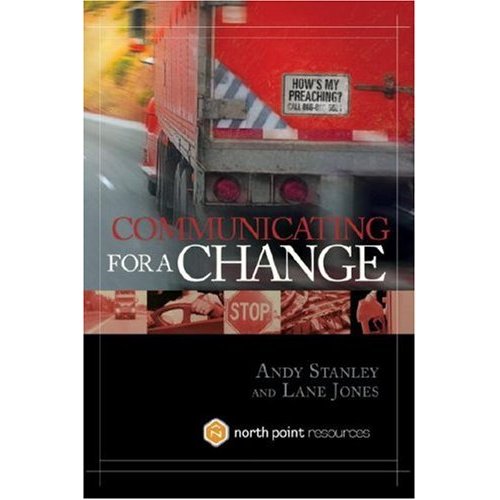
Let me be honest. I love studying the subject of preaching. I want to be a lifelong student of the subject. But if I’m honest, a lot of books about preaching are somewhat dull, tedious, repetitive and unengaging. Not this book. Engaging. Compelling. Motivating. Intriguing. Is it perfect? No. But, I think you should read it.
The book reflects a highly pragmatic authorship. Stanley writes, “I’ve listened to dozens of preachers and teachers whose stated purpose for communicating is changed lives but whose style of communication doesn’t support their purpose. If you are not willing to make adjustments for the sake of your goal then one thing is clear: Your goal is something other than changed lives. Your goal is to keep doing what you’ve always done, to do what’s comfortable.”
What does it take to preach for changed lives? According to Stanley and Jones it involves clear, engaging, relevant and applied truth from God’s Word. This book advocates strongly for one-point sermons. That one point is combination of textual idea, sermonic big idea and sermon purpose. The very slight confusion that comes from combining distinct elements of sermon preparation is worth forgiving for the clarity created in this model.
The book is in two parts. The first part, by Lane Jones, is an extended metaphor that teaches the concepts of the book. A frustrated fictional preacher gets the best preaching education of his life from an unlikely mentor. This narrative is well written, compelling and regularly convicting as well. The agenda is clear in this narrative, but since the agenda is practical skill training rather than a theological hobbyhorse (as in similar books in recent years), I thoroughly enjoyed it.
The second part is Andy Stanley working through the seven principles of the book. I found myself agreeing with so much here. Strong emphasis on the connection built by speaker to listeners, and on surfacing need and interest in the message, and on having a unity in the whole by the use of a main idea (the one point), and application driving every aspect of the message rather than being tacked at the end, and on and on. I found this book interesting, more than that, challenging and motivating.
Reservations about the book? Just one. I wish there was another chapter or two on the Biblical part of the message. I understand Stanley’s five-part progression through a message, and he states that the middle stage, the “God” or Bible presentation stage is the longest one. But what does that look like? He explains that we shouldn’t be superficial, or overwhelm with too much information. But what should we do in that part? This omission could be taken in a couple of different ways. Someone with a strong commitment to the Bible and exposition might try the Stanley model with a solid biblical core. Someone without that same commitment may preach a biblically weak idea birthed out of their own experience. The book allows for both. I wish it were stronger on the former. I’m left wondering . . . on the one hand I know who his Dad is, and I know where he studied, both clues lead me to expect a very biblical tendency. On the other hand the book is inconclusive. I am left looking for an opportunity to watch some of his messages on the internet to see how the theory works out in practice. In fact, I am highly motivated to do that. And I suspect I might be very pleased by what I see. If you read the book, do the same and let me know what you think.
The reservation is not a really a critique, it’s more of a yearning for more. This book is well worth reading. It will breathe new life into your preaching and your motivation for preaching. I honestly think that all of us would improve as preachers by reading and implementing at least some of what this book teaches.
Review: The Supremacy of God in Preaching, by John Piper

This is neither a how-to manual, nor a full theology of preaching, but it does make a definite contribution to the field. The book is divided in two parts. The first part is a series of lectures Piper gave at Gordon-Conwell Seminary on the subject of preaching. The second part is a series of lectures given at Wheaton College, focused on Jonathan Edwards; his life, theology and preaching.
In his typical style, Piper diagnoses the problem of the church as one which can be remedied by a prescription for the pulpit. “People are starving for the greatness of God.” What people need is God, whether or not they want Him as the focus of the preaching. This kind of “God-entranced preaching” can only flourish in churches where the Bible is esteemed as inspired and inerrant. Piper calls for preaching that holds in dynamic tension the greatness of God through preaching with gravity, and at the same time a glorious gladness that comes from the gospel. Such preaching requires that the preacher be diligent in steady, constant and frequent Bible study.
Piper followed advice he was given in seminary, to find one great evangelical theologian and immerse himself in that man’s writings and life. He chose Jonathan Edwards and so the second part of the book provides a brief summary of that study as it relates to preaching. After a brief biography and theological review, his final chapter delineates ten principle lessons from Edwards on the subject of preaching.
This book is short and a quick read, but worthwhile. The main themes of the book are definitely worth taking on board, although if taken to an extreme the reader would feel obliged to throw out every lesson in preaching and communication that has been learned in the centuries since Edwards. Piper writes as a response to problems he perceives in the contemporary pulpit, so at times his pendulum is swung too far the other way. However, the basic premise is spot on, people need preaching that is both grave and glad in its presentation of our greatest need, God Himself.
If you have never read Piper, then by all means get a taste here. If you have read Piper and found each book to be more of the same, then this is still worth reading because of its specific focus on preaching. Read, enjoy the motivation, accept any rebuke that is deserved and prayerfully consider before God how to integrate this book into your personal philosophy and practice of preaching.
Review: A Preaching Pod Prod
This morning I’d like to point you to a helpful new resource for us as preachers. The Preaching faculty at Gordon-Conwell Theological Seminary have recently begun a weekly podcast for preachers entitled “Preaching Points.” It is free and it is well worth a listen. At this point there are already four brief podcasts on the site. Titles so far include “Boredom is a Form of Evil,” “Be Yourself,” and “Being Biblical and Contemporary.” Each one lasts about five minutes. To access it you can either click on this link:
http://www.gordonconwell.edu/ockenga/cfp/preachingpoints/archives.php
or type ‘Preaching Points’ in iTunes. Perhaps you will find these podcasts a helpful pod prod for preaching excellence.
Review: Public Speaking: A Handbook for Christians, 2d ed., by Duane Litfin
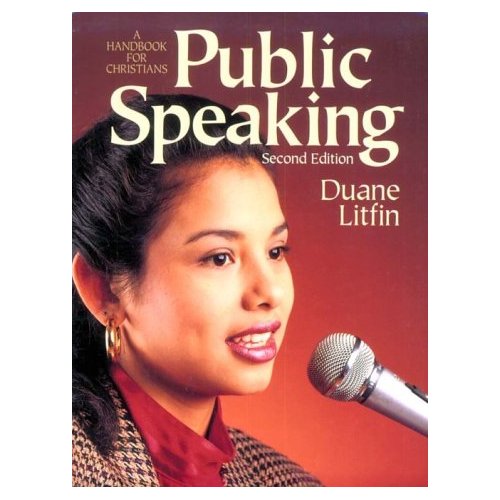
This is a college text focusing on speech communication, rather than homiletics. The main reason it may be worth reading is because it is built on the Haddon Robinson “Big Idea” preaching model. Robinson’s influence is evident throughout, not only conceptually, but also in specifics.
Since Litfin’s work is not primarily focused on preaching, he is able to challenge the reader to produce latently Christian communication in a variety of fields, a challenge perhaps we in ministry need to hear. Litfin does well to show what an audience centered communication approach looks like, including the factors that make for easier listening (such as concrete, familiar, suspenseful, interesting, humorous and life-related elements). The introduction of other elements of communication such as proxemics, paralanguage and so on add a dimension perhaps weak or lacking in many preaching texts.
Litfin’s emphasis on the importance and function of the idea reinforce Robinson’s work, but the text also goes beyond Robinson to mention other approaches to speech formulation.
Litfin’s final chapter addresses the issue of preparing a Bible message. This chapter provides a helpful and relatively succinct summary of the process of homiletics (at least in reference to preparation). Litfin’s seven steps largely parallel Robinson’s, except for introducing audience need earlier in the process. Introducing audience need prior to writing the speech idea – the same stance taken on this site, seems like the correct order if the Big Idea is to be stated with relevance to the audience.
This book is a useful book for reinforcing and amplifying some aspects of Robinson’s work. For a speech com class, this is a great text. For preachers? It is helpful if you feel the need for help to fully grasp Robinson’s work. Not a preaching text, but not a bad source of supplemental reading.
Review: Power in the Pulpit, by Jerry Vines & Jim Shaddix
Subtitle: How to Prepare and Deliver Expository Sermons

Power in the Pulpit is a lengthy three-section textbook. At times it may feel like the goal in writing was exhaustive explanation, rather than reasonable length. Although not in the same league as Robinson or Sunukjian, the book is worth reading. It is especially targeted at the minister preaching every Sunday.
The first section deals with the preparation for exposition. The task of preaching is defined with a lengthy support for exposition as the ideal philosophy of preaching. The foundation for preaching is seen in the word of God and worship of God, fundamental pre-requisites for preaching, along with the less well supported concepts of the call of God and anointing. Finally, the preparation of the preacher is set out through the idea of being a healthy, hard-working individual who is a good steward of heart, mind, body and schedule.
The second section is somewhat unsatisfying. The process of exposition is set out at length, but seemingly without original contribution. The analysis of the text is presented well, followed by the process of theme unification. In fact, the sections on the central idea, the proposition and the purpose, are all effective (albeit tedious at points). There is a bombastic attack on the new homiletic when the structure section begins (this makes the book read like a college text rather than a seminary text – proving a point cheaply using straw men, rather than engaging fairly with different views). Then the structure section gets into concepts like the keyword method. This section begins well but seems to get weighed down in detail and dogmatism by this stage.
The writers rightly urge the preacher to be not only biblical, but also relevant. So the preacher should observe culture and learn about people, they should particularly be concerned with how the message is relevant to their specific audience. The section ends with strength as the authors provide helpful discussion of invitations at the end of messages (detail often overlooked in preaching texts).
The third part of the book deals with the presentation of the message. After development comes delivery. Here the book comes into its own with detailed suggestions on how to communicate the thoughts of the message in a way that will engage and communicate with the audience. Here audience awareness is critical –level of education, type of vocabulary, manner of delivery and so on. In order to make the connection necessary with the audience, it is helpful to use visualization for the sake of more vivid communication. Part of this is visualization of the audience. Thus, the preacher who better knows his audience will be better prepared.
The book ends with a strong call for preaching from the heart. It is this personal connection, delivery of passion, of soul, of self, that magnifies the effect of communication on the recipients. Helpful appendices at the end deal with relaxation, breathing and voice.
This book certainly covers a lot of ground. Perhaps its greatest strength comes in its exhaustive dealing with delivery. It is certain chapters, such as on the voice, that will prove a useful resource.
Review: It’s All in How You Tell It, by Haddon and Torrey Robinson
Subtitle: Preaching First-Person Expository Messages.
This book, by Robinson and son, has a clear target. The sleek and well prepared script of the book flies effortlessly to hit that target. Unhindered by extraneous information, disconnected asides or time-consuming tangents, the book achieves its purpose. Preaching first-person expository messages.
The first major thrust of the book is to convince the reader of the efficacy of first-person preaching. Like a stealth bomber that flies in undetected by the defensive radar systems of modern believers, this kind of message can hit the heart like no other. By thinking through the audience and strategically designing the message, the preacher may be more effective using sanctified stealth than throwing traditional telegraphed torpedoes at them. People love a story. God’s Word is overflowing with them. So why do we tend to dissect a story and make it a lecture, leaking power at every stage in the process?
The book goes on to describe the process. Since this is expository preaching, it begins with massive amounts of study – of the text, of the character, of the setting. A key decision is what stance the character should use in light of the text and the audience. Are they with us, are we with them, do they know the listeners are there, etc? Then comes the well-worked big idea, definition of clear purpose, followed by structure, flow and the meat on the bones of the message. The process of preparing a first-person message is described essentially as a simplified Robinson process, with the additional step of character stance. The purpose of a message is not to perform (preacher-centered), but to effectively bring the big idea of a text home to the hearts and lives of the specific listeners that will hear it (Bible and audience centered).
There is a helpful section dealing with specific aspects of delivery such as movement, delivery, costume and so on. Obvious hindrances are overcome in the final chapter. One important lesson brought out in this section deals with the issue of sanctified imagination. As a preacher it is possible to easily assume people can tell the difference between fact and added detail. Assumptions are dangerous. A colorful illustrative detail can be misleading for an unaware audience.
The book ends with seven example sermons showing different approaches, different character stances and so on. Both Matthewson’s and Edward’s, as well as the Robinsons’ Herod sermons left an impression, even just in print. I would have liked to experience the effect of these sermons in person.
This book will leave you with one question. Why don’t you use first-person preaching more often?
Review: Introduction to Biblical Preaching, by Donald Sunukjian
Subtitle: Proclaiming Truth With Clarity and Relevance
Donald Sunukjian studied under Haddon Robinson at Dallas Seminary, then also taught there. He now teaches at Talbot Seminary in LA. Sunukjian has an ability to think through elements of preaching in minute detail, yet has a communication style that is clear and accessible – both in person and in his writing. These qualities have combined to make this a great book.
This is definitely another book in the Haddon Robinson school of thought. The process is similar, the emphasis on the main idea and the purpose are evident, delivery without notes is encouraged, etc. Incidentally, the reader should not be intimidated by the “zigzag” big idea – if Sunukjian came up with such effective preaching ideas regularly, surely more would be included in the book! He admits that you go with what you have, and only sometimes is the preaching idea a real humdinger.
He defines biblical preaching simply as “Look at what God is saying to us!” Throughout this 370 page book, numerous biblical examples are given to make clear the point being taught. Sunukjian has a large bank of example sermons that show up throughout the book so that the variety is not random and overwhelming, but reinforcing and familiar.
His ability to think through the details comes out in areas such as whether to use inductive or deductive approaches according to the material being covered, or how to preach a chiastic passage so contemporary listeners will understand it.
Sunukjian’s speciality is the subject of oral clarity – preaching so listeners can follow. His six elements of oral clarity are detailed in a chapter, but exemplified throughout the book. Sunukjian demonstrates a real awareness of what works for the listener, a concern sometimes missing in other “how to” preaching texts.
After the process is detailed, there are two sample sermons presented in the appendix. These are repeated with helpful explanatory notes to guide the reader through the process.
In a book of 370 pages, it seems strange to point to a section being too short, but the delivery chapter is very short. However, it is fair to say that if a preacher follows the teaching throughout the book, then delivery will be improved. If there were any other negatives, it would be a slight discomfort with one or two of the biblical examples. Again, this is a small point since most are handled very effectively.
Overall this is a very strong book, perhaps even a great book. As I read preaching books, I mark helpful points with post-its. Many books have only a handful sticking out, this one has a forest of post-its! As an introductory text for a preaching class, this would work well. As a supplemental book for those of us who’ve read other textbooks, this is definitely worth having. It has many definite strengths, is clearly organized and engagingly written. This definitely makes my list of top preaching books.
Review: Preparing Expository Sermons, by Ramesh Richard
Sub-title: A Seven-Step Method for Biblical Preaching
Sub-sub-title: The Scripture Sculpture Method
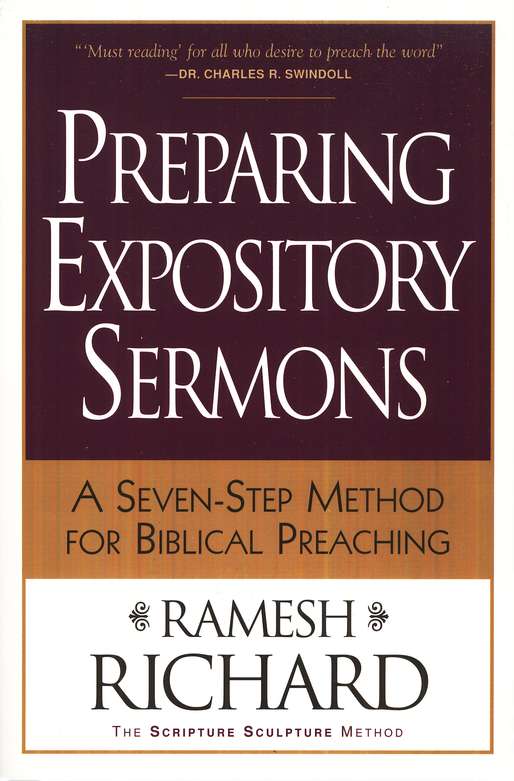
Ramesh Richard teaches preaching at Dallas Seminary as well as around the world in a noteworthy international ministry. His cross-cultural training and ministry experience gives his book a good level of sensitivity to preaching in various settings and cultures.
As a student and successor of Haddon Robinson at Dallas, there is a clear mark of Haddon’s influence throughout. This book is a good introduction to sculpting sermons and is worth reading. However, for reasons noted below, I would place others higher on my list of best introductions to the subject.
The book itself is short, 140 pages before the appendices. It is nice to read a concise work, but at times the writing feels slightly overwhelming, with one example or teaching element after another. Richard takes the reader through seven steps of sermon preparation. The steps make good sense and are similar to the seven stages I use on this site (main differences in stages 1, 6 and 7).
Throughout the book I found strengths, and usually a “but” as well. For instance, in stage 2 the focus is on the structure of the text. This chapter is great at demonstrating content cues and structural markers in a text, but it is almost exclusively focused on individual verses. By having one verse on a page, as suggested, it is harder to focus on the flow of thought in a “chunk” of text. On several occasions Richard suggests handling the Bible one paragraph at a time, but there seems to be little attention given to narrative texts that may need multiple paragraphs for a whole plot. In fact, even in the appendix that deals with narrative texts specifically, the idea of “plot” is strangely absent.
Probably the strongest step in the process is the fourth step, the purpose bridge. This stage links the Bible study to the stages of sermon formation. As far as Richard is concerned, the author’s purpose influences the process sufficiently in the Bible study stages of 1-3, so that now at 4, the preaching purpose is the only concern. I would suggest the author’s purpose must be specifically discerned, rather than assuming it will be discovered in the Bible study process provided, and the author’s purpose should be the starting point for the modern preacher (who obviously can and will sometimes select a differing purpose for the contemporary audience).
Richard is essentially very deductive in approach. He allows for inductive sermon shapes, but it seems that each major point in any sermon should follow a deductive pattern with the stating of the point up front. This feels a little rigid.
The final 60 pages of the book are given to 13 appendices. These deal with issues that regularly come up in Scripture Sculpture seminars around the world. Strong appendices include one on the Holy Spirit’s role in preaching (a regular concern when people formally interact with the process for the first time), and another on understanding your audience (brief, but with some helpful comments on differing cultures). On the other hand, several of the appendices are relatively weak and have the feel of an information dump for things that didn’t fit in the text of the book. Appendix 5 on principilization contains non-stop warnings, but does little to instruct the reader how to avoid the pitfalls. Appendix 10 provides a sample sermon introduction, but I would assume this sermon was for seminary students, since the language used seems a little lofty for a typical church congregation – omni-function, self-deification, apokalypsis.
For people wishing to have a book that gives a detailed step-by-step process for sculpting a sermon from an epistolary text, this would be a decent option. For those who, like me, are perpetual students of preaching, then this does contain much to commend it. Yet as a practical introduction to expository preaching, I would recommend others, such as Robinson and Sunukjian, above Richard.
(Ramesh Richard also has a book on preparing evangelistic sermons, which I suspect would be a very worthwhile read.)
 Biblical Preaching