 In the UK we have both a theory and a practical driving test. In life, the Bible only offers us the latter. So is living the Christian life primarily about what you know, or about who you know? Today’s post is over on Cor Deo – click here to go there.
Religion
Saturday Short Thought: Fresh Over Abundance from a Can
 This week the blog has been pondering issues of recycling sermonic materials and also recycling other peoples’ materials. Meanwhile we’ve welcomed a healthy baby daughter into our home and we are both thankful to our gracious Lord and very tired! So just a short thought to finish off the week.
I understand the challenge faced by many preachers with other work commitments and family priorities. I understand the feeling that some express, namely, that without borrowing the outlines and sermons of other preachers from the internet, they would never be able to preach a sermon on a Sunday.
Just as we close the week out, I’d like to offer an encouragement. Even if you are limited for time and feel unable to do the work of fully developing a sermon for your listeners, consider not taking the short-cut of outline borrowing or sermon lifting. Even if you are only able to develop what feels like an inadequate sermon for Sunday, try it anyway (how about next week?)
I suspect your listeners would prefer to feed on the real food of your Bible study in preparation than the canned contents of some internet repository. Your intro may be weak, your conclusion may be unsophisticated, your illustrations may be lacking, your outline may be undeveloped and your main idea might be just plain, well, plain.
But if your heart has engaged with God’s in prayer for theirs, and you have spent time with the Lord pondering how to present this text with relevance emphasised, then your listeners will be better fed than if you offer a sophisticated super-sermon that is not your own.
When we have guests, it is always hard to serve less than an adundant feast. But the truth is, visitors would rather have home cooked food than an abundant but canned meal.
You will also find that with regular practice, the process becomes more manageable, even on a very limited time budget. Let’s go for fresh over canned, for the sake of souls: both ours and our listeners’.


Eco-Preaching: Recycling and Plagiarism
 We live in an age of unprecedented access to information. Cut and Paste was a hassle until a few years ago. Now there is endless resource online just sitting there ready to be plagiarized. At the same time, preachers face the pressure of busy lives. And then there’s the pressure to live up to the impressive and often carefully edited sermons of the superstar preachers that everyone can listen to all week. It’s a recipe for plagiarism.
There’s plenty on this subject online already, so I’ll just offer a few thoughts on recycling content that is not our own:
1. As ministers of God’s Word, we should have higher standards than academics and journalists (and they can lose their jobs over it). Sadly, some act as if everything is fair game for cutting, pasting and preaching as if it is personal work.
2. Oral communication doesn’t require, and cannot support, the tedious footnoting needed in academic work. But it does need integrity. If I’m quoting the words of someone else, I mustn’t give the sense that they are my own. Last Sunday, for several reasons, I quoted “a great figure from church history” (and was fully prepared for people to ask who that was after the message).
3. Appropriately using a well-turned phrase or a helpful illustration as part of a message that is unequivocally yours is not the same thing as lifting a whole outline or sermon and preaching it as if it were your own. The latter is stealing intellectual property, it is deceitful toward your listeners, and it is cheating both yourself and others due to your lack of time in prayerful biblical preparation.
4. First person illustrations from someone else should not be shared in the first person. If it didn’t happen to you, and you give the impression that it did, you are lying.
5. Inasmuch as I’ve tried to be clear here, we need wisdom since there is so much that is unclear in this issue. May our wisdom be thoroughly shaped by the good character of the God we represent as we preach!


Eco-Preaching: 5 Dangers of Recycling Sermons
 Yesterday I offered five potential benefits of recycling sermons. Now let’s consider five dangers:
1. Personal stagnation. John Wesley is widely credited with saying “Once in seven years I burn all my sermons; for it is a shame if I cannot write better sermons now than I did seven years ago.” (Apparently, though, he was quoting another preacher, and disagreeing with him. We need to be careful when we recycle quotes!) But there is a validity to the sentiment expressed by whoever it was. If I always recycle the same message, I am missing out on all the growth of personal, devotional, spiritual biblical study and application, as well as the blessing of praying through new messages (since repetition of “successful” messages could lead to complacency and trust in the message rather than God).
2. Ministry burnout. Too much recycling can lead to a dangerous equation. An increase in activity (if I recycle I can preach in every possible gap in the schedule), combined with a decrease in personal feeding (since I can recycle in the wrong way without any time in God’s Word or presence), will lead toward burnout. Easy to be a firework in ministry.
3. Preaching thin. I mentioned this in passing the other day. When I prepare over several days and then preach a message, the message is much more than the outline or notes I record at the time. It is actually more than even the message I record and have on record as an audio file. There is also all the wealth of exegetical study, the supporting biblical content that didn’t make it into the message, but was fresh in my heart at the time of preaching. Returning to that message in the future means returning to a skeleton of the original. I am in danger of preaching “thin” – without the wealth of supporting materials.
4. Loss of attention. If the listeners get the sense that this is old material, rather than being a message from God for them, today, in particular, then the level of attention invariably drops. They will be subconsciously tempted to evaluate your performance, rather than listening for God’s message to their hearts. If it is recycled, it must be prayerfully re-prepared for them – don’t dump leftovers from the fridge, serve them with care! I know the various stories of “I’ll repeat the message until you act on it!” – but the truth is that it is much easier to be bold in an anecdote.
5. Loss of integrity. If the content you are recycling is not your own, then you lose integrity. More on plagiarism tomorrow!
Eco-Preaching: 5 Benefits of Recycling Sermons
 Here are five potential benefits that can come from recycling sermons. Not every one will apply to every situation, nor will every one always be a benefit. Please apply wisdom and balance this post with tomorrow’s post on the dangers of recycling sermons!
1. Time. Time is a valuable commodity. If I committed to never recycling a sermon, then I would have to take on a significantly lower amount of preaching in venues other than my local church. It can be a privilege to serve another group with a recycled sermon that doesn’t require me to sacrifice my main ministry commitments or my family.
2. Greater conviction. The first time a message is preached, it may only have a few days to saturate the heart and life of the preacher. If that message is recycled prayerfully and honestly, then the reworking of the text and the re-preaching of the message can allow the truth of it to penetrate deeper into the preacher’s life. This is not the case when a sermon becomes a mere performance through prayerless and heartless repetition. Sometimes I will listen to a message again, allowing it to minister to me, as part of my preparation to preach the same basic message.
3. Better message. If point 2 suggests that recycling can lead to a better preacher, then this point suggests the possibility of a better message. By prayerfully reviewing the first presentation, and by working further on both text and message, the recycled sermon can be a better one that its predecessor.
4. Offering our best. Let’s say a preacher is invited to preach as a guest somewhere. While it may be fair to critique itinerant preachers with their single polished gem of a sermon, there is also something to be said for a preacher offering their best. So for example, a younger preacher may have far better training and study in one particular book – why impose the requirement of preaching from a completely new section every time? I’d rather hear a preacher handling a text well than struggling through something that is new to them. If a sermon has been prepared well and it was worth saying once, why wouldn’t it be worth saying again (if refreshed, see yesterday’s post).
5. Reinforcement. I am sure we are too quick to move on in our preaching. That is, people need reinforcement. Typically this will come from thematic reinforcement from multiple messages, but perhaps there is a place for going back over familiar ground. People don’t tend to transform instantly, so why not recycle in the same venue (again, only if refreshed!)


Eco-Preaching: Recycled Sermons Must Be Refreshed
 I don’t believe a preacher should pull out an old sermon and just preach it, unless the invitation to preach was five seconds before the sermon slot. Any longer notice and the preacher should be prayerfully refreshing the message.
Undoubtedly, a recycled sermon takes less preparation time than a sermon from scratch on a passage previously never preached. But my suggestion, if you are preparing to re-preach an old sermon, would be to follow a process along these lines:
1. Prayerfully consider the text itself before looking at the old notes or outline. Even if you only have time for a brief engagement with the text, there needs to be a freshness about your approach to it, even if the end result remains the same in terms of message outline and details (since the passage does communicate something specific, and that, at one level, does not change). Be sure to feel the impact of the text on your heart as you pray through it.
2. Prayerfully consider the specifics of this occasion before looking at the old notes or outline. It is good to get a clear image of who the message will be preached to on this occasion. What are their circumstances, what are their needs?
3. Prayerfully walk through the whole passage preparation process as you reconsider the previously preached sermon (or ideally, your old exegetical notes). Why are you selecting this text? What are the pertinent elements of exegesis that should drive your understanding of this text? What do you now think was the author’s purpose in writing this text? Is that main idea still the best summary you can make of this text? You may find that your interim growth and biblical studies have changed your level of understanding so that you start tweaking your old passage or study notes. If you only look at the end product (outline, notes, etc.) then you are preaching without the richness of the exegesis that didn’t make it into the notes, but was fresh on your heart.
4. Prayerfully walk through the message preparation process as you reconsider the old sermon. What is your message purpose this time, this congregation, this occasion? Can you improve the message idea to fit this particular preaching event, or to better reflect the text’s idea? Is your old outline the most effective idea delivery strategy? Do the details of introduction, conclusion and “illustrative materials” fit? You may well find that the message also changes in some ways.
5. If at all possible, prayerfully preach it through out loud. Listeners can spot a stale notes-dependent presentation. Just because it looks ok on paper, does not mean it can be preached with freshness from your heart and mouth. Run through it and prayerfully “own it” again.
This may seem like a lot of work, but actually I could do this process in less than a couple of hours (plus the run through of step 5). This is a lot less time than a full sermon from scratch, and as we’ll see tomorrow, time saving is not the only benefit.


Eco-Preaching: Ever Old, Always New
 This week I’d like to go green and consider the notion of recycling sermons. We’ll touch on different aspects of this broad subject over the next few days (although there may be a quiet day or two as we have a baby imminently joining the family!) To get us started, two fundamental thoughts:
Ever Old – Every sermon we preach is made of recycled materials. All of us are standing on the shoulders of the giants who’ve gone before us (and sadly some are standing on the shoulders of non-giants too). If I stop to think about it, as I prepare a message, I am in the debt of so many people, and I never have new source material.
Ever Old Influences: As I think about yesterday’s two messages, there are too many influences to name. My mind scans over the preachers I have heard over the years, the professors at seminary who taught me how to handle the Bible, who taught through those particular books in survey or exegesis courses, who taught me the languages, who taught me homiletics and theology and pastoral ministry, etc. I think of the conversation partners I turned to in the form of commentaries, and the footnotes attest to some of those that influenced them. I could go on, but you see my point. I’ve preached hundreds of messages, probably into the thousands, and it would be a bit self-aggrandizing to suggest that I have generated more than a few truly original thoughts.
Ever Old Material: While I pulled out a few illustrative elements for yesterday (and didn’t look them up in an anthology of distant impersonal illustrations), the bulk of the material was the Word of God.We must be ever wary of the temptation to think our thoughts, be they original or probably not, are somehow better source material than the ever living Word of God! Yesterday in the course of my preaching I returned to texts that I’ve preached in this church in the past year, and without apology. We need to hear God’s Word.
Always New – Every sermon we preach is new. The text of Scripture doesn’t change, but everything else does. The preacher can never stand still. Either the preacher has grown, or the preacher has stagnated and changed negatively, but life never stands still. Two congregations can never be the same in constituents or their circumstances, even if it is the same church. The situation is always fresh. Different preacher, different listeners, different occasion, different set of needs. I suppose, in theory, I could preach the same text in the same church once a month for the next several years and never preach an identical sermon.
Tomorrow we’ll probe a bit beyond this foundational level as we seek to be good stewards of a preaching ministry.
Saturday Short Thought: Concluding Chronicles and Biblical Theology
 Over the past three weeks I have been preaching a series in 2Chronicles 26-36, which is effectively the end of the Hebrew canon (in the typical Jewish ordering of books), and the conclusion of the backwards looking summary of the Old Testament. Because my wife is expecting any day, I am uncertain of being able to preach tomorrow, and so made sure I finished the series last week. But I now have (potentially) another two messages in the series tomorrow since the baby seems to be comfortable where it is.
This leaves me in the nice position of being finished with the series, yet not finished. My plan is to allow an aspect of Biblical theology to put the finishing touches on the series. Let me explain.
One of the big themes in the last chapters of Chronicles is that of the devotion of the kings to the Lord. Some were, some weren’t. And the biggest manifestation in pre-exile Israel lay in the issue of overt idolatry. As the book ends, hope dawns with Cyrus’ decree that the temple should be rebuilt. Perhaps God’s promise to David will be fulfilled after all?
So in the progression of revelation, we move to a post-exilic Israel where overt idolatry was never a feature again. Historically we see this determination for purity in books like Ezra and Nehemiah, but canonically, the next step from Chronicles is Matthew. It’s a new world in Israel in Jesus’ day. No physical idols. But no idols?
Jesus addresses the issue of the less tangible idolatry of his day in the Sermon on the Mount. And the beauty of this is that Matthew 6 speaks so directly to our, typically non-physical idol, cultural setting. In post-exilic Israel, as in the modern Western world, money has become the “ba’al” for many. Yet the issue of our devotion to God remains paramount. Who is bigger in our eyes? The false god, indeed the replacement god of financial security, or the true God who really cares?
So maybe I will get to preach Matthew 6 tomorrow to finish the Chronicles series. Maybe I’ll get to push further into the New Testament and consider other areas of covert idolatry facing believers today. Or maybe I won’t!
___________________________________________
Next Week? Eco-Preaching: Recycling Sermons
Be Quick to Look, Slow to Decide
 This week we began another season of Cor Deo – a small group of people longing to know God more and grow closer to Him. We had some great discussions, studied some wonderful passages and enjoyed getting to know each other. One discussion moment was the highlight of the week for me. A passage was raised and considered. The more we looked at it, the more it opened up for us.
Here’s the thing. If we had looked at just the particular verse, even a good few minutes of studying it wouldn’t have been enough. We had to look at the surrounding context. By the end of our time in that passage, my own view of it had changed significantly. But we could have easily misunderstood the verse, even with our initial reading the context.
As we look at any passage in the Bible, we must be quick to look and slow to decide.
Quick to look at context – This is not the same as looking quickly at context. What is going on before and after the passage? What is the tone of the section? What is the flow of the section? In the case of the verse we were considering, it began an apparently new section in the epistle, but we had to go back and see what came before or we would have misunderstood it.
Quick to look at connectives – The flow of the text depends, in part, on the author’s use of “for” and “therefore” and “so” and “and”, etc. Little words that make a big difference. In this case I continued to ponder the passage after others were off into broader context, and looking at the connectives I started to ponder the structure.
Quick to look at syntax – What was the structure of that paragraph? What is the dominant thought and what is subordinate/supportive? Phrase by phrase, how does it work?
Slow to decide – Without the extra looking and being open to learning about the flow and structure of the immediate context, our target verse would have been essentially misunderstood. Every one of us had an automatic sense about the verse, but careful observation proved that our sense was wrong. I am so glad for that reminder of the importance of being quick to look, but slow to decide. I’d hate to have preached it the way that seemed obvious from first reading, when in fact the whole tone of the text is almost a polar opposite!

Stuck in the Mud
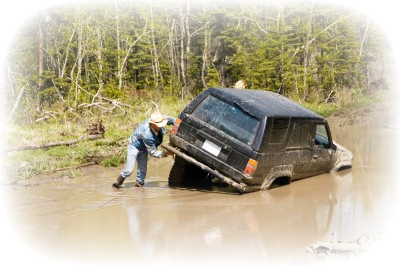 Some sermons seem to get stuck.
Some that I preach. Some that others preach. The sermon is moving along well, perhaps moving at a decent pace through a text, engaging and interesting, then suddenly, the sermon seems to go into thick mud. Suddenly the momentum is lost and the experience for preacher and listener alike changes significantly.
Why does this happen? The message is following the standard guidelines for sermons. The text is being explained, the relevance is being emphasized, illustrative material is helping listeners see the message clearly, etc. But momentum drains away and progress becomes elusive and there is a struggle on for the next ten to fifteen minutes as the sermon simply seems to stand still.
I was observing this recently from the listener’s side. It seemed that at a certain point in the journey through the message, the momentum stopped and we felt like we were spinning our wheels. Restatement. Repetition. Illustration. Repetition. Illustration. But no progress.
Have you experienced this phenomena? What would you suggest to avoid it happening? I’d suggest we look at the outline or manuscript and prayerfully evaluate it for progress and momentum, as well as for content and clarity. While a third illustration under the same point may compound the clarity, it might also feel like an anchor keeping the sermon from arriving at its destination.
I’d also suggest prayerfully preaching through a sermon to experience it through your own ears. Sometimes sermons look perfect on paper, but in reality simply don’t “come out well.”
One more suggestion – when it happens, take the time to evaluate why it happened and try to learn from you (or someone else’s) mistake. The tendency is to flee the scene of what feels like a sermonic flop, but perhaps there is more to learn there than when a sermon’s momentum was faultless.
How do you make sure your message keeps moving?

 Biblical Preaching