God’s Representative

I’ve only had one job with an official uniform. Whenever I wore it, I knew I was representing the company.  People would see me doing my job and they would see the whole company.  If I left a positive impression, the company benefitted.  If I didn’t, it didn’t.

Preacher, you represent God.  And I’m not primarily concerned about what clothes you wear.  I am referring to what demeanour you wear, what character you wear, etc.

Since this post is just sent out into the ether, can I be blunt?  Some preachers seem to not know the God that I know through His Word.  At least, if they do know Him, it doesn’t show.  Hang on, let’s stay blunt – it should show.

Some preachers minister to a church just by being there.  Somehow their interactions are genuinely caring, their demeanour reflects a God who is relational, their manner reflects a gospel that is good news, their lives reflect a relationship with a God who changes us from the inside out.  Others don’t.

I think it is vitally important to communicate the meaning of a text as accurately as possible.  But I know that communication includes more than the words used to explain the passage.

Communication includes demeanour, smile, manner, personality, body language and vocal tone.  When Jesus spoke, broken and sinful and needy people were drawn to him.  When Jesus spoke, only the hyper-religious seemed to get upset.  When some of us speak, it seems like only the hyper-religious can connect.  Surely this ought not to be?

Take for example, how moody God is.  I hope you’re thinking He’s not moody.  But some people preach as if He were – sometimes He is in a loving mood, sometimes He’s in an angry mood.  Surely if we read the Bible carefully we’ll see that God is love, which can help explain some of the tougher sections.  He isn’t wrath, which must then “balance” the loving side.

Should we therefore not preach judgment sections, or rebuke sections?  Of course we should, but perhaps we’d be closer to God’s heart if we were to preach through tears rather than clenched teeth?

When we stand to preach from God’s Word, whether we like it or not, whether we know we’re inadequate or not, we are representing God – a personal God, a God who has revealed Himself, His heart, His values.  We represent Him.  Do we represent Him accurately?

Add to FacebookAdd to DiggAdd to Del.icio.usAdd to StumbleuponAdd to RedditAdd to BlinklistAdd to TwitterAdd to TechnoratiAdd to Yahoo BuzzAdd to NewsvineLike This!

Canonical Representation

Yesterday I pondered the nature of the preaching event as representing the text being preached. Let’s push that further.  My sermon this coming weekend needs to also represent the whole of the canon.

This doesn’t mean that I need to try to cram in the whole of the canon.  I have observed some preachers who seem convinced their role is to quote as many different books as possible.  I counted 25 out of 27 New Testament books in one sermon – that was quite a feat (or ordeal, depending on your perspective!)

There is value in showing how your passage fits in the whole, especially when earlier themes are feeding into the preaching passage, or when it offers a sense of anticipation that needs to be followed through.  There is value in helping people see how the whole story of the Bible flows.  (It is worth saying that there are also reasons to stay focused where you are – it is much easier to go on a wild safari in the back seat of a concordance than it is to clearly go below the surface in your specific passage.)

So this weekend, whether I refer to other passages or not, I need to remember that I am representing the whole canon.

This means the God of my message shouldn’t come across as if our only revelation were this specific passage.  How sad to preach a passage and leave listeners with the sense that God is petty, or nasty, or soft, or distant, or whatever.  This passage is one piece of a bigger whole that we represent as we preach.

This means that the whole scope of God’s plan shouldn’t come across as being simplistic – it’s all about me and my forgiveness, or it’s all about us and our salvation.  Paul warned the church in Rome not to become arrogant through a simplistic salvation model.

We should neither automatically cross-reference, nor always stay only within our passage.  We need wisdom to choose how overtly we engage the rest of the canon.  But the fact remains, we represent the whole Bible as we preach a part of it.

Add to FacebookAdd to DiggAdd to Del.icio.usAdd to StumbleuponAdd to RedditAdd to BlinklistAdd to TwitterAdd to TechnoratiAdd to Yahoo BuzzAdd to NewsvineLike This!

Representing!

I always get nervous when the preacher is the centre of attention.

In a sense it is inevitable that the preacher will be focused on – the preacher is the one taking the risks inherent in putting your head over the parapet, standing there for half an hour and baring both your understanding and your life.  We shouldn’t wonder when people use us for target practice or to roast over Sunday dinner.

However I do get nervous when the preacher either courts or seems to settle into being the centre of attention.  Our flesh will naturally thrive on any pride-fodder.  That could be the “visiting man of God” mentality that pervades some cultures and is offered to the preacher, or the “specially called” mentality that seems to ooze from some preachers.

The reality is that it is not the preacher’s masterpiece based on a text that should be the focus, nor the preacher as a masterpiece of God’s handiwork (although the extent of God’s work in a life usually does show).  The preacher and the sermon function as representatives, not as figures of interest in their own right.  I’d like to chase that idea a bit for a few days.

Let’s start with the sermon itself.  As I’ve written before, a sermon shouldn’t just begin with a text, or bounce off a text, or even be based on a text.  The sermon should really re-present the text.

Obviously the preacher will bring strengths of explanation and presentation, and the profile of the listeners should shape the targeting of that text.  Nevertheless, the preacher’s task is not just to say what the text says, but also to do what the text does.

The text isn’t a mere repository of information or sermonic illustration, it is a fully inspired section of God’s Word.  So the preacher should be so gripped by it that there is a yearning to bring across that text with its full force.

I can’t imagine the churches Paul wrote to receiving his letter, reading it out and then going on as if nothing had happened.  I’m sure those writings stirred response.  How sad that so often sermons based on those texts have somehow failed to represent them adequately.  How sad to see people walking out of a church apparently untouched by the text presented, viewing the sermon as a required duty of church practice (and quiet listening as a required duty of good Christians).

As we preach a Bible text, let’s keep in mind that the sermon event – both the message and the preacher, are representing that passage to these people.

Add to FacebookAdd to DiggAdd to Del.icio.usAdd to StumbleuponAdd to RedditAdd to BlinklistAdd to TwitterAdd to TechnoratiAdd to Yahoo BuzzAdd to NewsvineLike This!

Preaching Triangle & Touching a Nerve

This week in Cor Deo I had the chance to give an hour’s introduction to Ezekiel.  A brief look at chapter 28 in our sweeping overview allowed a glimpse of the message to the “King of Tyre” and a chance to ponder the fall of Lucifer through a heart corrupted by a self-ward gaze.

I suspect the enemy isn’t overly concerned by some Christian preaching.  You know, the kind that offers a sanctified version of Genesis 3.  You can be independent, you can be successful, you can be like your own god, you can be equipped for a self-concerned life.  Whether it is evangelistic (you can get yourself the best future for you, here’s a ticket to a nice heaven password) or edificatory (you can be an independent success story, just look to yourself and do these things)…I suspect the enemy isn’t too bothered.

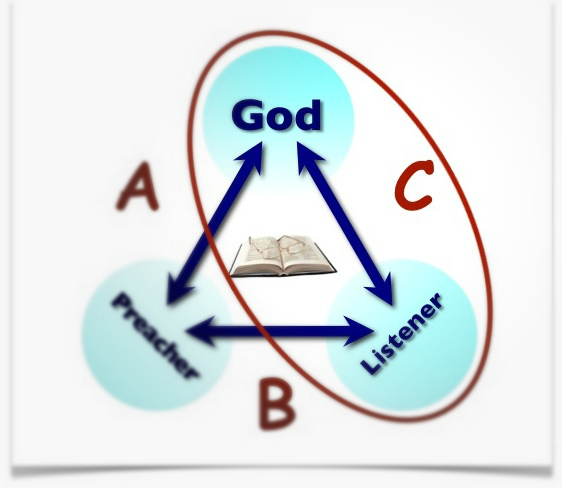
But what if a preacher catches on to the Preaching Triangle reality of interdependence?  The preacher’s own dependence on God in a love relationship, then a shared concern for the listeners to become reliant on God in a love relationship, manifesting in preaching that seeks to forge connections between listeners and preacher, and more importantly, God.  This be fighting talk from the perspective of the enemy of our souls!

Interesting how the verses that jump to mind seem to support this post.  Resist the devil and persist in being right and doing good?  No, resist the devil and draw near to God (in the context of broken relationships, friendship with the world, the jealousy of God over the Spirit made to dwell in us, humble dependence on God).  The devil prowls around like a roaring lion, so resist him and do right in yourself?  No, resist, recognize the experience of your brothers around the world, look to God to restore, confirm, strengthen, etc., which is why in humility we should cast our cares on the God who cares for us.

But what about the armour of God, that is all about individual response isn’t it?  Oh hang on, a key part is praying at all times in the Spirit, and they were to be praying for Paul too.  Never mind.  One more?  The god of this age has blinded the minds to keep folks from seeing the light of the good news of the glory of Christ, the image of God, so how did Paul preach?  Take a look at 2Cor.4 and see his dependence on God and self-giving for them . . . preaching triangle in the context of a great spiritual battle.

Do not lose heart.  Real relationally driven preaching will touch a nerve with the enemy, but the solution can never be a retreat into non-relational solitude, that’s just his way.

Add to FacebookAdd to DiggAdd to Del.icio.usAdd to StumbleuponAdd to RedditAdd to BlinklistAdd to TwitterAdd to TechnoratiAdd to Yahoo BuzzAdd to NewsvineLike This!

Other Gods and the Preaching Triangle

Yesterday I suggested only a genuinely Trinitarian view of God can make sense of the relational nature of the Preaching Triangle.  What would it look like with other Christian versions of God?

First, a God who is primarily and essentially alone can think only of Himself.  The thread of self-glorification would sour the relationships and make the whole circuit somewhat duty oriented, the delight would be sapped.  The preacher would be information-oriented and have a tendency toward a pressurizing manner as they preach.

At the same time, both the preacher and the listener would feel a tension between seeking the good of others in obedience to that command, while there is an under-tow of self-orientation in the God who drives the whole for His own self-honouring.  Both preacher and listeners might be drawn toward pursuit of Christianity for self-oriented goals.  There would probably be a different tone of relationship at every level – between the people and God, between the authoritian preacher and the dutiful listeners, etc.

Second, a God who is primarily and essentially unknowable would not make self-revelation the centre-piece of Christian ministry.  Instead any preaching model would pay little attention to the Bible, perhaps using it to stir an experience in the listener that doesn’t have integrity with the actual meaning of the text.  Perhaps it would be downplayed for the sake of the experience of worship so that the emphasis would be on some kind of encounter beyond revelation, rather than an encounter with a knowable God by means of His Word.

Has God made himself known, or are we to chase a mystical indescribable experience?  If the latter be the case, then the Bible would diminish in the triangle, and the preacher would be both elevated and diminished at the same time.  Elevated to the status of unique channel of spiritual power through which listeners might access the special experience.  Diminished because the communication of God’s Word isn’t really that critical in this type of Christianity (so I’d expect the preacher to offer unique benefits other than good biblical preaching in order to maintain their own import).

These brief critiques of two common false views of God assume that a relational view of preaching is accurate.  If either of these views of God were accurate, then the preaching triangle would be inherently different.  Much more authoritarian and less relational in the first case.  Much less content oriented and experiential in the second.

If our experience of preaching ministry is closer to the two critiques just offered, perhaps we need to revisit our view of God.  Which Christian version of God is shaping our preaching ministry, really?

Add to FacebookAdd to DiggAdd to Del.icio.usAdd to StumbleuponAdd to RedditAdd to BlinklistAdd to TwitterAdd to TechnoratiAdd to Yahoo BuzzAdd to NewsvineLike This!

God and God

This week I have been pondering the possibilities inherent in the relationships around the preaching triangle.  God and preacher, preacher and listener, listener and God.  I have certainly found it a stir in my own heart.  But as always, our view of God is profoundly significant here.

What kind of a God instigates this powerful circuit of relational connections?

Surely only a clearly Trinitarian God makes any sense here?

1. It takes the kind of God who exists in mutual delight to create the people, to birth the church, to shape the ministry in such a relationally delightful way.

2. It takes the kind of God who delights to communicate in a self-giving and other-centred way to make sense of the rich benefit for the preacher in their personal connection with God, or to make sense of the preacher giving themselves away in a non-self-protective nor self-serving ministry to listeners, or to result in an other-ward goodness-spilling dynamic among listeners.

3. It takes the kind of God who knows how to communicate effectively to make the Bible such a wonderful and vital book in each of the preaching relationships – a book that speaks engagingly to the heart of the preacher with every increasing profundity, a book that offers such rich variety and engaging diversity to allow a preaching ministry to not grow stale, a book that can be read with delight and benefit by the least trained new believer.

4. It takes the kind of God who knows the richness of community to leave us with a ministry model that creates communities on every side – communities of care, communities of responsiveness, communities of delight and service.

Other Christian versions of God simply don’t make sense of the Preaching Triangle.  If God were not genuinely Trinitarian, the preaching triangle would surely look different.  Tomorrow I’ll ponder a couple of possible alternatives.

Add to FacebookAdd to DiggAdd to Del.icio.usAdd to StumbleuponAdd to RedditAdd to BlinklistAdd to TwitterAdd to TechnoratiAdd to Yahoo BuzzAdd to NewsvineLike This!

Listener and God

In many ways the goal of preaching is this relationship, the listener and God.  We’ve already considered God and the Preacher, the Preacher and the Listener, but now for the third relationship.  As ever, dangers and potential.

1. There is a danger that the listeners connect with the preacher, but not with God, due to the effectiveness of communication that inherently lacks the richness of biblical content.

2. There is a danger that the listeners connect with the preacher, but not with God, due to the richness of biblical content that comes from and to deficient relationships with God (i.e. the preacher’s and the listeners’), to put this differently:

3. There is a danger that God’s personal care and concern and self-revelation not get through the preacher to the listeners.

4. There is a danger that the God presented by the preacher may motivate distance rather than intimacy and thereby hinder true connection.

5. There is a danger that the preacher’s goal be an equipped and informed listener who can then become a “self-made” or “self-starting” Christian (beware of application not built on response to and relationship with God).

But what potential!

First, can there be a greater thrill than to see others growing into a deeply forged relational responsiveness to a loving God?  Does it get any better than seeing others flourish spiritually as they discover the fullness of life offered in the New Covenant where they can actually know God personally?

Second, when people have a genuine relationship growing with God, then it will mean an increase in outward spilling and spreading goodness.  Why should that not result in blessing for the preacher?  While we don’t preach for that benefit, it would make sense in a community of captivated Christians, for preaching to forge a community of mutual delight – God in them and them in God and both in the preacher, etc.  Sadly the relationship between preacher and listeners is too often fraught with the tensions of world-like political power struggles and distrust, but what if the gospel really gripped a church, surely it would be different?

Furthermore, that outward spilling goodness would also mean mutual body life as listeners naturally minister by giving of themselves to each other.

It doesn’t end there, the spill of grace would then surely also reach outward again to the community (and that without the preacher pressuring people to be witnesses!)  That’s the thing about God’s relational bond, it doesn’t end there, it just keeps on spilling outward!

Add to FacebookAdd to DiggAdd to Del.icio.usAdd to StumbleuponAdd to RedditAdd to BlinklistAdd to TwitterAdd to TechnoratiAdd to Yahoo BuzzAdd to NewsvineLike This!

Preacher and Listener

In preaching, every participant matters and every relationship matters.  Yesterday we looked at the God/Preacher bond.  Now let’s consider the Preacher and the Listener.  Again, dangers and potential!

1. There is a danger that the preacher will create too much distance through a knowledgeable authority that isn’t balanced with vulnerability and spirituality, leading to disconnect from the listener.

2. There is a danger that the preacher will collapse themselves too far into the listener’s situation by a reverse of number 1 and have nothing of value to offer from God’s Word.

3. There is a danger that the Bible will not be seen as a means of hearing God’s heart, but as a weapon to be brandished in berating the listener, or as a curio that offers mere speculation to all present (including, and led by, the preacher).

4. There is a danger that the spiritual nature of preaching will lead to the preacher failing to value the interpersonal communication at the core of preaching – the value of the smile, of eye contact, of vocal tone and variation, of gesture, etc.

5. There is a danger that the preacher will resist performance and somehow also fail to value the interpersonal connection formed in preaching – both in vulnerability and personal elements of content, and in delivery aspects such as warmth and energy.

But what potential!

The preacher has the privilege of standing in the midst of God’s people and yet leading them in responsiveness toward a God who delights to stir hearts through His self-revelation in the Word.  Sometimes a church will refer to a worship leader as the lead worshipper.  The preacher is the lead responder to God’s Word.  The preacher doesn’t stand outside the gathering of listeners, but in their midst.  Yet the preacher stands there with a word from a communicating God.  Can it get any better than this, to be playing a key role in a community of responsiveness toward a loving God?

Add to FacebookAdd to DiggAdd to Del.icio.usAdd to StumbleuponAdd to RedditAdd to BlinklistAdd to TwitterAdd to TechnoratiAdd to Yahoo BuzzAdd to NewsvineLike This!

God and Preacher

Last week I introduced the Preaching Triangle.  Every participant matters.  Every relationship matters.  I’d like to develop the three relationships, starting with God and the Preacher.  Five inherent dangers, but what potential!

1. There is a danger that the preacher’s gaze will be on the Bible rather than God, that is…

2. There is a danger that the preacher’s focus will be on finding a message, rather than hearing God’s heart in the Bible.

3. There is a danger that the preacher’s strength might come from somewhere other than this relationship, which means the ministry will drain personal resources and lead toward burnout.

4. There is a danger that the ministry will reflect a personal agenda rather than God’s values.

5. There is a danger that the ministry will pursue a personal goal, rather than seeking God’s.

But what potential!  

First, to be cared for and ministered to by God Himself.  Martha needed to learn what Mary demonstrated – the privilege of sitting at the feet of our loving Lord that He might minister to us first, so that we might then minister to others.  We cannot love God by loving others with any lasting consistency.  Loving God by listening to Him must come first.  Enjoying the privilege of the intimate relationship that the Bible describes in the most intimate of terms: a friend of God, a brother of Christ, a child of Abba, the temple of the Spirit, the body, the bride, I could go on.

Second, to join with God in a community of carers looking outward to others.  “As the Father sent me, so I send you. . . Do you love me?  Then feed my sheep, tend my lambs.”  What a privilege it is, in the midst of the tensions and challenges of church ministry, to remember that we are privileged to participate in God’s work of soul-care.  Apart from Him we can do nothing, yet we are invited to join in, to serve and give together with a serving giving God!

Add to FacebookAdd to DiggAdd to Del.icio.usAdd to StumbleuponAdd to RedditAdd to BlinklistAdd to TwitterAdd to TechnoratiAdd to Yahoo BuzzAdd to NewsvineLike This!