Preaching Myths #7 – Sawn-Off Concordance

myth2Just coming at this from another angle, but one I’ve touched on before:

“Listeners are impressed with, and helped by, a blast of Scriptural cross-referencing diversity – it breeds confidence, assurance, awareness and whole-counsel-health.”

This thinking is fairly common.  Preachers assume that listeners will benefit from multiplied cross-referencing because it will give them confidence in the preacher’s knowledge, assurance of biblical truth, awareness of the big picture of the canon and health from receiving the whole counsel of God.

I do not want to say that the preacher should only ever preach from a single text and never cross-reference.  There are times when it is helpful.  For instance, if the main idea of the preaching text seems unusual, it may help to show the same idea elsewhere in the Bible.  For another instance, if the main preaching text is built on, or anticipates another biblical passage, it may be helpful to go there and show the link.

Also there are times when the message is built on multiple texts, as in a topical exposition, or when the message is tracing a biblical theme.

But there is a difference between a message that picks off key passages like an accurate sniper and a message that feels like the preacher has hacked off the barrel of their concordance and aggressively pulled the trigger in your direction.

1. Listeners gain confidence in the preacher through the quality of Bible handling, not the quantity of texts momentarily touched.  Imagine being taken into a new city.  Would you prefer a knowledgeable guide who takes you to a particular point of interest, or even a select few, and then introduces you carefully and accurately to their history and significance.  Or would you prefer to drive around the city at break-neck speed with shouts of, “and there’s a house!  And there’s a phone-box-thingy!  Another house!  That’s the place that so and so had something to do with!  Another house!  Town hall!  House! . . . etc.”?  The latter approach tires people out, overwhelms them, and by no means generates confidence in the tour guide’s knowledge.

2. Listeners gain assurance of biblical truth by probing a text well, rather than briefly touching on multiplied texts.  Even if there is a need for a quick survey to underline a truth, it is a truth seen by careful consideration of a primary text.

3. Awareness of the whole canon comes from a tour of selected highlights that is reinforced carefully, rather than from a snapshot of texts wrenched from context.

4. Health does not come from a shower of vitamin pills, but from properly digesting a good balanced diet.  Give the listeners the whole counsel, but don’t just shower them with biblical cross-references every week.  They need to be able to digest what they are taught.  Since explaining and applying the text takes time, why steal from explanation or application by filling the message with the sideways energy of unnecessary cross-references?

As a default, stick in your text and preach it better, your listeners will be grateful and healthier as a result.  When you need to cross-reference, do so on purpose and judiciously.

Preaching Myths #6 – Evaluation Verboten

myth2Thankfully this is quite a rare one in my experience, but since it exists somewhere, let’s prod it towards its demise:

“If a preacher has prayerfully prepared, then that must have been what God wanted us to hear – i.e. don’t critique a preacher.”

First of all, there are things to commend this idea.  Roasting the preacher is entirely too easy and simply critiquing the message should not become a cover for not letting God’s Word work in our hearts.  Sometimes God will speak to a church through a message that makes people uncomfortable.

However, the idea that a preacher is above critique because they prayed in their preparation is a strange notion.  Here are some points to ponder:

1. Preaching is not about direct revelation, so the preacher’s prayer by no means guarantees that the preacher is in step with God’s Spirit when he preaches.

2. Evaluation and critique is not always a matter of personal preference.  There are ways to evaluate preaching.  Is the Bible accurately handled?  Is the message organized and presented clearly?  Is the preacher and the message engaging?  Does the truth of the Bible nuzzle deeply into the realities of our lives today?  These are not matters of subjective preference and personal taste.

3. Just because someone else affirms a message, this does not negate a fair negative evaluation.  In most congregations you will find someone who likes a poor preacher.  This does not make them a good preacher.

4. The leaders of the church are responsible for the diet of the church, even if the speaker is a visitor.  It is the job of the leadership to make sure that people do not get fed with poor, weak, dangerous or sub-Christian teaching.

5. Evaluation is necessary for improvement.  While you may choose not to invite a visiting speaker back based on evaluation, there is a positive value within the church.  If you preach regularly, evaluation can help you improve. Howard Hendricks critiqued the notion that practice makes perfect.  “Practice makes permanent.  Evaluated practice makes perfect.”

Every church leadership needs to carefully and prayerfully evaluate who is feeding the flock.  You cannot be careless in this and expect no negative consequences.  Evaluation is not some sort of ungodly judging of others, it is a necessary part of serving the church and always moving toward better stewardship of the privilege of church leadership.

Preaching Myths #5 – Short Talk Required

myth2People still like to wheel this one out:

“The current generation cannot concentrate as long as in the past, so reaching this generation requires shorter talks.”

Uh, no.  There is no evidence to support this.  People always like to cite the rapid-fire nature of contemporary TV, or they buy into the increasingly high-paced and frantic presentation at some youth events.  But what about other evidence?  Films are longer than ever – gone, it seems, are the days of 80 minute action films.  And of course, preachers popular with the younger generation are all only giving 12 minute mini-talks, right? I listen to a lot of 40 minute messages, and then there’s the folks attracting the younger generation with their 60 minute messages!

The evidence is not all stacked up in favour of bite-size preaching.

1. People could never concentrate for 30, 40 or 60 minutes years ago.  People have always been gripped and regripped by good preachers every few minutes.  People have always been bored to tears by dull and unengaging preachers.  10 minutes is far too long to tolerate some preachers, others can hold attention for an hour. 

2. Gripping content and effective delivery, combined with engaging persona and prayer-prepared people will add up to concentration.  Notice that it isn’t delivery alone.  Great content poorly delivered will always be an open invitation to mental drift.  But poor content delivered well will still lose you.

3. Concentration is not optional.  As a preacher you either keep people with you or go learn how to do it.  Preaching to drifted minds and distracted hearts is not acceptable.  Get their attention and keep it.  If they aren’t listening, and you are ok with that, what are you doing?  Please don’t preach just to fulfill some sense of obligation, or worse, for the money . . . preach to connect and communicate!

Whether you preach for 15 or 60 minutes next time, make sure it is appropriate to the occasion and the listeners, and then do everything you can to avoid the charge of going on too long – that is, make it so good that folks leave pondering the punch of the message, not the pain of its protraction.

Preaching Myths #4 – Non-Gospel Preaching

myth2How about this one?

“We should preach the gospel to unchurched folk, but give teaching to church people.”

I grew up going to two church services on a Sunday.  One was for the church people.  One was supposedly for the unchurched people.  This second service always included a sermon that was a basic gospel presentation.  Whether or not there actually were unchurched folk there is not the point.  6:30pm was the time for a gospel presentation.

But can we make, or indeed, should we make, such a strong distinction?  I am not convinced.  The reason is because I have heard enough preaching that is supposed to be “teaching” to realize that believers need gospel preaching more than something entirely different.

Too many have dumbed down the gospel to a transactional deal struck between God and the sinner at the point of conversion, which then recedes into the background as the new believer now learns to implement their responsibility with good moral teaching from the Bible.  Learn this lesson.  Apply this truth.  Heed this warning.  Follow this example.  But gospel-less instruction can really start to sound like something other than Christianity.

Paul warned the Galatians when they started to think there was something more for them than an ongoing application of the gospel.

What about meat?  Indeed, we should move on to meat instead of milk.  How meaty do you want your gospel?  But to move from gospel to something non-gospel is not progress, it is moving backwards into the fleshly world of religion.  This is why some preaching could easily pass for instruction in another religion . . . responsibility-preaching will always appeal to the flesh, but it won’t be Christian.  Some closing thoughts:

1. Preach the gospel to whoever is present, whatever stage of faith they may be at. The lost need it, and so do we.  But preach the full, clear gospel, not a paper thin pale reflection of the real deal.

2. Since the gospel is at the core of instruction for believers, this means that every week can be both teaching for the believers and accessible for visitors.  Special guest events can be great, but visitors may return the next Sunday, or they might even just show up on a random Sunday.  Make every week seeker-safe.

3. Beware of the false “meat” of heavyweight responsibility preaching, or purely informational educative preaching.  It seems more meaty to raise the bar and pressure people to perform better, or to edify their intellect through an educational presentation . . . but our biblical preaching should be driving the gospel deeper into a life, not taking people away from the gospel – that is never progress.

Preaching Myths #2 – Cool Preaching

myth2Here’s another idea that bounces around in various forms, but I think should be probed a bit:

“Cool preaching attracts people.”

This could be the thinking of church leaders who decide to go with a “cool preaching” option in order to seek growth.  Or it could be the critique of traditional church folks who are looking sideways at a different church which has a perceived “cool factor” and is growing faster than their church is.  When used as a critique, it tends to carry with it the implication that such a church must be dumbing down, softening, weakening, diluting or corrupting the gospel in some way.

Before critiquing the myth, I suppose both thoughts can be affirmed.  Some churches do make superficial style issues a driving factor in their growth strategies and in some cases it does seem to attract people (although any style may well put others off coming in the first place, even a contemporary style).

And indeed, some contemporary styled churches have weakened the gospel leading to shallow conversions and poor discipleship.  But let’s be fair here, some traditional styled churches have weakened the gospel leading to shallow conversions and poor discipleship too!  Sweeping generalizations about contemporary versus traditional are very naive.

So, does cool preaching attract people?  I would say that it might, but probably not.  The primary people who tend to be attracted to “cool Christianity” may well be Christians whose tradition store has become overstocked and they want to try something different.

Three thoughts:

1. Christ attracts people.  Re-read the gospels and notice how normal and broken people were so drawn to Jesus.

2. Christlike communities attract people.  If people are not drawn to Jesus today, it is probably because their exposure to his body is cluttered by other baggage and distraction.  A community being transformed by the love of God so that they love each other (like Christ) will spill outwards in love to the community (like Christ) and thereby be a magnet to broken people (like Christ).

3. Effective preaching engagingly communicates what matters.  Cool preaching without biblical substance is see through.  People may well see through “cool-empty” just as they may see through “traditional-empty” (although sadly there will be those who don’t see through one or the other).  So what then for our preaching?

 A. We must seek to get the substance right: the Bible offered engagingly, the gospel full and clear, and the presentation of God in Christ as clear as the incarnation requires.

B. We must seek to remove unnecessary obstacles: issues of delivery, packaging, presentation, and content need to be carefully evaluated to make sure that people are not choosing to walk away from the gospel because of something other than the gospel.

Being cool is not the goal in preaching, unless you are wanting to temporarily attract young disenchanted Christians.  Cool is really not the issue at all, but recognize that in your pursuit of best substance, obstacle-light preaching, you will probably be critiqued for being “cool” but shallow.  Make sure you’re not.

Preaching Myths #1 – Pew Trust

myth2I may not debunk these myths fully, but I do hope to make us think.  Here’s one:

“Put effort into a one-off evangelistic preaching event in your church and people will bring people.”

Many churches recognize the need for preaching (as well as everything else), to be targeted if unchurched folk are going to be interested and understand.  So periodically we might have an evangelistic “guest service” and encourage our people to bring people.  Some will.  But churches often struggle with why the majority won’t bring anyone.  Perhaps the non-guest-bringers are just not as committed?  Or perhaps it is something else altogether.  Could it be:

1. They don’t have any meaningful contact with non-Christians.  This is sadly too common.  Too many church folks either feel woefully incapable of meaningful spiritual conversation or they are so busy with church activities that they have no time for meaningful relationships with anyone else.

2. They are not motivated to see others get saved.  This points to issues in their spiritual maturity, and the answer will not be more arm-twisting and pressure tactics.  Instead the church leaders need to think through actually helping them grow spiritually.

Perhaps the majority of people don’t bring people because they are very committed to reaching their friends, family, colleagues and neighbours!  Bringing a contact into church for an evangelistic event is a big step of trust:

3. Perhaps they don’t trust the church or event.  Here are some questions your church folk may be asking:

A. Do I trust the church to give my contact a good exposure to Christianity?  This means more than just the preaching.  Will they feel welcome?  Will people talk to them?  Will it feel awkward?  Will there be unnecessary obstacles to their coming to faith in Christ?

B. Do I trust the speaker?  Will the speaker be warm-hearted or fiery and offensive?  Will the speaker offer good news, or just a cringe-worthy critique of society today?  Will the speaker speak in Christian-ese and preach to the choir, or will the speaker be relevant, engaging, interesting, clear?  Which version of the gospel will be preached?  How will the speaker end the message – strong appeal, awkward appeal, gentle landing?  If it is a guest speaker, do I even know him or his plan?

C. Do I trust the following weeks?  Huh?  People look beyond the evangelistic event?  Some do.  I do. What if my colleague enjoys it and wants to come back, will church continue to be a good exposure to Christianity for them?  Who is speaking next week?  What will that experience be like?

D. Do I trust the discipleship ministry of the church?  Let’s say my colleague becomes a follower of Christ, wonderful!  Now, will the church be able to effectively disciple them?

Simply having an evangelistic event and pressuring folk to bring people is not enough.  As my good friend puts it, “I don’t want seeker-sensitive, but I do want seeker-safe.”  What has your church done to make this kind of outreach more effective?  What do you wish your church would do?

Preaching [Insert Word] Jesus

Jesus2Preaching Jesus.  This is the calling of the preacher.  It is an incredible calling.  We aren’t called to preach tips or suggestions, mere commands or philosophy, not even just ideas or concepts.  We get to preach a person.  When I met my wife-to-be, I was very capable of “preaching” her to any who cared to listen.  I didn’t struggle for motivation because I knew her, I liked her and I wanted to talk about her.  But over the years I’ve had to do some presentations I wasn’t thrilled about . . . ideas, subjects, topics.  These opportunities were very different.  The personal connection and consequent motivation is far different when we grasp that Christian preaching is primarily about preaching a person.

Preaching for Jesus.  And what a person we get to preach!  We get to represent the great object of the desire of all creation, the one who made it all and will bring it all to a close.  The one who brings eternal delight to the Father and who will reveal the delightful Father to all for all eternity.  This is not a political leader with tenuous temporary influence, or a new fad who will soon pass.  This is not preaching some hyped up celebrity, or some high achiever in one area or another . . . this is the wonderful counselor, the mighty God, the everlasting father, the prince of peace.  And we get to preach about him, and for him.  That means he cares, he takes interest, he wants it to go well.

Preaching with Jesus.  It just gets better.  We often think of our ministry being for Jesus, but can forget the great biblical theme of working with God.  He commissioned us to go and make disciples, but he did so with the promise of his presence!  What a privilege to not only speak of Christ and for Christ, but also with Christ.  As we preach to proclaim the gospel, we are doing so with him who is at work fishing for humanity.  As we preach to edify the church, we are doing so with him who is at work building his church.  As we preach to bring glory to God, we are doing so with the eternal Son who is well practiced and ever pleased to bring praise to His and our great Father.  Ministry with.  Seems like we don’t think about that enough!

Ten Top Testimony Tips

microphoneOnWhite2Testimonies can be so powerful, but there is an inherent risk that is not often mentioned: testimonies are often given by people who are not used to public speaking.  I believe anyone giving a testimony should be given instruction, but especially someone unused to the situation and what is expected.  Most testimonies that I have heard where things didn’t quite go according to the hopes of the organizers were testimonies where the person giving it was not instructed properly.  So here are my top tips:

1. Don’t teach.  Simple.  Don’t see this as your chance to teach. It is not the desire of the organizers that you teach.  Giving teaching in place of testimony is unhelpful, and giving teaching based on testimony is often ineffective.  Keep it clean and just give testimony.  You may be asked to teach another time.

2. Don’t turn experience into lessons for others, let God do that.  It is so easy to finish what happened to you with a lesson for them.  It rarely works.  Better leave that to God’s Spirit in this case.

3. Only refer to Bible verses if significant to your testimony.  Again, this isn’t the time for teaching or biblical exposition.  If it made a difference to you in your life story, great, otherwise save it for when you’re asked to preach.

4. Keep to time.  If you are given ten minutes, work hard to get it to ten minutes, don’t just free-wheel and drift to 15 minutes.  I remember hearing a trio of testimonies back to back and the first chap spoke for longer than was allotted for all three.  Everything fell flat after that.

5. Keep it simple.  Don’t start elaborating with extensive back story.  What was the situation before, what changed, what now?  Christ changed your life, tell that story.  Don’t tell random other life stories too.  And typically don’t pray, just do the testimony and leave prayer, exhortation, application, etc., to the meeting host.

6. Get stuck in, don’t waffle in the introduction.  Plan your testimony and really plan your launch.  Get stuck in, otherwise minutes will pass before you’ve even begun and then you are already in a losing battle.  Many testimonies could be told in the time taken for their own introductions!

7. Be humble.  Point to Christ, not to yourself.  In fact, point to Christ, not to books, preachers, ministries, etc.  If they were significant, make reference in passing, but keep the spotlight on Jesus.

8. Don’t get theologically out of your depth.  Plan it so you don’t wade into issues you don’t understand yet.  Nothing worse that the awkwardness created by somebody still uninformed making declarations about something currently beyond their reach.

9. Don’t declare things are unexplainable just because you don’t understand them yet.  This could be the “you can’t explain it, just believe it . . . leap in the dark” kind of confusion often offered by new believers freezing in front of informed folk.  Or it could be the “nobody can explain the end-times/predestination/creation/Trinity” type of theological assertions.

10. Don’t worry about your nerves, everyone expects you to be nervous.  They want to hear you and will probably listen better to you than the more assured preacher.

And last of all, remember this – when a testimony doesn’t work as planned, it is probably because the organizers failed to make expectations crystal clear.  Testimonies are so powerful, let’s use them well!

Static vs Dynamic Position Principle

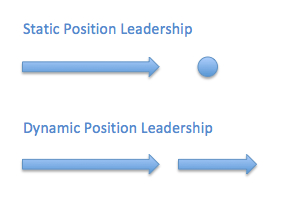
Static DynamicLast week I enjoyed a very pleasant afternoon discussion in the summer sunshine by the river in Bath.  Our conversation meandered through many gospel vistas and theological considerations.  Along the way we were talking about youth ministry, but the point I’d like to share here applies to us all.

Typically when churches are looking for a youth minister they will try to find somebody who is more spiritually mature than the youth in the church, but close enough in age to engage in all the requisite activities.  So the person is found and appointed, the programs are designed and the action begins.  Often the church wants pizza and programs so that the youth are happy, but whether or not there is any real spiritual growth is another matter.

Part of the problem here is the implementation of Static Position Leadership thinking.  I doubt you’ll find that term anywhere as I just made it up, but the principle is not rocket science.  The youth minister is represented by the dot, and the youth are the arrow.  The assumption is that since he is further along than they are, he can help them grow in the right direction.  But does it work like that?

What happens when one of the young folks suddenly comes alive spiritually and is praying fervently and reading the Bible voraciously and chasing God with a passion?  Does that teen simply move along the maturity arrow quicker than others, still moving towards the more mature youth leader?  Not if the youth leader is spiritually static.  It doesn’t take long for someone to overtake the “leader” when the leader is not really leading.

For true spiritual leadership to occur, surely the Dynamic Position Principle must apply.  That is, you can only lead others forward as you yourself are also currently moving forward.  A church that gets a youth minister who lacks personal genuine growth in their walk with God will be directly harming the youth in the church.  It won’t take much for one to surpass the leader in current spiritual momentum.  And it won’t take much for the static leader to squash the life out of those who might show him up if they continue.

If this is true for youth ministry, surely it is also true for whole church ministry.  Moving the dot to the right for an elder or pastor does not guarantee any sort of health in the church.  What is needed is mature and growing godly leaders if they are to infect others with forward momentum in their walk with Christ.