Review: Privilege the Text by Abraham Kuruvilla – Part 2

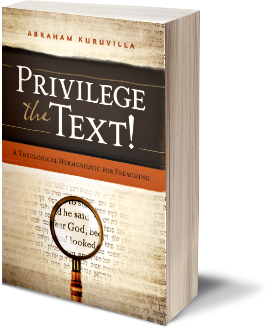
img_privilege_3d_02Yesterday I introduced and overviewed Privilege the Text: A Theological Hermeneutic for Preaching by Abraham Kuruvilla (herein: AK).   Let me offer two quotes to give a sense of the book:

“Application involves discovering the world projected in front of the text and aligning oneself to that world.  Such an alignment restores the relationship between God and his community.  A pericope, by way of its theology, thus contributes to the corporate mission of covenant renewal.  I submit that what God would have is that his people be captivated by the world projected in front of the text, and that they seek to be its inhabitants, aligning themselves to its precepts, priorities, and practices.  This is God’s gracious divine demand.” (p117)

and

“This is the crux of christiconic interpretation: in that he perfectly fulfilled divine demand, every pericope of Scripture implicitly portrays a facet of the image of Christ, the perfect Man.” (p262)

Strengths

AK’s book is clearly written.  While it is far more likely to appeal as a textbook than as an accessible read for the pastor in his study, it is not difficult to dip into the book and get AK’s point.  He also clearly has a longing for preaching to lead to transformed lives, as well as a passion for an increase in morality – all to be commended.

I think his critique of the weaknesses of Christocentric preaching is well worth reading, and concur wholeheartedly that we should think carefully how we handle individual pericopae in order to honour the inspired texts and pursue what the authors were actually doing with the texts they wrote.  While I might not phrase it this way, I do see the richness of individual texts sometimes getting “swallowed up in the capacious canvas of Redemptive-Historical interpretation.” (p240)

AK’s exegesis of Genesis 22 gives a level of engagement with the text that is fascinating to trace through.  It is a shame there were not more worked examples like this one (although the book would end up being prohibitively long).

Weaknesses

There are real strengths here, but I have to highlight some  concerns with the theological assumptions evident in the book.

View of God – The persistent recurrence of “divine demand” language presented a God who seems pre-eminently concerned with conformity to behavioural standards.  It was not just AK’s choice of label, but the tone and content throughout that reinforced a very limited view of God.  God is presented as a Father, but with the emphasis on our “filial duty of obedience.”  Twice AK stated that his view of preaching is Trinitarian (pp 267, 273), but after studying the book I remain unconvinced that the richness of intra-trinitarian relationality substantively marks this work.

View of Man (our nature, spiritual problem and solution) – At one point, AK states, “Philo was on the right track: ‘The proper end’ of man’s existence is ‘conformation to the likeness of God.’” (p261)  Philo is known for offering a blend of Jewish exegesis and Stoic philosophy.  Similarly, AK offers a blend of decent exegesis with an unquestioned commitment to a Stoic understanding of humanity.  The approach to a so-called “divine demand” in the text supposes an autonomous self-moved moral impulse in humanity.  Even accepting that the book is focused on believers who are “aided” and “empowered” by the Holy Spirit, the onus of their responsibility rests wholly on their own willingness to self-align to God’s preferred future.  If AK’s vision of preaching were fulfilled, my feeling would be that believers would still be essentially distant from God – aligned to his demands, acting like Him, and living spirit-empowered moral lives, but what about union with Christ, what about being “in Christ,” what about the triune intimacy offered in the Gospel?

For instance, AK submits that “what God would have is that his people be captivated by the world projected in front of the text, and that they seek to be its inhabitants, aligning themselves to its precepts, priorities, and practices.” 

I would submit that “what God would have is that his people be captivated by Christ who reveals the Father’s heart, whose love is poured out into our hearts by the Spirit, so that we are progressively transformed from the inside-out by God’s great New Covenant solution to our fallen sinful state – this sin being manifested not only in sinful behaviour, but also in autonomous obedience and religiosity.  God’s goal is not simply to be served by a holy people, but to be in union with His people who are transformed into the true holiness that is the context of His own fellowship within the Trinity.”

Purpose of Old Testament – On page 253, AK quotes and then responds to Dennis Johnson’s assertion that, “the purpose of Old Testament historical narrative is not to teach moral lessons, but to trace the work of God, the Savior of his people, whose redeeming presence among them reaches its climactic expression in Christ’s incarnation.”  

AK’s response is as follows: “If the purpose of the OT is only informational and historical, “to trace the work of God,” is there nothing in it that tells us what God wants of us, how God would have us live, what it means to be Christlike in specific facets of life.”

I feel it is slightly harsh to reduce Johnson’s position to being “only informational and historical” and therefore without any element of moral instruction.  I want to suggest that Bible texts are not merely informational and historical, nor are they primarily moral instruction, rather they are revelatory: divine revelation.  The texts of the Bible reveal God to us, and in that revelation we discover the fullness of life (including, throughout, revelation of God’s values that shape our values and transform our lives into conformity with His holiness).  However, we lose the heart of Christianity when holiness, loosed from a rich and delightful intra-trinitarian fellowship, becomes the primary emphasis.  There are plenty of religions offering demanding gods and moral obligations.  Only Christianity has a profoundly relational holiness defined by the delightful perfection of divine fellowship.

A Strange Omission – I am perplexed at AK’s omission of John 5 in his evaluation of key Christocentric preaching  texts – was Jesus not critiquing the seminarians of his day who looked for instruction, but missed the person being revealed?  That seems like a passage that needs to be engaged in this discussion at some point.

ConclusionI can commend aspects of AK’s book, but the foundational theological assumptions raise many concerns.  I find the implicit portrayal of God  to be very restricted.  I find the presentation of how humans function to be absolutely committed to an “autonomous self-willed” anthropology that resonates with Aristotelian and Stoic commitments, but seems to lack awareness of the full impact of Genesis 3.

Sometimes it is hard to read a book and evaluate the underlying theological assumptions of the author.  Sometimes it is easy to get drawn into the world as defined by the author and therefore find yourself going along with every proposal.  In this case the theological assumptions were clear, and it was at this foundational level that I found myself struggling with the sometimes very helpful content.

Who is God and what is He like?  What is man and what does it mean to be made in God’s image?  What is sin and the extent of the sin problem?  And what is grace, the solution to the sin problem?  These foundational questions should always be stirring us as we engage a book.

Next time I post, I want to offer some alternatives to a Christiconic approach to preaching.

Review: Privilege the Text by Abraham Kuruvilla – Part 1

img_privilege_3d_02Privilege the Text: A Theological Hermeneutic for Preaching by Abraham Kuruvilla

This book was Preaching Magazine’s Book of the Year for 2013 and has some significant endorsers.  Its four chapters span 336 pages, with essentially one (maybe two) “worked example” of Kuruvilla’s proposed approach to handling Old Testament narrative.  Let me begin with an overview of the chapters today, before highlighting some strengths and weaknesses tomorrow.

Chapter 1 introduces the field of hermeneutics.  Abraham Kuruvilla (herein AK) points the reader beyond simply pursuing the meaning of a text, to recognizing that with a “classic” text, there will be a timeless quality wherein the author “does” something with the text.  Specifically, and this will always be true of the Bible, the author is projecting a “world before the text” – a moral ideal that people in vastly different cultures and epochs can still access as the text is preached effectively, leading to life transformation.  AK finishes the chapter with six rules of reading, the last of which is the rule of centrality, which focuses interpretation of texts on the person of Christ.

Chapter 2 focuses on what AK labels “pericopal theology” – that is, pursuing the theology of each pericope, or preaching unit of text.  AK suggests that most contemporary expository preaching actually neglects the preaching text in favour of offering a broad systematic or biblical theological presentation of truth.  (He is clear that both systematic and biblical theologies are important as guardrails for interpretation.)  Instead, he is advocating that we Privilege the Text by pursuing the “pericopal theology” of each text, applying that to listeners so that they can align their lives with the “precepts, priorities, and practices of God’s ideal world,” what AK refers to as the “divine demand” present in every pericope.

Chapter 3 pursues the issue of “divine demand” and the place of obedience.  AK begins by showing that Dispensational, Reformed, Lutheran and New Perspective on Paul theologians all restrict the applicability of Old Testament Law today, but he is advocating that all law is applicable always – by means of the theological sense of each text.  AK states that OT Laws “are not criteria for salvation, but are guidelines for sanctification.” (P153)  God’s gracious provision through the Son and enabling operation of the Spirit mean that this is not merit-seeking legalism, but rather the “obedience of faith” that is the Christian responsibility in our pursuit of being holy like God.  Relationship precedes, but does not preclude, responsibility.

Chapter 4 picks up the question that becomes obvious by the end of chapter 3 –With repeated emphasis on the believer’s filial responsibility to obey (divine demand), how can the “rule of centrality” be brought to bear – i.e. how do we preach Christ?  AK begins with an extended exegesis of Genesis 22.  His intent is to show that the Bible as a whole projects “an image of Christ, with each pericope portraying a facet of this image: what it means to be Christlike.” (p212)  Abraham’s faithful obedience augmented God’s previous promise and became incorporated into it. For AK, this exegesis demonstrates that Christ does not need to be superimposed onto the text based on later revelation, but instead a facet of Christ’s character is seen in the text.  AK looks at the Redemptive-Historical or Christocentric approach to preaching, evaluating and critiquing the arguments put forward, as well as surveying the biblical passages used to support the approach (bizarrely, he does not survey John 5 here).  The alternative?  Christiconic Preaching.  This is where facets of the image of Christ are presented through the theological sense of any pericope, thereby giving listeners the opportunity to align themselves with God’s divine demand that we be holy as He is holy, that is, that we be increasingly conformed to the image of Christ.

Tomorrow I will offer a review by way of some reflections on this book.

Post-Preaching Stress Disorder

Depressed2Now and then you might preach a sermon and finish on a personal emotional high that lasts for days.  Typically you won’t.  William Willimon wrote that,  “On any Sunday you can give it your all and still know that the Word deserves more.” Typically you may find yourself feeling vulnerable, weak, drained, self-critical and/or regretful.  Post-preaching stress disorder: known by most preachers, not understood by most others.

People in your congregation probably don’t understand PPSD.  They are quite happy to chat with you after you have preached.  They might want to talk about other things (that can be tough – it feels like they ignored you completely).  They might want to talk about your message (that can be tough – you may feel too vulnerable at this stage).  They might want to discuss some detail in your message (that can be tough – your purpose and big idea related to major life change, but their discussion might revolve around some incidental element, or even be a misunderstanding of what you said).

It is not the fault of people in your congregation.  After all, there are probably many jobs and tasks that have emotional fall-out that you do not grasp.  Starting an education program in this area might just seem a little self-serving and self-promotional (look what I go through every week!).  So what to do?  Here are a few quick suggestions for those who struggle with PPSD:

1. Create a small team who do understand.  Your spouse would be a wise place to start.  After all, church requires up to an hour of complex interactions.  Then you go home.  It may not subside for another 36 hours!  Also, bring it into the conversation with your preaching team.  This could be other people who preach, or people who help discuss, plan, pray or feedback on the preaching ministry in the church.  None of us should try to do a preaching ministry alone . . . you need a team and they need to understand PPSD.

2. Let PPSD push you up against God in post-preaching conversation.  The danger is that we go it alone and end up crashing in some way.  Some will struggle with discouragement or depression.  Some will struggle with self-absorption and time-wasting.  Some will struggle with temptation and specific sins.  Some will struggle with a combination of these and more.  Some will struggle sometimes.  Some will struggle every time.  We are not designed to go it alone!  Let the PPSD push you up against God so that you take time to prayerfully reflect after preaching.  Maybe a Sunday afternoon walk.  Maybe a Monday morning prayer and reflection time.  You cannot leave God out until Tuesday and then start the process again.

3. Make notes during PPSD and review later.  It is not the time for massive ministry decisions, or self-critique, etc.  Know that your thinking is cloudy at this point, so make some notes and then look at them later in the week.  Learn, but keep it in context.  Ideally talk it through with others who will be honest with you.  It may be that your perspective is all skewed.  Or it may be bang on.  Either way, you will learn more in the context of a team.


Amazing Grace

amazing-grace-292x300A few weeks ago I had a very encouraging conversation with a thrilled believer. She had read a book about God’s grace and it was a delight to see her so stirred by what she saw there. She described how amazing it is that even though she was so guilty, the judge has paid the full price of all her sins – every last one of them.

This young lady was obviously in the afterglow of her encounter with a clear presentation of God’s grace and the wonder of forgiveness. I could have celebrated with her and probably lived off her excitement for a few days myself, but I was slightly concerned.

After the amazing miracle of forgiveness, what comes next? Some would say that the new believer needs to be instructed in the code of conduct that comes with their new status – after all, privilege brings responsibility. Others would say that the new believer needs to get used to living in light of their new status. Which way is correct? One? Both? Neither?

The amazing grace of the sacrificially benevolent judge has a profound and life changing impact. But how deep does that impact actually go?

What if the afterglow of the great gift of grace fades? Then the new believer will surely drift back into increasing sin, only now with assurance of sins forgiven. This kind of ‘free ticket’ would be a dangerous situation. A gospel of grace that is purely focused on a change in status is dangerously incomplete.

Consequently, does the new believer need training in a new code of conduct to bolster the status of being forgiven and also to protect them from themselves? I don’t think we have to jump there so quickly.

As I enjoyed her excitement about the judge’s remarkable grace I shared another dimension of the gospel story. I said, “You know, it is even more amazing than that,” she looked at me quizzically, “the judge forgave you, and he also proposed to you.” Her eyes widened. She hadn’t thought about it that way.

We discussed the ongoing wonder of being the bride of Christ, the ongoing impact of having your heart enlivened to the delight of knowing and loving him, the ongoing intimacy of being united to him by the indwelling Spirit, and so on. The gospel gives us lots to ponder!

Let me put this in different words to make the same point. If the New Covenant is merely a status change, then it is not enough. The newly forgiven individual will need some kind of external control mechanism and freedom restriction because their natural inclination to sin will soon break through and take charge.

But if the New Covenant is not only about the legal record, but also about the love relationship, then maybe we have a different situation. What if the New Covenant included provision for transformation of the heart, an inside to out supernatural change? What if the New Covenant included provision for the restored presence of the Spirit forging an intimate marital union between the believer and Christ? If this were included then perhaps the newly forgiven individual should be set free to live life to the full in the responsive joy of their new relationship with Christ.

That is an exciting prospect, but surely there would still be an inclination to sin alongside that new inclination to please God? Indeed the flesh versus Spirit tension is a reality we all experience. That is why our understanding of sanctification is so important.

It is easy to see sanctification as our follow-up work, our responsibility in light of the blessing of salvation. But this shifts the new believer’s gaze right back onto themselves. The message easily becomes ‘trust Christ for salvation and then look to yourself as you strive for your sanctification.’ Paul was no fan of this idea, no matter how well it was couched in biblical language.

Walking in step with the Spirit is about living in the reality of the New Covenant – not only learning to live in light of our new legal status, but also growing in our new relationship. The ongoing mechanism for growth is not self-determination, but response to the Son as the Spirit reveals him to us and stirs our hearts to love.

However we phrase it, the bottom line is this: our understanding of sanctification needs to be as God-centred and Trinitarian as our understanding of salvation.

Multiply Ministry Beyond the Pulpit 3

Multiply2Yesterday I began a list of ministry that compliments the platform given us as preachers.  The first five stood out to me as I observed a Christian leader at close quarters and was impressed by the impact he had when not preaching.  We thought last time about intercessory prayer, deliberate networking and being a funding conduit.  Here are two more from my list of observations of one leader (then I may add some more nudges):

4. Generous Distributor – Books, CDs, DVDs, etc.  Sometimes a targeted gift can make a massive impact.  I can think of four or five life changing books that every Christian should read.  I can think of more that not-yet-Christians could benefit from.  Here’s the challenging question . . . why don’t I have a stock of these books to give away to contacts?

5. Multiplicational Mentor – Get someone close and pour into them.  It could be knowledge and training, but it could also be networking and ministry exposure.  If, by God’s grace, you are living a life of ministry impact, it will only multiply by letting others get close.  If you aren’t, why are you preaching?

– – – – – – – – – – – – – – – – – – –

6. Ministry Champion – If there is a ministry you believe in, champion it.  It doesn’t take much to offer genuine support and encouragement to the ministry of another.  Endorse, pray, champion, network, encourage, text, fund.  What ministry beyond your own church do you cheer for?

7. Community Involvement – If your church is part of a community, it makes sense to have some involvement in that community.  Being on the board of a local school, or having some sort of presence with the local council, or . . . find a creative opportunity in your locale.  This is not just about evangelistic influence, although it should never be less than that.

8. Book Reviewer – If you read books, which sadly seems to be optional these days, why not write reviews so that others can benefit?  Put them online, in a journal, on amazon, etc.

There must be so much more, please share any ideas and let’s see what can be multiplied.

Multiply Ministry Beyond the Pulpit 2

Multiply2Some years ago I had the privilege of living next door to a well known Christian leader and communicator.  Watching him close up made clear to me how he had had such a significant impact on the world.  It was not just his preaching (although he did lots of that).  There were five noticeable areas of complementary ministry that are open to all of us.  If only more of us would invest our energies in these five areas, it is hard to imagine what could be achieved:

1. Intercessory Prayer – I would hope we all pray for those we minister to, but what about others who God brings across our paths?  We could quickly compile a large connection collection – people we can bring to God in prayer on a regular basis.  My friend is highly purposeful in this ministry . . . photos on the phone for when he loses a signal on the train (allowing him to pray for people), photo albums, lists.  How can the impact of this loving ministry be measured?

2. Deliberate Networking – You may have the same reaction to “professional networkers” that I do, but “humble Kingdom building networkers” . . . that is altogether different.  Person X has a passion for a certain area of ministry.  Person Y might be the ideal resource person or connection for person X.  If you know both, shouldn’t you be introducing them?  Like the ingredients of fireworks, sometimes it is about bring certain folks together for explosive impact.  I suspect a lot of us preachers have largely untapped networks.  Maybe we are not imagining the possibilities?  Maybe we want everything to revolve around us?  Maybe the greatest ministry impact you will have this year will come from introducing X to Y, or Saul to the believers . . .

3. Funding Conduit – We easily get caught up in the financial needs of our own family and our own church.  But there is so much that could happen if funds were released.  What if we all wanted to be used in this area?  Choose to live on so much, and be diligent in recycling everything else.  Hard to imagine how much could be moved on with this approach!

Two more to finish my list next time.  Maybe you have more ideas to add . . .

Multiply Ministry Beyond the Pulpit

Multiply2I was just pondering the extensive opportunities for ministry beyond the pulpit.  This may not seem relevant to a preaching blog, but I think it is.  As a preacher, you have many opportunities to serve God and others beyond the ministry that you give in preaching.  Let’s chase some ideas together and maybe one or two will spark something for you.

First, what about ministry directly linked to your preaching:

1. Written – The days of simply transcribing and publishing sermons are probably long gone for most, and yet there could be some scope for producing written materials that flow out of our preaching ministry.  Getting published is not the easiest challenge, but perhaps there is a venue for carefully written synopses.  (And I would imagine that if you have a good editing PA you might be able to churn out as many books as your favourite preacher/writer . . . but you need to think about what your theological message is.)

2. Online – Full sermon manuscripts will get very little traffic, since sermons are not written to be read.  Perhaps blog length summaries could serve a purpose?  Perhaps tweet length big ideas would be of benefit to others?

3. Recorded – It is easier than ever to record, lightly edit and upload your messages to the internet.  Don’t do it just because you can, but if there are people that want to hear them, why not let the same sermon do its work again?

4. Taught – Why not gather one or two interested parties to talk through your message and make it into a training exercise?  Could be potential preachers.  Could be people learning to handle the Bible for themselves?  In fact, get some feedback and you will benefit too.

5. Further Preached – Sometimes we leave a set of exegetical notes too soon.  Maybe a further sermon building on the message and developing the application, or maybe a discussion, a Q&A, or a small group Bible study?  There are no medals to be won for multiplying work unnecessarily.  If you put hours into a message, it may well have further work to do before you lay it to rest.

Next time, I want to ponder five ministry multiplication options that complement a preaching ministry . . .

Satan Hates the Holy Spirit

satan-hates-the-holy-spirit-300x300I think this might just be a blind spot in contemporary theology.  We know that Satan hates God and marriage and evangelism and even church planting.  But I have never heard anyone reference his hatred for the Holy Spirit.

As I ponder this idea I see more and more evidence to support the statement used as a title for this post. Sure, there is the obvious logical agreement: Satan hates God, the Holy Spirit is God, thus Satan must hate the Holy Spirit. However, affirming the logic of a statement is not the same as pondering the implications. So why does Satan hate the Holy Spirit and how is this seen in everyday life?

You can see the work of the enemy as you consider both the cults and secular society. In the cults there is always an undermining of the biblical doctrine of the Trinity – God is twisted from a gloriously loving tri-unity into a monadic power-broker (often seen as a devilish antagonist). In secular society the idea of God is also twisted into a perversion and caricature of reality and the convicting work of the Spirit is undermined by persistent indoctrination in the lie of autonomy and guiltless existence.

Now, what about in the church? Surely once people become believers the enemy’s attack on the Spirit becomes fruitless, doesn’t it? I don’t think that is the case. Does the enemy stop attacking marriage once we are saved, or does the antagonism increase? Are we not tempted to sin once we are believers? Of course not, so I suspect there is a consistency here.

So how does the role of the Holy Spirit suffer in respect to spiritual warfare? What is the enemy’s strategy to undermine the Holy Spirit’s work in our lives?

It seems to me that Christians tend to feel a pull in one of two directions, both of which are away from the reality of the Spirit’s work. Both pulls negate the fact that the Holy Spirit is a person rather than a force, and both distract believers from a wonderful and central element of the Christian life.

The first pull is to turn the Holy Spirit into a power-focused force. The Spirit becomes the fuel for Christian living and sometimes the fuel for spectacular displays of personal anointing. Undoubtedly there is truth in the mix here, but the corruption seems to come in respect to the emphasis and direction of focus. The power, or lack of it, tends to become the emphasis in Christian life and ministry. People caught up with a power-caricature of the Spirit tend to focus either on the Spirit, or on themselves.

The second pull is to turn the Holy Spirit into a silent and benign figure. The Spirit is assumed to be at work in the normal things of church life by means of, well, various means. Undoubtedly there is truth in the mix here as He is surely at work as we read the Bible, hear preaching, etc., but the corruption seems to come in respect to the emphasis and direction of focus. The emphasis in Christian life and ministry seems to shift to habits and personal commitments. People buying into a means-caricature of the Spirit might tend to be focused on themselves and their diligence.

The pre-eminent role of the Spirit is that of a communicator, specifically, relational communication between the Father and the Son, between God and us, and between us in the body of Christ. The Holy Spirit is primarily concerned with the power of love, not some sort of love of power. He pours out God’s love into our hearts and baptises us into Christ. The fruit of the Spirit is profoundly Christlike. He gifts us to build up the body of Christ that we might point each other to the head, who is Christ.

That’s the key issue with the Spirit – he wants to lift the eyes of our hearts to Christ. And that is why Satan so despises the role of the Spirit. By forcing the focus onto ourselves, or even onto the Spirit himself, the enemy seeks to undermine the Christ-ward gaze of true Holy Spirituality.

Perhaps this a factor in the strange phenomena of otherwise great Christian writers offering solid and helpful books, yet somehow many of them seem to remain blind to the importance of the Spirit in their discussions of living the Christian life, pursuing sanctification, living out Christian marriage, parenting or church ministry.

The Spirit seems to be a blind spot for many. And where the Spirit is relegated or twisted in some way, then the bottom line will always be a drift towards an autonomous and self-driven “spirituality” (which was The Lie back in Genesis 3, of course).

Perhaps we would do well to ponder the spiritual attack against the Holy Spirit. I suspect that if we were to ponder this, then we would find our hearts drawn to Christ. This is the goal of the Spirit, as well as the great fear of the enemy!

Gospel Preaching – Link

GospelPreaching2I have really enjoyed the interactions sparked by this last series on the gospel and our view of sanctification.  To wrap up the series, here is a great article by Dane Ortlund on Jonathan Edwards’ doctrine of sanctification.  I commend it to you, as well as the site it is hosted on.  UnionTheology.org is a newly launched site that you will want to browse around and bookmark.  You will find some items from me on there, along with some great articles, audio and video from others that will be well worth your attention.

Here is the article by Dane Ortlund on sanctification, and here is the link to the front page of the site.

Gospel Preaching – 5

GospelPreaching2In the debates over the nature of the gospel and life transformation, it seems that there is a missing third option.  There is a Car C that actually has a motor, but nobody seems to be mentioning it.  There is a Married Approach C that actually has an ongoing dynamic power, but it seems absent.

Let me ask the question in reference to your preaching of the gospel:

Where is the union?

Do you preach a pressure message that constantly urges people to do the work of growth?  Do you preach a momentum message that simply looks back to the wonder of their identity change at conversion – a message proclaiming what God has done in Christ that does stir gratitude and does stir life change and doesn’t promote sinfulness, but, maybe, does still lack something?

If the gospel doesn’t transform a life, do you balance grace with effort?  Do you preach grace more boldly?  Or do you make sure your preaching of the gospel of grace goes beyond gratitude to the dynamic relational and spiritual union of being one with Christ?

The gospel is not that God forgives guilt and then expects us to stir ourselves to obey with newfound ability to behave well.  He does forgive guilt, but it goes further than that.  Does God simply expect our gratitude to be the engine of transformation over the course of many years and many challenges?  Surely that momentum alone will not take us up the hills and mountains that sometimes stand before us in this life.

The gospel is wonderful news.  Not only are our sins forgiven so that we can be justified before God, we are also reconciled and made one with Christ by the Spirit (*are we allowed to mention the role of the Spirit in sanctification?)  We are united to Christ so that we don’t need to look at a list of expected marital behaviours, and while we certainly do remember and celebrate what he did to win our hearts and pay the price for us, we don’t live purely by remembrance . . . we live in a present relational union with him, we look to him, and we travel with him through all the challenges of life, growing closer and growing to be like him as we keep our eyes on him.

Too much of the sanctification debate seems to be about looking to self versus looking back to conversion.  Given the choice between the two I know which way I’d lean, but I know the critiques ring true if that is all we have.

God’s grace does truly transform.  God’s grace truly is enough.  But God’s grace is not just gratitude for a status change.  God’s grace is about the Spirit of the Father and the Son, purchased for us by the Son, so that we can be truly united with him and join him in his present, dynamic, delighted relationship with his/our Father.  We don’t just have the status of being married.  We are married to someone so wonderful that if you want to encourage me in my Christian life, then don’t bother pressuring me to perform, just do your best to preach Christ to me and you’ll probably be amazed by the “performance” that results, but I won’t even be aware of that, because my eyes will be on him.