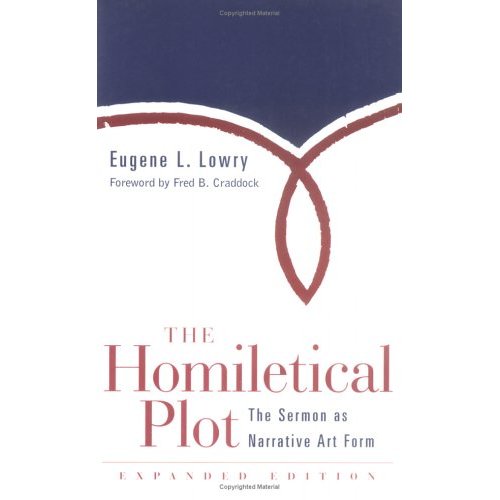
Review: The Homiletical Plot, by Eugene Lowry

lowry.jpg

Eugene Lowry’s work sits under the broad umbrella of the New Homiletic. His work overlaps considerably with Fred Craddock. Other New Homiletic writers have been criticized for writing well, but failing to provide a clear model of what they are suggesting. This charge cannot be leveled at Lowry. The Homiletic Plot was first released in 1980, then re-released twenty-one years later. The text of the book remains unchanged, with the only significant change being an additional afterword. This addition is very helpful, clarifying elements of the book and providing an overview of the New Homiletic field.

The Homiletical Plot provides a plotline for narrative sermons which suggests the preacher might typically move through five discernible stages in a narrative sermon. Don’t confuse narrative preaching with preaching on narrative texts. The former is an organic approach to preaching that develops sermons using temporal sequencing to develop a sermonic experience, the latter could take any form, but uses a biblical story as its text. In fact, a biblical narrative contains features of plot already, so the resulting sermon might vary from the “Lowry Loop” more than non-narrative texts. However, it is important to note that Lowry is not suggesting the forcing of any text into his 5-stage loop.

Whether or not you have read much from New Homiletic writers, Lowry is well worth reading. It is relatively short (131pp) yet has many strengths. He presents a good case for thinking of sermons as horizontal rather than vertical, an event in time rather than space, progressing rather than static, organically developed rather than constructed. The opening stage of upsetting the equilibrium should be required reading for every preacher. The notion of complications and plumbing the depths of the real issues in life is very thought provoking, whether or not you agree with Lowry’s theology (which he does not push on the reader). The notion of a sudden shift is surely a powerful concept and I appreciated the positive approach to concluding the sermon.

There are three weaknesses worth noting. Even with all the explanation and helpful diagrams, the reader is still left wondering what this actually looks like in a sermon. The danger of example sermons in an appendix is that they will turn off some readers and narrow the potential readership. However, the problem of no sample sermon is that the reader is left pondering exactly how Lowry might “plumb the depths” or perform the sudden shift.

Perhaps the greatest problem with the book for those of us committed to expository preaching relates to explaining the biblical text. Lowry states that he would typically spend more time on stage 2 (analyzing the discrepancy) than the other stages put together. Does this pursuit of deeper issues in the listener leave enough time to actually explain the text itself?

The final concern relates to the “Gospel” that permeates the model. Lowry continually refers to “experiencing the gospel” (stage 4), but which gospel? At times it feels like nothing more than the good news that God has turned things upside down in Jesus. This book will appeal to a broad spectrum of Christendom, and deliberately so, but some of us may feel the need to translate some of its teaching into our paradigm.

On one hand the book is highly refreshing and challenging – it certainly contains much for us to learn. On the other hand it highlights the dividing line between New Homiletic and those of us who would hold back from being counted in that camp. If it is possible to reduce the notion of a sermon to its minimum required features, then perhaps two broad camps can become more clear. The expository preaching camp might be satisfied with Sunukjian’s trio of bare essentials: A Bible text explained + the Big Idea + Relevance = a sermon. The reader of Lowry is left with a different trio: A “Gospel” image derived a Bible text + Plot + Relevance = a sermon.

This book would benefit all of us as preachers. Some aspects of it may not fully satisfy all of us. But it gives us all plenty to think about!

The Big One: Glory!

I’m sure we all would concur that we want to preach to the glory of God!  It is a motivation that should drive everything we do.  But let’s make sure this is not an ambiguous concept.

God is glorified when we magnify Him in our preaching.  When His Word is preached, He should be the central character, the hero, the one elevated as a result.  This means our preaching is not about us as preachers, or merely about our listeners, or even about Bible characters, it is first and foremost about God.  Theocentric preaching, absolutely.

However, it is important to remember that bringing “glory” to God is not merely saying big things about Him or saying those things in a certain voice.  Glory is the fruit of love.  Consider John’s presentation of glory in his gospel, in chapter 17, for instance.  So as we preach God’s Word out of love for Him, and stir in others a greater love for God, He is glorified.

Furthermore, genuine love for God will show in the lives of our listeners.  Whatever we do, whether in word or deed, it should all be to the glory of God.  We should glorify Him in our bodies.  There are numerous references like these that point out the need for appropriate practical emphases in our preaching.  It is not enough to always stir worship, but not life change.  As I listened to Joe Stowell recently, I was reminded again that preaching for transformed lives means a practical righteousness in the lives of our listeners that is the greatest apologetic of our age – which all brings glory to God!

Let us preach to the glory of God, but not hide behind that motivation as an excuse for irrelevant or application free sermons.

Written Text: More Than Words

It would seem obvious that a written text, such as the one you will preach next Sunday, is made up of words on the page.  Furthermore, we all know that words on a page convey information.  So our task in preaching must revolve around the relevant explanation, proclamation and application of those words, right?  Right, sort of, but it’s much more than that.  Words on a page are not randomly generated codes from some computer.  They are coherent and purposeful communication.

How is writer communicating with those words? We need to be sensitive to the tone of writing as well as the words written.  Is the writer rebuking or encouraging, defensive or freely celebrating, sarcastic or sombre?  For example, when you consider the cultural context and background issues in Corinth, you might expect a rebuking and attacking tone toward the end of 1Cor.15.  But actually the tone there is careful, then celebratory and genuinely encouraging.  It would be a shame to miss the tone as you study it and then preach rebukingly.

What does the writer intend to occur through that communication? If the writer intends to inform and stir specific application, then it will help us to pick up on that from the text.  For instance, if the tone is encouraging and positive, it would likely be counter-productive to preach a stinging message from the text.

Start with the tone and intent of the writer.  There may well be reason to preach in a different tone or with a different goal.  But first of all see if the writer’s tone and intent fit your situation.  That’s the best place to start.  If you decide to change your tone or intent because of the congregation, great, but let’s be careful not to default to always rebuking, or always guilt-inducing, etc.

As you study your passage for the next sermon, remember to ask yourself, “what was the writer’s tone here?” and “what did he intend to achieve through this text?”

The Commitment to Expository Preaching

Over time words can change their meaning and the connotations attached to them.  This is true of both “expository” and “preaching.”  As you probably noticed, gone are the days when the preacher in town was highly respected and appreciated by all.  Today there are many who view the whole concept of preaching very negatively.  As preachers we might be tempted to avoid the term.  Maybe in some circles that might be a good idea.  For instance, when interacting with a non-believer.  When I’m travelling and sit next to a stranger on the plane, I’ve learned not to shut down the conversation by referring to myself as a missionary, a minister, or a preacher.  Other job descriptions are more intriguing and stimulate further conversation (anything from lecturer in Ancient Near Eastern Spirituality to communications trainer will keep things going).

However, within church circles, let’s not be bashful about the concept of preaching.  In reality the people in your church are not bored with preaching.  If anything, they are bored with your preaching!  I get told that people can’t concentrate beyond 25 minutes of preaching.  I may not say it, but I tend to think that actually they might prefer only 25 minutes of the preaching they’ve heard.  The onus here is not on the church culture to correct its view of the biblical importance of the preaching ministry.  The onus is on us preachers to improve and make sure that the specific preaching our people are thinking of when they refer to preaching is good preaching!  As Haddon Robinson said on one of the early Center for Preaching podcasts, “not all preaching is worth it, but good preaching is worth it!”  Let’s agree on that and press on to develop so that our listeners will not be among the voices of disapproval for this critical ministry.

The Elements of Expository Preaching

The study of expository preaching can be a lifelong journey. For many of us it should be a lifelong journey. And the complexity of this ministry allows for a lifetime of learning. Consider the complexities of biblical interpretation and the diversity of biblical genre and form. Think about the continual changes in society, not to mention the ever developing experiences and needs of each individual listener. Ponder the numerous variables in effective oral communication, seemingly increasing all the time as advances are made in the fields of communication, rhetoric, education and homiletics. It is clear that there is plenty for us to keep studying and stretching ourselves as preachers: from applied linguistics in discourse analysis to the epistemological paradigms of postmodernity. From family systems dynamics to unintentional perlocutions in the preaching event. There’s plenty to learn for all of us.

But let’s not get caught in a fog of confusion here. The core issues are still the core issues. Preaching must always be concerned with the specific meaning of the biblical author and with the relevant and effective communication of that meaning to contemporary listeners. Preaching remains a spiritual endeavor very much concerned with the work of the Trinitarian God in you and through you. Excellence in Bible study, effectiveness in communication, relevance in presentation, and all of the above in a close reliance on the Spirit of God through prayer. Boil expository preaching down to its elements, and it is not much more than this: God, you, them & Bible study, communication and relevance.

Take stock of the basic elements – where should your learning and passion for growth be focused at this point in the process?

The Smaller Hats Worn in the Pulpit

This site is dedicated to stimulating biblical preaching.  The main hat the preacher wears is that of the biblical and relevant communicator.  There are lots of angles on that main role, and they are explored post by post on this site and others.  But I would like to mention some smaller hats worn in the pulpit.  These are typically not your main role in preaching (although in a particular sermon they may be), but these are roles to be aware of.  Areas of strategic influence for the preacher:

Materialism Underminer – Throughout the week the people in our congregation are bombarded by messages of materialism.  It’s everywhere they look – billboards, TV, radio commercials, shop windows, magazine racks, etc.  A constant stream of a very powerful big idea.  When we preach, whatever the text and message might be, we break into that stream of information and give a few moments of spiritual reality again.  Perhaps in passing comments or illustrations we even undermine the message of materialism too!  (The same could be said of society and media obsessions with independence, evolution, humanism, etc.)

Family Support Officer – Many people come from, live in or have come out of broken homes.  The enemy is attacking the family unit at every level.  Yet for those minutes on a Sunday morning, people are allowed to look through the windows into your life.  I’m not saying you should air your private laundry, or show-off your family or children (be sensitive to those who don’t have what you have).  However, glimpses into a healthy home can be powerful antidotes to the stream of failure society parades before us.  I still remember the illustrations given from the home life of one of my profs at seminary.  Bruce Fong is now president at Michigan, but in his Multnomah days the Fong family functioned as an inspiration to single me and others.

Missions Mobilizer – We’re living in a world of desperate needs, yet none as desperate as the 9 people dying every 5 seconds, most of whom step into a lost eternity.  The greatest need in world missions today is still people, followed by finance and other resources.  The only source of people who could go and make a difference is the local church.  That puts us as preachers in a key role.  Let’s be aware of the opportunity and inspire our people to be genuine global Christians!

That’s three more hats to ponder.  Any others that come to mind?