Letter from the Tax Office

I enjoyed a good conversation about preaching yesterday.  Here’s a thought.  2 hypothetical situations:

Situation 1 – I have received a letter from the tax office stating that a Mr Jones is going to be hearing from the bailiffs if he doesn’t pay his tax bill within five days.  I figure out that Mr Jones lives six doors down from me.  Out of courtesy I take the letter to him and hand it over.

Situation 2 – I have a close friend who works in the tax office who lets me know that a mutual friend of ours, who happens to live next door, is long overdue on a tax payment and needs to respond immediately.  I go next door and explain the situation carefully and clearly to Mr Smith, making sure he understands the gravity of the situation.

Which situation will offer the more compelling communication.  Obviously the second one.  Why?  Because in the first I know neither the person in the tax office, nor the recipient.  In the second one I know and like both of them.

Question: when you preach, which situation fits you? Ignore any tax and duty typology here – that’s not my point.  As a communicator do I take data from the study of a written document and present that clearly to others?  That is, do I handle a 2-D document in a manner that is relationally disconnected?  Or do I have a heart-level connection with both the Author of that document, and the listeners of my message?

Many preachers and pastors are alert to the importance of knowing and loving the people to whom they preach. Humans can sense when someone cares, or even when someone likes them.  Have you heard a preacher that didn’t seem to like you?  I have recently and it left me stone cold.  A good shepherd really loves his sheep.  A good under-shepherd will too.

Fewer preachers seem to be alert to the importance of the heart connection in the other side of the preaching mix. That is, do you as a preacher know not only the text, but do you know and love and like the God who inspired it?

This makes a massive difference, but is rarely addressed in the preaching books.  Massive difference.  If you are not compelled and captivated by the One whose Word you preach, then why should your listeners be marked by its presentation?  Your love for them alone is inadequate.  It will carry things a decent distance, but it will fall short.  The connection, ultimately, has to be between them and Him.  Relational coldness between you and them, or you and Him, will short-circuit the whole loop.

Add to FacebookAdd to DiggAdd to Del.icio.usAdd to StumbleuponAdd to RedditAdd to BlinklistAdd to TwitterAdd to TechnoratiAdd to Yahoo BuzzAdd to Newsvine

Life Instruction Preaching

Another of David Gordon’s flawed approaches to preaching is what he calls the How-To sermon (p82).

How-to preaching differs from moralism not so much in the what as in the how. Unlike moralism, it expends less time describing what one ought to do, and more time how to go about doing it.  In one sense, it is even worse than moralism, because it reduces life and religion to technique, and suggests (implicitly, never explicitly) that a sinner can change his ways if he just has the right method.

How-to preaching, like moralism, pushes the person and work of the redeeming Christ out of the realm of the hearer’s consideration.  The hearer’s utter inability to rescue himself from sin, and Christ’s utter ability to do precisely that, would not be at home in such a homiletical environment.  The how-to sermon implies that human behavior is not a matter of an intractable will, not a matter of total depravity, not a matter of rebellion against the reign of God the Creator, but merely a matter of technique.  It is worse than Pelagianism because it doesn’t even accept the burden of attempting to prove that the will is morally unencumbered by original sin; it assumes this heresy from the outset.

I won’t get into how the human soul operates in this post (i.e. whether Augustine’s issue with Pelagianism was merely a concern of his view of the will), but I do want to engage with Gordon’s critique of how-to preaching.  After all, with the clamor for “relevant” and “applied” preaching in our day, surely there is here a tension between what should be preached and what people ask to be preached?  I don’t think so, although itching ears are a biblically described scourge on our churches nonetheless.

I agree with Gordon absolutely that we might as well preach on how the leopard can change his spots, since teaching a sinner to live right is just as effective.  Christianity is absolutely not a set of techniques for holy living.  It is about the privilege of participation in the loving life of the Trinity through relationship via Christ by faith.  As we preach the Bible we preach of this God who has made life available if we will trust His Word, His way, His character, etc.  So as we preach the Bible, we preach of God’s self-revelation to those that need Him.

Thus we can, we must, preach applied messages (rightly defined), and relevant messages, since the Bible very much speaks to us today.  But when we take the wondrous self-giving of God and turn it into a manufacturer’s manual (i.e. a book telling you how to avoid any contact with the manufacturer by handling life properly), then we are not preaching the Bible, but a type of heresy that has no place in the church.

Add to FacebookAdd to DiggAdd to Del.icio.usAdd to StumbleuponAdd to RedditAdd to BlinklistAdd to TwitterAdd to TechnoratiAdd to Yahoo BuzzAdd to Newsvine

An Officious Calling

David Gordon’s list of four failing approaches to preaching includes the category of “Introspection.”  Let’s hear some highlights (pp83-84):

Some of the neo-Puritans have apparently determined that the purpose and essence of Christian preaching is to persuade people that they do not, in fact, believe. …This brand of preaching constantly suggests that if a person does not always love attending church, always look forward to reading the Bible, or family worship, or prayer, then the person is probably not a believer.  To the outsider, it appears patently curious to take an opportunity to promote faith as an opportunity to declare its nonexistence.

Since the sermon mentions Christ only in passing (if at all), the sermon says nothing about the adequacy of Christ as Redeemer, and therefore does nothing nourish or build faith in him.  So true unbelievers are given nothing that might make believers of them, and many true believers are persuaded that they are not believers, and the consolations of Christian faith are taken from them.

It is absolutely debilitating to be told again and again that one does not have faith when one knows perfectly well that one does have faith, albeit weak and imperfect.

It is really hard to see any positive that comes from this kind of preaching.  The bruised reed and smoldering wick do seem to get broken and snuffed out.  The dead in sin are hardly offered life when the love of God is not offered as the vivifying affection.  Even the self-righteous are only reinforced in their misbelief since they will always assume this message is for someone else.

The self-righteous like it too much; for them, religion makes them feel good about themselves, because it allows them to view themselves as the good guys and others as the bad guys – they love to hear the minister scold the bad guys each week.  And sadly, the temperament of some ministers is simply officious. Scolding others is their life calling.

So, what can we suggest to preachers who find themselves being described in this post?  I suppose the only solution is to fling yourself at the foot of the cross, read the Word for yourself and see your own brokenness and need.  If you see brokenness in yourself, surely you see the need for others to be tended, to be cared for, to be shepherded, to be encouraged.  If you see no brokenness in yourself, then perhaps you need the very gospel you are convinced nobody else really believes.

Add to FacebookAdd to DiggAdd to Del.icio.usAdd to StumbleuponAdd to RedditAdd to BlinklistAdd to TwitterAdd to TechnoratiAdd to Yahoo BuzzAdd to Newsvine

Pulpit Talk Is Never Nothing

When you preach, what you say may or may not be biblical, accurate, helpful, engaging or even Christian.  But one thing it can’t be is nothing.  There is no neutral.

1. Poor handling of the Bible is not nothing. Some preachers may read the text and then say whatever they want, failing absolutely to communicate the meaning, the intent or the relevance of the text.  But they aren’t doing nothing.  You can’t judge dismiss it and say, “Oh, that’s just so and so, we know what he’s like…”  Truth is that such poor handling leaves an impression on the impressionable, it trains the incompetent to greater incompetence in Bible handling, it adds fuel to the fire of the skeptic who silently evaluates and concludes that there really is no substance to Christianity.  It may be damaging, but it is never nothing.

2. Improper application of the Bible is not nothing. It’s amazing what some people will seek to apply to the listeners.  The disciples met with the risen Jesus in the evening, so we should be sure to attend the evening service at church.  How is this any better than reading Noah and conclude the spiritual and godly are the few still prepared to throw birds through windows?  Whatever might be said of this kind of applicational tripe, you cannot say, “Oh, that’s just preacher so and so, we know what he’s like…”  Truth is that such improper application is harmful both in its impact and in its failure to impact.  People whose lives are in need of the balm of the Word, in need of the conviction of the Spirit, in need of the wooing of Christ, in need of encouragement, of soul care, of love . . . these people get only guilt, pressure, nonsense, harm and damage.  Whatever this type of application may be, it is never nothing.

I suppose I could list all manner of other things here . . . unthought-through illustrations, inaccessible explanations, anecdotal content that serves the main idea not one whit.  The preacher preaches and there is no sense in suggesting that every word that proceeds is automatically a fruit of time spent with the Lord.  Some words spoken are not befitting for the Christian pulpit.  Yet no words spoken are merely nil.  Each word, each sound, each expression, each detail . . . it all does something.  Let’s be sure to make it all count for eternity.

Add to FacebookAdd to DiggAdd to Del.icio.usAdd to StumbleuponAdd to RedditAdd to BlinklistAdd to TwitterAdd to TechnoratiAdd to Yahoo BuzzAdd to Newsvine

Strangling the Gospel

David Gordon lists four types of failed sermon types that are prevalent today.  The list is worth considering in full, but especially the first sermon type he describes.  The first on his list, and the first on mine, is moralism.  Here are some highlights that I have pulled from this section of the book:

Protestant liberalism was a way of understanding Christianity as essentially consisting of a particular moral framework, and of understanding Christ as essentially a great moral teacher.  [It] often denied outright that Christianity was a redemptive religion. . . . Rather, it perceived Christianity as consisting of the discovery of a right and proper way to live an ethical life.

…Ironically, the very orthodox and evangelical Christians who protested against Protestant liberalism in the early twentieth century are quite likely to promote its basic emphases from the pulpit today.

…Moralism occurs whenever the fundamental message of a sermon is “be good; do good” (or some specific thereof).  Whenever the fundamental purpose of the sermon is to improve the behavior of others, so that Christ in his redemptive office is either denied or largely overlooked, the sermon is moralistic.

…Go and listen to the typical sermon in the typical evangelical or Reformed church, and ask what Luther would think if he were present.  Luther would think he was still in Rome.  (Taken from pp79-81)

This is a huge issue.  Moralism and legalism is a plague in some churches.  Somehow the fresh and dynamic, personal and engaged reality of relationship with Christ tends to grow dim over time (and over generations).  So in some churches today there are those who would essentially affirm the preaching of a Roman Catholic or Mormon or Conservative Moralist or child behavioural traditionalist  guest speaker.

Legalism is not honouring to God.  Legalism strangles the gospel.  It chokes love.  It throttles grace.  It undermines the gospel.  Let us be very careful to really preach the glorious grace of the gospel of Jesus Christ.

Moralism is always an attractive shortcut to producing churches full of people who look very christian.  Let’s dare to take the path less travelled – to preach the transforming grace of God, His captivating love that doesn’t mass produce Pharisees, but will stir a response.  The love of the Trinity in the gospel will always polarize, it will distinguish, it will certainly bother some of the core people in any church.  But let’s not forget who bothered Christ the most – it was the moralistic legalists who mastered the form, yet missed the heart.

Add to FacebookAdd to DiggAdd to Del.icio.usAdd to StumbleuponAdd to RedditAdd to BlinklistAdd to TwitterAdd to TechnoratiAdd to Yahoo BuzzAdd to Newsvine

Preaching is Dead vs Dead Preaching

There is a significant difference between using the wrong means to achieve a goal, and using the right means poorly.  I like the way David Gordon puts it in response to those that claim preaching is not necessary any more:

I concur with them that the church is failing in many circumstances, but I attribute this not to the church’s employing the wrong means, but to the church’s employing the right means incompetently.  If the patients of a given hospital’s surgeons continue to die, we could, I suppose, abandon the scalpel.  We might also consider employing it more skillfully.  My challenge to the contemporaneists and emergents is this: Show me a church where the preaching is good, and yet the church is still moribund.  I’ve never seen such a church.  The moribund churches I’ve seen have been malpreached to death.
(p33)

How true this is.  I’ve yet to meet someone who opposes expository preaching that has tasted of the real deal.  People tend to reject a caricatured, or an inadequate, or an incomplete version.  The preaching of a church has a massive amount to do with the health of the church.  Show me a truly healthy church with poor preaching.  Show me a spiritually impoverished church with consistently good preaching.  I suspect you can’t do either.

It certainly takes much more than preaching to build a healthy church.  But it seems that it can’t be done without.

Add to FacebookAdd to DiggAdd to Del.icio.usAdd to StumbleuponAdd to RedditAdd to BlinklistAdd to TwitterAdd to TechnoratiAdd to Yahoo BuzzAdd to Newsvine

Not Too Good, Just Good Enough

Here’s a quote from David Gordon’s chapter on the state of preaching in Why Johnny Can’t Preach: The Media Have Shaped the Messengers.  I reviewed the book on Monday and recommend it as a quick but insightful read.  Anyway, here’s the quote:

[People distort my concern with] “Ah, David, you’re right; ours is not a day of great preaching.”  This is not my concern. . . . I don’t care about its presence or absence one whit.  What I care about is the average Christian family in the average pew in the average church on the average Sunday.  And the problem there is not that we don’t have “great” preachers; in many circumstances we don’t even have mediocre preachers.  If Jesus tests Peter’s profession of love by the ministerial act of feeding his sheep, our sheep do not need gourmet meals.  But they do need good, solid nourishment, and they are not ordinarily getting it.  (pp14-15)

I agree.  Now let me put this positively.  I tend to teach people, particularly in respect to the main idea of their sermons, that the goal isn’t stunning or great.  The goal is just good, faithful and clear.  We read super-ideas in some preaching books.  These stunning, out of the park, hit it for six, idea-of-the-year, super-main-ideas tend to be the very best the author has ever preached.  We can’t live up to some of these pithy, witty, clever, assonated, succinct and memorable main ideas.  We may never achieve a single one good enough to be published.  But the thing is this – if we will just preach consistently biblical, faithful, plain, clear, just decent main ideas that are derived carefully from the text and targeted prayerfully toward the hearts of the people . . . just a steady diet of good main ideas will transform our churches.

Add to FacebookAdd to DiggAdd to Del.icio.usAdd to StumbleuponAdd to RedditAdd to BlinklistAdd to TwitterAdd to TechnoratiAdd to Yahoo BuzzAdd to Newsvine

Hear the Text Here

When we read a Bible text, do we really read it?  Do we really read it?  Two important and slightly distinguished questions…

1. Do we really read it? Everyone assumes that we read it if we run our eyes over it and notice what is there.  The reality is that most of the time we don’t really look carefully at the text and notice what is there.  We miss biblical quotations and allusions, we miss details in the text, we miss the flow of the text, we miss the mood of the text, etc.  As Gordon writes in his book, we are not in a culture that trains us to be close readers of quality texts anymore.

2. Do we really read it? That is, we have a tendency to not only not read very well, but to excuse poor reading of this text because of a wider understanding of the whole Bible.  Of course we should read every passage in its context in the Bible.  We must have a Bible wide theology, and a Bible defined theology.  Yet it is so easy to impose a theological position on a text so that the text itself is not heard.  I observed this recently when one line in a Psalm triggered a theological thought for one person, so that he argued against the surrounding text in order to underline his own theological position.  He would say he was being biblical, but his theological position was overriding his reading of this particular text.

This post is cast in a negative tone, but the goal is positive.  Let us be careful readers, and careful readers of each text.  Surely that will help us be better preachers.

Add to FacebookAdd to DiggAdd to Del.icio.usAdd to StumbleuponAdd to RedditAdd to BlinklistAdd to TwitterAdd to TechnoratiAdd to Yahoo BuzzAdd to Newsvine

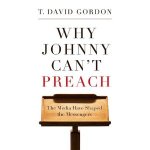
Review: Why Johnny Can’t Preach, by T.David Gordon

It’s a short book,108 pages, but it packs quite a punch.  T.David Gordon wrote Why Johnny Can’t Preach during a year of treatment for cancer.  Given only a 25% chance of survival, he found his focus clear and the desire to compromise his message absent.  The book is hard-hitting, but I found the tone entirely appropriate and not harsh despite the subject matter.

The writer is a media ecologist – that is, one who studies the effects of the change of media forms on the culture.  Taking his title from two books in the 1960’s on the growing inability of students to read and write, this book focuses on why the present state of preaching is so dire.

The first part of the book sets out his evidence for his claim that preaching is ordinarily poor.  While admitting freely that his first line of evidence is merely anecdotal, I found the presentation of evidence hard to argue with (not that I’m inclined to argue since my experience largely reflects the author’s).  Yet Gordon’s evidence is not merely subjective.  He goes to some pains to make clear that there are some objective measures of sermon quality that can be used to identify problem preaching.  It is too common to hear “that is just your opinion” if a sermon is ever questioned or critiqued.

The author’s argument culminates with the almost total absence of the annual review, not missing in any other profession, but indicative that all sides know there is an issue.  Gordon doesn’t blame seminaries for this state of affairs.  In his perspective they haven’t changed, but the calibre of incoming student certainly has.  What has changed?  Because of the change in media forms, Johnny is no longer able to read, nor write, nor discern the significant, and hence he can’t preach either.

True preaching requires close examination and study of a quality text, something non-readers have no experience of today.  People don’t study classical languages.  They don’t read literature.  They aren’t equipped to really study a text.   People read for content, but don’t learn to look at how a text communicates.

True preaching requires careful composition.  But people don’t write letters anymore.  They talk on the phone. Instead of careful composition, we live in a day of easy and cheap talk.

True preaching requires a sensibility of the significant.  But the only way to watch hours of television is to turn off such sensibility, so most do.

A once-common sensibility (close reading of texts) is now uncommon, and a once-common activity (composition) is now comparatively rare.  A once-common daily occurrence (face-to-face communication allowing us to “read” the unstated feelings of another) has been replaced by telephone conversation in which visual feedback is absent.  A once-common sensibility, the capacity to distinguish the significant from the insignificant, is becoming rare.  For a minister today to preach a basic average sermon by early-twentieth-century standards would require a lifestyle that is significantly countercultural.

The book is not solely concerned with capacity to study and compose.  The fourth chapter looks at the content of sermons and gives a fine rebuttal of four contemporary approaches – moralism, how-to, introspection and “so-called culture wars” . . . helpful content that I will come back to in other posts.

At certain points I would suggest that the author’s view of Christian preaching is a little narrow.  There is more to an inherently relational faith than merely submitting our will to God’s will.  Perhaps the Bible text, if read carefully, might present the heart of God such that our hearts might be changed in response.

Nevertheless, even taken on the author’s terms, the book’s message is important and needs to be considered.  All of us live in a fast-paced world that simply doesn’t allow for careful reading of God’s heart in His Word.  Perhaps it is time we were more counter-cultural in order to be able to read the text well.

Thankfully, T. David Gordon is still alive and serving the church through his teaching and writing.  We should be grateful for this little gem of a book.  Buy this book, perhaps even pass on a copy to someone else!

(If you are in the UK, click here to buy.)

Add to FacebookAdd to DiggAdd to Del.icio.usAdd to StumbleuponAdd to RedditAdd to BlinklistAdd to TwitterAdd to TechnoratiAdd to Yahoo BuzzAdd to Newsvine