Biggest Big Ideas – 7. Community

Woven through the warp and woof of Scripture’s great landscape are themes so glorious and rich that we can barely put them into words.  I’m trying.  What are the ten big ideas of the Bible?  God, creation, sin, grace, faith, redemption.  Where next?  I suppose it is obvious if we pause to consider what kind of God we have:

7. The glorious tri-unity of God reaches out to both create community, and to draw us into the community of His love.

God’s passion for beautiful unity in diversity brings the unlikely into unexplainable unity to reflect the good and pleasant bond of God’s fellowship.

In the very beginning, the conversation of God led to the creation of two creatures made in His image.  Male and female.  United to each other and to God by His Spirit.  Diversity, yet beautiful other-centred unity.  The image of God.  A wedding to start the story, but nothing like the wedding that will end it.

Sin drove distance like a wedge into the Edenic marriage, and the relationship with God.  The apparent freedom of self-love is a destructive prison of competition, fear, hatred, as well as the deafening silence and dark terror of living as the dead, alone in the coffin of our self-defined worlds.

So God has continually moved toward His creation, promising to create community beyond our wildest dreams.  He promised to bless all families through one man’s seed.  He promised to establish a kingdom of righteousness, even though his holy nation resisted the privilege of priesthood.

He is now calling out a bride for the Son He loves – the church, a temple of stones united in one God-inhabited structure of worship, a body of diverse yet valued parts united under one head, a bride of diverse peoples bound together by the captivating love of the beloved and longing for His return.

As God brought together Jew and Gentile into one body, His multi-coloured wisdom has quite literally been presented to a watching world and spiritual realm.  Where else can there be true unity between people long divided?  Where else can a world be taken aback by the mutual love of people so different and naturally opposed?  (Consequently where else is racism, or hatred, or political power-mongering, or falsity so unspeakably hideous?)

Unity among God’s people is not just a pragmatic idea – a means by which we can avoid losing energy for our greater mission of reaching the world.  Unity among God’s people is our greatest testimony in reaching the world.  Our unity speaks of His character and nature.  Our disunity screams a lie about God to a watching world.

So we long for the day when all the tribes of Israel and all the tribes and tongues and nations and languages of the church will reflect God’s unity and diversity in our eternal reflections on His worthiness around the throne and the Lamb.  This will be no cacophony.  This will be the most harmonious symphony of voices, of languages, of stories, of peoples…of one people, united in the world of God’s love.

There are not a few passages that address issues of unity among God’s people – from narratives of brotherly disunity to psalms celebrating the refreshing nature of brotherly unity.  From Jesus’ foundational instruction of squabbling disciples, to epistles extolling the glorious potential implicit in the gospel applied.

Let’s not preach unity as some pragmatic ideal for the sake of some other goal.  Let’s not preach unity as independent creatures tolerating each other.  Let’s recognize that God’s passion for unity flows from who He is, and what He’s making us to be.

Add to FacebookAdd to DiggAdd to Del.icio.usAdd to StumbleuponAdd to RedditAdd to BlinklistAdd to TwitterAdd to TechnoratiAdd to Yahoo BuzzAdd to NewsvineLike This!

Biggest Big Ideas – 6. Redemption

I’ve been blogging through ten of the biggest big ideas in the Bible.  Somehow every passage seems to touch on at least a few of these.  So far we’ve pondered God, creation, sin, grace and faith.  Today’s idea brings so much together, but may we never take it for granted:

6. In God’s great plan of redemption He brings home straying adulterous hearts into the fullness of His forever family.

The story of the Bible is the story of the redemption of humanity, but this doesn’t make it a story about us.  Primarily it is the story of God.

It is His promised grace that overcomes fatal sin.  It is His faithfulness to His word.  It is His self-revelation, His becoming flesh and His sacrifice that does what we could never do.  In the end it will be His bride presented to Him by His Father, and His kingdom presented to His Father.  The redemption story is God’s story, and it reflects God’s character throughout.

The salvation offered to humanity is a gift beyond compare.  Doctrines weave together into the richest tapestry, like the glorious righteousness in which we are clothed, and ultimately transformed.  What are the beautiful threads?

Justification speaks of the transformative conquering of sin and guilt in the gracious and righteous declaration of a hideous price fully paid.  Reconciliation speaks of the broken relationship restored to more than it ever could have been without the redemption story.  Adoption speaks of the gracious inclusion into the inheritance and provision of the divine family.  New birth speaks of the spiritual life transforming the dead heart into a living, beating reflection of the heart of our Abba.  Cleansing speaks of the inside-out purging of impurity.  Sanctification speaks of a precious and careful ownership.  Glorification speaks of magnificence yet unseen in the loving embrace of a giving God.

As you would expect of a triune God, the imagery of redemption’s story is saturated in relational colours.  Like a lost son we are arrested by a stunning display of our loving Father’s self-humiliating grace.  Like a straying harlot wife we are melted and won by our groom’s persistent love.  Like an enemy wishing Him dead, we are made His friends by His laying down of His life.

The problem of sin is so profound, and the solution so beyond the creature, that the whole of creation groans in anticipation of the redemption of the pinnacle of creation.  Yet how creation will sing when made new in the final answer to the question of rebellion.  Is there better life to be found apart from God?  Is there life at all?  No.  He is the life giver, and what lengths He has gone to in order to give us life!

Eternal life in the joy filled family of the truly life-giving God.

So when we preach a passage in the Bible, we preach a snapshot from the family album that tells the tremendous tale of God’s great love story.  Hallelujah, what a Saviour!

Add to FacebookAdd to DiggAdd to Del.icio.usAdd to StumbleuponAdd to RedditAdd to BlinklistAdd to TwitterAdd to TechnoratiAdd to Yahoo BuzzAdd to NewsvineLike This!

10 Biggest Big Ideas – 5. Faith

So what are the biggest recurring ideas underlying the whole sweep of Scripture?  I am enjoying tracing out a few thoughts on ten of the biggest.  So far I’ve pondered our triune God, His wondrous creation, our profound fall, His glorious grace.  Now to the mechanism of our restoration:

5. Every person in every situation stands at a fork in the road, free to trust God’s good word or to orient their hearts after the words of another – for the just shall live by faith.

In that garden the first couple were presented with a lie.  It was a lie about God’s character: He cannot be trusted to determine what is best for you.  It was a lie about human status: you can be like God.  And in God’s apparent absence it was a battle of words: His word versus the lie.  It has been ever since.

Every person in every narrative of Scripture stands at a fork in the road.  We stand continually at that same fork in the road, whatever the situation.  The question remains the same.  Will we trust the good word of God, or the forked tongue of the serpent.  The truth versus the lie.

What is God’s solution to the great problem of sin?  It is His grace.  Yet it would be no solution if that grace were forced on people.  They freely chose to love another.  So God offers His word and invites us to trust, drawing our hearts from the magnetic captivating grip of self-love to respond to His self-giving love.  Faced with the lie, gripped by the lie, saturated in the lie, we are invited to trust His Word.

Faith?  Seriously God, will you make it all dependent on fallen ones trusting in your Word?  Yes.  The word of God’s promise can be trusted.  The Word of God’s presence calls us to trust.  Just as the serpent skewered and lifted up was a solution for snake-bitten sinners, so the snake crushing elevation of Him who knew no sin becomes for us the focus of a trusting gaze.

So faith is absolutely the antithesis of works.  Works can never be a ladder out of death.  Only God can raise the dead, so He calls humanity not to work, but to trust.  Faith is not the answer to what must I do?  Faith is the answer to the cry, I can do nothing!

God is God, we are not.  God is good, we are not.  And God is ours, if we will trust Him, His word, His provision, His grace.  Faith is trust in His Word.  Faith is gaze on His gracious provision.  Faith is the bond that brings us into the fellowship of our Triune God.

May our preaching of His Word offer opportunity to trust in His goodness, both for those dead in sin, and for us who now having been made alive are delightd to do the good that He prepared beforehand for us.

Add to FacebookAdd to DiggAdd to Del.icio.usAdd to StumbleuponAdd to RedditAdd to BlinklistAdd to TwitterAdd to TechnoratiAdd to Yahoo BuzzAdd to NewsvineLike This!

10 Biggest Big Ideas – 4. Grace

This week I have been pondering what might be the overarching, biggest of big ideas in the Bible.  These ideas pervade so much of the canon and are reflected in the specific main ideas of individual passages.

So far we have pondered God, creation and sin.  Now to the continual surprise of the Bible:

4. God’s solution to great sin is the greater power of His glorious grace.

God’s right to rule has been profoundly challenged by the rebellion of Lucifer and humanity.  Surely if God is God then the response from above must be the crashing fist of divine judgment?

Surprisingly, yet unsurprisingly, God’s solution is grace.  Surprisingly because in our power-hungry corruption of the divine image, we naturally would judge all sin in a self-serving display of divine wrath.   Unsurprisingly God is not like the fallen us, but He is just like Himself – that is, self-giving, generous, the God who is love.

Yet surely this is to deny another side of God, another mood of His?  Surely we must balance God’s love with God’s wrath?

No, we do not honour God by offering a schizophrenic portrait of a two-sided God.  Nor do we help by making the Father angry and the Son kind. We must instead seek to present God as He does in His Word.  God’s love spurned leads to wrath, but this shows the fullness of His love, not the reining in of love.

The holiness of God is His perfect, untainted, uncorrupted love.  This profoundly loving God has a purity about all He is and all He does.  So the prophets presented both the muscly arm of divine recompense, right alongside the arm that tenderly cares for the sheep that have young.  And the climax of that prophetic vision is not the crashing down of the fist of divine judgment on sinners, but the outstretched arms of the Lamb upon whom that fist would fall.  All sin will be judged, the wonder is that mine is judged already.

We should always be surprised by grace since it is by definition undeserved.  We should never be surprised by grace since it comes from the core of who God is.

There are glimpses of grace in every corner of the canon, whispers of love when screams of vengeance would fit.  Threaded from the fall in one garden to the rising in another garden is the ribbon of God’s great promise:

In a fallen world there is hope in the coming seed.  There is to be blessing for all the families on earth through the seed of one man.   There is hope for the firm and forever establishment of the kingdom of the seed of another man in the same line.  The ribbon of God’s great promise threads through sinning kings and trusting prostitutes, through flawed heroes and unknowns, showing grace on its journey to grace made flesh in the single seed of the woman, of Abraham, of David.  The seed that must fall into the ground and die, yet in humiliating death demonstrate the depth of God’s glory.

The great corruption of sin marks every passage, and the super-abounding solution is not raw justice, but unjust grace.  God in His goodness moves toward his harlot creation in love, giving of Himself, so that the greatest of sins pale before the greater glory of God’s goodness and grace.

If we preach the Bible with a pounding fist of self-righteous indignation, what are we doing?  Surely the Bible preached should lead to a pounding of the hearts of those captivated by God’s extravagant grace.

Add to FacebookAdd to DiggAdd to Del.icio.usAdd to StumbleuponAdd to RedditAdd to BlinklistAdd to TwitterAdd to TechnoratiAdd to Yahoo BuzzAdd to NewsvineLike This!

10 Biggest Big Ideas – 3. Sin

The 10 biggest ideas in the Bible?  We’ve considered God and His creation.  Now we need to probe the problem.

3. Our profound capacity for love has been perverted into a self-love that drives a charade of independent divine status, in mockery of and in sickening rebellion against the loving leadership of our good God.

Within three biblical chapters God’s perfect creation is corrupted to the core.  It is corrupted from the core.  And the story of God’s resolution to our relational rebellion takes the whole canon to fully resolve, leaving only two chapters for the briefest glimpse of a post-fall new creation.  This is the great tension in the grandest of meta-narratives.

Lovingly created for relational interdependence and trusting dependence, the human race is marred by love perverted and trust destroyed.  The manifestation of the fall, the fruit, if you will, was in the eating of the forbidden fruit.  Yet the core of the event was at the level of the heart, not merely a matter of rule-breaking.  The corruption was caused by a love turned inwards, by a rebellious spurning of God’s right to rule in love, and by a fatal distrust of His good Word.

A God-given capacity to love another, delight in another, live for another, trust in another and give to another was twisted, perverted and corrupted.  It became the horrific reorientation of the power of divine love into a love of divine power – shamefully manifesting in a love for self, delight in self, living for self, trusting in self and giving to self.

Now the god of a human heart is the perceived good of that same human heart.  Instead of lovingly trusting a loving and trustworthy self-giving God, the default wiring of humanity is to hate and despise Him, performing the charade of god-hood as if that is really about self-concern, independence and power.  Even the pathetic performance shows a profound corruption of God’s true nature.

Believing the lie, we present a lie.  Every person a theologian by birth, and every person profoundly wrong.  God is not self-concerned and power-obsessed – it’s not just the “who is God?” question we answer so badly, but also the “what is God like?” question.

Sin re-orients the heart, taints the mind and manifests in broken behavior.  Some shake their fist at heaven in acts of overt rebellion, demonstrating the horrific and grotesque nature of sin by the evil that they do.  Others shake their fist at heaven in an act of apparent goodness, diligently demonstrating their ability to do good in a self-loving independence from the God who alone is good.   Even righteous deeds are as filthy rags.  Whatever is of independent un-faith is sin.

Sin is the tension in every biblical narrative, and every personal narrative.  It isn’t a question about whether we can do good, or whether we can be empowered to do good.  It is a question about what or who can ever recapture our hearts and draw our incurved souls from addiction to self, to gaze on the truly lovely, the genuinely loving and the profoundly trustworthy God who made us for participation in His love.

So as we preach the Bible we must never miss the fallen condition focus of every passage, the context of sin in which every text swims.  Neither must we offer any sense of instruction for independent goodness, for that was the root of the issue.  Sin is pervasive and profound, and God’s solution is glorious beyond words.  Yet we preach.  We preach . . . you finish the sentence: “we preach . . . and Him . . . .”

Add to FacebookAdd to DiggAdd to Del.icio.usAdd to StumbleuponAdd to RedditAdd to BlinklistAdd to TwitterAdd to TechnoratiAdd to Yahoo BuzzAdd to NewsvineLike This!

10 Biggest Big Ideas – 2. Creation

I am slowly offering what I think might be the ten biggest ideas in the Bible.  I encourage you to write your own list, the process is a real joy.  Yesterday I wrote about God and His self-giving goodness.  I need to develop one aspect from that post:

2. Even in its current corrupted state, God’s creation reflects God’s heart and nature.

Those who start with a generic God born of human speculation will tend to emphasize the power of God.  Often this truth grows so loud that other truths are drowned out.  Yet the God of the Bible doesn’t seem as passionate about His own power as some might suggest.  He is all-powerful, of course, but that is defined and driven by the loving relationality of the unity of the three – Father, Son and Spirit.

The giving and overflowing love of the Three-in-One speaks a word, and an abundantly diverse and beautifully united creation into existence.  His eternal power is seen in the stunning reflection of His divine nature – with its vibrant, abundant, giving, creative, procreating, beauty.

Yet the beauty of creation is merely a stage for the most powerful beauty of all – the wonder of loving relationship.  Creation is the stage for the relationships of creatures made in the image of a relational God.  So every field, every mountain, every sunset, every vista, is a delight best experienced alongside another with whom God’s creation might be enjoyed.

We live in a broken, corrupted and perverted creation.  Even through the death and the brokenness, we still see overwhelming beauty – from the abiding grandeur of the milky way, to the unique features of an individual leaf.  Yet it is not only the lingering beauty that captivates, it is also the smothered whisper of what could be and should be.

The greatest pain is not that felt in a dying body, or that of a marred creation, but the deepest agony of broken relationship.  Sadly we may experience the worst of fallenness in our bodies, or see the most grotesque disfigurement of creation, but every human inherently feels the deepest agony of all in the context of broken relationships: with friends, with family, with God.

Creation stirs us, yet creation itself groans.  It groans to be the stage of what could be and should be, and by God’s grace and power, one day will be.

The Bible repeatedly returns to the relationship of creation to God – He made it, He owns it, He stamped it with His imprimatur, and He will pour out life to overcome death.  Our hope is the new creation, the stage for a greater joy than could ever have been known in Eden.

So we preach a Bible that is earthed, quite literally.  Both the past stories, our present experience, and our shared future hope, is well earthed in a world that reflects more about God than we usually even begin to notice.  One day we will.

Add to FacebookAdd to DiggAdd to Del.icio.usAdd to StumbleuponAdd to RedditAdd to BlinklistAdd to TwitterAdd to TechnoratiAdd to Yahoo BuzzAdd to NewsvineLike This!

10 Biggest Big Ideas – 1. God

Every passage has a unique main idea.  But are there thousands of completely different main ideas in the Bible?  Haddon Robinson said several times that there are basically variations on roughly ten big Big Ideas in the Bible.  We students kept trying to get a list out of him, but to no avail.

So I’ve decided to suggest my own ten.  As you read through the Bible you may come up with a different list, but I suspect these macro main ideas are recognizable to all who are reading the Scriptures.

1. Everything is defined in relation to the triune God whose relational nature overflows into all that He has made.

The Bible doesn’t argue for the existence of some generic divine being, but assumes the existence of the one true God.  He is a God who exists in the loving communion of Father and Son and Spirit.   God is not only inherently good, His loving bond is the very measure of goodness.

It is out of this relationship that creation comes, the unrequired but unsurprising act of a loving and giving God.  Creation reflects His creative artistry, His generous power, and His delight in blending diversity in beautiful unity.  Even creation in its present corruption demonstrates the pervasive power of relationship.

Yet creation is not all God gives to enable us to know Him.  His nature and character is revealed definitively by the Son who always reveals the unseen Father to us, and His Spirit who points us to the Son.  Both the Son and the Spirit are given into a fallen world in an act of deep generosity.

It is out of God’s nature that the whole human story makes sense.  Created as loving responders, humanity has a wondrous capacity for love and joy and delight and response.  Equally, as true heart-driven beings, humans have an equally profound capacity for hate and grief and sadness and diverted affection.

It is not possible to make sense of creation without seeing it in the context of God’s goodness and the profound impact of creaturely rebellion.  It is not possible to make sense of any human without seeing him or her in the context of their relationships, especially the pre-eminent relationship with God himself.

Not only is every aspect of creation, and every human, defined by their response to God, so is every event only understood in light of God’s role.  So every narrative in Scripture is primarily a narrative about God, even when He is not mentioned.  Every character is either trusting Him or not.

Consequently every biblical sermon has to be, above all else, a sermon about God.  Technically this is called Theocentric preaching.  The term doesn’t matter.  God does. And not just any God, or even some assumed generic God of human speculation, it must be the triune, covenant making and keeping, self-giving God who is love.

Let’s be sure to preach every passage with a profound prayerful awareness of the God whose Scripture it is.

Add to FacebookAdd to DiggAdd to Del.icio.usAdd to StumbleuponAdd to RedditAdd to BlinklistAdd to TwitterAdd to TechnoratiAdd to Yahoo BuzzAdd to NewsvineLike This!

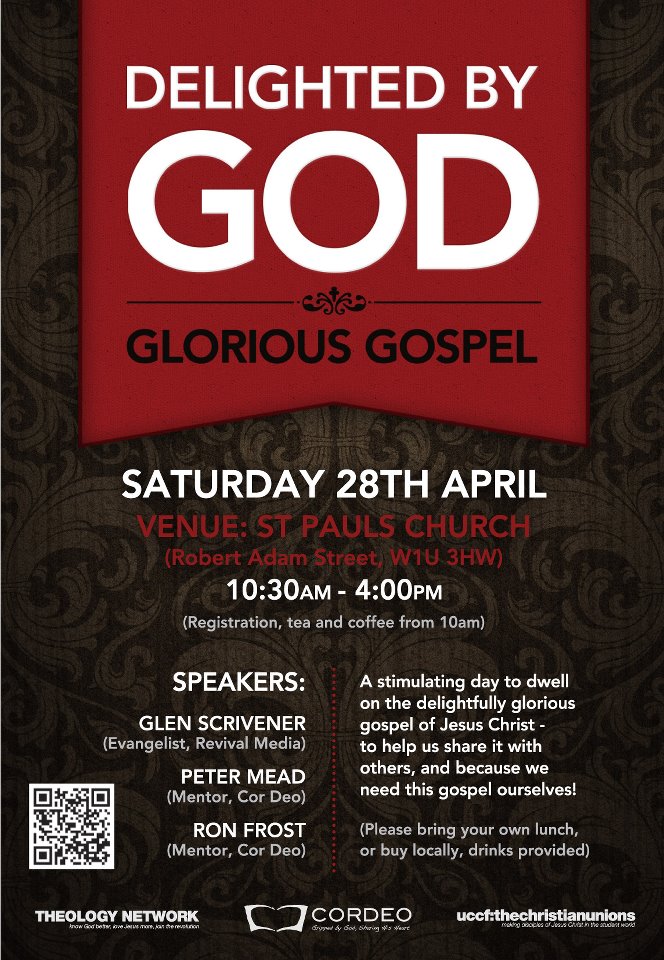
Saturday Short Thought: Glorious Gospel

In a little while I’m heading to London to speak at a Cor Deo Delighted by God conference.  Our subtitle for the day is Glorious Gospel.  I am excited to hear the other sessions and to ponder together just how glorious the gospel really is.

What it comes down to, I suppose, is how glorious our God is, and what kind of gospel He has given us.  Too often the presentation of the gospel I hear is less than glorious.

It seems like a negotiation between a willing sinner and a reticent God.  The sinner is willing to say some words in order to gain a significant package of benefits.  And God is open to some sort of a contractual deal, but really is essentially resistant without the intervention of a kind lawyer working for us.

This is such a corruption of the truth.  God’s initiative is critical, and the extent to which He has gone to overcome the resistance of the human heart is stunning.  And as for the language of contracts, let’s dump that in the grip of His fatherly embrace!

The gospel is wondrously glorious, but it’s the kind of glory that involves His being high and lifted up, in absolute self-giving humiliation.

Let’s be sure we don’t preach a watered down, or petty, or negotiated gospel.

PS We’d really appreciate your prayers for today’s conference to go well!

_______________________

Next Week: The 10 Biggest Big Ideas

In the classroom Haddon Robinson said more than once that there are basically eight to ten big big ideas in the Bible.  He never gave us a list, but I’ll offer mine starting on Monday.  What would you include?

15 Ways to Improve Clarity

This week I’ve been writing about the doctrine of Biblical clarity – the fact that the Bible may be understood.  This is a cause for great rejoicing.  Imagine for a moment that the Bible was absolutely impregnable.  Anyway, one of the points I made the other day was that preachers are representing a God who made His book understandable, so we should model a passion for clarity in our communication.

Let’s have a rapid-fire list of factors that influence our clarity in preaching.  I’ll start, you finish:

1. Voice. If it isn’t loud enough, and distinct enough, it isn’t clear enough.

2. Vocab.  Don’t try to impress, try to communicate.  Jargon doesn’t help, good word choice does.

3. Preaching Text.  If you stay in your text as much as possible, it should be easier to follow.

4. Structure. A memorable outline remembers itself, there’s no need to be clever, be clear.

5. Main Idea. One controlling, dominant thought, distilled from the passage is critical for clarity.

6. Unity. Let every element of the message serve the main idea, nothing extraneous.

7. Order. Take the most straightforward path through the message, so others can follow.

8. Transitions. Slow down through the turns or you’ll lose the passengers.

9. Pace. Sometimes you really need to take the foot off the pedal to keep people with you.

10. Visual Consistency.  Keep your gestures and scene “locations” consistent to reinforce well.

11. Verbal Consistency.  Let key terms rain down through the message, don’t be a thesaurus. 

12. Restatement. Restate key sentences in different words, less patronising, but helps clarity.

13. Illustrative Relevance.  Be sure illustrative materials have clear connection to the message.

14. Flashback and Preview.  Whenever appropriate, review and preview at transitions.

15. Pray.  Pray for message clarity during preparation, God cares about this!

That’s a start, what would you add?

Add to FacebookAdd to DiggAdd to Del.icio.usAdd to StumbleuponAdd to RedditAdd to BlinklistAdd to TwitterAdd to TechnoratiAdd to Yahoo BuzzAdd to NewsvineLike This!

Clarity: More Than Thinking

Yesterday I offered three implications of the doctrine of Biblical clarity for us as preachers.  Since the Bible is written by a master communicator who made sure it could be understood, therefore we need to work hard at understanding, we should help others know it can be understood, and we should strive to be clear in our own preaching.

There’s one more issue that I wanted to add to the list.  This might be the one we need to ponder more than the others.  Clarity is not really about intellectual capacity.  The brightest scholars can make the biggest mess with interpreting Biblical texts.  The simplest Christian can profoundly understand God’s Word.

Intellect is a blessing, but it is not a requirement.  Formal training is a privilege, but it is not the definitive necessity.  Reference resources are helps, but they are not preconditions for understanding.  We have to grasp the fact that understanding communication is not an exclusively brain-defined exercise – our brain, or anyone else’s.

Dr B may be a very intelligent individual.  Mr S may never have finished school and struggle to read.  But which of these two is most likely to understand the nuances of Mrs S’s communication?  Probably the husband who loves her.

4. Preachers have to both recognize and model that understanding is not primarily a matter of intellectual capacity or formal training, but alignment of heart by the Spirit.  We can so easily purvey the notion that scholarship and intellect are pre-eminent distinctives of effective biblical study.  The Word of God makes wise the simple.  But there is a profound spiritual and relational aspect to understanding the Bible.

Notice how Jesus speaks of the role of the soil in the parable of the good soils (Matthew 13, Mark 4, Luke 8).  In his explanation the repeated issue is their hearing.  He continues on in Mark and Luke to speak of a lamp under a jar, then returning immediately to the issue of hearing.  He warns them, “Take care then how you hear, for the one who has, more will be given, and from the one who has not, even what he thinks that he has will be taken away.”  

So how is the good soil defined?  In Matthew it is the one who hears and understands.  In Mark, it is those who hear and accept. In Luke, it is those who hear the word, holding it fast in an honest and good heart.

As preachers we can easily give the impression that the issue is intellect.  It isn’t.  The real issue is the alignment of the heart, its responsiveness to the God whose word is being spoken.  It is more about Spirit enlivened relational capacity than genetically transferred intellectual capacity.  As preachers of God’s Word, we must both recognize and model that.

Add to FacebookAdd to DiggAdd to Del.icio.usAdd to StumbleuponAdd to RedditAdd to BlinklistAdd to TwitterAdd to TechnoratiAdd to Yahoo BuzzAdd to NewsvineLike This!