Three Versions of Divine Marriage

divine-marriage-300x300The Bible’s favourite analogy for the relationship between God and His people is marriage.  We have certainly mentioned this before on this site.  God’s great plan is to call out a bride for His Son from a fallen and sinful humanity.  God’s great promise throughout the Bible is that you shall be my people, and I will be your God.

It is a beautiful image.  I want to ask, though, what image comes to mind when we consider the Christianity we are presented with and experience?  I want to offer three human level pictures to highlight the variety of versions of Christianity . . . click here to see what they are.

Worldly Church

Worldly-Church1-300x225Another recent post on the Cor Deo site:

On a normal street in a town near somewhere, there is a church.  I won’t describe the building in any detail because this may cause you to either disassociate yourself from it and start pointing the finger at others, or to feel like I am pointing my finger at your type of church.  Let’s just say it is a church not unlike yours or mine.

This post presents an analogy that may be more than a bit relevant to how we preach on sin in our churches.  Click here.

Jesus the Nazarene

Jesus-the-Nazarene-300x252Just catching up on Cor Deo posts, in case you missed any:

Why does Matthew end his great Christmas narrative with a whimper?  Other sections of his gospel finish with strong summaries, so why not the first two chapters?  Why have a great story end with some geographical details, an obscure reference to an unidentified prophecy and a comment about Jesus being called a Nazarene?

 This post ponders the impact of this great enigma of biblical interpretation in the gospels.  Click here to go to the post.

The New Normal

The-New-NormalThis week I am catching up on posts I have written for the Cor Deo blog in the past few weeks.  Just in case you missed one . . .

Everyone assumes their perspective is a healthy and balanced one.  If we can see one person off in one direction, and another off in the other, we must be the one holding the privileged position of balance.  But maybe we need to take an often-overlooked factor into account.

This post ponders the impact of living in a post-Genesis 3 world . . . a reality that should impact every sermon we preach!  Click here to go to the post.

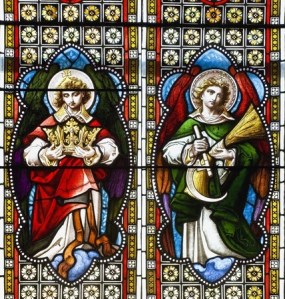
Don’t Stain Glass the Bible Folks

StainedGlassLots of Christians have a habit of “stained glassing” Bible characters.  Sometimes it seems like pretty much anyone other than Jezebel and Judas Iscariot will get a free pass and find their actions vindicated by believers.

Why does this happen?  Perhaps it is the result of Sunday School training that can sometimes turn the biblical narrative into myth-like stories with morales based primarily on character behaviour.  Perhaps it comes from too easily assuming that faith in God is a binary reality whereby any faith in an individual equates to full faithfulness, rather than recognising that God patiently works with people who are in the process of learning to trust Him rather than themselves.  Perhaps we are just nice people who assume almost everyone in the Bible is a nice person too (i.e. you have to be overtly evil to be anything other than laudable).  Perhaps it comes from forgetting that the primary character to focus on in the Bible is God, rather than the people, so that the people become models for our actions where perhaps they shouldn’t.

So where does this happen in the canon?  There are countless examples, but let me prod our thoughts with a few characters that tend to get “stain glassed.”

The Patriarchs – Abraham responds to a call from God, but when does he really trust God’s promise?  Sure, he moves with his family a long distance, but it is only after he separates from his family that God follows up with him.  Then it is another while before Abraham seems to finally trust God’s promise about his seed.  So between his initial call and his being declared righteous by faith there is the bizarre incident with giving his wife away in Egypt.  Abraham is on a journey, a faith journey.  And if we try to sanctify his decisions and affirm it all, then we may upset the wives in our congregation, and misrepresent the text.

Other OT Characters – Ruth was amazingly godly, but was Naomi acting by faith when she setup a very compromised situation?  Do we want to affirm everything about Mordecai and Esther?  Heroic and courageous?  Certainly.  But deeply faithful?  Worth pondering.  Nehemiah always gets lauded as the ultimate leader, but what legacy did he leave in respect to the hearts of the people, as well as the building project?  Was Jonah just reluctant, or was there a heart issue with him, in contrast to the character of the God he ended up somewhat representing?

Disciples – This is an interesting category.  Perhaps it is an anti-category.  That is, often I hear the disciples being treated like dunces when we treat them as if they should have fully grasped the content of all four gospels before the gospels were even written!

The Bible is full of real people with real issues and real messy mixed up faith responses, and for that we should be profoundly thankful.

Courage and Preaching Tone

ToneHead2This series of posts has pondered the issue of preaching tone.  I’ve suggested we should understand the tone of a text and consider carefully the tone of the message.  Communication between people is rarely, if ever, purely informational.  Communication from God is never dispassionate.  He cares about people who will listen to our preaching.  So as well as considering the tone of the text, the situation of the listeners, and the tendencies of ourselves as preachers, we also need to pursue God’s heart in respect to the sermon.  What does God want to happen?  What tone would reflect his concern for the situation?

So to finish, let me highlight a danger and then two things to pray . . .

Danger: Considering the tone of a presentation is vitally important, but it does open up the dangerous possibility of inauthenticity.  If I am going to say something important to my wife, I would be foolish to not consider how the tone will come across.  But once I start thinking about tone, there is always the danger of faking something and launching into a performance.  When it comes to preaching, a performance never represents God well because God does not pretend.  God does not fake emotion.  When God speaks, God speaks with pure and authentic passion.  If we pursue “effective preaching” by looking at matters of tone, then we are in danger of inauthenticity unless we are gripped by the conviction that we must represent God not only in what we say, but by our character as we speak.  Though flawed and broken, somehow we get to speak for God.  Ambassadors.  We represent.  This kind of danger demands that we be prayerful about the privilege of preaching.

Prayer Point 1: Discernment.  Pray for God to give you discernment.  To be able to discern the intent of the biblical author and the need of your listeners.  And to be able to discern God’s heart for them, as well as God’s perspective on you.  Instead of asking God to be able to discern the state of your own heart as you approach a preaching engagement, better to ask him to do the searching and trying and weighing and to lead you into a place where you can preach in a way that represents his heart most effectively.

Prayer Point 2: Courage.  It is much safer and easier to preach dispassionately as if preaching were mere presentation of material.  Arms length.  Uninvolved.  But preaching calls on us to love people enough to be real with them.  It calls us to preach as one who represents Christ the Word of God.  Just as Christ was not universally loved by the lost and by the religious, so we might find our hearts trampled as we give ourselves away in preaching ministry.  That takes courage.  Pray for it, because the Lord knows what its like to represent the Father well and to suffer as a result.

Preaching and the Tone of the Message

ToneHead2So assuming we agree that the tone matters, how are we to arrive at the tone of a message?  Three steps are needed here:

1. Consider the tone of the text.

As we develop sensitivity to the text and the setting of the text, we should be increasingly effective at grasping the tone of the author.  We need to go for a humble confidence rather than a brash confidence in this.  We are looking at lots of factors and weighing them up.

2. Consider the listeners to the message.

Who are you preaching to, and what is the occasion of the sermon?  Sometimes the occasion will influence the tone significantly (i.e. a funeral), sometimes it will be less significant.  It is not enough, though, to figure out the tone of the text and replicate that.  That text needs to be preached with sensitivity to these listeners.

3. Consider yourself as a preacher.

What is your natural or default tone?  Do you have a theological bias?  For instance, do you see everything as duty and expectation?  Do you see everything as gentle and joyful?  Do you turn any passage into a guilt trip?  The better you know yourself, the better you will be at selecting tone on purpose rather than defaulting into a tone that is less than helpful.

When you have evaluated all these factors, then there is still a bit more to consider.  Next time I’ll blog about the dangers and the needs as we think about preaching tone.

Preaching Tones and Texts

ToneHead2This series is not about “adding tone” to lifeless letters and words.  It is about recognizing the tone of the text, and then being sensitive to the impact of our tone as we preach that text.  Here are a couple of example contrasts:

1. Tone of writer: Galatians and 2 Timothy.  This is perhaps the two extremes in Paul’s writing.  In Galatians Paul is very upset about the false teachers.  He forsakes convention to deliver a stinging astonishment statement in 1:6 instead of the standard thanksgiving opening.  In chapter 3 he is questioning who has cast a spell on the believers who he obviously loves deeply, but is so concerned about.  And by chapter 5 he makes the strongest remark in all of his writings, again about the false teachers.

Compare that with the sensitivity of Paul in his later letter to Timothy, beloved Timothy.  He writes about false teachers there too, but the tone is completely different.  He is concerned, he is deliberate, he is urgent, but he is gentle at the same time.  Paul wanted both letters to get through – one as a wake-up call, the other as an encouragement.

2. Imposed tone of preacher: Hebrews and Ephesians.  One example of how we can impose a tone that contradicts the material we are preaching can be seen when we think about these two letters.  Hebrews is a sermonic message designed to encourage and warn.  It startles.  It urges.  It paints pictures and explains a small number of specific Old Testament texts in such a way as to urge the believers on.  But preachers can bring in a foreign tone – one of theologically dense intensity that loses the energy of the original letter/sermon.

Or think about Ephesians.  The opening sentence in 1:3-14 is abundant in language choice.  The grace of God seen in the choosing, the giving of the Son, the giving of the Spirit, is lavished on believers.  And what might we do with it?  To be honest, too many of us turn it into a sterile detailed presentation of a theological doctrine triggered by one or two key words in the passage.  I wonder if the Ephesian elders would recognize our presentation of it?

Tone matters.  The tone of the text.  And the tone of the preacher.