Exegesis Homiletics

I am currently preparing a course that I will be teaching at the end of October – Hermeneutics for Preaching.  I came across this very important reminder in Grant Osborne’s Hermeneutical Spiral (p343):

“The hermeneutical process culminates not in the results of exegesis (centering on the original meaning of the text) but in the homiletical process (centering on the significance of the Word for the life of the Christian today).”

To some of us it is obvious that there must be a direct link between exegesis and homiletics, but we all need the reminder.  C.R.Wells, in Interpreting the New Testament (edited by Black and Dockery, pp506-523), writes the final chapter on interpretation and its connection to preaching.  He warns of some critical approaches that will produce “tempting” content for sermons, but content that should not be included.  However, critical methods that deal with the “text-as-is” have great potential as tools of the preacher.  According to Wells, “Every preacher should and must be a critic, but no preacher should ever forget that critical study serves homiletics.”

Accurate interpretation governs expository preaching.  So two simple implications:

1. Don’t allow interpretation and exegesis to be an end in itself. Study in God’s Word must run its course, not only to personal application, but to communication for corporate application.  If you have opportunity and ability to preach the Word, do it.  If you don’t, then find another way to share the truth and its implications with others.

2. If you ever preach, then be an ever-improving interpreter and exegete of God’s Word. Don’t try to preach without the foundation of biblical interpretation under your efforts.  Preaching is more than sharing the fruit of exegetical work out loud, but it cannot be less.  Skill in communication, relevance in content, personal spirituality and prayerful preparation are all important, but without effective biblical interpretation undergirding your messages, don’t call it preaching.

Avenues of Audience Analysis

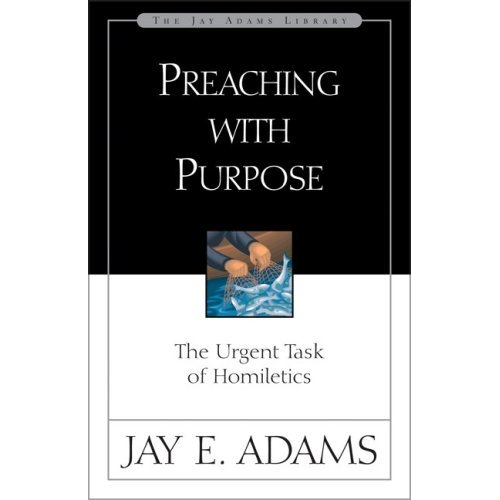
In order to preach effectively, we must be at home in the world of the Bible, and in the world of our people.  We need to know them.  Jay Adams, in Preaching with Purpose, suggests three principal ways to analyze the congregation to whom we preach.  Perhaps it’s worth evaluating our own ministry through these categories to see where we might be missing out on helpful understanding of our listeners?

1. Informal contact with people. More than just rubbing shoulders on a Sunday or in church activities (where people tend to act the way they feel they should), this means getting into the normal lives of the people in the church.  Spending time with people at home, at work and at play is time well spent.  Without probing or surveying, plenty of useful insight will emerge in this natural environment.

2. Counseling contact with people. Not surprisingly from Jay Adams, he sees the value of counseling people.  Obviously confidentiality must be respected, but analysis of counseling notes will point to trends, concerns, areas of struggle.  He points out that just as preachers are helped by counseling, so counselors are helped by preaching.  If a counselor does not preach then they are in danger from not doing the deliberate and regular biblical exegesis they need to be biblically solid in their ministry.

3. Formal contact with people. Finally, Adams advocates for doing systematic, deliberate analysis of the congregation.  When first arriving in a church it is important to analyze the congregation and review the diet they have received from the pulpit.  Then regular surveys of key people, probing of elders, and so on, all helps to fill in the picture for the preacher.

Do we take “audience analysis” seriously?  Is there one approach, of these three, that needs more deliberate effort on our part?

Holding Back the Obvious

Sometimes a passage very obviously points beyond itself.  For instance a passage with an obvious parallel to today, or a passage that points forward to Christ.  Psalm 22 is a classic example of the latter, or Genesis 22.  It is natural to make the obvious connection from the start and repeat it throughout.  Sometimes this is very worthwhile – especially when the parallel is to today.  Highlighting and emphasizing the applicational relevance of a passage is usually very helpful (rather than holding out until a few brief applications at the end).  However, if the application is obvious, it may be worth holding back before you state it.  Certainly when your passage obviously pre-figures Christ in some way, it is worth considering holding back on the mention of Christ.

Why?  Three reasons.

First, it is good for the congregation to see that a passage has value in its own right, without having to overtly read it through New Testament glasses that were not available to the original readers.

Second, it is good for the sermon because if the connection is clear, then the listeners will be thinking about that as you go, perhaps wondering if you are missing the obvious.  This added tension can really maintain interest in the sermon.

Third, it is good for you as a preacher, because it allows you to “pack a punch” when that tension is finally resolved.  References throughout the message will add explanation, but will reduce the impact.

For the sake of demonstrating the value of a passage in its own right, for added tension and for added impact, it is often worth holding back the obvious, especially when the obvious is Jesus.

Non-Words

Last night I was watching the first half of the God Delusion Debate between Richard Dawkins and John Lennox.  It is interesting on a number of levels, but I’ll just mention one.  Dawkins hesitates way too often.  Um, ah, uh.  So far Lennox has not.  It makes a difference.  I’ve been following the US presidential race and reading analysis of the communication involved.  The media’s favorite candidate uses many non-words, but the newest participant in the race does not.  It is making a difference.  In the UK I’ve noticed that some people seem to revere the skill of using non-words and hesitation (think of the last university students you heard interviewed – they often do it).

The manner in which we communicate influences listeners at both the conscious and sub-conscious level.  Since we do not want to undermine the truth of what we say when we are preaching the Word of God, let’s be vigilant for non-words.  Figure out whether you use non-words or filler-words.  Perhaps identify your personal, uh, like, you know, favorite.  Then wage war against it.  Mean what you say and say what you mean.  It’s not just about wasting words, it’s also about undermining the good things that you are saying.

When In Doubt, Sound It Out

Sometimes preparation grinds to a halt.  You feel like you’re drowning in a sea of paper, half-finished thoughts, words and scribbles everywhere.  Even with a good system for organizing your pre-sermon study and message notes, it is still possible to feel stuck.  You’ve gone from a sprint to crawl and the open expanse before you now feels like a brick wall in a cluttered alley.  I don’t think I am alone in experiencing this roadblock in preparation.

There are lots of tips that people share, but one stands head and shoulders above the others from my perspective. Of course you should pray, it may be wise to do something else, perhaps get some exercise to clear the brain jam or even sleep, the natural thought organizer.  But head and shoulders above them all (or at least one always worth trying in combination with some of the others) – use oral preparation for oral communication.

It’s not surprising that words on paper sometimes feel overwhelming when we are actually preparing for an oral form of communication, not a written one.  So stand up, Bible in hand, and preach it.  It may still feel jumbled and confused, but it is amazing how quickly a flowing and organized message can form when it is formed orally rather than on paper.

Then you can shift into reverse and write your notes and/or manuscript!  It is worth going back to paper for a couple of reasons.  Sometimes you can really nail it orally, but then be unable to do so again.  The discipline of going back to paper helps to cement the preparation.  If you understand that an outline is simply a representation of thought structures, then it should be straightforward to outline a series of thoughts that have formed in the oral presentation.  Furthermore, even if you preach without notes, the discipline of writing the outline or manuscript will provide a focus for further preparation, and a record for future re-preaching of the same passage.

Oral preparation need not replace paper preparation, but it can act as a turbo boost to the preparation process!

The Lesson of the Soils

In the synoptics’ parable of the sower, the one variable is the soil.  Same sower, same seed, but different soil.  The variable results therefore point to the state of the soil as a critical consideration.  I don’t intend to do anything like a full exegesis here, more of a pondering on the truth already stated.

There are implications in this for those that listen on a Sunday morning. What can be done to encourage them to come to the sermon with open and expectant hearts?  Surely there needs to be an ethos in the church that the Bible is for the church.  It’s not for academics to dissect in their ivory tower exegesis labs.  It’s for the community of God’s people in the real world, looking for real help, real insight, real spiritual food, real input from God.  This morning I enjoyed listening to a series being introduced at a good church – one of the speakers quoted Karl Barth, “If we expected to hear God’s Word more, we would hear it even in weak and perverted sermons.  The statement that there was nothing in it for me, should read that I was not ready to let anything be said to me.” I don’t share that to spark a debate on neo-orthodox conceptions of God’s Word, but to put a finger on the attitude of the heart in listening to the Bible preached.

There are implications in this for those that listen before Sunday morning. Surely our churches need to be encouraged to listen well, to be good hearers of God’s Word as it is preached to them.  But that same encouragement must also be pointed our way.  We are real people, in a real world, with real challenges and real spiritual needs.  We do not sit in anything even slightly ivory or lab-like as we prepare to preach.  Like others, we too sit under God’s Word as listeners, as hearers.  Let us make sure we have expectant hearts and an eager openness to be shaped by the Bible passages we study.  Right now I am studying Joel and preparing a series in this little power-packed book.  I must prayerfully listen well, before I dare to speak it to others.

The one variable is the soil.  Always.  Theirs on a Sunday morning, the world’s as we witness to them, but ours too as we sit under God’s Word, listening as we prepare to speak.

Preaching Warning Passages

I was just reading a little commentary on Joel by Thomas Finley.  On page 38 he makes a comment that is worth our attention as preachers.  It’s not new, it’s not profound, but it’s easy to leave this out of the equation as we evaluate our ministry.

According to Finley, the prophets, such as Joel, “had the power as preachers to motivate people to repent on the basis of warning them of the judgment to come. Although the New Testament focuses on the Lord’s grace and mercy, the warnings of judgment are not absent there either. In light of Joel and the rest of Scripture, one might wonder whether contemporary pastors who tend to avoid “fire and brimstone” preaching in favor of a steady diet of mercy and forgiveness provide an incomplete presentation of God’s Word.”

While we must recognize that culturally our listeners have changed over recent decades, and consequently their appreciation for a dramatic and aggressive pulpit pounding has dropped, this does not mean we cannot preach warning of judgment.  The culture in which we preach, the people to whom we preach, behoove us to give careful attention to our tone, attitude, word choice and so on.  But the Bible text has not changed, and if we are to preach the whole counsel, then we will be preaching passages like Joel – heavy on warning, powerful in presentation of divine judgment.

The calling of expository preaching demands not only a sensitivity to our listeners, but an absolute commitment to hearing the Word of God, and presenting it accurately, faithfully and clearly.

Please Ponder Passage Purpose

I am continuing to read Jay Adams book Preaching with Purpose (1982).  Chapters 5 and 6 concern selecting a preaching portion, but point beyond stage 1 to the oft-neglected stage 3 in my process – passage purpose.  Adams points out that a preaching passage has unity not because of literary convention, or by rhetorical fiat and received homiletical tradition.  A preaching passage has unity because of the author’s purpose (“telically speaking” – major emphasis on the term “telos” and “telic” in Adams!)

Each book has an overarching goal, or perhaps several main goals.  Some books state that goal (see John 20:30-31, 1John5:13), while in others it is through studying the whole that the goals become apparent.  It is the preacher’s task to determine what that overarching goal is, then also to determine what the specific purpose in the indiviual passage is.  This individual passage purpose will relate to the overarching goal(s).  What was the author intending to achieve?  Was this section to inform, to convince or to motivate?  (Three developmental questions in Adams form)

So often preachers study the passage content, but give little or no attention to passage intent.  Without the intention or purpose of the author, the passage remains a collection of content details.  When we add in to the study process the critical element of passage purpose, then we are able to genuinely understand the passage, and hopefully, to beneficially preach the passage.  Without passage purpose, a message is likely to pull a passage out of context and misrepresent the intention of the content.  As I’ve written elsewhere, the message purpose does not have to match the passage purpose, but it does have to begin there and it does have some restraints imposed by the passage purpose.

Next time you are selecting and studying a passage, give some deliberate thought to the passage purpose – you haven’t really studied the passage until you do!

Pondering Purpose

This morning I am pondering purpose.  Honestly I am pondering the purpose of the spyware and virus that is pushing me closer and closer to replacing my pc – why do people write these evil things?  Hopefully my character can be shaped by the frustration.  But as my pc is scanned for the tenth time, I have reached for Preaching with Purpose by Jay Adams.  It is a book with an edge (which appeals right now as I have an edge too this morning!)

There is so much purposeless preaching today in which the preacher has only the vaguest idea of what he wants to achieve.  The members of congregations who are subjected to this sort of preaching for any length of time, as a result, both individually and corporately, themselves, become aimless and confused. . . . the amazing lack of concern for purpose among homileticians and preachers has spawned a brood of preachers who are dull, lifeless, abstract, and impersonal; it has obscured truth, hindered joyous Christian living, destroyed dedication and initiative, and stifled service for Christ. (Page 1)

It would do us no harm at all to take our next sermon and run it through the purpose test.  What is the purpose of that introduction?  What is the purpose of that illustration – why there, why that one?  What is the purpose of the sermon shape?  What was the author’s purpose in writing that passage?  What is the purpose of preaching that message at all?  Purpose should drive every aspect of preaching.

Now if I can just rescue my pc . . .

Evangelistic Preaching – A Flexibility Test?

I don’t think there is a definitive model for evangelistic preaching.  There are guidelines, certainly, but also a real need for flexibility.  You have to flex according to the kind of church you are in, the occasion on which you preach, the kind of people to whom you are preaching and so on.

I grew up in a church context where there was, in theory, an evangelistic sermon every Sunday night.  In many ways it was a remnant from an earlier generation in which people would attend church simply because a service was taking place.  By the time I came along (due to being in a Christian family), our culture had changed.  Week after week the meeting would take place, always to the same crowd of believers, usually without clear explanation of how to respond to the gospel, often without clear explanation of the meaning of the cross.  The format of the service was traditional and probably distinctly alien and uncomfortable for any outsider that might attend.  It certainly did not motivate me to invite non-believers.

I think many churches are more purposeful about evangelistic meetings now (at least in my circles).  More creativity, more “natural” communication, more effort to remove the “cringe” factors.  But one thing is clear – there is not one way to preach evangelistically.  Taking into account the people present, how the meeting has been promoted, the expectations of those who have invited friends, etc. all influences how to preach.  Sometimes a gentle introduction to Christianity that leaves people wanting more is ideal.  Other times it is critical to give a more complete gospel presentation.  Sometimes it is time to “shake the tree” and catch the already ripened fruit by overt calls to decision.

It takes sensitivity, wisdom, faith and courage to know which way to go on a particular occasion.  Generally it is best to present the way you informed the church that you would (because they bring guests according to what they are expecting you to do!)  Ultimately, there will probably be criticism coming from somewhere, but that is evangelistic preaching – never easy, always critical.  There is no simple formula, for there are so many variables.  But at its core the gospel doesn’t change, and the world needs it as much as ever.