The Blessing of New Year

It’s the last Sunday of the year.  It’s the season of gym-joining, diet-starting, habit-kicking and so on.  As I come to the end of the year I tend to do my personal review in November.  I ask myself two questions to kick-start my thinking process.  1 – Am I doing the most strategic ministry open to me?  2 – Am I growing?  I find these two questions help me review, evaluate and reconfigure ministry for the next year.

But there is something about the end of a year.  It’s good to look back and work through the year. Recall the highlights and lowlights, the challenges, the surprises, the encouragements.  As a preacher think back to favorite series or sermons, critical moments in the pulpit and out, evidence of lives being changed that may have been stark or subtle.  Give thanks.  It is too easy to march on to the drum beat of urgency and not take the time to give thanks to the God who has made every breath possible.

There is also something about the first of the first of a new year.  Look ahead to 2008 as you currently see it.  Pray for the year, for the ministry, for the people.  Be specific wherever you can.  This will be a critical year for some people.  This could be a vital year for the church.  This is a vital year for the church worldwide, just as every second is a vital moment (two people die every second, most go to a lost eternity).  Pray for a renewed passion for preaching, for ministry, for global missions.  God has put you where you are to make a difference in your corner of the harvest field and to make a difference in the harvest field.

And today, as we preach, we have perhaps a unique opportunity to stir reflection and gratitude for the year now ending, and also infuse passion for the year ahead!
Bible Read Through

It’s that time of year when resolutions are made, and often it is about 3-7 weeks from when they are broken! But reading through the Bible in a year is a very healthy idea for both the preacher and the congregation. Perhaps this Sunday would be the best time to mention it? Here are a handful of resources and ideas:

1. Once Through – Steve Mathewson has done the math and shares helpful ideas in his latest blog entry. Remember that many in your congregation will have tried, but failed to read through the whole Bible. Many more probably have never tried. Any help to make it acheivable can only be a good thing!

2. A Voluntary Once Through – It may be too short notice for tomorrow, but perhaps the idea could be mentioned tomorrow and presented the following Sunday. Since people often quit when trying on their own, add the support of others through a voluntary Bible Read Thru program. If people sign up to the program, they will get an encouragement partner with whom will check in once a week and mutually enourage each other to press on (they can bring their own or be assigned one, and incidentally, if they want to, they could get together and share highlights from their reading too). Perhaps the program leader could send an email or letter to participants once every six weeks to encourage them to press on. Perhaps the whole group could come together once a quarter to share both highlights and struggles of the read through. Then at the end of the year have a celebration meal together – for some it will be a massive achievement! All you need is a program coordinator . . . who knows what it might start in peoples’ lives?! (I’d love to hear of churches that try something like this!)

3. Which Order? – It is popular to mix up the Bible and read a couple of chapters from here and a couple from there. Matthewson helpfully suggests a couple of options. I would also strongly suggest simply going cover to cover (less complicated, more context). Some might like to try the Hebrew order for the Old Testament, an author ordering for the New, or a chronological ordering for the whole.

4. How About More Than Once? – I would be careful about this idea with the whole church since it may intimidate some, but there are some people who need the prod the read through several times in a year. Through in six months (7 chapters per day), every four months (10 chapters), every three months (13 chapters), in two months (20 chapters). Before dismissing these timescales, take a look at this article by Ron Frost.

5. A Bible Marathon Once in a While? – Perhap you could use the turning of the New Year to give a first mention to a Bible Marathon later in the year? A Bible Marathon is a great way to soak in the Bible for a few hours for dedicated volunteers. Perhaps going for Hebrews to Revelation (less than three hours) would be a good way to help people finish the read through next winter, or maybe Judges to 2Kings (roughly ten hours) would be a good push through the historical section in late spring? For guidelines from Garry Friesen, leader of dozens of successful Bible marathons, click here.

So how about it? Suggest reading through the Bible to the church . . . and go for it yourself?

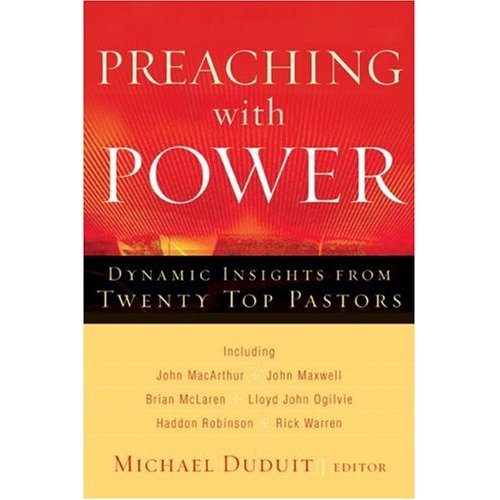
Review: Preaching with Power, edited by Michael Duduit

Subtitle: Dynamic Insights from Twenty Top Pastors (2006)

duduitpower.jpg

As editor of Preaching Magazine, Michael Duduit is able to take good content from that magazine and publish it in book form. This is exactly what this book is. Twenty interviews with top preachers that have appeared in Preaching Magazine and now appear in this book from Baker.

There are some very helpful interviews here. I would particularly note Haddon Robinson on expository preaching in a narrative world, David Jeremiah on preaching through pain, Andy Stanley on preaching without fear and Bryan Chapell on expository preaching.

Other contributors range from John MacArthur and Jerry Falwell to Dan Kimball and Brian MacLaren. From Erwin Lutzer and Lloyd John Ogilvie to T D Jakes and Adrian Rogers. From Jerry Vines to Rick Warren. The contribution is varied and the subjects span a spectrum of related interests.

I won’t extend this review by sharing specific insights from the interviews, I simply want to explain the nature of the book. If you’ve read the magazine for a decade or two then you will have read it all before. If you haven’t been a subscriber to Preaching, then this book might tempt you. This is a worthwhile book to read, or just to pick at when you have spare ten minute chunks of time.

(This book does not break into the top ten must read’s for preachers.)

Practicing What I Preach

For many preachers life is lived in reverse.  People take Sunday off and come to church.  It’s no day-off for us.  People finish work and come home in the evening, but sometimes we have to preach, teach or lead then.  And the season of relaxed family time easily becomes the busy and draining season for preachers – ie Christmas.  So, since I have a whole week until I have to preach, I will be taking a couple of days off from the blog.  Let’s be honest, you wouldn’t check it on Christmas Day anyway, would you?

The Wonder of Christmas

One of the great occupational hazards of ministry is that we can so easily lose the wonder of what we are dealing with.  With the demands of the schedule, the expectations of people, the burden of creativity in a season that comes every twelfth month (but is only fully reported in two gospels), the ongoing reality of messy lives (people still get in trouble, marriages still fail, loneliness still bites, folks still sin), and so on, we can easily lose the wonder of Christmas.

In this post I don’t want to prescribe how to keep the wonder of it all, I just want to suggest we do.  Whatever it takes.  Perhaps time with family.  Perhaps some extra guarded time alone with God.  Perhaps a special treat carol concert. Perhaps a brief journey to a sentimental place.  Perhaps read one of those booklets the church is offering to visitors over Christmas.  Whatever it takes.

Let us make sure that we don’t go through Christmas feeling the pressure and the burden of it all, without also renewing the wonder in our hearts.  Let us be captured by the grace of God that He would step into this world.  Let us be gripped by the hope inherent in the Christmas story for a world of sinners – for Christ came into the world to save sinners!  Let us be stirred afresh by the history-changing event of the incarnation.  Ponder the first Christmas, ponder the reality of the incarnation, ponder the journey from Bethlehem to Calvary, ponder the everlasting nature of the incarnation.  Ponder.  Ignite the wonder again.  Whatever it takes.

Don’t Half Quit

There are always reasons to quit.  This is true in anything you pursue.  Sport, music, hobby, fitness, work, ministry, marriage.  Anyone who has ever been successful at anything has had to overcome numerous opportunities to quit.  How true is that in preaching?  There are few things that can compare with it – how important it is, how much people need it, how much you give both in preparation and presentation, how emotionally and physically draining it can be, how open to criticism you become, how relentless the schedule can feel, how exacting the standards are in peoples’ minds for every other area of your life.  To give the Lord our best as preachers we must exhibit a tenacious relentlessness.

The temptation to quit may always be lingering in the background, but for various reasons, good and bad, many of us would not simply quit.  Perhaps it’s a little like marriage among some Christians a couple of generations back.  A marriage could go very sour, but divorce was considered so inappropriate that couples would live out a “Christian divorce” – two separate lives lived under one roof for the sake of appearance.  That’s a danger for us as preachers.  When the pressures build, as they do so regularly, so do the temptations.  Temptations to quit may be rejected.  But temptations to half quit are an ever present danger.

When the schedule is tight and you are drained emotionally and physically, pulled in numerous directions, don’t half quit on your preparation.  It may seem tempting to not really study the text, to short-circuit all exegesis.  When Sunday is rapidly approaching and your energy is low, don’t half quit on sermon shaping.  Don’t just go with your study notes, but try to think through your audience and their needs, think through the best way to communicate this passage to themWhen you go through the post-sermon emotional roller-coaster that many preachers feel so often, don’t half quit.  Don’t make decisions that will undermine your subsequent ministry because of how you feel at that moment.  When you are on the receiving end of unfair criticism or unjustifiable sniping, don’t half quit.  Don’t steel your heart against the people you minister to so that by not loving them they can’t hurt you.  When you love you get hurt, but love anyway.

I’m not saying anything about rest, responsibilities with family, etc.  I’m not saying sacrifice yourself to the point of burnout in an attempt to be spiritual.  There’s all sorts of appropriate balances to wisely employ in ministry.  But those are for another post.  All I’m suggesting today is that preaching is no easier than most other things you might pursue in life, and in many ways it is harder.  To be the best you can be, to give the best you can give, you must be doggedly relentless.  Don’t quit.  And maybe more importantly, don’t half quit.

A Preacher’s Personal Cloud

It is too easy to get caught up in present ministry and future plans, but forget past blessings. As a preacher, whether you have only just begun or have been ministering for decades, you are not a self-made preacher. The truth is that people have marked you. Your ministry now is partly the result of past investment and example from others.

Let’s take half an hour and prayerfully go back over those people who have marked our lives for ministry. Perhaps you could take a piece of paper and list people that invested in you, or were an example to you. Make a brief note summarizing their influence. Take some time to give thanks to God for His work through them. Not only will this exercise allow for gratitude toward God, but it may also prompt an expression of gratitude toward others who have blessed you (who are still on earth), and a renewed passion to press on in your ministry. I suppose we could say that each of us is surrounded by our own personal cloud of witnesses!

Think of your early exposure to preaching and church ministry – perhaps a preacher who also noticed you and cared about you. Think about those who have invested time in you during your formative years, perhaps some were preachers, but took the time to pour into you. Think about those who opened doors for you to preach, to attend Bible school, to take on your first ministry role. Think about the trainers, perhaps in the local church, or perhaps in college or seminary (if only there were more trainers in churches, but let’s be thankful for both!) Think about inspiring examples you heard at key events, or regularly at certain stages of life. Think about formative books that shaped you in this area. Think about key prayer partners who believed in you. Think … make a note … give thanks … press on!

New Category

Just to let you know that we’ve added a new category in the menu to the right.  If you click on “Preacher’s Personal Life” you will be given a list of all the posts related to this vital subject.  Hope that is helpful.

Preaching Passion – Checking the Foundations

According to Augustine, our task is to say what God says. One of our core convictions must be that when the Bible speaks, God speaks. So let’s take a moment or two to run a quick evaluative test to make sure our passion in preaching has not grown pale. These three indicators are by no means an exhaustive list, but they represent perhaps the foundational layer of passion for us as preachers. How would you rate . . .

Your passion for God Himself. This is primary. As Christmas approaches and we contemplate the incarnation again, are we stirred by the passion of a God willing to go to such extreme lengths, to step into His creation, to become like us and redeem us? The spreading goodness of God spread very far and very low in reaching us. Are we truly captivated by the great and glorious God who in grace reached out for us? Is He the object of our affection, our worship, our attention?

Your passion for God’s Word. This is how we know Him. This is the means by which all other channels of spirituality and experience can be evaluated. The Bible is an amazing gift. Has it become just a tool of your trade? Or is it still gripping your thoughts as you dive ever deeper into God’s great revelation to us?

Your passion for God’s people. This is not just the concern of those in formal ministry. This is an indicator of spiritual health in all of God’s people. We become like the One we love and worship. Over time His values become ours too. Consequently a passion for people is an indicator of spiritual health. People you will preach to this Sunday, and people you will never meet until heaven. Local, global. For God so loved the world . . . so if we are close to Him, we will too.

Then there is the strand running through it all. It was implicitly there throughout yesterday’s post, it is here stated overtly. The strand going through all three indicators in this post is prayer. Prayer indicates your passion for God. Prayer shows the difference between dutiful drudgery through required study and delight-filled questing through God’s Word. Prayer reveals your heartbeat for others.

How is your passion for preaching? Paler than it should be? As hot as it could be?

The Path to Preaching With Passion?

It is easy to fake pulpit passion. All you have to do is raise the voice, pound the fists, point the finger, grimace a little and before you know it, you have fake pulpit passion. But what does it take to have genuine passion? And why would you want it?

Why? Because genuine passion marks deeply. Genuine passion is contagious, people catch it. It is commanding, people aren’t easily distracted from it. It is convicting, people have hearts changed by it. It is challenging, people see their apathy wilt under it. Genuine passion marks people deeply. (Just in case you’re tempted to fake it, remember that fake passion is off-putting, embarrassing, ineffectual and counter-productive.)

How? Genuine passion is a spiritual dynamic. It all seems to come down to, and flow from, the heart. A heart captivated by a passionate God. A heart filled with the Word of God. A heart walking in step with, beating in time with, the Spirit of God. A heart moved with compassion for the people to whom it will preach. Gripped by God, saturated in the Word, filled with the Spirit, and crystal clear on the urgency of the task of preaching that particular text to those particular people at that particular time. A genuinely passionate preacher is truly a potent tool in God’s hands.

All this is not to say that relaxed or carefully casual delivery is wrong. I often use both and see others doing so effectively. But there is also a time for allowing the passion to show. May God give us the wisdom to know when.