Preaching [Insert Word] Jesus

Jesus2Preaching Jesus.  This is the calling of the preacher.  It is an incredible calling.  We aren’t called to preach tips or suggestions, mere commands or philosophy, not even just ideas or concepts.  We get to preach a person.  When I met my wife-to-be, I was very capable of “preaching” her to any who cared to listen.  I didn’t struggle for motivation because I knew her, I liked her and I wanted to talk about her.  But over the years I’ve had to do some presentations I wasn’t thrilled about . . . ideas, subjects, topics.  These opportunities were very different.  The personal connection and consequent motivation is far different when we grasp that Christian preaching is primarily about preaching a person.

Preaching for Jesus.  And what a person we get to preach!  We get to represent the great object of the desire of all creation, the one who made it all and will bring it all to a close.  The one who brings eternal delight to the Father and who will reveal the delightful Father to all for all eternity.  This is not a political leader with tenuous temporary influence, or a new fad who will soon pass.  This is not preaching some hyped up celebrity, or some high achiever in one area or another . . . this is the wonderful counselor, the mighty God, the everlasting father, the prince of peace.  And we get to preach about him, and for him.  That means he cares, he takes interest, he wants it to go well.
Preaching with Jesus.  It just gets better.  We often think of our ministry being for Jesus, but can forget the great biblical theme of working with God.  He commissioned us to go and make disciples, but he did so with the promise of his presence!  What a privilege to not only speak of Christ and for Christ, but also with Christ.  As we preach to proclaim the gospel, we are doing so with him who is at work fishing for humanity.  As we preach to edify the church, we are doing so with him who is at work building his church.  As we preach to bring glory to God, we are doing so with the eternal Son who is well practiced and ever pleased to bring praise to His and our great Father.  Ministry with.  Seems like we don’t think about that enough!

Static vs Dynamic Position Principle

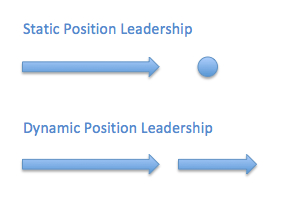
Static DynamicLast week I enjoyed a very pleasant afternoon discussion in the summer sunshine by the river in Bath.  Our conversation meandered through many gospel vistas and theological considerations.  Along the way we were talking about youth ministry, but the point I’d like to share here applies to us all.

Typically when churches are looking for a youth minister they will try to find somebody who is more spiritually mature than the youth in the church, but close enough in age to engage in all the requisite activities.  So the person is found and appointed, the programs are designed and the action begins.  Often the church wants pizza and programs so that the youth are happy, but whether or not there is any real spiritual growth is another matter.

Part of the problem here is the implementation of Static Position Leadership thinking.  I doubt you’ll find that term anywhere as I just made it up, but the principle is not rocket science.  The youth minister is represented by the dot, and the youth are the arrow.  The assumption is that since he is further along than they are, he can help them grow in the right direction.  But does it work like that?

What happens when one of the young folks suddenly comes alive spiritually and is praying fervently and reading the Bible voraciously and chasing God with a passion?  Does that teen simply move along the maturity arrow quicker than others, still moving towards the more mature youth leader?  Not if the youth leader is spiritually static.  It doesn’t take long for someone to overtake the “leader” when the leader is not really leading.

For true spiritual leadership to occur, surely the Dynamic Position Principle must apply.  That is, you can only lead others forward as you yourself are also currently moving forward.  A church that gets a youth minister who lacks personal genuine growth in their walk with God will be directly harming the youth in the church.  It won’t take much for one to surpass the leader in current spiritual momentum.  And it won’t take much for the static leader to squash the life out of those who might show him up if they continue.

If this is true for youth ministry, surely it is also true for whole church ministry.  Moving the dot to the right for an elder or pastor does not guarantee any sort of health in the church.  What is needed is mature and growing godly leaders if they are to infect others with forward momentum in their walk with Christ.

Gospel Dimensions 3

TapeMeasuresIn the last two days I have made some suggestions as to how a limited view of God and humanity will tend to undermine our preaching.  What about our view of sin?

1. When we see the problem as partial rather than total.  How often have we heard, or said, that if God’s pass mark is 50, then even a 49 is still falling short of the glory of God?  Therefore even the most “perfect” performer of self-righteousness can be caught out because they must have at least stolen a biscuit when they were small or a paperclip from work in recent years.  Perhaps we say imagine a perfect white sheet of paper, then put a dot of ink on it . . . no longer perfect.  Heaven is perfect, etc.  This is all true, but dangerously untrue at the same time.  Hypothetically a person could be a 49/50 performer, but in reality, nobody is.  To put it another way, we are all zero out of 50 because self-righteousness is not the goal.  Sin is not about independent performance according to a standard.  The standard reveals our independent performance and abject failure.  The independence is a huge part of the issue, so our paper is not mostly white, it is completely covered in blotched ink.  And that ink comes in two colours:

2. When we see the problem as naughtiness.  Naughtiness is like blue ink.  It is the colour of the younger son’s track record as he crawls back wearing swine deodorant from the far country.  But naughtiness is not the extent of sin.  It is one manifestation, but it is not the whole deal.  The Bible does not say we have all been naughty and fallen short of the performance levels of God.  Independent self-righteousness is red ink.  You may prefer red, but it still covers the white of the page when splashed liberally onto it.  Our righteousness is like filthy rags before a God who longs for hearts to not be far from Him.  Some human sheets are mostly blue.  Some are mostly red.  None have any white showing.  I am trying different ways to say the same thing: our sin is far worse than we realise!

3. When we see the problem as a hindrance rather than death.  Broken will?  Clouded uninformed mind?  Slightly marred record?  Sin goes deeper than all of this.  The heart of the human sin problem is the human heart.  That is where we are dead toward God, dead in our self-love, dead because life is found in relationship with God.  And we cannot fix our own hearts.  Fully dead in sin, and fully unable to do a thing about it.

If we present sin as petty naughtiness, then we will preach the good news that a petty God is willing to put up with our paperclip theft.  Hardly the gospel.  And if we preach a shallow or superficial portrait of sin, then we can very easily offer a gospel of heavenly benefits to people whose hearts remain far from Him.  Is this not an anti-gospel?

Mixing the Matters

Proud2You matter.  Preaching matters.  Your preaching matters.  But don’t mix these up.

You matter – you are a person for whom Christ died, a person who has been bought with a price and baptised into the body of Christ to participate in the fellowship and life of God himself.  Just like the people you preach to, your worth and value are to be found in Christ.

Preaching matters – what God has done in Christ for your listeners and you is truly worth sharing boldly and openly.  Preaching matters because God is an incarnationally-minded communicator and as a result, we have something to say.  Preaching the word of God has always been a key part of God’s mission in this world, for there is a revelation and a proclamation at the core of that mission.

Your preaching matters – you may not be so-and-so famous preacher who draws huge crowds, but you are more than just the person scheduled to preach this next time.  The people gathered have a divine appointment with the word of the gospel, so you will want to give your very best for their sake, and for His.  The famous preacher is not scheduled to be there, by God’s providence, you are.

Don’t mix these up – one of the ways we can get into trouble as preachers is to start to confuse these truths.  Since preaching matters, I matter because of my preaching?  Careful!  The moment we confuse our identity in Christ with our role in ministry, we are set for trouble.  I recently heard of a visiting preacher who marred his reputation by his reaction to a circumstance that thwarted his opportunity to preach.  It is good to take your preaching seriously, but never think you are indispensable.  It is good to serve God in preaching, but never let your identity be determined by it.  Your preaching matters, but God can, and does, work apart from your ministry.

Paul Tripp on Law and Grace

49331I am really enjoying Dangerous Calling by Paul Tripp.  Here’s a paragraph that jumped out at me last night as I read a few pages:

When I hear a sermon that is essentially law-driven, that is, asking the law to do what only the grace of Jesus Christ can accomplish, I am immediately concerned about the preacher.  I immediately wonder about his view of himself, because if he had any self-consciousness about his own weakness and sin, he would find little hope and comfort for himself and his hearers in that kind of sermon.  You see this dynamic in the Pharisees.  Because they thought of themselves as righteous, perfect law givers, they had no problem laying unbearable law burdens on others.  Their misuse of the law had its roots not only in bad theology but also in ugly human pride.  They saw law keeping as possible, because they thought they were keeping it. And they thought that others should get up and keep it as well as they did.  They were the religious leaders of their day, but they were arrogant, insensitive, uncompassionate, and judgmental.  They were not part of what God was doing at the moment; no, they were in the way of it.

If you want more, get the book.  This paragraph is on page 153.

Weakening our Legacy by Dangerous Independency

CorDeo_2013_002bPreachers will always be tempted to function and minister alone.  After all, preaching and pastoring are lonely pursuits for several reasons.  However, if we give in to that temptation, then we will seriously undermine our potential impact in a community.

Today is the last day of this year’s full-time programme at Cor Deo.  It has been such a delight to go shoulder to shoulder with eight other men who are hungry to know God more and love Him together.  We have studied the Bible and theology and practical ministry and personal spirituality.  We have ministered together, traveled  together, laughed together, done life together.  And we are all genuinely sad that this rich season is coming to a close.

So will we settle for ministry from a distance?  Will we be satisfied with lone ranger ministry?  No chance.  These men will be looking for others with a heart for God with whom they can pursue Him in the years to come.  Here are a few brief thoughts on avoiding independency as a preacher:

1. Never forget Jesus view of the crowds and the few: he was willing to lose the crowds, but he valued leaving a deeper mark on fewer people.  The example of Jesus challenges our “bigger is always better” mentality.  After feeding thousands and caring for the crowds, Jesus would spend time explaining to and investing in a small group of men.

2. Mentoring must not be an option for someone involved in ministry.  Actually, even Jesus’ ministry to the crowds would strategically involve those few men.  Don’t view mentoring as a ministry option that may or may not fit you.  Ask God to point out people to whom you can give yourself and your ministry.

3. Don’t fall for worldly-wise ideas about necessary distance and avoiding friendship in leadership –  The only people who find friends threatening are those precariously perched on top of a power pyramid where someone getting close becomes a threat to their position.  Jesus certainly didn’t model ministry from a distance, but he had the twelve, among whom he had the three, among whom he had the one.  As Andy Stanley puts it, do for one what you wish you could do for all.  You can’t give yourself away evenly, so don’t make the mistake of not giving yourself away at all.

4. Pray for a Bible read through partner – could well be the best thing you’ve done in ministry.  The heartbeat of Cor Deo’s success in the lives of the participants this year has again been the Bible read through partnerships.  Simple idea: find someone who will share your ambition to know God more by reading through the Bible boldly and relationally.  Set an end goal (perhaps 3 or 4 months), go for it.  Underline your highlights and meet up once a week to share a few minutes of highlights and pray for each other.  Watch lives get transformed (including your own).  Click here for a better explanation.

5. See through your own busy excuse.  Of course we are all too busy for any of this, but we all find time for what we consider truly valuable.

Listener Levels: 7 Suggestions to Improve Accessibility

MeasuringTapeHow can we improve at offering explanation that will help people at the lower range of understanding?  Perhaps your preaching goes over peoples’ heads, but you want to explain the Bible in a way that is accessible to younger Christians or less biblically literate folk?  Some suggestions:

1. Pray about it – Nobody cares about your listeners as much as God, so ask for His coaching.

2. Get feedback – Try to find out from people what is lacking.  It could be that your vocabulary is obfuscatory, or your content is too dense, or your delivery is unengaging, or your words are indistinct and hard to catch, etc.

3. Watch and evaluate some great explainers – Watch a preacher who is especially effective at explaining and describing the biblical content and action.  What are they doing well?

4. Vary the elevation of your helicopter – If everything is explained from 100ft, then your messages will be deadening.  You need to be able to lift up to 5000ft for a brief overview of the Bible, and you need to be able to land the chopper when you are settling for a while in a verse.  Too much content where you need to be flying higher will lose listeners in overwhelming detail.

5. Surrender prideful vocabulary – To put it simply: your mission is not to impress, but to communicate.  Relegate your original language vocabulary, your technical grammatical vocabulary, your systematic theological terminology and any other impressive jargon to your study.  Know it, understand it, and sometimes, if necessary, explain it, but generally speaking it is best to leave it behind when you go to preach.

6. Achieve more by preaching less and driving it in more – Speaking of leaving things in the study, try leaving more of your message there.  Often we confuse people by trying to achieve too much education in a single sermon.  Andy Stanley says that many sermons would make great series.  Try to cover less and you will have time for clearer explanation.

7. Improve your outlining – A lot of messages are complex because the preacher hasn’t thought themselves through to a point of clarity.  I typically point to the main idea at this point, since a clear main idea will create clarity throughout the message.  So true.  But also give some time to evaluating the outline.  Is it as simple and clear as can be?  Is each part of the message doing something specific?  If at a certain point in your message you don’t even know that you are trying to explain, nor will your listeners!

What else would you add?

Dangerous Assumption 5: Other Options

Assumption25This week we have looked at two dangerous assumptions that can override good preaching preparation.  One is overtly too human-centred, leading either to striving or enabled independence.  The other is apparently God-centred, yet perhaps open to the charge of misrepresenting the God-centred reality presented in Scripture.  One variation of this latter assumption makes God profoundly selfish, the other makes Him non-relational in His controlling.  Let’s finish the week with a few miscellaneous other assumptions that could be causing us to misrepresent the Bible text we are preaching.  Again, our goal is not to be negative, but to stir us to pray for God’s perspective on our handling of the Bible – let’s let God be the coach in all of this.

Dangerous Assumption C: It’s all about something else.

7. The power filter.  This may just be a variation on some of what we’ve considered already.  It is the notion that Christianity is about spiritual access to power on another plane.  Somehow we have to tap into this secret energy source that will give us super-human stamina or impressive miracle power to wow the world.  The Bible can then become a set of data to twist and use as leverage in accessing this heavenly fuel.  Again, the marital and relational nature of true Christianity gets lost here.  The Spirit who pours out God’s love into our hearts becomes the conduit for wow-fuel that leaves Jesus distant and enables our thoroughly dependent independence.

8. The nice filter.  This is where the preacher filters out anything tough or challenging or difficult and makes everything soft and nice.  In one form everything becomes syrupy and fluffy, without any hint of wrath or anger, etc.  In another form, the wrath and anger of God become another “side” to Him that is somehow held in tension with his love.  We therefore lean on the loving “side” of God and are spared the nasty side.  Alternatively we celebrate nice Jesus who has delivered us from angry Father.  Whatever version grips us, we have a problem.  Unless we see God’s holiness and justice and wrath and jealous nature as part of His triune love, then we will have a God with a split personality or a divided trinity.  Nice is not the issue, but His love might be more significant than we realise.

9. The hobby horse filter.  This is where every passage is seen through lenses looking for a hobby horse issue.  Consequently the pet topic becomes elevated disproportionately whenever a text offers a link.  It could be a theological issue, a pet illustration category, or whatever.  In fact, here’s another variation:

10. The agenda filter.  This is where our personal or political or cultural agenda is imposed on any passage.  We could all pick an issue in national or church politics and create a “study Bible” with notes linking almost any passage to the subject of our own choosing.  Thankfully publishers don’t publish most of these potential study Bibles!

Let’s spend time with God asking Him to show us where our lenses are changing the hue of His self-revelation to us in the Bible.  Our desire to be biblical preachers is to please the God who has spoken, who speaks, who has revealed and will be revealed by our preaching.  He is more than able to point out where we may be misrepresenting Him, so let’s be sure to ask!