Discourse is Not Just Epistles

When I teach preaching courses, I tend to refer to the three types of Scripture: discourse, narrative and poetry. The various genre fit within these categories and so they give a good overview of different Biblical text types. So the principles of narrative interpretation would apply in the Gospels, Acts, historical books and so on. The principles of poetry would apply in Psalms, of course, but also other wisdom literature and poems found in historical books (eg.Exodus 15). The principles of discourse interpretation naturally work in the epistles, but that is not the only place we find discourse.

As direct communication, discourse is often the easiest type of passage to interpret, and it is usually one of the easier ones to preach. While narrative and poetry have real advantages for sermon formulation (for instance we could mention tension and imagery respectively), discourse tends to be direct instruction. With a sensitivity to the original context and audience, appropriate progression through exegetical, theological and recontextualization stages of sermon preparation, the preacher is able to formulate an attractive preaching plan for the text.

Other New Testament Discourse – Obviously the Epistles tend to be the preacher’s favorite in the Bible churches of the western world. But consider the other discourse possibilities in the New Testament. In each of the Gospels we have recorded speeches by Jesus – direct instructional communication. His Sermon on the Mount, or Olivet Discourse, or instructions to the seventy-two, etc., can all make for great preaching. Then in the book of Acts we have the speeches of Peter on Pentecost, Stephen on his promotion day, Paul in Athens and so on. In Acts it seems that the speeches do not supplement the action, but actually are the action, moving the broader narrative forward time and again.

Old Testament Disourse – Consider Joshua 1, for instance. God’s instructions to Joshua at that key moment of transition. It is part of history, part of a broad narrative, but actually those first nine verses are not a plot to trace, they are a discourse. Then you’ll find discourse in the wisdom literature, such as Job and Ecclesiastes, but arguably in poetic form throughout.  Likewise many of the oracles in the prophets bear features of discourse-driven communication, along with poetic structuring.

As preachers we may easily fall into the trap of thinking anything outside the epistles will be either narrative or poetry. This is not true, and tomorrow we’ll consider what this means in our preparation.
Getting to Grips with the Genres: Poetry (2)

Yesterday’s post was concerned with how poetry works.  Now let’s consider the implications for our preaching.

Implications for Preaching Poetry

-If preaching narrative connects listeners to plot and discourse connects listeners to ideas, then poetry connects listeners to feelings attached to ideas.

-This means that preaching poetry is slow. It’s less like going on a run than it is like sitting before a painting in an art gallery. The preacher is to draw out colors, themes, nuance, and ideas, line by line, in a way that gives time and space for listeners to connect not just cognitively but affectively to the poem.

-Consider using music, paintings, pictures, movie clips, etc., to draw-out an idea.

-Consider allowing for testimony that affirms the points in poetry. Consider attaching biblical narrative to the points too.

-Poetry speaks to truths and feelings that we have felt, will feel, and need to feel. They are not fiction but fact. We need to be shaped by them. Allow your preaching of poetry the time, space, tone, posture, and space to accomplish this. It’s worth it!

Getting to Grips with the Genres: Poetry (1)

Poetry is different from narrative and it is very different from discourse. How though is our preaching of poetry different from our preaching of narrative and discourse? To answer this question, today we will consider how poetry works and functions. Then tomorrow we’ll consider some implications for preaching poetry.

How Poetry Works – Besides employing literary devices such as imagery, metaphor, allegory, simile, wordplay, irony, hyperbole, etc., the prevalent literary device in Hebrew poetry is parallelism. There are many ways to describe parallelism. One common way is to discern between four kinds of parallelism – antithetical parallelism, synonymous parallelism, synthetic parallelism, and emblematic parallelism. In antithetical parallelism, the first line of a sentence is in contrast to the second line (Ps 34:19). In synonymous parallelism, the first line of a sentence is similar to the second line (Ps 49:3). In synthetic parallelism, the second line of a sentence builds upon the idea of the first line (Ps. 49:5). In emblematic parallelism, the two parts of a sentence connect through simile or metaphor (Ps 49:20).

How Poetry Functions – Parallelism insists that the reader slow down, mull over, and consider how each sentence functions. More than that, because each sentence is laced with metaphor, allegory, simile, wordplay, irony, hyperbole, etc., poetry insists that its content be felt. Rhetorically, poetry connects affect to ideas.

Wrestling with Flow

There are shortcuts in preaching.  Perhaps some are legitimate, although none spring to mind.  But there is one major shortcut that is very common, but that undermines the whole preaching event.  Failing to wrestle with flow.

It is easy to break a passage into its chunks and preach a sermon from each chunk.  Be sure to wrestle with how the text flows together.  If it is a true unit of thought, then there is unity, but it may take work to be able to understand and communicate it.  How do Proverbs 3:11-12 relate to 3:1-10?  How do the small parts of James 1:2-18 fit together?  Why does Luke 18:7-8 come attached to verses 1-6?  It’s easy to preach two or three sermons welded at the seams, but this is a shortcut that is not worth taking.  Be sure to wrestle with the text more and preach one message – of course it may have 2 parts, 3 movements, or whatever . . . but it needs to be one message.  

So, this week, as we prepare our sermons, let us put on our wrestling gear, enter the arena and give our all to pin down the flow!

Scripture Interprets Scripture – Cross-Referencing in Preaching

You’ve probably heard the oft-used line that “Scripture interprets Scripture.”  This principle of hermeneutics seems to be the only principle for some people, but I would suggest it is one among many helpful principles.  It is right to say that no passage will ultimately contradict the rest of the canon, for there is a divinely inspired unity to the Bible.  However, this does not mean that we should neglect near context interpretation in favor of distant context interpretation.  What a writer means by a word or phrase should be evaluated in light of the sentence, the paragraph, the section, the book, the other books by the same writer, the other books from that time period, the other books in that “Testament” and the other books in the Bible – in that order!  Like concentric circles around the bull’s-eye, the closer the context, the more weight we should give it.  So a term used in a letter by Paul does not automatically mean the same as that term in Matthew or John or Ezekiel. 

One exception to this hierarchy of correlation would be to go to a text evidently in the thoughts of the author prior to others that may technically be “closer contexts” but were unknown to the author.  For example, when an NT writer is obviously leaning on an OT passage, that passage may be technically the most distant context, but it actually may be more helpful than another NT writer.  So I’d look more carefully at the prophet Paul is quoting than Matthew’s use of the same term.  We should correlate carefully.

Having stated that we should select cross-references in light of their actual value in interpreting our target passage, this does not mean that we need to give that information to our listeners.  We do a lot of study that does not need to be flashed from the pulpit.  Generally it is better to explain your target passage, rather than potentially confuse or overwhelm listeners with a series of different passages.  In part 2 I will give some specific guidance on cross-referencing in the pulpit.

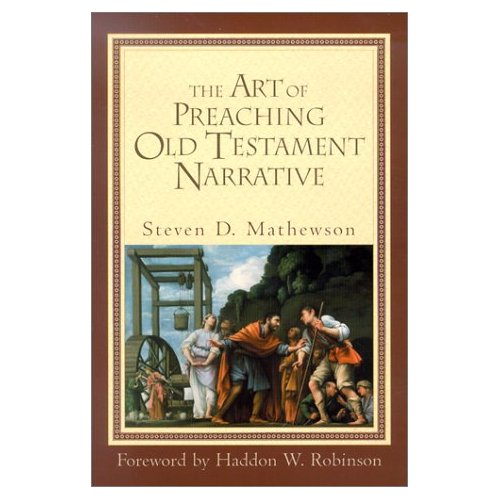
Review: The Art of Preaching Old Testament Narrative, by Steven D. Mathewson

mathewson.jpg

There are many preaching books, but only a handful I recommend wholeheartedly.  This is one of them.  Mathewson’s passion for the many narrative passages in the Old Testament is contagious.  His passion for the effective preaching of these passages is greatly needed today.  This is especially the case while significant preachers continue to view Old Testament narratives as primarily illustrative material, rather than preaching texts. 

Mathewson’s work is widely researched, with significant influences including Robert Alter’s The Art of Biblical Narrative and Haddon Robinson’s Biblical Preaching. 

The first of the three sections in the book is concerned with hermeneutics – how to move from the selection of a text to a focused central concept.  The second section is more focused on the homiletical process – how to move from the central concept to the sermon.  This section is strongly influenced by Robinson’s methodology and serves as a very helpful clarification on that method.  While Robinson’s book is succinct and well-written, Mathewson’s presentation of the ten-stage approach with a specific focus will help the reader understand Robinson’s methodology more fully.

Mathewson’s explanation of biblical narrative forms support his central idea of developing sermons using the flow of the story, rather than a forced and rigid analytical presentation. 

The third and final section of the book contains five example sermons from Mathewson, Donald Sunukjian, Paul Borden, Haddon Robinson and Alice Mathews.  These are helpful in a variety of ways, although no example sermon can ever be perfect.  There are also a couple of appendices – one on Hebrew plot analysis (for Hebrew trained preachers with a lot of time on their hands) and one on helpful commentaries.

There are many books on preaching, but I’ve yet to find one that can match Mathewson in terms of dealing with Old Testament narratives.  This book is worth buying, reading and considering carefully.  Having read this, you might also be inspired to read Robert Alter’s The Art of Biblical Narrative, if you have not done so already.  Two strong recommendations in one review – I would apologize to your bank balance, but these two books would be money well spent.

Getting to Grips with a Genealogy

What do you do when you are preaching through a book and there is a genealogy? I have faced this a few times, although I don’t claim to have a ‘one-size-fits-all’ solution to the challenge. Here are a few tips:

1. Study the function of the genealogy. The author included it for a reason. How does it fit with the flow of thought in the book? It is easy to get caught up in the details of the list, but miss the function of it.

2. Select the preaching passage carefully. If you are able to divide the preaching passages, do not assume lots of verses in a genealogy mean lots of preaching material. It may be that the genealogy can be summarized briefly, leaving plenty of time for an adjoining text.

3. Survey the framing of the genealogy. What does the author write as a lead in, and what are the first comments leading out of the genealogy? Consider, for example, Luke 3:21-23 and 4:1-3.

4. See if any pattern is broken. Sometimes there is a pattern in the way the text is written, which can become quite rhythmic to the ear. Be sure to check for any breaks in that pattern that might suggest a place of emphasis. For example, consider the change in pattern for Enoch in Genesis 5:24.

5. Scrutinize the places of emphasis. Be sure to consider carefully the first and last names in the list. Often a genealogy is a bridge through time linking one place in history with another. For example, see Ruth 4:18-22.

6. Scan for misfits. In light of the apparent function of the genealogy, are there individuals whose inclusion might be considered surprising? For example, the presence of, and similarities between the women, in Matthew 1:1-17. Be careful not to allow an interesting observation to overwhelm the rest of the genealogy. This example in Matthew has more than one interesting feature!

7. Search for every clue to the author’s intent. Your goal is not to preach random details from a list, nor to exhaust listeners with exhaustive historical details, but to search diligently for the author’s intent when he wrote and/or included the genealogy. This is a repeat of the first point, but this is worthy of restatement in this final position of emphasis!

Old Testament Stories – part 2: Good Illustrations?

It is often tempting to use Old Testament stories as illustrations in a sermon, but before doing so, here are five questions to consider:

1 – Do they know the story? Many listeners do not know the stories of the Bible. This means we have to explain our illustration. Does it make sense to have to make something clear, that is given in order to make something else clear? If your listeners need to get to know these stories, why not preach on them?

2 – Is there a better illustration? This may sound heretical, but in a hierarchy of illustrations, most biblical stories actually sit low on the ladder – experienced by none, learned by few. Biblical stories should be preached, but that doesn’t mean they must be our primary pool of illustrations for other biblical texts.

3 – What’s the main idea of the text? A different biblical text will have a different central idea than the one you’re preaching. There is the ever-present danger of misrepresenting a biblical text.

4 – Are you going in the right direction? If people don’t accept your point from one biblical text, offering them another often won’t help. However, if they do accept what you are saying, then why move backwards to the Old Testament instead of forward into their lives with a relevant illustration of personal application?

5 – What example are you giving? To listen to some preachers, some might get the impression that all they need to live the Christian life is the New Testament, and a passing acquaintance with the Old. If the preacher does not model the highest respect for the whole canon, who will?

There may be good reason to use a biblical illustration, but before doing so, consider these questions first.

Old Testament Stories – part 1: Preaching Texts?

Some people take the view that the texts for preaching should come primarily, or even exclusively, from the New Testament. In order to preach “the whole counsel,” many use the Old Testament as illustrations in their sermons. Should Old Testament stories be illustrations, or preaching texts in their own right?

There are some reasons to hesitate before using an Old Testament story as an illustration in a sermon. Part 2 of this post will give five questions for the preacher to consider before using the Old Testament for an illustration.

Steve Mathewson (The Art of Preaching Old Testament Narrative – review coming soon) lists four reasons many preachers struggle with preaching Old Testament narratives.

  1. Tendency to view stories as fluff.
  2. Minimizing of the role of Old Testament stories in the canon.
  3. Intimidating features of Old Testament language and literature.
  4. Enslavement to a particular style of exposition. That is to say, Old Testament stories usually feel forced when preached using analytical outlines and “impaled on the frame of Aristotelian logic” (to use Fred Craddock’s phrase, As One Without Authority, p45).

It is not easy to preach Old Testament stories well, but “all Scripture is God-breathed and is useful . . .” All of it. Preach it all.

Preaching Psalms

The other day I preached a Psalm in a University Bible study. A young lady came up afterwards and said, “I always expect to get something from the Gospels or Epistles, but I don’t expect much from the Psalms, but you brought that to life!” Now obviously I didn’t “bring it to life” since the Word of God is very much alive without needing my medical attention, but it raised an issue in my mind. What are some key points to remember in preaching a psalm?

1. Don’t let the outline kill the sermon – Often the work in the study is brought into the pulpit in the form of an outline which dominates the message. This has a tendency to make an emotive piece of writing (almost all psalms) into a source of intellectual thought and didactic material. With the possible exception of some wisdom psalms, you are not preaching a carefully constructed and tightly argued piece of thought. You are preaching the outpouring of a writer’s heart with all the emotion, reaction to God and circumstances, as well as theological perspective and so on. (This does not deny that Psalms are usually extremely carefully constructed, just that they often go beyond reasoned arguments, cognitive understanding of facts and propositional thought.)

2. If possible, go with the flow – I’m amazed how quickly some preachers resort to rearranging material. There can be good reasons to do this, but the default approach should be to study the flow of thought and preach that flow. Many psalms, when studied with reference to flow, have an almost narrative quality to them. This is where the outline helps you as the preacher move effectively through the text.

3. Take advantage of the great asset of poetic literature…imagery! – Many psalms are full of powerful imagery. With a little clarification, imagination or description, the images built in to a psalm will often add vivid colour to a sermon. Be careful not to just explain imagery so that it remains sitting on the page before your congregation – words understood are not as effective as images felt or experienced. What was it like for Asaph to come to God’s sanctuary again in Psalm 73. The constant pursuit by goodness and mercy is a deeply moving truth in Psalm 23. The barren woman given children goes through intense extremes of emotion in the space of a few words in Psalm 113. It is easy to present analysis of imagery, but develop the skill to tell it so it is both felt and understood.

4. Recreate mood, not just meaning – Since Psalms are poetic or hymnic, they do not merely convey information, but also they stir feelings, they convey a mood. In fact, many Psalms are built around the shift in tone or mood between one section and the next. It is not fair to David to preach the desperation of Psalm 22 without the confident trust of the last dozen verses. Psalm 73 turns completely on one verse. Often we preach both parts of a psalm with the same “mood” or lack of it. Or we turn a psalm of celebratory praise into a serious exhortation to worship. Think about how to enter in to, and recreate in some way for your hearers, the mood inherent in the psalm. A psalm that is felt and understood will make a far deeper impression than a psalm that is merely analysed and understood. In fact, you have to question whether analysis alone can lead to understanding poetic literature.

5. Carefully present relevance continually – The literature is written in a form that is foreign to our understanding of poetry, in a culture that is several millennia away from our own. Be careful to relate the text to our own experience whenever appropriate. A study of David’s experience through a psalm, ending with brief points of application only at the end, is likely to be a flat sermon. It is better to share that experience through the psalm, moving back and forth between 1000BC and 2007AD throughout.

(Peter has also commented on this post)