Cliches, Soundbites and Pithy Grabbers – Beware

Even for the vast majority of us who are not “broadcast” when we preach, there is still a temptation to achieve good soundbites. On one hand, this is not too far from the goal of having a single sentence summary statement, a big idea, a main idea, a proposition, a take-home truth or whatever you call it. The condensed nature of a single sentence aids the unity of the message, the effectiveness of communication and the memorability of the important core of the message. On the other hand, too many soundbites, cliches or pithy grabbers can be very detrimental.

Have you ever had a conversation with someone who only seems to speak in cliches? I’ve had the privilege a couple of times. It doesn’t take long before you don’t feel that they are actually in a conversation with you. It soon feels like they are looking for the next opportunity to role out one of their catchphrases. Despite your best efforts, you can’t help but suspect a lack of authenticity.

The effect created in a couple of minutes of conversation with a “soundbiter” is just a rapid version of listening to a “soundbiter” preaching. After the positive effects wear off, it doesn’t feel like they’re talking to you. It feels pre-packaged, inauthentic, fake.

It’s good to have principles that you live by and lead by, it’s good to be a clear communicator who is memorable, catchy, pithy and precise. However, you can have too much of a good thing. Don’t put your listeners through endless concatenations of cliches when you’re preaching. Even when you’re not preaching, in other leadership communication, don’t rely too heavily on soundbites. Listeners and followers would rather know you are authentic (communicated via natural style), than the king of cliche.
Preaching Story: Make the Switch

A switch that could make a big difference when preaching narratives.  How do you preach a story?

Common Default Approach – This is the approach that begins the message with the reading of the text, then moves on to talk about the story, noting elements within the text and giving both explanation and application based on those observations.

Strengths & Weaknesses – It is easier to read a text straight through than to interrupt the reading of the text, people know the whole story from the start and it allows great freedom in terms of what you do with the rest of the message.  These are strengths to one degree or another.  However, there are also inherent weaknesses in this approach.  The story becomes a specimen to examine, rather than a narrative to be experienced (once the reading is over).  The inherent tensions within the narrative are essentially lost, although a good preacher will attempt to rekindle them in the elements of retelling the narrative that follows the reading.

Original Force Approach – Okay, I made that name up, but it does convey my point here.  The simple switch I’m suggesting is instead of “read the story and talk about it,” rather try to “tell the story homiletically.”  What I mean by that is allow the form of the story, and the telling of it, to form the spine of most of the message.  In the process of telling the story, combine explanation of context, culture, historical setting, etc., with deliberate application for contemporary listeners.

Strengths & Weaknesses – The weaknesses that stand out to me with this approach are the greater challenges involved in telling a story effectively such as vivid description, maintaining tension, etc. Thus it may be slightly harder to preach well in this way.  However, the strengths of this approach are significant.  The original force of the passage can be recreated for listeners, whether or not they already know the end of the story.  The inherent tensions and intrigue in a narrative can become strengths of the message (you don’t have to create tension with a story, it has tension inbuilt).  Explanation can feel natural as the story is told, application can carry the implicit force of the narrative.  The ability of a narrative to overcome resistance is harnessed rather than lost (in the common default approach, listeners often put their guard back up once you start “preaching” again after the story’s been read).  There are other strengths too – while it may be harder to preach this way, it makes preaching preparation more interesting as you enter fully into the narrative rather than standing over it with scalpel in hand.  So much more could be added . . .

Next time you preach a narrative, instead of reading it and then talking about it, try telling the story so that the original force is felt as the thrust of the sermon.

Mindset Switch on Texts

The traditional approach to preaching a Bible passage is that it is a collection of data, probably in an antiquated form.  So for many preachers, coming to the text is coming in search of sermon content – data to be transmitted, information to be mined and presented.

In recent years awareness has increased significantly in regards to the inherent strength and function of Bible texts.  They are not collections of data presented in incidental forms.  Rather, it is becoming clearer to many that God speaks through the texts as texts.  God speaks not only through the information contained in a text, but also through the way that the text itself functions.  God did not only inspire the content, but the genre and form of the passage.  Poetry is poetry for a reason.  Discourse is discourse on purpose.  Prophetic writing is that way for a reason (this being a positive reason, not just an excuse to dismiss any content that doesn’t fit with your theology, as I see an alarming number of people doing these days).

If you are still of the mindset that a Bible text is a collection of data to be mined for personal edification and sermon preparation, please consider this switch.  Treat a text as a piece of purposeful communication.  The genre matters.  The form matters.  The function of the text is a key factor to consider in understanding the text.

When Do Listeners Switch On?

You know what I mean.  People are sitting and listening, sort of, until you say a key phrase, then suddenly everyone is really listening carefully.  Let’s make the assumption that having people really listen is a positive thing.  Now let’s consider some examples of “switch on” phrases and consider the implications for our preaching:

“How does this apply to us?” – People do tend to listen more when the message is about them, their lives, their needs, etc.  We could critique that theologically and point to the self-obsession of humanity.  Or we could be thankful that all Scripture is both God-breathed and “useful” – i.e. life changing.  And then we could stop leaving application to the last three minutes of a message and look for ways to include it throughout.  Compare and contrast an introduction infused with relevance and applicational preparation for the message to follow, with the standard switch off phrase “Last week we were deep in 2Chronicles 17, please turn with me to 2Chronicles 18 . . .”

“Let me tell you a story . . .” – People of all ages love a good story.  “Once upon a time” does wonders for children of all ages.  This kind of phrase is much more of a switch on than “let’s talk about the story.”  I’ve said it before, when the passage is a narrative, tell the story!  Even when it is not, how can the message be engaging and interesting, rather than mere lecturing and information transfer?

“Here’s how I struggle with this . . .” – People are always interested in appropriate vulnerability from the preacher.  Haddon Robinson urges preacher to neither be the hero, nor the jerk, in the stories they tell by way of illustration.  He is right, but he is not saying be absent from your illustrations.  People are far more interested in you as a real person, than they are in Napoleon or Lenin.  It is good to personalize aspects of the message, as long as it doesn’t make you look too good, or too much of an idiot.  Credibility and interest can increase or crash with personal stories.  Choose wisely, but choose some.

Some things switch on listeners, but integrity demands that we don’t use them.  Over-promising and then under-delivering, offering success guarantees in a messy world, promising healing or wealth when the text doesn’t support that application.  We must have integrity so that we’re not mere pragmatists.  However, it is easy to go to the other extreme and fail to learn from the reactions of listeners.  What other phrases switch on the listener?  What might be the implications for our preaching?

Highlight the Apologetic Value of Details

Sometimes in preaching we will cover details that have apologetic value.  This will probably not be the main thrust of the passage, but if time allows, why not note the inference that can be made so that our listeners are strengthened in their view of the accuracy of the Bible?  Our churches would be stronger in this day and age if more believers had a fact-based robust evangelical bibliology.  We don’t have to wait for the next DaVinciCode-esque attack on the Bible, we can be reinforcing a proper view of the Bible through our preaching.

Consider, for example, Mark’s accurate knowledge of names and languages. The more we study, the more we discover that the gospels have exactly the pattern of names and languages we would expect them to have if they were true.  The more common names in Judea/Galilee at the time of Christ have qualifiers added to help the reader know which John (brother of James / son of Zebedee, or the baptizing one) or which Judas (brother of Jesus, Iscariot, or son of James).  On the other hand, no information needed to identify the Thaddeus (39th most popular name), or Philip (61st).   This may not seem that significant, but at that time, the 2nd most popular name among Jews in Palestine was 68th most popular in Egypt.  The writers (especially Matthew and Mark on this issue) demonstrate real accuracy in their choices of names and when to add clarification details – was this sophisticated research leading to accurate fiction, or was it just plain accurate history?

For another example, consider Mark’s knowledge of local languages. In 14:70 he knows local differences in accent.  In 5:41 he gives the correct Aramaic for that time and place (see also 7:11; 7:34).  In 11:9 he gives the right pronunciation for the locals saying “Hosanna,” rather than the Old Testament “Hoshiana” (in the Talmud the Rabbis apparently complain about the local crowd mispronouncing the “sh” as “s”).  Yet at the same time, Mark knows accurate Roman Latin – see 6:27 (speculator); 15:39 (centurio); 12:42 (quadrans) . . .  all details, but the kind of evidence you’d expect for an eyewitness testimony written in Rome.

As Peter Williams of Tyndale House, Cambridge, recently stated, “The gospels have exactly the pattern of names and languages we would expect them to have if they were true.  The pattern is too complex for an ancient forger to reproduce (it would be a level of sophistication never seen in antiquity!)”

(Thanks to Peter Williams for his great teaching on this subject, and he would point to Richard Bauckham’s book Jesus and the Eyewitnesses as a key source.)

Notice the Details

When you are studying a text and preparing to preach it, make sure you notice the details.  No word is there by accident.  As I sometimes say, the writers of the Bible were neither drunk nor wasteful.  Not drunk means that they were coherent and deliberate in what they wrote.  Not wasteful means that papyrus was expensive, so they didn’t waffle for a paragraph or two before getting into it.

Sometimes the details in a passage are helpful theologically.  For example, why does Mark tell the reader that the grass was green when Jesus fed the five thousand?  Is this mere ornamentation?  Or is it part of a larger package of details and tone that are suggestive of Jesus bringing something of the eschatological feasting and abundance?  It can be hard to discern the difference between allegorical misreading of Scripture and sensitivity to the original writer’s intent.  The goal is not to make it say something Mark didn’t know, but to recognize what Mark intended to communicate both overtly and subtly.

Sometimes the details in a passage are helpful apologetically. In a day when the Bible is roundly mocked, we have listeners who need their trust in the Bible bolstered by our preaching.  Thus it is worth noting apparently incidental details that actually under gird a robust evangelical bibliology.  For example, notice the difference between names used in speech quotations and the same names used by the narrator.  Jesus was the 6th most common name in that part of the world at that time, so naturally in speech his name would be qualified, such as “the Nazarene, Jesus” (Mark 14:67).  Yet in the narration, Mark doesn’t need to identify which Jesus he is writing about, so it is just “Jesus” (eg. Mark 14:62, 72).  Mark could easily have had the servant girl referring to “Jesus,” but he didn’t.  Was Mark phenomenally accurate in making up the story, or is he in fact quoting speech with word perfect exactitude?  (Compare the narrator with the speech quotations in Matthew 14:1-11, for another example of this.)

Tomorrow I’ll share a couple more examples of textual details that offer apologetic value for our preaching.  (I’m indebted to Peter Williams of Tyndale House, Cambridge, for these apologetic examples.)

Macro Framing

As a preacher it is important to know the big shape of the book you are preaching.  It is also important to communicate it.  Too many Christians see the books of the Bible as a random assortment of random  chunks.  Our preaching should not exacerbate that lack of macro awareness.  While preaching a passage it is helpful for our listeners to hear how this piece fits in the whole message of the book.

We won’t agree on every attempt to “macro frame” a Bible book, but we should agree that people need to recognize the unity and flow of the books.

The first three chapters of Ephesians describe the calling of believers as church – a body united in Christ Jesus.  Then from 4:1 on the book is concerned with the conduct of believers as church – a body living out its unity in Christ Jesus.  Calling: Conduct.  Overly simplistic?  Maybe, but better than only having random details or a couple of favorite verses.

What about Mark’s gospel?  Two big questions.  Who is Jesus and what does it mean to follow him?  In 1:1 the reader is told who He is (Christ, the Son of God), but the characters in the narrative take a long time to get there.  The hinge of the book is in the middle of chapter 8, where Peter makes his “you are the Christ,” confession, only to then put his foot in it by rebuking Jesus for introducing crucifixion talk.  But the reality is that a Christ who is simply miracle-working man of power is an incomplete Christ.  You can’t have the Christ without the cross.  So in the next chapters Jesus keeps explaining and predicting the cross.  He came not to be served, but to serve and to give his life as a ransom for many.  The followers of Jesus are to take up their cross and follow Him.  Do they get it?  When will someone understand?  Perhaps once the Christ dies on the cross, and the climactic statement of the centurion standing close by, “this man was the Son of God.” (1:1; 8:27-34; 15:39).  Mark’s gospel has a profound flow to it, but how will people know this if we don’t let it slip out in our preaching?

Romans seems to move through four chunks of thought – Our problem (we lack God’s righteousness – 1:18-3:20); God’s provision (he gives us His righteousness – 3:21-8:39); God’s promise (we can trust His promise of righteousness – 9:1-11:36); Our practice (we live out God’s righteousness – 12:1-15:33).  Now I know that this righteousness emphasis doesn’t also point out the other core issues of God’s faithfulness and unity between God’s people that spans the book.  Perhaps we can present differing macro frames of reference for the same book to help people see the big picture?

We’ll leave it there for now, but as preachers, let’s not miss opportunities to help people see where a passage fits in the flow of a book.  Let’s do some macro framing!

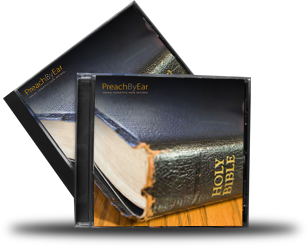
Review – Preach By Ear, by Dave McClellan

DVD-cover-shot

Dave McClellan is a graduate of Grace College and Denver Seminary, as well as having a PhD in Rhetoric & Communication from Duquesne University. He is the pastor of The Chapel at Tinkers Creek.

What if there were a different way to prepare and to preach? What if we have learned preaching in a primarily literacy-based worldview? What if preaching were really an oral form of communication – not just in delivery, but in every respect? What if there were a genuinely oral homiletic? Preach By Ear leans heavily on Walter Ong’s work in respect to orality and literacy. Since the massive changes wrought by the printing press, we have gained so much. But Dave McClellan suggests we may have lost much as well.

He argues compellingly that preaching is intended to be genuinely from the preacher, rather than an external, arms length, process. Yet the effect of literacy is to separate thought from the person. Hence so much of today’s preaching is prepared via book study that is held at arms length, then delivered leaning on notes that keep the sermon separate from the preacher and completed before the event of delivery. McClellan suggests that while preaching has moved back and forth on the orality-literacy scale through the centuries, the 20th century saw the most extreme move to the literacy end of the scale ever.Homiletics was separated from rhetoric and the approach we are familiar with is not as balanced and effective as we may think it is.

As well as leaning Walter Ong, McClellan also looks to Quintillian for rhetorical input. The DVD’s contain a 7-part series of presentations, with each part ranging from 15-25 minutes in length (the final part – “homework” – is a bit longer).  On the one hand the full series is necessarily brief and lacking in the extra background and footnotes that a book might offer (as well as more worked examples to help the viewer see how Preaching By Ear can be genuinely expositional in practice). On the other hand, the series didn’t need to be any longer (it is up to the viewer to apply the lessons learned in a way that handles the text well).  It achieves its purpose of introducing an alternative approach to preaching and sermon preparation well. It may make you want to pursue aspects of the subject further, or simply start getting experience with this different approach.

This double DVD set is very well produced and enjoyable to watch. While it is not exactly “Hollywood” in production quality, it goes well above and beyond a video of a seminar.  The quality of production is clear in the clips available on the website – see below.  Anyay, in the 7-part series on the DVDs, Dave McClellan lays a foundation for an orality-based approach to preaching and then offers some instruction. The first three parts present the concept of orality and literacy, a theology of orality and a brief (but interesting) history of preaching. The next three parts are concerned with preparing the preacher, preparing the message and delivery. The final part offers a series of practical suggestions to help the viewer become better prepared for genuinely oral preaching.

I would encourage you to get hold of this DVD set and ponder its content. Perhaps you’re already kind of thinking this way. Perhaps you’re at the opposite end of the scale. Wherever you are at in your preaching, I think it would be worth adding Preach By Ear to the mix.

By the way, during July the DVD’s are on sale for 50% of the normal price. To see preview clips and order the DVD set, please go to PreachByEar.Com

Filler Words

Here’s a good list of common filler words.  This list is from an article by Ellen Finkelstein, original article here. I mean, basically, overall, it is actually just really definitely worth literally eliminating these from your speaking . . .

Really: “I really want to say how important this is.”
Actually: “I was actually flabbergasted!”
Literally: “I literally sank through the floor.” (Don’t you mean “figuratively” which is the opposite?)
I mean: “I mean, I think it’s OK to say no.”
Definitely: “I’m definitely a supporter of environmental awareness.”
Basically: “Basically, I’m fine with that.”
Overall: “Overall, I don’t see how we can pay back the debt.”
Just: “I’m just so upset about the situation.”
Kind of: “I’m kind of (kinda) ambivalent about him.”
Sort of: “I’m sort of (sorta) ambivalent about him.”
Like: “I, like, don’t know how it’s going to turn out.”

Eliminate these from your speaking.

Any others you use or hear?

Verbal Variations

We’ve looked at the important issues in voice and non-verbals over recent days.  Both of these have to reinforce and support the work being done by your words when you preach.  But before we move on, just a couple of comments on the verbal aspect of delivery . . . the words you choose to use.  I’ll keep this post brief since the others have been so long!

Your goal is not to impress people with big words. Don’t try to make people think you are clever, or have studied really hard, or are super-spiritual, or super-humble, or funny, or whatever.  Your goal is not to create a specific impression of yourself.  It is tempting to impress, decide not to fall for this.

Your goal is to communicate. So choose words that people can understand.  Explain big Bible words that people need to understand, but explain simply and clearly.  Try to use words that are vivid, not bland.  Describe things well so that you don’t just give infomation or abstraction, but you paint a living picture on the screen in their minds and hearts.  Use words that bring in all the senses.  Be engaging rather than flat.  Be lively rather than ponderous.  Be creative rather than predictable.

Words matter, they matter very much!