God and God

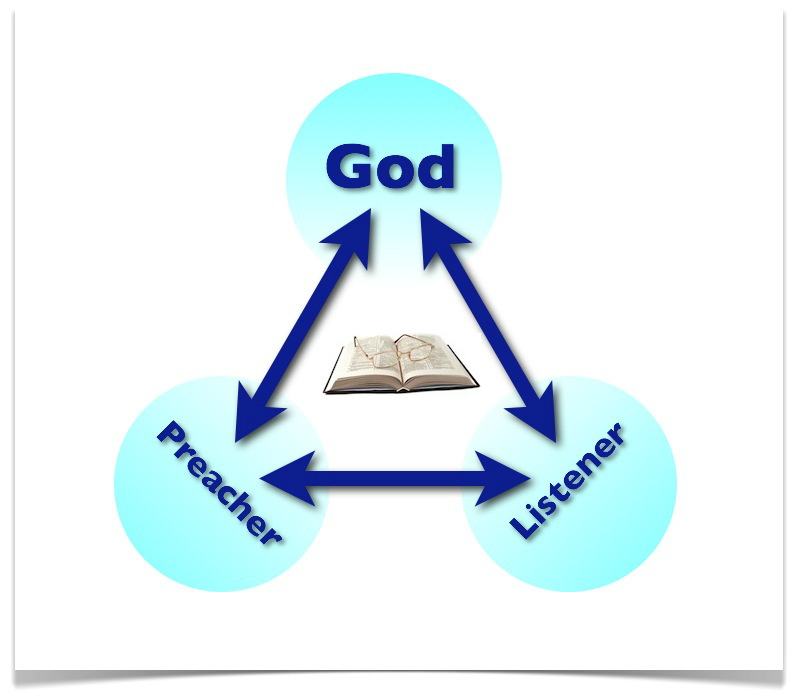
This week I have been pondering the possibilities inherent in the relationships around the preaching triangle.  God and preacher, preacher and listener, listener and God.  I have certainly found it a stir in my own heart.  But as always, our view of God is profoundly significant here.

What kind of a God instigates this powerful circuit of relational connections?

Surely only a clearly Trinitarian God makes any sense here?

1. It takes the kind of God who exists in mutual delight to create the people, to birth the church, to shape the ministry in such a relationally delightful way.

2. It takes the kind of God who delights to communicate in a self-giving and other-centred way to make sense of the rich benefit for the preacher in their personal connection with God, or to make sense of the preacher giving themselves away in a non-self-protective nor self-serving ministry to listeners, or to result in an other-ward goodness-spilling dynamic among listeners.

3. It takes the kind of God who knows how to communicate effectively to make the Bible such a wonderful and vital book in each of the preaching relationships – a book that speaks engagingly to the heart of the preacher with every increasing profundity, a book that offers such rich variety and engaging diversity to allow a preaching ministry to not grow stale, a book that can be read with delight and benefit by the least trained new believer.

4. It takes the kind of God who knows the richness of community to leave us with a ministry model that creates communities on every side – communities of care, communities of responsiveness, communities of delight and service.

Other Christian versions of God simply don’t make sense of the Preaching Triangle.  If God were not genuinely Trinitarian, the preaching triangle would surely look different.  Tomorrow I’ll ponder a couple of possible alternatives.

Add to FacebookAdd to DiggAdd to Del.icio.usAdd to StumbleuponAdd to RedditAdd to BlinklistAdd to TwitterAdd to TechnoratiAdd to Yahoo BuzzAdd to NewsvineLike This!

Listener and God

In many ways the goal of preaching is this relationship, the listener and God.  We’ve already considered God and the Preacher, the Preacher and the Listener, but now for the third relationship.  As ever, dangers and potential.

1. There is a danger that the listeners connect with the preacher, but not with God, due to the effectiveness of communication that inherently lacks the richness of biblical content.

2. There is a danger that the listeners connect with the preacher, but not with God, due to the richness of biblical content that comes from and to deficient relationships with God (i.e. the preacher’s and the listeners’), to put this differently:

3. There is a danger that God’s personal care and concern and self-revelation not get through the preacher to the listeners.

4. There is a danger that the God presented by the preacher may motivate distance rather than intimacy and thereby hinder true connection.

5. There is a danger that the preacher’s goal be an equipped and informed listener who can then become a “self-made” or “self-starting” Christian (beware of application not built on response to and relationship with God).

But what potential!

First, can there be a greater thrill than to see others growing into a deeply forged relational responsiveness to a loving God?  Does it get any better than seeing others flourish spiritually as they discover the fullness of life offered in the New Covenant where they can actually know God personally?

Second, when people have a genuine relationship growing with God, then it will mean an increase in outward spilling and spreading goodness.  Why should that not result in blessing for the preacher?  While we don’t preach for that benefit, it would make sense in a community of captivated Christians, for preaching to forge a community of mutual delight – God in them and them in God and both in the preacher, etc.  Sadly the relationship between preacher and listeners is too often fraught with the tensions of world-like political power struggles and distrust, but what if the gospel really gripped a church, surely it would be different?

Furthermore, that outward spilling goodness would also mean mutual body life as listeners naturally minister by giving of themselves to each other.

It doesn’t end there, the spill of grace would then surely also reach outward again to the community (and that without the preacher pressuring people to be witnesses!)  That’s the thing about God’s relational bond, it doesn’t end there, it just keeps on spilling outward!

Add to FacebookAdd to DiggAdd to Del.icio.usAdd to StumbleuponAdd to RedditAdd to BlinklistAdd to TwitterAdd to TechnoratiAdd to Yahoo BuzzAdd to NewsvineLike This!

Preacher and Listener

In preaching, every participant matters and every relationship matters.  Yesterday we looked at the God/Preacher bond.  Now let’s consider the Preacher and the Listener.  Again, dangers and potential!

1. There is a danger that the preacher will create too much distance through a knowledgeable authority that isn’t balanced with vulnerability and spirituality, leading to disconnect from the listener.

2. There is a danger that the preacher will collapse themselves too far into the listener’s situation by a reverse of number 1 and have nothing of value to offer from God’s Word.

3. There is a danger that the Bible will not be seen as a means of hearing God’s heart, but as a weapon to be brandished in berating the listener, or as a curio that offers mere speculation to all present (including, and led by, the preacher).

4. There is a danger that the spiritual nature of preaching will lead to the preacher failing to value the interpersonal communication at the core of preaching – the value of the smile, of eye contact, of vocal tone and variation, of gesture, etc.

5. There is a danger that the preacher will resist performance and somehow also fail to value the interpersonal connection formed in preaching – both in vulnerability and personal elements of content, and in delivery aspects such as warmth and energy.

But what potential!

The preacher has the privilege of standing in the midst of God’s people and yet leading them in responsiveness toward a God who delights to stir hearts through His self-revelation in the Word.  Sometimes a church will refer to a worship leader as the lead worshipper.  The preacher is the lead responder to God’s Word.  The preacher doesn’t stand outside the gathering of listeners, but in their midst.  Yet the preacher stands there with a word from a communicating God.  Can it get any better than this, to be playing a key role in a community of responsiveness toward a loving God?

Add to FacebookAdd to DiggAdd to Del.icio.usAdd to StumbleuponAdd to RedditAdd to BlinklistAdd to TwitterAdd to TechnoratiAdd to Yahoo BuzzAdd to NewsvineLike This!

God and Preacher

Last week I introduced the Preaching Triangle.  Every participant matters.  Every relationship matters.  I’d like to develop the three relationships, starting with God and the Preacher.  Five inherent dangers, but what potential!

1. There is a danger that the preacher’s gaze will be on the Bible rather than God, that is…

2. There is a danger that the preacher’s focus will be on finding a message, rather than hearing God’s heart in the Bible.

3. There is a danger that the preacher’s strength might come from somewhere other than this relationship, which means the ministry will drain personal resources and lead toward burnout.

4. There is a danger that the ministry will reflect a personal agenda rather than God’s values.

5. There is a danger that the ministry will pursue a personal goal, rather than seeking God’s.

But what potential!  

First, to be cared for and ministered to by God Himself.  Martha needed to learn what Mary demonstrated – the privilege of sitting at the feet of our loving Lord that He might minister to us first, so that we might then minister to others.  We cannot love God by loving others with any lasting consistency.  Loving God by listening to Him must come first.  Enjoying the privilege of the intimate relationship that the Bible describes in the most intimate of terms: a friend of God, a brother of Christ, a child of Abba, the temple of the Spirit, the body, the bride, I could go on.

Second, to join with God in a community of carers looking outward to others.  “As the Father sent me, so I send you. . . Do you love me?  Then feed my sheep, tend my lambs.”  What a privilege it is, in the midst of the tensions and challenges of church ministry, to remember that we are privileged to participate in God’s work of soul-care.  Apart from Him we can do nothing, yet we are invited to join in, to serve and give together with a serving giving God!

Add to FacebookAdd to DiggAdd to Del.icio.usAdd to StumbleuponAdd to RedditAdd to BlinklistAdd to TwitterAdd to TechnoratiAdd to Yahoo BuzzAdd to NewsvineLike This!

Saturday Short Thought: Image of God

This week I’ve been blogging about the inherent relational connections in the preaching event.  I have just finished writing notes for a session on the Life of the Preacher (more than a bit about relationships in that!), and today am looking forward to a reunion of last year’s Cor Deo team, along with this year’s team.  There is a theme here!

And yet the preaching ministry is often such a lonely one.  While I understand all the dynamics that can make it so, I have to say that it is incredibly inconsistent with the gospel we preach.  This week I was in a conversation where the image of God was raised.  This is often defined anachronistically by imposing a much later philosophical anthropology onto the notion, resulting in the image of God being seen to mean our unique ability among God’s creatures to think abstractly, choose freely and rule as we see fit in our independence.  But is the image of God really and primarily about our cognitive faculty and self-directed will?  Is that really what God is like in Himself?

Looking at the text in context, it is clear that a major feature of the image of God must be some aspect of relationality.  The “let us” language, the male and female, the unity in diversity, even the dominion elements seem to be more about a loving care than a sharp powerful domination.  The Bible, from that point on, from cover to cover seems to support a relational core to what it is to be made as human in God’s image.

Looking at our world today, we see that relationality is so important, even to those who deny it with every fibre of their being and action of their life.  People sacrifice family on the altar of career advancement, achieve all their life goals and then drink themselves into oblivion because they have nobody to share the triumph with.  Maybe our relationships should feature more on our CV’s than merely a token reference or two at the end.

So as preacher’s of God’s Word, let’s be sure to not impose cultural or philosophical values onto the text of Scripture.  More than that, let’s be sure to let the biblical emphasis on relationality mark our lives and ministries.  Let us not contradict by our lives the truths we preach with our lips.

Add to FacebookAdd to DiggAdd to Del.icio.usAdd to StumbleuponAdd to RedditAdd to BlinklistAdd to TwitterAdd to TechnoratiAdd to Yahoo BuzzAdd to NewsvineLike This!

The Preaching Triangle of Relationships

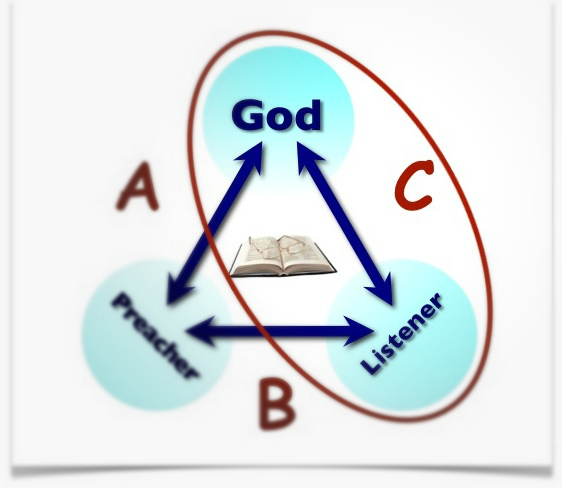
I have introduced the notion of preaching as being the combination of three participants gathered around the Bible.  But the key feature of this approach is to see the importance of the relationships.  Like an electrical circuit, what matters is the connections.  And when there is a full set of connections, then something powerful occurs!

A. God & Preacher.  The preacher doesn’t engage the Bible merely to find a message for the listener.  Rather the preacher’s primary concern is to engage with God relationally.  Out of the overflow of this relationship comes the ministry to the listener.  God doesn’t empower the preacher merely for the sake of the listeners, but loves and delights in His child.  When this relationship fades from view, the preacher will experience dullness in ministry and potentially burnout.  As the preacher engages with God personally, he/she also joins with God to form a community of carers – that is, the preacher starts to look toward the listeners with God’s loving concern.

B. Preacher & Listener.  The preacher speaks with the authority of God’s Word, yet does so as one on the same level as the listener, as a fellow responder to God’s Word.  The listener will appreciate the knowledge and spirituality of the preacher, but also will appreciate the vulnerability of a fellow believer who clearly recognizes the community of believers.  A sermon motivated by love for listeners will be better than one motivated by self-love in the preacher.  As the preacher/teacher’s heart connects with the hearts of the listeners, a community of responsiveness toward God is reinforced.

C. Listener & God.  The effective preaching of God’s Word enables the listener to relate not only, or primarily, to the preacher, but to God himself.  But more than that:  in effective biblical preaching God is giving of Himself to the listener, building the connection between them.  In this connection both God and the listener become a community of listeners, joining together to delight in each other, and even in the preacher as he/she makes much of the grace of God in His Son.  (When preaching offers a non-biblical portrait of God, or leaves Him out altogether, then both God and listener will be grieved or burdened.)

So whatever opportunity you have, be sure to view the teaching opportunity as primarily a relational opportunity – between God and you, then between you and them, for the sake of them and God!

Add to FacebookAdd to DiggAdd to Del.icio.usAdd to StumbleuponAdd to RedditAdd to BlinklistAdd to TwitterAdd to TechnoratiAdd to Yahoo BuzzAdd to NewsvineLike This!

The Preaching Triangle – Omissions 3 and 4

Yesterday I pondered the possibility of effectively losing God and / or the preacher from the preaching event.  Today I’ll complete the scene by pondering the potential omission of the listener, as well as the critical fourth element of the Preaching Triangle.

3. Listener.  God speaks through His Word and through the preacher, empowered by the Spirit, making much of Christ, but the heart of the listener is always free to respond or reject Him.  It is naïve to assume that the listener is always ready and motivated to hear the message of God’s Word – hence the need for demonstration of relevance in order to salt the thirst of the listener for God’s Word.  Well-handled Scripture effectively communicated in dependence on God will transform lives and churches, but the condition of the soil into which the seed falls is always a key factor (i.e. some won’t respond no matter what!)

And when we fail to emphasize relevance to the listener?  Then we have an historical lecture, a pulpit performance to impress God (it doesn’t), or a demonstration of the preacher’s theological acumen, but we do not have transformational Christian biblical ministry.

But there is also the fourth element, the Bible:

Bible.  The Bible is the self-revelation of a wonderful communicator.  God inspired every word, every choice of genre, etc., and so we should seek to honour His work by doing our best to understand His Word and re-present it to others.  The Bible should not be an end in itself, but the means by which we can know the heart of God: His personality, His loveliness, His values, His concerns, His delight.

And when we omit the Bible?  Then we have personal opinion, or implied direct revelation (highly questionable), but we do not have authoritative Christian biblical ministry.

Why might the preacher fail to pay attention to the listener in the preaching event?  Perhaps too much self-focus, perhaps a lack of understanding that communication needs to be aimed to fully arrive, or perhaps a lack of concern for others.  And why might the Bible get lost in the mix?  Again, numerous possible reasons: a faulty view of direct revelation, an elevated view of one’s own wisdom or spirituality, an inadequate view of the Bible, or even a lack of care for the listener’s real needs.

Tomorrow I’d like to start considering the relationships implied by this Preaching Triangle.

Add to FacebookAdd to DiggAdd to Del.icio.usAdd to StumbleuponAdd to RedditAdd to BlinklistAdd to TwitterAdd to TechnoratiAdd to Yahoo BuzzAdd to NewsvineLike This!

The Preaching Triangle – Omissions 1 and 2

Yesterday I suggested that every participant matters in the preaching triangle.  What happens when we leave one out?

1. God.  The goal of all biblical ministry in the church is to know the God who reveals His heart in His Word.  The Spirit who inspired the biblical authors also empowers the biblical communicator to point to the Son, that through Him, the Father might be known.  God is at work in both the preacher and the listeners, and both need to be responsive to Him.

And when we somehow leave God out?  Then we have an informed presentation, or a human-level exhortation, or a religious performance for a distant deity, but we do not have Christian biblical ministry.

2. Preacher.  God has chosen to use inadequate communicators to enable others to hear His Word and respond.  We also form a connection with the listeners (either good or bad) and communicate with our lives as well as with our words.  Effective communication involves the heart to heart connection of the preacher with the listener, as well as both with God.  This means that as well as the verbal content (the words), the preacher must also effectively communicate by means of the vocal and visual elements (use of voice, plus posture, gesture, expression and movement).

And when we downplay the role of the preacher?  Then we lose the incarnational nature of God’s self-revelation, we lose the privilege of hearing God’s Word spoken with power.  We might be able to affirm a strange view of “reliance on God” (based on a hope that He might work around us and despite us), but we do not have incarnational or effective Christian biblical ministry.

Why would someone leave out either of these participants in their approach to preaching?  I suppose a view that God is distant and disconnected, or excessive confidence in one’s own intellectual ability might lead to the first omission.  A highly “spiritual” view of God’s work despite the preacher, combined with a potentially confused view of humility might lead to the second omission.

Tomorrow I’ll consider the implications of leaving out the other two…

Add to FacebookAdd to DiggAdd to Del.icio.usAdd to StumbleuponAdd to RedditAdd to BlinklistAdd to TwitterAdd to TechnoratiAdd to Yahoo BuzzAdd to NewsvineLike This!

The Preaching Triangle – Introduction

Preaching is not about performance, nor ritual.  It is a communication event.  Like most things, how you understand it flows out of how you view God.

If you see God as a distant power broker, a singularity focused exclusively on his own self-absorption, that will influence the way you preach.  I suspect you’ll be torn between making much of Him because you should, and making much of self because that is the logical conclusion of being made in His image.  The Bible will function as a code of instruction to decipher and disseminate that others might know how to satisfy the distant One.

But if you see God as the eternal fellowship of the trinity who is always others-centred, so that His love has reached out to us to bring us into fellowship with Him by His grace, then that will also influence the way you preach.  And it seems to me that preaching will consequently be a much more relationally-charged event.

In the next days I’d like to probe the notion of preaching being essentially about three relationships, between three ‘participants,’ centred around the inspired Word of God.  The participants are all required:

1. God.  Without whom preaching is an exercise in human performance.  I wonder whether we might sometimes tip our hat to the importance of God’s role in our preaching, but then pray and preach as if our dependence is only token?  Truly, apart from me, you can do nothing.  Surely preaching without God’s involvement is an exercise in abject futility?  But what does it mean for God to be involved?  Just that we pray to Him?  If we pray to Him and then preach about Him, is that enough?  What if Christianity is much more participatively relational than we have realized?

2. Listener.  Without whom preaching makes no sense, since it is not about us or our desire to impress God with our rituals and performance.  Again, I wonder if our preaching is genuinely marked by an awareness of those to whom we preach?  More than that, do we really consider the connection between us and those to whom we preach?  It is easy to tip our hat to the importance of knowing the listener, but then preach as if they are a generic gathering of folks.  But the listeners matter precisely because of the kind of God that we have.  He knows, He loves, He cares.  Consequently He expects those preaching His Word to also know, love and care.

3. Preacher.  Without whom the conversation would be about something other than preaching, but really, does the preacher matter?  I say yes.  There is a vital role for the preacher precisely because of the kind of God that we have.  He is a communicator, He cares, He incarnates.  Consequently He values the human speaker, who also should care, who in some way is an enfleshed presentation of the Word.

All three participants matter greatly in the preaching triangle.  Tomorrow I’d like to drill down a bit more on why each one matters, before we then start to probe the relationships in this triangle.

Add to FacebookAdd to DiggAdd to Del.icio.usAdd to StumbleuponAdd to RedditAdd to BlinklistAdd to TwitterAdd to TechnoratiAdd to Yahoo BuzzAdd to NewsvineLike This!