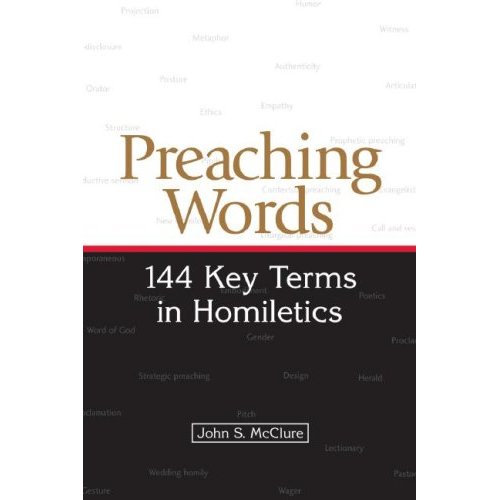
Review: Preaching Words: 144 Key Terms in Homiletics, by John S. McClure

144KeyTerms

This is not a dictionary, although the similarities are clear. 144 terms are stated and defined succinctly. Then explanation with quotes from key figures in the area follow in anything from one paragraph to four page explanations of the definition, and then a brief bibliography.

For the author, these terms make up the “building blocks of homiletics” (p.xii) However, the extent to which you resonate with his confidence will depend on your theological stance. The words chosen reflect the diversity of ‘key’ concerns in the broader realm of homiletics – from feminist preaching and gender, via deconstruction or Nommo, to kinesics and embodiment.

There is a good amount of helpful content mixed in to this volume, including some helpful summaries of various writer’s works. If your preaching library already includes several good texts on expository preaching, Biblical interpretation/hermeneutics and so on, then this book would offer a helpful introduction to homiletics beyond the more evangelical sphere. If you want an introduction to preaching, despite McClure’s confident introduction, this is not the book for you.

A collection of building blocks for preaching? No. When key blocks like “hermeneutics” do not even include the possibility of interpreting the Bible as we would affirm, a building constructed with this block would be at risk of crumbling under any weight. These are not building blocks, but windows – helpful and easy to see through, some of which open into areas of homiletical study many of us seldom consider, or even know exist.

This succinct book is very helpful, if you are looking for an introduction to homiletics in its broader forms. There is real benefit here, but look carefully, you would not want to fall through some of these windows.
After you preach, then what happens?

In his book The Seven Laws of the Teacher, Howard Hendricks refers to an English bishop who said, “You know, wherever the apostle Paul went, they had a riot or a revival. Wherever I go, they serve tea.” (p165.)

While it would be wrong to try to stir response, either riot or revival, in our own strength, we should be preaching for response. This is why it is so important to have a clearly defined purpose for a message. We often hear about the importance of the main idea of the sermon. But for an effective sermon, you also need a clearly defined purpose – the specific response you prayerfully expect to occur in the life of the listeners.

(Peter has responded to a comment on this post)

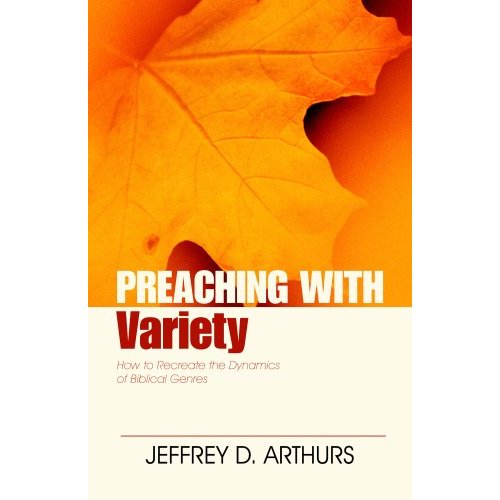
Review: Preaching with Variety, by Jeffrey Arthurs

Sub-title – How to Re-Create the Dynamics of Biblical Genres.

Arthurs Variety

I hope this book gets the recognition it deserves. This is a power-packed paperback that seeks to stimulate Biblical preachers in developing variety in their preaching through awareness of how the various Biblical genres function. Arthurs offers not only understanding of how the genres do what they do, but also many suggestions on how to reflect their diversity as we preach them.

Arthurs states, “I believe that a sermon’s content should explain and apply the Word of God as it is found in a biblical text, and a sermon’s form should unleash the impact of that text.” (p.13)

Arthurs is not arguing that the form of a text dictate the form of a sermon, even if that were possible. Rather he argues that genre sensitive preaching seeks to replicate the impact of the text. He affirms the great freedom in form available to preachers, and encourages that freedom by presenting the great variety found within the six major Biblical genres.

The first two chapters argue in favor of variety in preaching, firstly because God the master communicator uses such great variety in all His communication – not least in the diverse forms of literature used in His Word, and secondly because our listeners value variety.

The rest of the book deals with six Biblical literary forms: Psalms, Narrative, Parables, Proverbs, Epistles and Apocalyptic. In each case presenting an introduction to the genre, a helpful explanation of the rhetorical devices used to create their impact and numerous helpful suggestions on how to preach the different types of text. The result of these suggestions, if heeded, will be real variety in Biblical preaching.

Arthurs is as much concerned with rightly handling the Biblical forms as he is with prompting variety in preaching. He is urging effective understanding of the rhetorical function of Biblical genre, so that one’s preaching might also fizz with Biblical variety. This is not the definitive book on creative preaching, for there are others that suggest many exciting and bizarre possibilities. However this may well become a model book on interpreting Biblical genre (and in that divinely designed diversity is the shove we all need to vary our preaching!)

So I hope this book gets the recognition it deserves. Thomas Long’s brief paperback on literary forms has been rightly praised as a helpful introduction to the subject of genre studies with some help for the preacher. Arthur’s work may well replace Long’s, for it is a more complete introduction to more Biblical genres from a more definite evangelical stance, with much more in the way of practical suggestion for the preacher.

This book will help you say what the text says, and do what the text does!

(Peter has responded to a comment on this review) 

Missing in Action

Just a short post that might stimulate a different type of discussion. When I listen to preachers, or evaluate my own preaching, I find some things are often missing in the pulpit. For example, Robinson highlights the importance of the “Big Idea” and the “Sermon Purpose” in his book Biblical Preaching. This is essentially the same thing as Thomas Long’s two terms, “Focus” and “Function” – what a sermon intends to say and do. (Long, The Witness of Preaching, 2d ed.) These two things are often MIA – and how sermons suffer for it! While these two are two of the most important things that can go MIA, there are others too…

(Peter has commented on this post)