Snapshot or Replay?

Van Harn presents a helpful analogy for us (Preacher, Can You Hear Us Listening, p53).  When you preach a biblical text, do you preach a snapshot or a replay?  Sports journalists use both.  Immediately after a key moment in a game, the replays kick in.  The moment can be savored, the action understood and the intensity felt.  The next morning a snapshot is placed on the sports pages.  It brings back memories of the action, but it is not the same.  A snapshot is a two-dimensional, frozen representation of an event that took place.  A replay is a moving image, perhaps from various carefully chosen angles, perhaps with slow motion, all intended to bring you into the moment of the action.

The text is technically a frozen image of the action, but we should be sensitive to the dynamic nature of the written text.  As preachers we need to do more than give a snapshot of the biblical story.  Rather we should seek to let our listeners enter into it as we choose careful angles and appropriate commentary alongside slow motion replays.  A sermon should not be a mere lecture of facts, but an entrance into the dynamic reality of a living text.

We must engage the text as literature, plot, story, history and record.  We must meet the listeners in the heart, the mind, the imagination, the conscience, and the will.  Effective preaching involves more than recitation of facts, it requires us to purposefully engage both the text and the listeners at multiple levels.

Manipulation in Proclamation

As preachers we are called to do more than inform the mind.  We are not lecturers.  We are not called to achieve a stated goal by any means possible.  We are not salesmen.  So how are we to navigate the pulpit so that we fulfill our calling, but don’t overstep the mark and take on tasks that are not ours?

1. Preach to the heart.  It is important to understand that people are not just mind and will, but first and foremost are heart-driven.  The Bible teaches this, even with all the gymnastics some teachers go through to avoid what the text says.  The heart is more than mere emotions, but it is not merely the mind as some suggest. In Ephesians 4:17-18 Paul urges the believers not to function like the unsaved Gentiles.  They do not act well because of their minds, thinking, and understanding.  But there is another issue.  Their minds are the way they are because their hearts are hardened.  The heart is central, critical and very much in control.  So, as preachers we must address the heart and not take a short cut to just the mind or will.

2. Don’t stir the emotions and then attach spiritual content to that.  Since the heart includes emotions, it is tempting to merely stir the emotions and then attach our message to that emotional reaction.  You can tell a moving story about the little boy who finally hit a home run (for Brits think of a boy hitting a six), then as people feel themselves filling up, drive home the application of the sermon.  “You too are standing at the plate, Jesus is asking you to commit to this challenge this week, will you commit?  Will you swing the bat?”  This is riding on the back of imported emotion to “achieve” something while preaching.  This is manipulation.

3. Allow the text to reach the heart. The solution is not to merely preach an intellectual sermon and avoid the heart.  The key is to preach the text well so that the text itself and the message of the text can do its job.  If the passage is moving, let it move people.  If the passage is stirring, let it stir people.  When the text itself and the message itself stir the emotions, great.  Don’t feel you have to import a moving story to get the job done.  Make sure that emotions are stirred by the text, the message, the idea itself.

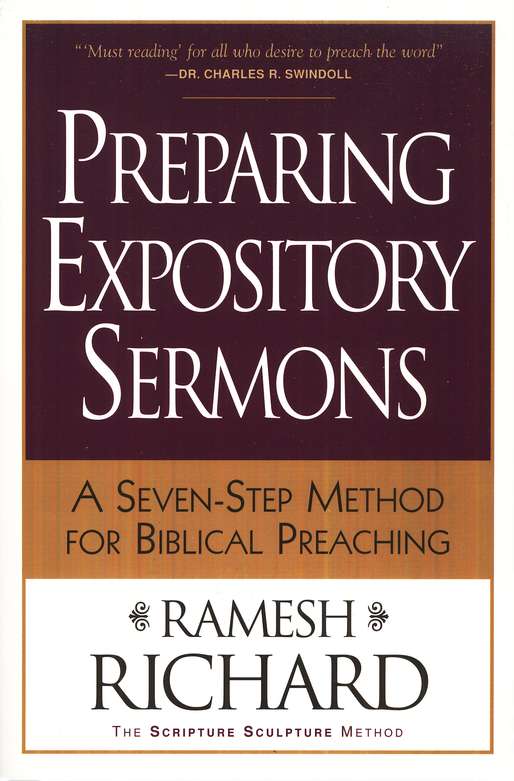
Review: Preparing Expository Sermons, by Ramesh Richard

Sub-title: A Seven-Step Method for Biblical Preaching

Sub-sub-title: The Scripture Sculpture Method

ramesh.jpg

Ramesh Richard teaches preaching at Dallas Seminary as well as around the world in a noteworthy international ministry.  His cross-cultural training and ministry experience gives his book a good level of sensitivity to preaching in various settings and cultures. 

As a student and successor of Haddon Robinson at Dallas, there is a clear mark of Haddon’s influence throughout.  This book is a good introduction to sculpting sermons and is worth reading.  However, for reasons noted below, I would place others higher on my list of best introductions to the subject.

The book itself is short, 140 pages before the appendices.  It is nice to read a concise work, but at times the writing feels slightly overwhelming, with one example or teaching element after another.  Richard takes the reader through seven steps of sermon preparation.  The steps make good sense and are similar to the seven stages I use on this site (main differences in stages 1, 6 and 7).

Throughout the book I found strengths, and usually a “but” as well.  For instance, in stage 2 the focus is on the structure of the text.  This chapter is great at demonstrating content cues and structural markers in a text, but it is almost exclusively focused on individual verses.  By having one verse on a page, as suggested, it is harder to focus on the flow of thought in a “chunk” of text.  On several occasions Richard suggests handling the Bible one paragraph at a time, but there seems to be little attention given to narrative texts that may need multiple paragraphs for a whole plot.  In fact, even in the appendix that deals with narrative texts specifically, the idea of “plot” is strangely absent.

Probably the strongest step in the process is the fourth step, the purpose bridge.  This stage links the Bible study to the stages of sermon formation.  As far as Richard is concerned, the author’s purpose influences the process sufficiently in the Bible study stages of 1-3, so that now at 4, the preaching purpose is the only concern.  I would suggest the author’s purpose must be specifically discerned, rather than assuming it will be discovered in the Bible study process provided, and the author’s purpose should be the starting point for the modern preacher (who obviously can and will sometimes select a differing purpose for the contemporary audience).

Richard is essentially very deductive in approach.  He allows for inductive sermon shapes, but it seems that each major point in any sermon should follow a deductive pattern with the stating of the point up front.  This feels a little rigid.

The final 60 pages of the book are given to 13 appendices.  These deal with issues that regularly come up in Scripture Sculpture seminars around the world.  Strong appendices include one on the Holy Spirit’s role in preaching (a regular concern when people formally interact with the process for the first time), and another on understanding your audience (brief, but with some helpful comments on differing cultures).  On the other hand, several of the appendices are relatively weak and have the feel of an information dump for things that didn’t fit in the text of the book.  Appendix 5 on principilization contains non-stop warnings, but does little to instruct the reader how to avoid the pitfalls.  Appendix 10 provides a sample sermon introduction, but I would assume this sermon was for seminary students, since the language used seems a little lofty for a typical church congregation – omni-function, self-deification, apokalypsis.

For people wishing to have a book that gives a detailed step-by-step process for sculpting a sermon from an epistolary text, this would be a decent option.  For those who, like me, are perpetual students of preaching, then this does contain much to commend it.  Yet as a practical introduction to expository preaching, I would recommend others, such as Robinson and Sunukjian, above Richard.  

(Ramesh Richard also has a book on preparing evangelistic sermons, which I suspect would be a very worthwhile read.)

Why Some Sermons Are Not Fresh

There are many reasons why a preacher may struggle to prepare a message that is really fresh and vital. Here are three to be aware of and guard against:

1. Schedule pressure – The reality for most of us is that there are not enough hours in the week. With the best intentions to give time to the sermon preparation, life continues to happen. Crises occur in the church and in the family, other tasks take more time than expected, and so on. When the walls of time are pressing in, the preacher naturally will move to “just getting a message” rather than fully preparing a message from that particular text for those people on that Sunday. Just a passing comment – if there is never enough time any week (perhaps because you are preaching five times a week), then perhaps something needs to be changed.

2. Text familiarity – After years of formal and personal Bible study, it is inevitable that the text can take on a certain level of familiarity. The temptation is to move on to hunt sermon detail material such as illustrations, rather than taking the time to study the passage again. There may be a temptation to jump from the text to a doctrine that seems both pertinent and important. The challenge is to first take the opportunity to study the text again. Often I find that my understanding at the level of doctrine may not change too much, but the literary structure of a passage usually becomes clearer each time I return. Focus on the literary structure and features of the text, look for turns in the plot, points of tension in the narrative, significant movements in the flow of thought.

3. Spiritual staleness – Being in ministry can be a lonely place. Everyone has expectations of us, many place demands on us and few understand the unique battles of the ministry on every level, not least spiritually. With high levels of output, and potentially very little input other than that which we pursue for ourselves, spiritual dryness can easily set in. There are numerous elements in a solution to this, but mention must be made of our relationship with God and our relationships with other people. Both need transparency, both need constancy. There is much more, but there can’t be less than this.

Under pressure to produce it is easy to slip into a pattern of merely creative sermon making. But as Van Harn suggests, the minister is not called first of all to be creative, but to be a faithful listener to the text. (Preacher, Can You Hear Us Listening?, 19)

Hey Preacher – You a Prophet or a Priest?

I’m not using prophet or priest in the full biblical sense.  I appreciate the terminology though as it is easier to remember than the terms I’ve used to teach this same point in the past (so thank you Dave Stone for mentioning this in your seminar in Cambridge):

1. Younger preachers have a tendency to try to be a prophet.  They can be full of zeal and just want to give the bottom line, they want to say it like it is.  God can and does use young preachers with hard-hitting messages (George Verwer comes to mind, who founded Operation Mobilization as a teenager).  However, it is worth pointing out to young preachers that people also need a priest.  As Haddon Robinson says, “for every  ‘you jerk!’ you need ten ‘atta boys!’”

2. Older preachers have a tendency to stay as a pastor and priest.  Having lived the life and built the credibility, some more established preachers hold back from preaching the strong messages people need to hear.  If you’ve lived the life, walked the trail with the Lord for many decades, and if it is the message of the text, then preach it!  Don’t always hold back and protect feelings.

3. People need both “prophet” and “priest.”  Whatever age or stage you are at as a preacher, remember that people are people.  They need comforting, challenging, encouragement and exhortation.  People need the tender care and the tough love of the Great Pastor, so as we preach His Word, let us be sensitive to both the “prophet” and the “priest” elements.  Know the needs of  the people and preach the Word!

Review: Preacher, Can You Hear Us Listening? By Roger Van Harn

vanharnl.gif

I was surprised by this book.  I am not sure what I was expecting, but I was both blessed and challenged by it.  The focus of the book is on listening, both to God and to people, by the preacher and the congregation.  Perhaps the strongest lasting impression left is the notion of the preacher being a ‘pioneer listener’ – he who is one of the people, yet listens first to God’s word for the people.  The preacher listens to, with and for the people.

The book is structured using twelve questions.  The first sets up the opportunity to present a biblical theology of hearing/listening in the New Testament.  Then he moves through issues of the noise of a fallen world, the importance of the biblical text and gospel story, as well as contemporary culture to a final call for preachers to be listening to their people.

Chapters 2, 3, 5 and 6 are particularly strong as Van Harn addresses issues relating to Biblical interpretation and presentation.  Unfortunately chapter 4 breaks the sequence.  As he tries to show the importance of presenting the gospel behind every text he inadvertently does a good job of debunking the rather simplistic idea of the chapter.  His imagery of a smudged window is not comfortable to this reader.  Having criticized this chapter, I should reemphasize how effective those before and after were in their purposes.

As well as affirming the need to hear the story behind, and around, the text, it would have been nice to read a chapter affirming the need to hear the story in the text.

Van Harn effectively presents the need for listeners to see the connections between text and sermon, as well as sermon and life.  His presentation of the need for a helpful angle and proper distance is excellent.  He highlights the importance of the sermon in helping the community of believers interpret their culture, knowing when to say yes, no, or maybe to those things going on around them.

His presentation of the church as that which is one, holy, catholic and apostolic is interesting, but he is strangely quick to dismiss the distinction between the visible and invisible church.  The closing chapters perhaps lost the strength of the first half of the book, but still are worthy of your time.  Van Harn’s closing suggestion for hearing the congregation is simple and seemingly quite effective.

This is clearly a book written by a man who has given much thought to the generally neglected subject of listening.  I think we could all benefit from reading it, and hearing what he has to say.

Speaker Introductions

I have heard a lot of introductions.  I’m not writing of those by the preacher, but those about the preacher.  My ministry has never been in a solo-preacher church.  So with different speakers (be they team members or visiting speakers), there is potentially some need to introduce the speaker.  In my traveling role I hear many introductions before I speak.  Here are some musings on the subject:

1. It is easy to say too much.  In an attempt to help the people know the preacher, or to establish his credibility, many will say too much.  I feel that academic qualifications are relevant only in an academic setting or when they relate to a specific and unusual subject matter.  Excessive listing of achievement or position achieves little other than making the speaker’s life sound impressive (and more distant from the “normal” listener).  When asked what to say in an intro, I will usually request that they say as little as possible, perhaps mentioning that I’m married with four children (i.e. a normal person). 

2. The introduction is mostly the preacher’s job.  After a short and simple introduction, I can then decide anything I need to add explicitly for increased credibility or connection.  It is important to note that people are struck far more by the preacher’s manner and delivery in the introduction to the sermon than any achievements they may have in other areas of life.

3. Be sensitive to the worship mood.  In some settings a lot of prayerful thought has gone into the flow of the meeting.  It is a shame to interrupt the moment with an unnecessary introduction of the preacher.  (There have been times when an introduction was so over-the-top that I expected it to end with the words, “so will you join me in worshipping our speaker this morning, Mr . . .”  Obviously this is not the kind of worship I have in mind when I refer to the worship mood!)

4. Is it necessary then, or at all?  It is not a rule that the speaker must be introduced before they come up to speak.  Consider whether the whole meeting would be better served by an introduction in the notice sheet / bulletin, or earlier on in proceedings, or not at all.  Something special can be achieved with a seamless transition between music and message that can never be replicated with an interlude for introduction. 

That Message from That Text?

It is vital that the listener be able to see how the message comes from the text they are looking at. The credibility of the speaker matters, but the credibility of the Bible matters more. It matters that people listening to a sermon can look at the text before them and see how the message flows from that particular text. It is not good enough to preach truth, or to preach a sound idea. It matters that the truth and the idea come from the text presented to the people.

Some years ago my wife and I sat in church as the visiting preacher preached the gospel. The message was true, the gospel was clear. But the message was not true to that text, and the gospel was not clear from that text. His “clever” presentation of the gospel undermined the very credibility of the gospel he proclaimed.

Since you’re wondering, he preached the gospel using the three phrases from Job 41:8. First point was that we must identify with Christ (lay your hand on him). Second point, that we must remember what He did for us (remember the battle). Third point was that our salvation is not dependent on us, but on Him, there is no need to keep “getting saved” again (and you will do it no more). The text is not presenting the gospel, it is God telling Job to get in the squared circle and slug it out with leviathan.

May our listeners never leave saying, “Great message, but I don’t see how he got that message from that text!”

Peter has responded to comments on this post.

Preaching Resource Teams in the Local Church

I know some pastors who love this idea. I know others that seem to flee from it. Consider it. Consider approaching a group of people in the church and ask them to be part of your Preaching Resource Team.

1. Tell them what sermons or series are coming up. They can be on the look out for illustrations, information, stories, statistics, etc. They feed this to you and you filter it for helpful material. In reality, a lot will never get into a sermon, but that is also true with your own hunt for illustrations. Having others feed this stuff to you will help you as there will be a nugget here and there.

2. Tell them when you are going to use their stuff. “Hey Steve, thanks for that moon-landing story, I’m going to use that this Sunday!” Steve will be there. Steve’s family and friends will probably be there too as he herds them in with his head held high.

3. Tell the people where you got the story. “Steve passed me a story that really makes this idea clear for us. When Neil Armstrong first stepped onto the moon . . .” Now Steve is really beaming (maybe on the outside, probably on the inside), and will double his efforts to help you. Others will also want to help you too, once they see that you are open to input.

4. Tell the team you appreciate them. Perhaps once a year you could throw an appreciation meal for your Preaching Research Team. Make them feel special, appreciated and involved. What do you have to lose?

There are numerous ways to involve members of the congregation in sermon preparation or feedback. I’ll mention others in time, but liked the sound of this idea when I heard it mentioned recently by Dave Stone.

Using a PC in Preaching Preparation

It is so easy to take technology for granted.  Some of us have access to more tools than we know what to do with.  Others who read this may have access to relatively little.  Just for fun, here’s my top five helpful tools on the computer, in reverse order:

5. biblicalpreaching.wordpress.com – not a shameless plug, but a pointless plug since you are here already!  I hope this site is useful to preachers as they prepare to preach, that is the point of it.

4. Google – the internet is an incredible thing.  If I want to use the Challenger disaster as an illustration, I can use google and have as much detail as I want almost instantly.  There are dangers though.  The internet can be more effective than an Oreck Excel vacuum cleaner at sucking away your time.  Be disciplined, tread carefully, filter wisely.  In the spiritual battle of sermon preparation, the internet can be an easy tool for the enemy too.

3. Good reference software – I have Libronix on my computer.  This is a huge help, especially when traveling away from my bookshelves.  It is possible to quickly skim through numerous commentaries helpfully turned to the right page at the click of a mouse button.  I say Good reference software for a reason.  There is a lot of filler material on reference software.  Learn what is quality, up-to-date material and generally don’t give too much time or attention to the tools that aren’t. There are some real exceptions, but a lot of free software is free for a reason.  While some titles may have been cutting-edge in their day, public domain status now is not without cause (generally they won’t sell).  Use the best tools available to you, but they are tools – you still have to do the thinking work!

2. Good Bible software – I use Bibleworks for Bible software.  I hear great things about Accordance and Gramcord, and Logos is also in the running.  It is helpful to have a quick reference for parsing verbs, checking the lexicon, analyzing the frequency of a term and so on.  It is no substitute for being able to handle the original languages and can become a crutch that allows whatever skill you have acquired to atrophy.  Those who have not studied the languages should not think that merely parsing a verb makes you a language scholar, there is still much that the software won’t and can’t do for you.  The blessing of speed in research is a responsibility, it means you theoretically have more time to do the hard work of thinking!

1. Word processor – Useful in so many respects.  Obviously you can type outlines, manuscripts and so on.  Cut and paste allows you to reduce a message to an appropriate length and focus.  Material removed from this weeks message can go in what Dave Stone calls a “leftovers” section and may be perfect for next weeks message.  Illustrations can be stored in a folder and searched for using any keyword you put in the file.  Record, remember and retrieve, the key elements in effective filing.  I could go on.  I’ve put a potential danger or warning in the previous listed items.  I can’t think of one for the word processor (I suppose I should say “back-up your files” – nothing worse than losing so much great material!)