Breaking Writing Rules for Manuscripts

As you may have read in previous posts, I think the best approach is to prepare a full manuscript, but then to preach without notes. The full manuscript allows you to sculpt and craft the language carefully in order to be precise and effective. This can be overdone and end up feeling like a contrived performance, or underdone and end up feeling like a rambling grasping for the right words. But the main rule to remember when writing a manuscript is that you are trying to write for the ear, not the eye. Most other rules can and maybe should be broken.

For example, David Buttrick helpfully suggests that a single move in a sermon (think “point”) may last 3-4 minutes, but since it has inherent unity, it should be manuscripted in a single paragraph. If the stages of development within a move are manuscripted as separate paragraphs, then the move will tend to fall apart. First sentences in paragraphs tend to break the flow of an idea as it is still forming. Perhaps this reflects the nature of oral communication. When speaking to a group, it takes longer for a thought to form in the group consciousness. Hence longer paragraphs.  (See Buttrick’s Homiletic, p50)

Let me quickly incorporate that suggestion in a simple three-level approach to writing for the ear:

On a micro level, sermon manuscripts can break rules of sentence structure. You must write as you speak. Yes. Sometimes incomplete sentences.

On a mid level (is that the right term?), sermon manuscripts will include more repetition that normal written prose. Your manuscript will show evidence of going over the same concept. Repeating, or even better, restating what you’ve just written. You wouldn’t do this in written English, but you’re writing for the ear and that requires repetition and restatement. Saying the same thing again in different terms. Giving hearers one more opportunity to catch what you’ve been saying.

And on a macro level, sermon manuscripts should reflect the unity of the sub-parts in a sermon. So a movement, or point, should cohere. Using bigger paragraphs may help achieve that inner unity.

Incoherent Preaching

Very few preachers are incoherent.  Yet many preachers are incoherent.  Before you accuse me of being incoherent, let me explain.  The other day I sat through a sermon from a visiting speaker.  I may be my own worst critic, but I try to be gracious to others.  Sorry.  On this occasion I failed.  Why did I have such a hard time with the message?  Because it did not cohere.

The man was coherent.  No reason to believe otherwise.  Every sentence made sense.  Every word fit in its context.  Yet at a higher level the message was incoherent.  It didn’t stick together.  The pieces may have made sense as distinct units.  But the reason for joining them together was unclear.  At a level higher than words or sentences, the message lacked unity.  All the parts of a message must be coordinated to form a single, unified whole.  Without this careful and deliberate cohesion, at a macro level the message is incoherent. 

The need for unity in a message is not a new idea.  It’s been a big idea since long before big idea preaching was defined.  But just because unity, or coherence, is a long established need in speech formulation, this doesn’t mean that we automatically achieve it.  It takes work to make a message cohere.  It takes hard work to avoid being incoherent!

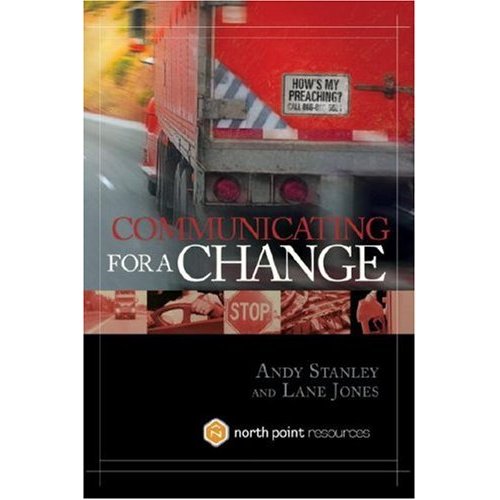
Review: Communicating for a Change, by Andy Stanley and Lane Jones.

stanley.jpg

Let me be honest. I love studying the subject of preaching. I want to be a lifelong student of the subject. But if I’m honest, a lot of books about preaching are somewhat dull, tedious, repetitive and unengaging. Not this book. Engaging. Compelling. Motivating. Intriguing. Is it perfect? No. But, I think you should read it.

The book reflects a highly pragmatic authorship. Stanley writes, “I’ve listened to dozens of preachers and teachers whose stated purpose for communicating is changed lives but whose style of communication doesn’t support their purpose. If you are not willing to make adjustments for the sake of your goal then one thing is clear: Your goal is something other than changed lives. Your goal is to keep doing what you’ve always done, to do what’s comfortable.”

What does it take to preach for changed lives? According to Stanley and Jones it involves clear, engaging, relevant and applied truth from God’s Word. This book advocates strongly for one-point sermons. That one point is combination of textual idea, sermonic big idea and sermon purpose. The very slight confusion that comes from combining distinct elements of sermon preparation is worth forgiving for the clarity created in this model.

The book is in two parts. The first part, by Lane Jones, is an extended metaphor that teaches the concepts of the book. A frustrated fictional preacher gets the best preaching education of his life from an unlikely mentor. This narrative is well written, compelling and regularly convicting as well. The agenda is clear in this narrative, but since the agenda is practical skill training rather than a theological hobbyhorse (as in similar books in recent years), I thoroughly enjoyed it.

The second part is Andy Stanley working through the seven principles of the book. I found myself agreeing with so much here. Strong emphasis on the connection built by speaker to listeners, and on surfacing need and interest in the message, and on having a unity in the whole by the use of a main idea (the one point), and application driving every aspect of the message rather than being tacked at the end, and on and on. I found this book interesting, more than that, challenging and motivating.

Reservations about the book? Just one. I wish there was another chapter or two on the Biblical part of the message. I understand Stanley’s five-part progression through a message, and he states that the middle stage, the “God” or Bible presentation stage is the longest one. But what does that look like? He explains that we shouldn’t be superficial, or overwhelm with too much information. But what should we do in that part? This omission could be taken in a couple of different ways. Someone with a strong commitment to the Bible and exposition might try the Stanley model with a solid biblical core. Someone without that same commitment may preach a biblically weak idea birthed out of their own experience. The book allows for both. I wish it were stronger on the former. I’m left wondering . . . on the one hand I know who his Dad is, and I know where he studied, both clues lead me to expect a very biblical tendency. On the other hand the book is inconclusive. I am left looking for an opportunity to watch some of his messages on the internet to see how the theory works out in practice. In fact, I am highly motivated to do that. And I suspect I might be very pleased by what I see. If you read the book, do the same and let me know what you think.

The reservation is not a really a critique, it’s more of a yearning for more. This book is well worth reading. It will breathe new life into your preaching and your motivation for preaching. I honestly think that all of us would improve as preachers by reading and implementing at least some of what this book teaches.
Spirituality’s Ignored Ingredient

Peter Adam wrote that when it comes to spirituality there is a curious phenomena in Protestant Christianity. In our bookshops we can find much on the subject from Catholic, Celtic and Orthodox sources. But strangely there is often very little that addresses the Bible as a source of spirituality. He notes that for many, a good evangelical grounding in the scriptures is considered a solid first-step in life, but then people must pursue spiritual maturity in a different context – catholic, celtic, orthodox, charismatic or whatever. Surely something isn’t right when people don’t look to the Bible as the resource for spirituality?

God has spoken. We are to have open ears to hear and a heart to obey. We are transformed by trust in His Word. We respond to Him using His Word, we praise Him according to it and we speak it to others. We have life now and hope for forever, all because of His Word. As Jesus said, “Sanctify them in the truth . . . Your Word is truth.” (Jn.17) The Bible is the preeminent tool in the Holy Spirit’s repertoire for our growth in spirituality.

As John Donne once wrote, “The Scriptures are God’s Voyce; The Church is his Echo.” If we as preachers of the Word are not absolutely clear that the Bible is central and critical for spirituality, then how will our listeners pick up on it? Certainly not from the bookshelves in bookstores, either secular or Christian. Let us preach with a clear perspective that the Scriptures must not be ignored in any quest for spirituality.

Peter Adam’s book is Hearing God’s Word: Exploring Biblical Spirituality. IVP, 2004.

Peter has responded to comments on this post.

Preach Like It May Their Last

If you are preaching today, it is tempting to be caught up in your own world.  Concerned about your presentation, the details of the sermon, even the peripheral details that you didn’t delegate to someone more passionate about them.  But know this – today’s sermon may be the last some of those people ever hear.

The tired teenager who is gaining the freedom to not have to come to church, but has not yet gained a sense of need for church.  Today may be their last.  The person who’s been coming for a while, but only fits in on the outside, by dressing right, yet on the inside is wracked with doubts and is tired of pretending.  Today may be their last.  The couple whose marriage is seconds away from complete train wreck and can’t keep up the show any longer.  Today may be their last.  The guy struggling with significant temptation who feels like he’ll cave in any day, but is currently painfully unaware of the waves of guilt that will follow.  Today may be his last.

Today may be the last time some people in your congregation hear you preach.  It may be their last sermon, their last Sunday morning at church.  We’ve all heard evangelistic messages that point out the urgency of the occasion.  “You may step out of here and be hit by a bus.  Do not delay!”  Let’s turn that urgency on ourselves for a moment.  Some of them may die before next Sunday.  But there are dozens of other reasons why you may not see them again.  The reasons are important, but so is this sermon.  How much more direct should it be?  How much more relevant?  How much more real should you be?  How much more urgent?

This may be their last.  Preach in a way that will make this sermon count.

Urgent Needs in the Pew, Urgent Changes in the Pulpit?

As I wrote my post yesterday, a package arrived. Having made a guess at how Andy Stanley views preaching, I received his book on preaching. I will soon post a review of the book. But let me share something from the book today. In fact, let me share one point that underlies his instruction throughout the book. Here it is – since there is such an urgent need in our listeners, will we do anything we can to effectively connect their lives to God’s Word?Let me quote a bit for you:

“Every single person who sits politely and listens to you on Sunday is one decision away from moral, financial, and marital ruin. Every one of ‘em. Many are considering options with consequences that will follow them the remainder of their lives. [He describes several examples] . . . There they sit. Silent. Waiting. Hoping. Doubting. Anticipating. What are we going to do? What are you going to do? What are you going to say?

“This is the world we have been called to address. These are the issues we have been called to confront. There is much at stake. There are many at risk. The great news is the pages of Scripture are filled with principles, narratives, and truth that address each of those needs The question you must answer is, to what extreme are you willing to go to create a delivery system that will connect with the heart of your audience? Are you willing to abandon a style, an approach, a system that was designed in another era for a culture that no longer exists? Are you willing to step out of your comfort zone in order to step into the lives God has placed in your care? . . . Will you communicate for life change?”

Stanley’s urgency is stirring. What is he advocating? What kind of delivery system does he suggest? Should we be making urgent changes in our preaching? I’ll finish the book and give you my thoughts.

Quote from Communicating for a Change, by Andy Stanley and Lane Jones, pp88-89.

Imposing Points On a Text?

In response to the Lazy Preaching? post, one reader asked the following questions – “Does not one run the risk of ‘imposing’ on the text your desire to extract one point? Should not the number of point(s) be driven by the text in question?” These are good questions. How would you answer them? Here’s a couple of things to bear in mind:

The text is in the driving seat – It is absolutely right to suggest that the text itself should inform the shape as well as the content of a sermon. We are not required to replicate the shape of the text, but that is the best place to start. If the text has two chunks, or three movements, then start off assuming your sermon will too. Then, when designing the sermon, evaluate whether this is the best way to communicate the message to your listeners. So we are not restricted to the shape or order of the text, but moving away from that should be thought through and purposeful.

A literary unit does have one “point” – Let’s not get confused on terminology. Here I am actually referring to the main idea, big idea, proposition, take-home truth or whatever label you prefer. That main idea will then typically be developed in more than one point or movement within the message. So while it would be wrong to impose any structure on a text, it is not wrong to look for the main idea. A true literary unit has a unity of thought. Whether it is a parable, a psalm, a poem, a paragraph in an epistle, a prophetic oracle, a proverb, or whatever, it has one main idea. The logic of communication determines that a unit of thought has inherent unity, and therefore that text can be distilled into one main idea by asking the two key questions – what is this author writing about? And, what is this author saying about what he’s writing about?

In reference to Andy Stanley, I don’t know much about him. I’ve never heard him preach. I just received his preaching book which I’ll review in due course, but all I know so far is what I read in that interview. He states that he preaches one point sermons. I wonder if he means sermons with one clear main idea? I’ll need to listen to him preach or read the book to find out. In reality, I suspect that he would use several movements within a message in order to drive home the one main idea (or point, if you want to use that terminology).

Lazy Preaching? – Part 2

Well yesterday’s post stirred more response than usual!  Andy Stanley stated his point in strong terms, which probably sparked some response.  While as an Englishman I might state the same point in a slightly more understated way, I do urge people who attend my preaching courses to stick in their primary passage most of the time.  Naturally people ask for exceptions to that suggestion.  I have two main exceptions in my own thinking.  Let me share those with you and then ask what other exceptions you might add to the list.  As I wrote yesterday, there are fewer legitimate reasons to use multiple cross-references than we tend to think.

1. When the idea of the primary text does not sound biblical.  If you preach a passage and clarify the point, but people internally react with a metaphorically raised eyebrow.  “Is that biblical?”  In this instance I might run through a series of other passages very quickly that support the same idea.  In this situation I am not developing each cross-reference in detail, or going topical for multiple points, but simply allowing the weight of evidence to underline the biblical nature of what the primary text is saying.

2. When the primary passage leans heavily on another biblical passage.  For example when preaching the middle of 1Peter 3 recently, I was very aware of how much Psalm 34 was influencing Peter’s thought at that point, so I took some time to go back there during the sermon.  Again, not a topical approach, but supportive of the primary passage.

I can imagine one or two other reasons to go to other passages that may be legitimate too, but these are the main two in my thinking.  I’d love to hear more interaction on this subject.

I think we should be wary of anything that sounds like “memory trigger cross referencing” (you won’t find that in any book, I just made up the label!)  So you’re preaching through a passage and a word or phrase triggers your memory of another (perhaps more familiar) passage . . . so you go over there for a moment.  Carrying on you find numerous opportunities to go on a safari through the canon.  Often there is no scriptural reason for doing so, no awareness of what texts influence which writers, no awareness of specific contexts and meaning, and no genuine purpose for the excursions in respect to the specific purpose of the primary text and the sermon.  Memory trigger cross referencing is indeed very easy, all you need is a concordance, or a few favorite passages.  Surely we would agree that is lazy preaching?  But when should we consider going elsewhere in the Bible?  The lines are open  . . .

Lazy Preaching?

Andy Stanley, pastor of North Point Community Church, made a passing comment about lazy preaching in an interview with Preaching magazine.  He was talking about his desire to come up with a statement, a takeaway point in a sermon.  His stated goal was that a listener could come back to the same passage of Scripture later and say, “I know what that means.  I know what that’s about.”  Because of that goal he does not like to say, “Paul said” and “John said that again” and so on.  Here are his words, reprinted in Preaching with Power edited by Michael Duduit:

I hate sermons like that.  When I listen to them, I just turn them off.  I think just one passage that says it is all we need.  Just help me understand the one passage – please don’t proof text every point with a verse.  I think that’s lazy preaching.  It would be easy to develop sermons like that.

I tend to agree.  There are reasons to go to other passages, but far fewer legitimate reasons than many of us think.  When we have the opportunity to preach a passage, let’s do the hard work and really preach that passage.  It’s easy to skip all over the canon, but if there isn’t a genuine reason for doing so, it’s lazy preaching.

Getting to Grips with the Genres

Imagine a history teacher that teaches history like it is fiction. Imagine a poetry teacher that teaches poetry like it is math. To do this would be absurd. History is not fiction and poetry is not math. Each subject functions differently. History functions through names, dates, and other facts whereas fiction functions through plot. Poetry functions through imagery, meter, and rhyme whereas math functions through logic, rules, and order. Principle: to appropriately teach these subjects the teacher must let each subject speak.

This principle applies to homiletics. Different genres fill the pages of Scripture. In the Lord’s sovereignty, he chose to use narrative, prophecy, gospel, epistle, apocalyptic, etc. to communicate specific truths. If we use the same sermon form without considering the genre then we mash unique kinds of literature into foreign forms. As preachers, we must allow Biblical genres to speak and even form our sermons.

In following posts over the next few weeks, I will attempt to accomplish two things. First, I will highlight how different Biblical genres function. Second, I will highlight the distinct rhetorical impact different Biblical genres intend.