Bible Read Through

It’s that time of year when resolutions are made, and often it is about 3-7 weeks from when they are broken! But reading through the Bible in a year is a very healthy idea for both the preacher and the congregation. Perhaps this Sunday would be the best time to mention it? Here are a handful of resources and ideas:

1. Once Through – Steve Mathewson has done the math and shares helpful ideas in his latest blog entry. Remember that many in your congregation will have tried, but failed to read through the whole Bible. Many more probably have never tried. Any help to make it acheivable can only be a good thing!

2. A Voluntary Once Through – It may be too short notice for tomorrow, but perhaps the idea could be mentioned tomorrow and presented the following Sunday. Since people often quit when trying on their own, add the support of others through a voluntary Bible Read Thru program. If people sign up to the program, they will get an encouragement partner with whom will check in once a week and mutually enourage each other to press on (they can bring their own or be assigned one, and incidentally, if they want to, they could get together and share highlights from their reading too). Perhaps the program leader could send an email or letter to participants once every six weeks to encourage them to press on. Perhaps the whole group could come together once a quarter to share both highlights and struggles of the read through. Then at the end of the year have a celebration meal together – for some it will be a massive achievement! All you need is a program coordinator . . . who knows what it might start in peoples’ lives?! (I’d love to hear of churches that try something like this!)

3. Which Order? – It is popular to mix up the Bible and read a couple of chapters from here and a couple from there. Matthewson helpfully suggests a couple of options. I would also strongly suggest simply going cover to cover (less complicated, more context). Some might like to try the Hebrew order for the Old Testament, an author ordering for the New, or a chronological ordering for the whole.

4. How About More Than Once? – I would be careful about this idea with the whole church since it may intimidate some, but there are some people who need the prod the read through several times in a year. Through in six months (7 chapters per day), every four months (10 chapters), every three months (13 chapters), in two months (20 chapters). Before dismissing these timescales, take a look at this article by Ron Frost.

5. A Bible Marathon Once in a While? – Perhap you could use the turning of the New Year to give a first mention to a Bible Marathon later in the year? A Bible Marathon is a great way to soak in the Bible for a few hours for dedicated volunteers. Perhaps going for Hebrews to Revelation (less than three hours) would be a good way to help people finish the read through next winter, or maybe Judges to 2Kings (roughly ten hours) would be a good push through the historical section in late spring? For guidelines from Garry Friesen, leader of dozens of successful Bible marathons, click here.

So how about it? Suggest reading through the Bible to the church . . . and go for it yourself?

Preaching Outside the Safety Zone?

As we approach the new year and are thinking through the possibilities in 2008, let us think about possibilities for ministry outside the safety zone of our own pulpits.  Depending on what country you live in, and your network of contacts, there may be possibilities to serve in other strategic settings as well as your own.

You probably have not been invited to be chaplain to the US Senate recently, but perhaps push some doors in the local government?  Then if you are outside the US, what about local schools?  In the UK there are many Religious Education teachers more than happy to let others teach class for them!  What about prisons, retirement communities, hospitals, etc?

Now we should temper any zeal with wisdom.  It may be that you would do more harm than good in some settings – ask those who know you and love you enough to tell you if that might be the case!  Some chaplains get specialized training for a reason.  However, there are community ministry opportunities that may be begging for the input of a sensitive, yet bold, minister of the Word.  Perhaps we should consider pushing some doors and stepping out of the safety zone once or twice in 2008?  Your network of contacts includes the ultimate One, the One who can open doors and use us beyond our wildest imaginations! Pray about it, and if you see an opportunity then push the door, our Lord can always close it if He prefers.

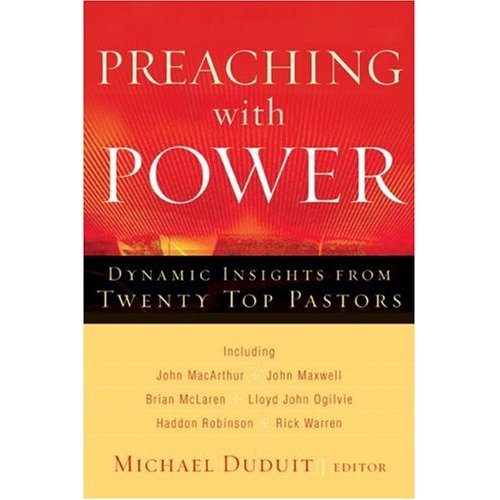
Review: Preaching with Power, edited by Michael Duduit

Subtitle: Dynamic Insights from Twenty Top Pastors (2006)

duduitpower.jpg

As editor of Preaching Magazine, Michael Duduit is able to take good content from that magazine and publish it in book form. This is exactly what this book is. Twenty interviews with top preachers that have appeared in Preaching Magazine and now appear in this book from Baker.

There are some very helpful interviews here. I would particularly note Haddon Robinson on expository preaching in a narrative world, David Jeremiah on preaching through pain, Andy Stanley on preaching without fear and Bryan Chapell on expository preaching.

Other contributors range from John MacArthur and Jerry Falwell to Dan Kimball and Brian MacLaren. From Erwin Lutzer and Lloyd John Ogilvie to T D Jakes and Adrian Rogers. From Jerry Vines to Rick Warren. The contribution is varied and the subjects span a spectrum of related interests.

I won’t extend this review by sharing specific insights from the interviews, I simply want to explain the nature of the book. If you’ve read the magazine for a decade or two then you will have read it all before. If you haven’t been a subscriber to Preaching, then this book might tempt you. This is a worthwhile book to read, or just to pick at when you have spare ten minute chunks of time.

(This book does not break into the top ten must read’s for preachers.)

When 10 is Only 7

Since every book review posted on this site can be found by clicking on the Review category in the list to the right, there is really no need to have a page of the same reviews sitting on the site too. This profound insight has spurred me to change the Books page to Top Books. It is a list, a countdown, a veritable hit parade of preaching must-reads. To qualify for this list a book has to be reviewed on the site and be considered a must-read for all preachers. So this top 10 list is now ready for viewing and critique. But actually there’s only 7 books on there. The other 9 that have been reviewed all have their merits but don’t qualify for the list. A couple would qualify (Long certainly, Richard maybe), but have a stronger equivalent already there (Arthurs and Sunukjian respectively). So feel free to take a look. Disagree if you like. I’m not sure I agree with the placement of a couple of them! Others will be added in time.

Practicing What I Preach

For many preachers life is lived in reverse.  People take Sunday off and come to church.  It’s no day-off for us.  People finish work and come home in the evening, but sometimes we have to preach, teach or lead then.  And the season of relaxed family time easily becomes the busy and draining season for preachers – ie Christmas.  So, since I have a whole week until I have to preach, I will be taking a couple of days off from the blog.  Let’s be honest, you wouldn’t check it on Christmas Day anyway, would you?

The Wonder of Christmas

One of the great occupational hazards of ministry is that we can so easily lose the wonder of what we are dealing with.  With the demands of the schedule, the expectations of people, the burden of creativity in a season that comes every twelfth month (but is only fully reported in two gospels), the ongoing reality of messy lives (people still get in trouble, marriages still fail, loneliness still bites, folks still sin), and so on, we can easily lose the wonder of Christmas.

In this post I don’t want to prescribe how to keep the wonder of it all, I just want to suggest we do.  Whatever it takes.  Perhaps time with family.  Perhaps some extra guarded time alone with God.  Perhaps a special treat carol concert. Perhaps a brief journey to a sentimental place.  Perhaps read one of those booklets the church is offering to visitors over Christmas.  Whatever it takes.

Let us make sure that we don’t go through Christmas feeling the pressure and the burden of it all, without also renewing the wonder in our hearts.  Let us be captured by the grace of God that He would step into this world.  Let us be gripped by the hope inherent in the Christmas story for a world of sinners – for Christ came into the world to save sinners!  Let us be stirred afresh by the history-changing event of the incarnation.  Ponder the first Christmas, ponder the reality of the incarnation, ponder the journey from Bethlehem to Calvary, ponder the everlasting nature of the incarnation.  Ponder.  Ignite the wonder again.  Whatever it takes.

Thriving in the People / Passage Tension

Phillip Brooks said something along these lines: He never went to his study and looked in the Bible that he didn’t see his people’s faces running across his study. When he went out to meet his people, his study would beckon and he would see the Bible.

This tension is not a reason for frustration. When studying a passage, pause and consider who would be directly helped by it. Take a moment to pray for them. Then get back to study. When meeting people, perhaps on a Sunday at church, do the reverse. Between conversations consider what passage would help the person you just spoke to, again fire a quick prayer for them. Then press on to the next interaction. In reality every passage holds value for everyone in the church, but allow your mind to make specific connections anyway.

This mental exercise can bear ministerial fruit. With practice you will find yourself more naturally bringing helpful Bible texts into conversations, and more naturally bringing relevance and application into your preaching.

As preachers we live in a tension between people and passages. Embrace the tension and learn to thrive in it.

Don’t Half Quit

There are always reasons to quit.  This is true in anything you pursue.  Sport, music, hobby, fitness, work, ministry, marriage.  Anyone who has ever been successful at anything has had to overcome numerous opportunities to quit.  How true is that in preaching?  There are few things that can compare with it – how important it is, how much people need it, how much you give both in preparation and presentation, how emotionally and physically draining it can be, how open to criticism you become, how relentless the schedule can feel, how exacting the standards are in peoples’ minds for every other area of your life.  To give the Lord our best as preachers we must exhibit a tenacious relentlessness.

The temptation to quit may always be lingering in the background, but for various reasons, good and bad, many of us would not simply quit.  Perhaps it’s a little like marriage among some Christians a couple of generations back.  A marriage could go very sour, but divorce was considered so inappropriate that couples would live out a “Christian divorce” – two separate lives lived under one roof for the sake of appearance.  That’s a danger for us as preachers.  When the pressures build, as they do so regularly, so do the temptations.  Temptations to quit may be rejected.  But temptations to half quit are an ever present danger.

When the schedule is tight and you are drained emotionally and physically, pulled in numerous directions, don’t half quit on your preparation.  It may seem tempting to not really study the text, to short-circuit all exegesis.  When Sunday is rapidly approaching and your energy is low, don’t half quit on sermon shaping.  Don’t just go with your study notes, but try to think through your audience and their needs, think through the best way to communicate this passage to themWhen you go through the post-sermon emotional roller-coaster that many preachers feel so often, don’t half quit.  Don’t make decisions that will undermine your subsequent ministry because of how you feel at that moment.  When you are on the receiving end of unfair criticism or unjustifiable sniping, don’t half quit.  Don’t steel your heart against the people you minister to so that by not loving them they can’t hurt you.  When you love you get hurt, but love anyway.

I’m not saying anything about rest, responsibilities with family, etc.  I’m not saying sacrifice yourself to the point of burnout in an attempt to be spiritual.  There’s all sorts of appropriate balances to wisely employ in ministry.  But those are for another post.  All I’m suggesting today is that preaching is no easier than most other things you might pursue in life, and in many ways it is harder.  To be the best you can be, to give the best you can give, you must be doggedly relentless.  Don’t quit.  And maybe more importantly, don’t half quit.

A Preacher’s Personal Cloud

It is too easy to get caught up in present ministry and future plans, but forget past blessings. As a preacher, whether you have only just begun or have been ministering for decades, you are not a self-made preacher. The truth is that people have marked you. Your ministry now is partly the result of past investment and example from others.

Let’s take half an hour and prayerfully go back over those people who have marked our lives for ministry. Perhaps you could take a piece of paper and list people that invested in you, or were an example to you. Make a brief note summarizing their influence. Take some time to give thanks to God for His work through them. Not only will this exercise allow for gratitude toward God, but it may also prompt an expression of gratitude toward others who have blessed you (who are still on earth), and a renewed passion to press on in your ministry. I suppose we could say that each of us is surrounded by our own personal cloud of witnesses!

Think of your early exposure to preaching and church ministry – perhaps a preacher who also noticed you and cared about you. Think about those who have invested time in you during your formative years, perhaps some were preachers, but took the time to pour into you. Think about those who opened doors for you to preach, to attend Bible school, to take on your first ministry role. Think about the trainers, perhaps in the local church, or perhaps in college or seminary (if only there were more trainers in churches, but let’s be thankful for both!) Think about inspiring examples you heard at key events, or regularly at certain stages of life. Think about formative books that shaped you in this area. Think about key prayer partners who believed in you. Think … make a note … give thanks … press on!

High-Calibre Listener, Beware!

True expository preacher is not just about convictions regarding the Bible. It also involves convictions in relation to the congregation, the listeners. As a preacher you are committed to bringing God’s message from God’s Word to the people God has prepared and brought together for a particular service. Giving attention to both sides of the bridge, to use the metaphor Stott popularized, means awareness of the listeners as well as the text.

Typically a good awareness of the listeners will help you to preach relevantly. But beware of one type of listener – those you perceive to be “high-calibre.” I don’t like that term and only use it in the absence of a better alternative. What I mean is anyone whose presence tempts you to either feel intimidated or to show-off. Perhaps a well-known guest, or a seminary professor, or a published theologian. There are others too that could be listed. One of the blessings of studying preaching at Gordon-Conwell is to have to preach with Haddon Robinson in the room . . . and you’d better believe that feels intimidating at first!

In these situations everything in our flesh may cry out to try to impress them. Perhaps more erudite language, or complex thought patterns, or the old favorite – name dropping. Don’t. Intimidation or temptation to show-off is distraction from the purpose of preaching. Attempts to impress will usually fail. These kinds of people actually want real ministry, not posing. More than that, these kinds of people need real ministry. It doesn’t matter whether someone has a PhD in theology or flunked out of school early. What matters is that you are preaching before the God of the universe, and before people who need Him. Be aware of the listeners, but beware of any listeners who might tempt you to lose sight of your Audience of One, and the fact that everyone there needs to hear from Him.