We Preach By Faith

Life is often hard.  Life is often deeply disappointing.  Despite what some may claim, life is not one great victory march of pain-free delight through this fallen world.  Living by faith is not a great party free of trouble and hardship.  And preaching is a lot like life.

We prepare to the best of our ability and saturate our lives and ministry in prayer.  Yet so often it falls short.  We get tired and frustrated, saddened by the lack of change in others, or even in ourselves.  We give of ourselves to people who then somehow turn and tear out our hearts.  We find ourselves seething deep inside at great failure or simply at the persistent polite feedback.  And then typically we find ourselves praying stained glass prayers about our next sermon, the kind we feel we’re supposed to pray.

But look to the examples in the Bible of the brutal honesty of God’s men in prayer.  Consider Job chapter three, David in numerous psalms, Jeremiah in chapter twenty, or Paul with his thorn in the flesh.  They poured out their emotion, their hurt, their anger to God.  They didn’t sugar-coat their prayers in sanctified clichés.  They were real, and they knew God could take it.  Yet when all their energy was spent, when all the feelings were out, when they lay totally wiped out before God . . . there was still a trust in God’s Word, still a burning in the bones, still a faith though weak and smoldering.  My grace is sufficient for you.  Will you take my hand and press on?  Do you trust me?

Real faith is not all about grand and glorious certainty.  Often it is found in the midst of total inadequacy, absolute weakness and apparently overwhelming failure and hurt.

We live by faith.  Let us also preach by faith.  Be brutally honest with God about ministry, about preaching, about the preparation that takes so much out of you, the delivery that leaves you deeply vulnerable, about the sometimes sweet agony of it all . . . and about the feelings of failure, inadequacy, discouraging results, the backhanded slap of polite platitudes with no hint of life change, the deep questions, the temptation to settle for less, or to quit altogether.  Pour it out, pour it out until there is nothing left.  Then remember that whisper from above, “my grace is sufficient for you.”  That hand outstretched to take yours and lead you on.  To prepare another sermon, to preach another sermon, to give everything you’ve got to the best of your ability, and to do it all by faith.
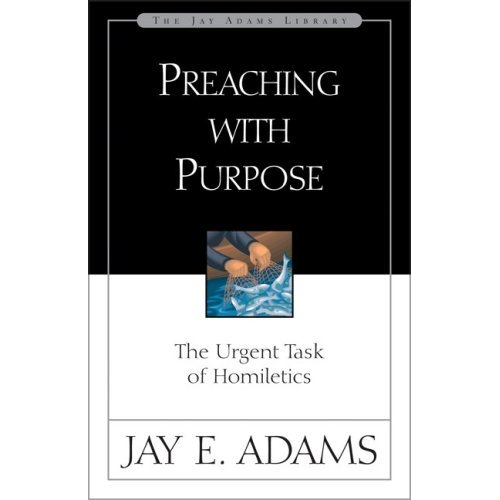
Review: Preaching with Purpose, by Jay Adams

Subtitle: The Urgent Task of Homiletics (1982)

Jay Adams is generally known as the Biblical or Nouthetic Counselling author of Competent to Counsel. Yet he would point out also his personal focus and study in the area of preaching.  Years of thought in this field went into this accessible book.  Still today, a quarter of a century later, it is well worth reading.

22 chapters in 160 pages.  The chapters are short and a quick read.  However the instruction given is worthy of considered thought and personal reflection.  For Adams, preaching should be, must be, a purposeful task.  It is not about informing, but motivating and changing listeners as the Word of God is spoken to them.  Everything in preaching should be driven by the “telic” concern (the goal/purpose of it all) . . . and that concern drives each element of the book.  What is the purpose of the illustration, the introduction, the outline, etc.

I have referred to the book several times in the last weeks because I have resonated with so much of what is written.  As in most books, there are certain positions taken with which some would disagree (such as the note on the role of the literary structure not being any influence on the sermon structure), but overall this is a little book that packs a punch.

If you haven’t read Preaching with Purpose, don’t ignore it because it has been around a while.  The content does not feel dated, and the teaching is well worth hearing for those of us that really want to preach for changed lives, rather than just lecturing for informed minds.

Technique and Skill Alone Are Not Enough

I believe in being a good steward of the privilege of preaching.  It is a privilege to have opportunity to preach.  And it is a privilege to do the best you can.  I believe in being trained to handle the Bible and well trained in homiletics.  I believe in continuing to study hermeneutics and homiletics, not to mention contemporary culture, your listeners, and other related fields.  It is good to hone your technique using feedback, perhaps watching yourself on video and so on.  It is appropriate to put effort into effective communication skills.  All this and so much more, it’s all about being a good steward of your ministry opportunity.

But preaching takes more than that.  Preaching to change lives goes beyond technique and skill.  There is also the entirety of your life – what you stand for, give yourself to, how you walk the walk and not just talk the talk.  But preaching takes more than that.

Ultimately preaching to change lives has a dimension that goes beyond any skill or technique, beyond anything to do with you.  Ultimately there is a divine dimension that cannot be forced.  No preparation on our part, or specifically phrased prayer, can twist God’s arm to do what only He can do.  Nothing on our part is the key to God’s involvement in today’s sermon.  Just as the prophet Joel could only point to character of God in the hope that repentant Judah would be delivered (see Joel 2:12-17), just like our salvation springs from the gracious, compassionate, abounding love of God’s character, so the ultimate and most critical element in our preaching His Word springs purely from who He is, as He chooses.

Prepare well, pray fully.  Perhaps He will move in His grace among your listeners today.  Let’s be sure we are good stewards, but good stewards that lean fully on His grace alone.

Tomorrow Will You Preach, or Just Report?

One reason that a lot of preaching in churches seems to fall short is that there is a lack of engagement with the people present.  I’ve heard numerous messages that fall into the category of relatively dispassionate lecturing.  The speaker stands as a reporter of the facts of their research.  They study a text, then that information is presented.  Then maybe there is an attempt at application.  But it falls short.

The preacher is not a reporter of facts found during their research.  The preacher is called to speak to the listeners from God’s Word.  The Bible is not exhibit A.  It is the source of the message for us, today.  The Bible doesn’t sit off to one side and get pointed at during the presentation, it sits in the hand of the preacher as the source and driver of the message for us.

So often the problem is a lack of engagement.  First, a lack of engagement with the life of the preacher during preparation.  If the Word of God does not speak into the life of the preacher, then the Bible will be presented at arms length, as an exhibit.  Second, a lack of deliberate engagement with the lives of the listeners.  Tomorrow, be sure to preach the Word to them, don’t just talk about the Word in their hearing.  Today, make sure you’ve opened yourself up to the text you’re planning to preach.

If you are a preacher, your role is more than merely reporting.

Review: The Word Became Fresh, by Dale Ralph Davis

Subtitle: How to Preach from Old Testament Narrative Texts (2006)

Davis is a respected Old Testament scholar and pastor.  Puzzled by the prevalent view that the Old Testament is a “problem” (caused, he asserts, by a skeptical brand of Old Testament criticism during the last two centuries), he sets out to show that preaching from the Old Testament is not that difficult.  He achieves his goal in this 150-page easily accessible paperback from Mentor (Christian Focus Publishing).

Although he has published several Old Testament commentaries, Davis admits to hesitancy when writing about preaching.  A negative experience teaching preaching has caused him to steer clear, consequently this book focuses on accurate interpretation of Old Testament narratives for preaching (one step removed from homiletics proper, but in my mind very much a preaching book!)

The nine chapters of the book consist of simple instruction, engaging writing and a constant flow of examples from all over the Hebrew canon.  Although relatively simple, this is not in any way lightweight.  I particularly appreciated his addendum on the popular desire for Christocentric, rather than merely Theocentric preaching.

The book begins with “Approach” which is a fine chapter on the basic elements of interpreting narrative passages (perhaps I describe it as fine because it comes close to my own approach!)  The next chapter “Quirks” moves the study on a level by recognizing the literary features commonly used in OT narrative.  The chapter on “Theology” gently moves on in the expositional process, centering on Genesis narratives.  “Packaging” considers literary context and text structure, again, more examples given.

In “Nasties” Davis addresses the sometimes brutal nature of OT narratives.  Then “Macroscope” addresses the important issue of seeing passages in the context of entire books.  If there’s one place where preachers tend to come unstuck in OT narratives, it is in the area of application.  The next chapter “Appropriation” contains valuable cautions and tips in this area.  “Center” urges a Theocentric commitment in our preaching (and the excellent addendum on Christocentric preaching).  Finally, in “Synthesis,” Davis pulls it all together with expositional examples from Exodus 1 and 2.

This is a great little book, and I recommend you chase it down and read it through.  The instruction is helpful and the numerous examples are a gold mine for those that preach a lot and sometimes appreciate a nudge in the right direction.  One thing is missing, a pet peeve of mine in this kind of book, there is no Scripture Passage Index.  I don’t want to have to read through a book a second time in order to find out if a particular passage is addressed.  Perhaps you should do what I did in Alter’s book on OT narrative and create a passage index as you read through it.  That’s not too hard, but I’d rather pay the author and publishers for that extra two or three pages.  (Note – see first comment on this review for a link to an index for this book!)

For a structured methodology in preaching OT narrative, I’d recommend Mathewson.  For great insight into the literary skill of the OT narrative authors, Alter is still the classic in its field.  But this book by Davis should not be overlooked on either count.  Davis’ little gem is worthwhile reading as an introduction to OT narrative preaching or OT narrative interpretation.  And if you think you are beyond needing an introduction, call it something else and read it anyway!

No Greek or Hebrew? A Tip

A very significant proportion of preachers around the world have had no training in the original languages.  After hearing yet another example in the last weeks, I’d like to give a tip regarding “this word literally means…” Generally speaking, unless you have thoroughly researched it.  Don’t use it.

The latest example I heard from the leader of a Bible study.  The verse seemed to be clear enough in content, but then we were given an exciting insight into the Hebrew text, “in the original language this word literally means . . .”  Interesting, perhaps even exciting, but actually, wrong.  It struck me as being slightly bizarre at the time, but not having my Hebrew text in front of me, and not wanting to “lord it over” in some way, I just made a note to check it later.  There’s no way it could be understood that way, unless the source of the alternative understanding had a particular theological agenda (which I’m fairly sure I can guess).

Sometimes “this literally means” might be helpful. It’s rare, but now and then this kind of background linguistic knowledge can add a nuance or some colour to our understanding of a passage.  One example is where a dynamic equivalent translation is “hiding” the repetitious use of a term (eg.”flesh” in Romans 6-8).  It is helpful to know there is a theme being repeated, and that the term used has particular connotations lost in some dynamic translations.

Often “this literally means” is not helpful. Remember that a decent translation (of which we have many in English) is the work of scholars trying to convey the meaning of the original text.  That means they tried to choose words that would express the thought and meaning of the original.  An “insight” that moves us in a new direction is not helpful if that insight is not accurate.  Without a decent amount of training in the original languages it can be hard to tell if someone knows what they are writing or speaking about.  Typically it is worth checking the “insight” against more than one academic commentary, or asking someone with genuine skill in the language (i.e. not just a course or two).

Sometimes “this literally means” is borderline heresy. Here’s the real danger, not just that our dabbling in “original language” comments lead our listeners slightly off track (although that is bad enough), but that we actually verge on heresy.

We are so blessed with good translations in our language.  If you have not had opportunity to seriously study Greek and Hebrew for a couple of years or more, it’s best to not pull out the “this literally means” type of comments.  Just as you may get it wrong, so do others, and some of them get their insights published!

Exegesis Homiletics

I am currently preparing a course that I will be teaching at the end of October – Hermeneutics for Preaching.  I came across this very important reminder in Grant Osborne’s Hermeneutical Spiral (p343):

“The hermeneutical process culminates not in the results of exegesis (centering on the original meaning of the text) but in the homiletical process (centering on the significance of the Word for the life of the Christian today).”

To some of us it is obvious that there must be a direct link between exegesis and homiletics, but we all need the reminder.  C.R.Wells, in Interpreting the New Testament (edited by Black and Dockery, pp506-523), writes the final chapter on interpretation and its connection to preaching.  He warns of some critical approaches that will produce “tempting” content for sermons, but content that should not be included.  However, critical methods that deal with the “text-as-is” have great potential as tools of the preacher.  According to Wells, “Every preacher should and must be a critic, but no preacher should ever forget that critical study serves homiletics.”

Accurate interpretation governs expository preaching.  So two simple implications:

1. Don’t allow interpretation and exegesis to be an end in itself. Study in God’s Word must run its course, not only to personal application, but to communication for corporate application.  If you have opportunity and ability to preach the Word, do it.  If you don’t, then find another way to share the truth and its implications with others.

2. If you ever preach, then be an ever-improving interpreter and exegete of God’s Word. Don’t try to preach without the foundation of biblical interpretation under your efforts.  Preaching is more than sharing the fruit of exegetical work out loud, but it cannot be less.  Skill in communication, relevance in content, personal spirituality and prayerful preparation are all important, but without effective biblical interpretation undergirding your messages, don’t call it preaching.

Avenues of Audience Analysis

In order to preach effectively, we must be at home in the world of the Bible, and in the world of our people.  We need to know them.  Jay Adams, in Preaching with Purpose, suggests three principal ways to analyze the congregation to whom we preach.  Perhaps it’s worth evaluating our own ministry through these categories to see where we might be missing out on helpful understanding of our listeners?

1. Informal contact with people. More than just rubbing shoulders on a Sunday or in church activities (where people tend to act the way they feel they should), this means getting into the normal lives of the people in the church.  Spending time with people at home, at work and at play is time well spent.  Without probing or surveying, plenty of useful insight will emerge in this natural environment.

2. Counseling contact with people. Not surprisingly from Jay Adams, he sees the value of counseling people.  Obviously confidentiality must be respected, but analysis of counseling notes will point to trends, concerns, areas of struggle.  He points out that just as preachers are helped by counseling, so counselors are helped by preaching.  If a counselor does not preach then they are in danger from not doing the deliberate and regular biblical exegesis they need to be biblically solid in their ministry.

3. Formal contact with people. Finally, Adams advocates for doing systematic, deliberate analysis of the congregation.  When first arriving in a church it is important to analyze the congregation and review the diet they have received from the pulpit.  Then regular surveys of key people, probing of elders, and so on, all helps to fill in the picture for the preacher.

Do we take “audience analysis” seriously?  Is there one approach, of these three, that needs more deliberate effort on our part?

Holding Back the Obvious

Sometimes a passage very obviously points beyond itself.  For instance a passage with an obvious parallel to today, or a passage that points forward to Christ.  Psalm 22 is a classic example of the latter, or Genesis 22.  It is natural to make the obvious connection from the start and repeat it throughout.  Sometimes this is very worthwhile – especially when the parallel is to today.  Highlighting and emphasizing the applicational relevance of a passage is usually very helpful (rather than holding out until a few brief applications at the end).  However, if the application is obvious, it may be worth holding back before you state it.  Certainly when your passage obviously pre-figures Christ in some way, it is worth considering holding back on the mention of Christ.

Why?  Three reasons.

First, it is good for the congregation to see that a passage has value in its own right, without having to overtly read it through New Testament glasses that were not available to the original readers.

Second, it is good for the sermon because if the connection is clear, then the listeners will be thinking about that as you go, perhaps wondering if you are missing the obvious.  This added tension can really maintain interest in the sermon.

Third, it is good for you as a preacher, because it allows you to “pack a punch” when that tension is finally resolved.  References throughout the message will add explanation, but will reduce the impact.

For the sake of demonstrating the value of a passage in its own right, for added tension and for added impact, it is often worth holding back the obvious, especially when the obvious is Jesus.

Non-Words

Last night I was watching the first half of the God Delusion Debate between Richard Dawkins and John Lennox.  It is interesting on a number of levels, but I’ll just mention one.  Dawkins hesitates way too often.  Um, ah, uh.  So far Lennox has not.  It makes a difference.  I’ve been following the US presidential race and reading analysis of the communication involved.  The media’s favorite candidate uses many non-words, but the newest participant in the race does not.  It is making a difference.  In the UK I’ve noticed that some people seem to revere the skill of using non-words and hesitation (think of the last university students you heard interviewed – they often do it).

The manner in which we communicate influences listeners at both the conscious and sub-conscious level.  Since we do not want to undermine the truth of what we say when we are preaching the Word of God, let’s be vigilant for non-words.  Figure out whether you use non-words or filler-words.  Perhaps identify your personal, uh, like, you know, favorite.  Then wage war against it.  Mean what you say and say what you mean.  It’s not just about wasting words, it’s also about undermining the good things that you are saying.