The Non-Academic Preacher Compliment

Last week I spoke to a friend who had asked to borrow my master’s thesis.  He was positive about it, but mentioned that he’d had to look up some terms I’d used.  He was a bit surprised since he doesn’t have that challenge when I preach.  That’s an encouraging compliment in my eyes!

Here’s a quick quote that is somewhat related in Phillip Jensen’s chapter, “Preaching the Word Today” in Preach the Word, the book of essays in honor of Kent Hughes:

With the discriminating eye of the cynic, the modern scholar can deconstruct the author’s writings so as to explain what he “really” meant.  Only the expert – never the ploughboy – can know what was meant.  The priesthood of all believers is no longer replaced by the sacerdotalism of the sacramentalists but by the arrogance of the academy.

We need to be so careful.  I think it is good to get the best academic training possible (a matter of good stewardship), but we need to be very careful not to develop the easily associated arrogance that comes with training, nor to carry that arrogance into the pulpit.  We serve the priesthood of all believers; we are not the priesthood for all other believers.

Let’s make sure we open up the Bible in peoples’ laps, rather than moving it further away from them.  Let’s make sure we communicate well, rather than impress with lofty language that the ploughboy doesn’t understand.  Let’s make sure we prepare for ministry and prepare for a message as fully as we are able, but not let that show in any way that will hinder our listeners.
Monday: Renewing Vision Day

Monday is a good day to take stock, take a deep breath and recommit ourselves to God’s work.  That doesn’t just mean being willing to ever preach again, although for some that might be a good step on a Monday morning!  It means recommitting to really do the work of biblical preaching, rather than just going through the motions.  A couple of quotes from Philip Ryken’s chapter “Preaching that Reforms” in Preach the Word:

If we are living in an age of relativism and narcissism, what are the implications for preaching?  Obviously, Bible teaching will be out of favor.  As sinners, we generally do not like to have our selfishness exposed; but this is one of the primary purposes of preaching the Bible.  In a post-Christian culture, the last thing people want to hear is the truth about their self-centeredness.  What preaching there is, therefore, tends to be therapeutic rather than prophetic.  It aims to make people feel better about who they are rather than to challenge them to become, by God’s grace, what they are not. (p192)

How tempting it is to preach messages that are therapeutic, rather than prophetic.  It’s hard to choose to preach the Word when its message is uncomfortable, unpopular, “unsophisticated” or somehow might offend somebody.  Later in the chapter, Ryken addresses the issue of evangelism:

This kind of proclamation requires boldness, a virtue that is sadly lacking in the contemporary church.  One of the reasons evangelicalism is in decline is because Christians have lost their nerve.  In these post-Christian times, we tend to be a subculture rather than a counterculture. (p198 )

I am not encouraging insensitive brash proclamation, or unnecessarily offensive preaching.  I am just taking stock of my own ministry again this morning and renewing my vision to preach the Word.  It’s the greatest privilege, but it demands an appropriate level of boldness too.  Let’s set our sights on our Lord afresh in order to renew our vision of Him, His Word, His building of His church, His mission to the world … and our privilege of participation in that.

A Patient Ministry

It is generally obvious that life transformation generally happens gradually.  While God might give a breakthrough epiphany moment from time to time, He does His patient work of building the church all the time.  This is true on multiple levels.

We need patience with the congregation. That’s not to suggest we preach without an edge of expectancy, encouragement and even exhortation.  It is to suggest that we pray for breakthroughs, but trust God to work out His plans in each life in His timing.

We need patience with ourselves. It’s easy to respond to a small bit of negative feedback, or a feeling of failure last time we preached, and suddenly have a list of personal weaknesses that need to be fixed.  We need to patiently serve faithfully.  Seeking to improve out of good stewardship of our ministry, but trusting God to continue working in our lives at His pace.

We need patience with key people. It could be a “well-intentioned dragon” – a constructive critic in the church.  It could be a person of influence with unclear motives.  It could be an individual that requires far more energy than we feel able to give.  We must pray for wisdom, for strength, for patience to not make rash moves at our speed that miss what God is doing at His.

I am by no means affirming ministry weakened by low expectation, unimproved by lack of personal growth or unnecessarily hindered by a motivation-drain unaddressed.  I am simply reminding myself and us all of something I was told fifteen years ago: “God walks at 3mph.”  Let’s keep our gaze on Him and serve, even live, with prayerful patience.

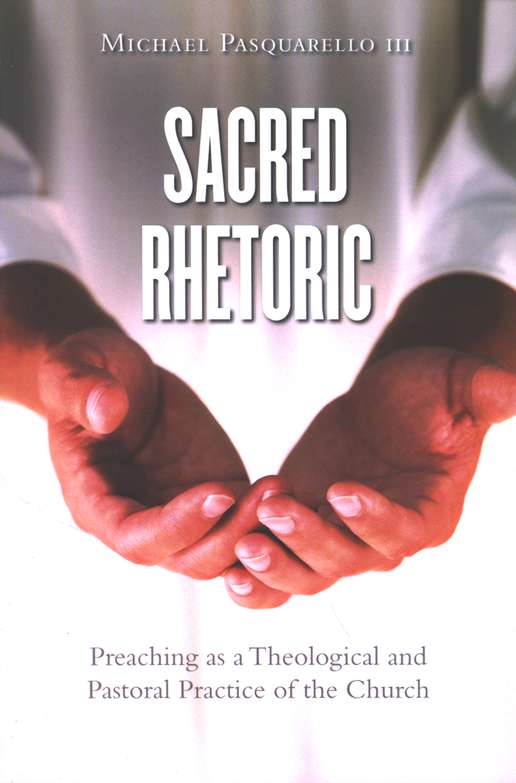
Review: Sacred Rhetoric, by Michael Pasquarello III

Subtitle: Preaching as a Theological and Pastoral Practice of the Church (2006)

pasq-sacred-rhetoric

Pasquarello is concerned by modern approaches to preaching.  He sees contemporary approaches as being obsessed with “how-to’s” at the cost of having lost the divine-human conversation – we’ve mistakenly traded in communion for consumption.  The field of homiletics, by establishing itself in distinction from the related fields of theology, exegesis, spirituality and worship, has somehow lost its moorings and become merely a technical field of somewhat sanctified communication.

This book offers nothing new, but rather seeks to reconnect us to the past.  It seeks to offer the possibility of engaging with ten esteemed mentors in the field of preaching, ten mentors from church history.  From them we can reignite a passion for true preaching – that which is “a theological and pastoral activity [of the church] that locates us in God’s story, drawing the world with us toward our true end: peace and friendship, communion with the Triune God.” As Steinmetz suggests in a quote in the conclusion, “Only when we have regained our identity from the past can we undertake our mission in the present.” (Both quotes on p135.)

The majority of the book is not a critique of present practice, but rather a presentation of ten preachers from the past.  Beginning with a slightly more lengthy treatment of Augustine, the book moves on to consider such esteemed names as Gregory the Great, Benedict, Bernard of Clairvaux, Bonaventure, Aquinas, Erasmus, Latimer, Luther and Calvin.

I do not feel adequately prepared to make judgment on whether the presentation of these men is either accurate or rightly balanced in terms of historical detail.  What I do know about church history suggested the presentations were on track.  However, as a reader I can say that this book stirred my heart for the privilege of preaching – participating in the central action of God’s story in this age.

Although short (139pp), this is not a quick read.  It takes time to ponder the presentation of each preacher.  It takes time to digest the relative benefits from conversation with each one.  It takes time, but it is worth it, for we are surely not participating in something new in our generation.  We stand as preachers, as those engaged in the glorious calling to sacred rhetoric.  Whether or not you are a regular reader of church history, this book is well worth reading as we seek to participate in God’s ongoing story.

Points on Picking Passages – Part 2

Yesterday we saw that God is sovereign and all Scripture is “useful” (which sounds like an understatement when separated from 2Tim.3:16!)  So when there is freedom to choose a passage for a message, consider:

Consider the people. Who are they?  What do they need?  What issues are they facing in life, both individually and corporately? Sometimes a prayerful consideration of the applicational needs of the people will prompt your thinking toward a specific passage or kind of passage.

Consider the program. What teaching have they had recently?  What is coming up after your message?  Sometimes the program might suggest a helpful place to go for your message.  Perhaps a helpful OT background passage for the subsequent series in a NT book.  Perhaps a passage with a similar idea to reinforce teaching they’ve recently heard.  Perhaps something very different to bring balance to the program.

Consider your preference. There is nothing unspiritual about asking yourself, what do I want to study and preach?  If you are personally motivated to be in a specific book or passage,  then it will enliven both your study and delivery.  Often such a choice leads to more work, not less, because when the heart engages with the opportunity, the preacher will give more in the preparation stage.

Consider your personal ability. Some passages are harder to interpret than others.  Some are harder to preach than others.  Is the study time available before you preach enough to really study the passage well (and are you capable of such study)?  Is the time available for the message long enough to really preach a long narrative with all the necessary description and narration?  There’s nothing spiritual about biting off more than you can chew.  Lives are changed by simple and the familiar passages preached well.

Careful of excessive delay in decision. However you choose, it is important to choose.  It is much better to spend hours wrestling with the text in prayerful preparation, than it is to spend hours wrestling with what passage to preach.  The sooner you make a decision, the sooner the text can start working in your life (a prerequisite to effectively preaching it to others).

Any other considerations that you would add to the mix?

Points on Picking Passages – Part 1

While you may agree that working through a book is the ideal default when planning a preaching schedule, what if you are only preaching a single message? What if a passage is not assigned and you are free to choose? What freedom to delight in! Or perhaps, what a stress to despair in! Today I’ll lay a foundation with two firm facts, then tomorrow offer several considerations as a passage is chosen.

Two Firm Facts:

1. God is sovereign. We should pray throughout the preparation process, including the selection of a passage. However, we don’t need to wait endless hours for direct revelation of a specific passage when God has not promised to give us such a revelation.  How often have we preached and then heard, “that was exactly what God knew I needed to hear?”  Far more often than an angel visits us with preaching instructions.  God is not at the mercy of our ability to “spot the signs” and discern some slightly hidden hints from heaven.  God is sovereign.

2. All Scripture is “useful.” In theory any passage can be preached with appropriate application to any given group of listeners. Obviously some passages are far harder to preach relevantly than others depending on the passage and the listeners. However, there is not one perfect passage for this occasion that if you miss it you will have failed. Enjoy the freedom that comes from knowing what they need is the Bible – clear and applied – not a needle in the haystack that you somehow have to find.

Tomorrow I’ll offer some considerations to complete this post.

The Challenge of Narratives 4: Acts

Unlike the Old Testament narratives, and in some senses, even unlike the gospel narratives, the Acts narratives should be easier to interpret and preach.  After all, this is now church history, not ancient Israel history.  But there is a challenge:

The challenge of “normativeness” – how are we to understand and apply descriptions of a unique season in history – the founding of the church?  Three comments on this:

1. Acts is not “mere history” – Don’t make the mistake of saying we shouldn’t preach from Acts because it is merely a historical account.  It is inspired theological Scripture.  It is as much theology as the epistles!  Acts is history, and it is more than that.  However,

2. Acts is not “all history” – some elements of the Acts story are unique and we shouldn’t presume that it is all normative for where we stand in that same history.  Possible examples include the following.  Should we be concerned that the apostles have died?  Should we be looking for qualified replacements?  Some sing that we need another Pentecost, but what are we suggesting about the work of the Spirit in the Church?  Should we expect Ananias and Sapphira-type church discipline to occur every time there is sin in the church today, or should we be learning from a unique event?  What about the “Gentile tongues” at conversion that are presented as a sign to the apostles at a key transition moment in the progress of the gospel?  Acts is not totally typical of all church history.

3. Acts is “all applicable” – Just because some of the events may not occur again, this doesn’t mean that the text is irrelevant (think about the crucifixion of Jesus, for instance).  All Scripture is useful, applicable, but the challenge is having the wisdom to discern how to apply it.  We need to consider Acts in light of the clear teaching of the epistles, as well as the progress seen within the epistles (consider the different emphasis in 1Corinthians as compared to the later Pastoral Epistles – both concerned with health in the local church, but a different emphasis).  Let’s be careful not to automatically use “Acts” labels for contemporary experiences that may or may not be the same thing as what occurred back then.

Acts is rich and fertile soil for study and preaching, but whatever your theology, I trust you’ll agree that it is not without its challenges!

The Challenge of Narratives 3: Gospels – Part II

Note – Peter has extended comments related to this post, see previous in the series here

Last time we looked at the interpretational challenge of more than one “author.”  Now, let’s see another challenge:

2. More than one “account” of the event. What are we to do when we find the same story told in two, three, or even all four gospels?  Perhaps like me you were taught the analogy of the car accident?  A solution to the “problem” of multiple, but not identical accounts, this explanation goes like this:

The Car Accident. A car is involved in a crash, so the Police come to the scene and take eye-witness accounts of what occurred.  The person standing at the traffic light saw it one way, but the person coming out of the shop saw it differently.  Same event, different accounts.  Hence we have four gospels, problem solved.

But as with all such analogies, this one falls short.  It doesn’t take into account that each “eye-witness” statement was written under inspiration and with theological intent.  The gospels were not transcripts of history intended to give chronological exhaustive accuracy.  Rather, they are historically accurate, but they are primarily theological writing skillfully arranged to convey four specific and distinct messages.

So what do we do?

1. We should compare multiple accounts of the same event in order to check for accuracy in our understanding of what transpired (you wouldn’t want to preach factual error because you didn’t read Mark’s account).

2. We should compare multiple accounts in order to recognize the emphasis given in the particular text you are studying (i.e. what is John emphasizing here?)

3. We should resist the temptation to preach a composite harmonization of the event itelf, but rather preach the text.  The text is inspired, not the event.  So study them all, but if your text is in John, preach John.  If your text is in Mark, preach Mark.

eg. The feeding of the 5000 has different emphasis in each gospel, so don’t preach a composite of John’s “bread of life” theology with Mark’s “kingdom feast has come” theology.

eg. The stilling of the storm in Matthew 8:23-27 is in a sequence of three miracles emphasizing Jesus’ authority.  In Mark 4:35-41 it stands as a lesson to the disciples after teaching on the unstoppable nature of the kingdom, and begins a series of four stories emphasizing the fear/faith theme.

Time Wasted When Time Is Short

It’s easy to waste time you don’t have when you’re preaching.  For example, as we start our message, it is tempting to say that if only we had longer we could do a better job of preaching the passage.  We waste time by saying this and achieve nothing other than a vain attempt to protect our reputation from a negative reaction to our preaching (aka an excuse).

Don’t tell people you wish you had more time to do justice to the passage.  Use the time you have to the full.  I won’t take any more of your time on this post!

The Challenge of Narratives 2: Gospels – Part I

Peter has extended comments on this post.

When we come to interpreting the narratives in the Gospels, we are faced with a couple of potential difficulties.  I’ll call it the double challenge of more than one:

1. More than one “author” of the parables. Our goal in interpretation is to grasp the author’s intended meaning.  But which one?  There’s Jesus telling the story in the first place, around AD30, in Aramaic, somewhere in Galilee or Judea.  What did Jesus intend for those original hearers to grasp and learn?  But then there’s Luke, for example, retelling the story, around thirty or more years later, in Greek, to a reader somewhere in the Greek speaking world.  Primarily our concern is with what Jesus intended, but we’d be naïve to think that Luke’s intent was unimportant.  Luke did not struggle to focus, and thereby put together a random gospel.  No, he sequences his material with precision and skill.  We see this when different gospel writers frame the same content in a different sequence of material.  But that is another challenge again.

Next time I’ll give the other half of the challenge, the other “more than one!”