Why is it that some people are seemingly so alive, and others seem stone cold, when both have the same Bible? Maybe the difference is in them…click here for today’s post


Why is it that some people are seemingly so alive, and others seem stone cold, when both have the same Bible? Maybe the difference is in them…click here for today’s post
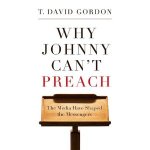
 There is a significant difference between using the wrong means to achieve a goal, and using the right means poorly. I like the way David Gordon puts it in response to those that claim preaching is not necessary any more:
I concur with them that the church is failing in many circumstances, but I attribute this not to the church’s employing the wrong means, but to the church’s employing the right means incompetently. If the patients of a given hospital’s surgeons continue to die, we could, I suppose, abandon the scalpel. We might also consider employing it more skillfully. My challenge to the contemporaneists and emergents is this: Show me a church where the preaching is good, and yet the church is still moribund. I’ve never seen such a church. The moribund churches I’ve seen have been malpreached to death.
(p33)
How true this is. I’ve yet to meet someone who opposes expository preaching that has tasted of the real deal. People tend to reject a caricatured, or an inadequate, or an incomplete version. The preaching of a church has a massive amount to do with the health of the church. Show me a truly healthy church with poor preaching. Show me a spiritually impoverished church with consistently good preaching. I suspect you can’t do either.
It certainly takes much more than preaching to build a healthy church. But it seems that it can’t be done without.


When we read a Bible text, do we really read it? Do we really read it? Two important and slightly distinguished questions…
1. Do we really read it? Everyone assumes that we read it if we run our eyes over it and notice what is there. The reality is that most of the time we don’t really look carefully at the text and notice what is there. We miss biblical quotations and allusions, we miss details in the text, we miss the flow of the text, we miss the mood of the text, etc. As Gordon writes in his book, we are not in a culture that trains us to be close readers of quality texts anymore.
2. Do we really read it? That is, we have a tendency to not only not read very well, but to excuse poor reading of this text because of a wider understanding of the whole Bible. Of course we should read every passage in its context in the Bible. We must have a Bible wide theology, and a Bible defined theology. Yet it is so easy to impose a theological position on a text so that the text itself is not heard. I observed this recently when one line in a Psalm triggered a theological thought for one person, so that he argued against the surrounding text in order to underline his own theological position. He would say he was being biblical, but his theological position was overriding his reading of this particular text.
This post is cast in a negative tone, but the goal is positive. Let us be careful readers, and careful readers of each text. Surely that will help us be better preachers.


 In a culture that is as committed to the Sunday roast dinner as it is to complaining, it isn’t surprising that people here talk about having Roast Preacher for dinner! But as parents we are sensitive to the presence of children at our dinner table (and for the record, the absence of roast dinners on a Sunday – all who manage that feat on a Sunday are borderline miracle workers in our opinion!) So how to discuss the sermon with the family present? I like three questions used by the author of the book I’m not naming until next week. I think we should try these:
1. What was the point or thrust of the sermon?
2. Was this point adequately established in the text that was read?
3. Were the applications legitimate applications of the point?
If the main point was not clear, then it will be interesting to determine together what the sum total, bottom line, distilled main idea actually was from our perspective. (Preachers note this, if you don’t make your main point clear, others will be guessing or dismissing, and neither is good!)
If the main point was not established in the text, then we have two paths ahead of us. One would be to guess where the main point actually did come from (danger of psycho-analysis with children present). The more productive path would be to look at the text again and determine what the main point actually is in the text. (Preachers note this, most people will not automatically go back to the text and hunt down a statement of the main point of it. They will either accept what you said, or they will ignore and move on – neither is a good result.)
If the applications were not legitimate applications of the point, then again we have a couple of options. One would be to trace out both the roots and the fruits of the false applications . . . which would hopefully lead to other Bible study and application of other biblical truth. Or it might lead to spotting false agenda and considering the long-term fruit of sub-gospel preaching. Depends on the sermon, I suppose. The other option would be to chase more legitimate applications of the teaching of the text read. (Preachers note this, most people either buy what you say or ignore it. You probably get the pattern here by now.)
So let’s say we end up chasing down the legitimate applications of the actual main point of a text, having heard a disunited message that failed to establish its main point in the text read or provide legitimate applications. I suspect we’d be a very rare family if we managed that over our Sunday lunch. Preachers note this – these three questions are not unfair, let’s be sure people can answer them easily and in the affirmative.


 It isn’t unusual to hear people speak of expository preaching as an irrelevant mode of communication that has no place in the contemporary church. Outdated. Unnecessary. Irrelevant. Here’s a quote from a footnote in the book I just finished this morning and will review sometime soon, but will leave you in suspense for now (p79):
As long as original sin has the human race in its grasp, and as long as the conscience has the slightest awareness of guilt, declaring the competence of the sin-bearing Christ to rescue the guilty will never be irrelevant.
Absolutely. The problem with the “irrelevance” talk is that it seems to be looking at entirely the wrong thing.
1. People don’t always know what they need. Everyone seems to be an expert in how long they can concentrate, how they learn best, how they need to be fed, etc. As a parent I know it is possible to be most sincere about what is best, yet in my slightly advanced maturity I can see through the best laid plans of toddlers and children. In a culture that has degenerated on so many levels, the frogs in the near boiling water are happy to announce that preaching the Bible is now irrelevant to them since they are so advanced compared to all who have come before. It seems, at times, that the only advance is the march of sin toward judgment.
2. People don’t always know what they haven’t heard. For example, feed a church poor preaching consistently and they may moan, but they also will cling on to the scraps of good that they receive from the pulpit. Sometimes great expository preaching can be as much of a shock to the system as a nutritious feast is a shock to a starving body.
3. People don’t always know the difference between critiquing bad examples and critiquing something as a whole. I can say that tomatoes are unnecessary for me to have an enjoyable diet because I have only tasted sour excuses for tomatoes. But now that I have enjoyed some of the finer specimens from Italy and elsewhere, I wouldn’t be so brash in my dismissal of all tomatoes. The same goes for expository preaching. What may be irrelevant is the kind of pseudo-expository preaching many have grown accustomed to (lacking biblically, lacking communicationally, lacking applicationally, lacking spiritually, lacking in gospel, lacking in skill, lacking in prayer).
Baby. Bathwater.
We don’t always realize just how fast our fast-paced lives are. We live in an age of flashing images that rush by at frantic pace. As the book I’m currently enjoying points out, “we become acclimated to distraction, to multitasking, to giving part of our attention to many things at once, while almost never devoting the entire attention of the entire soul to anything.” (p50)
But preaching a biblical text demands that we slow down and focus. We must concentrate fully on the text.
1. Poetry – “the rhythms and cadences, the music of the language, cannot be experienced at all by scanning.” (p.50). Indeed the dense line by line nature of poetic art demands focused reading if we are to glimpse the gold that is there.
It is not just poetry though, we must also slow for:
2. Narrative – it takes focused concentration for the imagination to engage, for the images to form, for the tension to be felt. Characters have to be met, tension faced, resolution experienced. Narrative will only yield superficial and petty sermon outlines if it is not engaged slowly.
3. Discourse – it takes focused concentration to follow the intricate composition of an epistle or recorded speech. How does the thought flow? What is the main thought? How is it developed? Again, discourse will preach after a superficial glimpse, but it will be poor!
Slow down. Read the text. Then maybe you can preach it.






 Biblical Preaching