The Problem of Performance

The danger of performing is not only there when preaching a first-person sermon. It is a danger every time we preach. After all, as a preacher we study an ancient text, determine its main idea and its contemporary relevance, then design a message to communicate both the meaning and the relevance to the congregation who will sit before us on Sunday morning. Our goal is not to fill time, but to stir people and to see lives transformed. As has been said many times, we preach to comfort the disturbed and disturb the comfortable. And if we’re honest, there are ways to get that done. It is not out of our reach to spin a story a certain way in order to turn the emotions of our listeners, or ask a rhetorical question that we know will poke a nerve of guilt in them. So how are we to avoid stepping up to the pulpit and treating it like a stage?

1. Give preparation time to soak. Last minute preparation will lead to last minute desparation wherein “preaching tactics” will seem like our only hope. We must be diligent to begin the study and thinking process early enough for a message or a series to soak in before we must pour out. Even if all we can do is to start reading and making some notes ahead of time, it is worth it. Performance is lines through an actor, but preaching is truth through personality (Phillips Brooks succinct definition). Allow time for the preparation to become a part of who you are so that you preach something you truly believe and know deep down.

2. Prepare more, not less. In the quest for “natural” delivery, it may be tempting to prepare less. The hope is that what comes out will be less of a performance and more “from the heart.” The reality is that unprepared preaching will often lean heavily on our own abilities. It is better to craft, to sweat, to wrestle, to pray, to think and to think some more. As I have written before, in an ideal world it is best to write out a manuscript in full and edit it closely and prayerfully. All that extra work will result not in performance, but genuine preaching “from the heart” as well as “from the text” – choosing to do minimal work will compromise both the text and your heart, leaving only any performance skills you may have.

3. Pray. Not just a “bless this effort” prayer, but real prayer. Personal wrestling with the God who is at work in you first. Persistent wrestling for those who will receive the message. There is a great spiritual battle raging around you and around them. Let us not fight in the pulpit a battle we have not first heavily engaged in the closet.
Preacher’s Worst Nightmare

There are all sorts of things that can go wrong for a preacher. What is your worst nightmare? Last week I was at an event at All Souls in London, where a preacher referred to arriving at a church and realizing the message he planned to preach there was one he had preached there before. Is that a nightmare? What about sitting in a service as the first part dragged longer and longer, leaving less and less time for the message? I haven’t enjoyed that experience when it has happened. Or the other extreme. A couple of years ago in the Caribbean I was asked to preach for twenty minutes, but when we arrived at the church I was told my message would be live on the radio and I had to finish on the dot at 10:05am . . . and I was introduced at 9:00am. A twenty minute message squeezed into sixty-five. I’m sure you could add to this list of preaching nightmares.

But the worst nightmare? That’s easy. Preaching a sermon that is all me and no God. That’s the worst nightmare.

Preaching Short – The Challenge

When people are first asked to preach, their main concern is “how can I fill that time?”  Once preachers have some experience, they tend to want more time than they have.  If you are used to preaching for 30, 35, 45 minutes, then it is a real challenge to prepare a 10, 12 or 15 minute message.  It forces you to “think yourself clear” to a far greater extent.  It forces you to cut more diligently and preach lean.

Sometimes that is forced on you.  Today I am preaching in a series, but through a translator as we have a load of guests from France with us.  The blessing of preaching through an ‘interrupter’ is that I have had to think through the message to a greater level of clarity and simplicity.  I am not sure if I have succeeded yet.  But it is an interesting thought.  Why not deliberately preach short once in a while?  Why not preach a message half as long as you typically do?  It will challenge you as a preacher, it will shock your listeners and demonstrate that church form is not set in stone.  It will allow extra time for musical response, personal response or fellowship.  I am not advocating preaching shorter sermons all the time.  If you are in a church that allows and appreciates longer sermons, then praise the Lord.  But why not cut the length of a sermon periodically, for your sake and for theirs?  Is that a challenge worth taking?

First-Person: Beware of the Danger of Acting

If you decide to preach a message “in character,”  then you are choosing to act as someone other than yourself.  People will know that you are acting and to a certain extent they will accept that.  However, there is good acting and bad acting.  Good acting looks real.  Bad acting looks like a performance.  Flamboyant movements and exaggerated speech do not work anymore.  People enjoy movies, tv shows, etc., that seem real.  There is something about “performance” that puts people off.

So when you decide to preach a first-person sermon, try to select a character that can come across naturally.  You may change your voice, your personality, your temperament, but every change puts you at greater risk of “performing.”  Natural communication is powerful, but performance can be counter-productive.  Know yourself, know your listeners and select your character carefully.  Remember, you don’t have to be a character in the story, you could be an observer unmentioned in the text.  For example, Don Sunukjian preached Esther from the perspective of an observer in the king’s court (I suspect he would have struggled to preach as Esther without seeming unnatural!)  Select your character so that you can present a compelling natural account, rather than a contrived and unnaturally flamboyant performance.

First-person preaching is not an excuse to perform, it is a choice to preach a message in the most effective way possible.

Motion Detectors

Preaching is not about performance.  It is not an act.  Our goal when we are preaching is to communicate in a natural manner, as ourselves, because “naturalness” is critical to trustworthiness.  The problem is that standing up and speaking before a crowd incites a certain level of nerves.  Nerves influence movement.  So while it is quite right to be somewhat nervous under the weight of the responsibility of preaching God’s Word, unnatural communication is not good stewardship of the opportunity.  We should be aware of our tendency when nervous – not too aware, for we are not performers, but aware enough to be ourselves when in front of a crowd.

Beware of perpetual motion.  At one end of the scale, some people react by moving constantly.  Shifting weight between feet, pacing, rocking, etc.  This can come across as twitchy and shifty.  

Beware of frozen motion.  At the other extreme there is frozen motion.  This could be stance, where your feet become rooted to the spot.  This is natural for a while, but not forever.  Or perhaps a body part.  Maybe a dead arm in the pocket, or resting on the podium.  Or facial expressions.  A forced grin or a perma-frown.  Or eyes.  Always looking at limited focal points – one or two faces, or worse, a clock, or your notes.  

A significant proportion of communication comes through non-verbals.  All your listeners are experts in it (they are observing and interpreting body language every day).  Their motion detectors are permanently on, evaluating whether someone is moving normally and naturally or not.  This all goes on subconsciously.  Somehow you need to also deal with your own body language subconsciously.  Too much awareness and you may start to perform.  Too little awareness and you may be undermining your ministry.  There are far more important things in preaching than your body language, but unfortunately those important things may get lost if unnatural motion detectors are buzzing in your listeners.

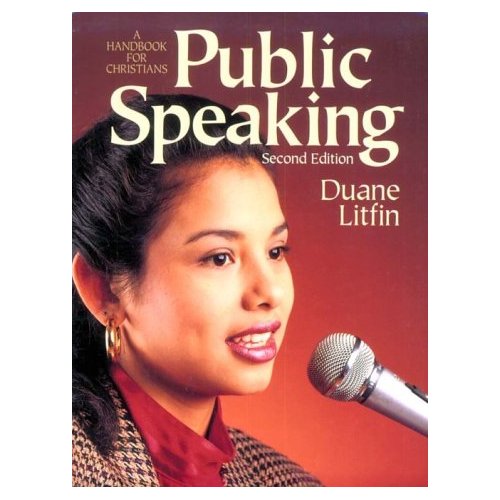
Review: Public Speaking: A Handbook for Christians, 2d ed., by Duane Litfin

litfin.jpg

This is a college text focusing on speech communication, rather than homiletics. The main reason it may be worth reading is because it is built on the Haddon Robinson “Big Idea” preaching model. Robinson’s influence is evident throughout, not only conceptually, but also in specifics.

Since Litfin’s work is not primarily focused on preaching, he is able to challenge the reader to produce latently Christian communication in a variety of fields, a challenge perhaps we in ministry need to hear. Litfin does well to show what an audience centered communication approach looks like, including the factors that make for easier listening (such as concrete, familiar, suspenseful, interesting, humorous and life-related elements). The introduction of other elements of communication such as proxemics, paralanguage and so on add a dimension perhaps weak or lacking in many preaching texts.

Litfin’s emphasis on the importance and function of the idea reinforce Robinson’s work, but the text also goes beyond Robinson to mention other approaches to speech formulation.

Litfin’s final chapter addresses the issue of preparing a Bible message. This chapter provides a helpful and relatively succinct summary of the process of homiletics (at least in reference to preparation). Litfin’s seven steps largely parallel Robinson’s, except for introducing audience need earlier in the process. Introducing audience need prior to writing the speech idea – the same stance taken on this site, seems like the correct order if the Big Idea is to be stated with relevance to the audience.

This book is a useful book for reinforcing and amplifying some aspects of Robinson’s work. For a speech com class, this is a great text. For preachers? It is helpful if you feel the need for help to fully grasp Robinson’s work. Not a preaching text, but not a bad source of supplemental reading.

First Person: An Extra Challenge

Sometimes preaching a passage in first person is the best and most effective way of communicating it.  Preaching in character allows you to engage the story in a more vivid and engaging manner.  Yet preaching first person sermons well is by no means easy.  You have to do all the work of Bible study and designing the message as for a normal sermon, but you also have to do more . . . more research, more planning, more details.  Two brief thoughts to add in to the planning process:

1. Remember that you are presenting the history, but need to preach the theology of the text.  For example, if you are preaching a narrative from the Gospels, you should preach the narrative in light of one of the written records.  I say this as opposed to preaching a composite blend of multiple accounts, to preach the event itself.  So if your narrative is found in all three synoptic Gospels, then be aware of all three (so as not to present a historical error in your story-telling), but make sure your idea, purpose and emphasis come from one of them.  The historical event was revelation, but the written account is inspired.

2. Remember to find ways to provide the evidence to support the idea of your sermon, and your interpretation of the text.  In normal preaching this is more simple, you merely decide how much of your textual study should be demonstrated and in what way.  If your understanding of the passage is influenced by the term the writer chose to use, then you can demonstrate that.  But when preaching first person, you usually can’t refer to the text in this way.  Do not therefore simply tell the story without letting your study show.  Show it in other ways.  For example, in Mark 4:35-41 you discover that the term “rebuked” is significant in understanding the story as Mark presents it, as is the use of “be still” in Mark’s gospel.  When preaching in character you cannot simply explain how these terms point to Mark’s intent in his presentation of the story.  But they can still show.  For example, speaking as a disciple, “You should have seen Him!  It wasn’t just that He spoke to the storm, it was also the way He did it.  As I thought back on it after, playing that moment over and over in my mind, I realized where I’d seen Him speak like that before.  It was when . . .” (then describe briefly the earlier incidents in Mark 1 and 3).  You can’t refer to chapter and verse, but you can refer to the stories in such a way as to highlight the significance.  And again, “The words He used, ‘be still!’ – He’d said that before . . .”  In first person it takes creativity to support your interpretation of the text, and it will be an indirect approach.  But you must do it, otherwise you run the risk of telling a story, but not preaching a text.

On This You Cannot Work Too Hard

Pastoral ministry and family life rarely yield the full quota of hours we would like to perfectly prepare each sermon.  However, there are some elements of a sermon that don’t do well with a short-cut approach.  Time spent on this aspect of the sermon is always time well spent.

Clarity.  It doesn’t come by accident.  The only thing that is clear when you don’t spend time on clarity is that you didn’t spend time on clarity.  It takes work to think yourself clear and then more work to preach in a clear manner. 

However, it is tempting to bypass this aspect of sermon preparation.  This is because everything seems so clear to you, the preacher.  You have spent hours in the text (hopefully).  You have wrestled with understanding the passage and then forming a sermon.  Yet for the clarity to come through, you have to pay close attention to matters of clarity.

I have been both a student and a teacher in preaching classes.  The students know that they need to communicate a clear big idea.  They know that the class will be asked for the big idea once their sermon is over.  Consequently the smart students “work the system” by stating and reiterating their big idea seemingly to an extreme level.  Then when the prof asks the class what the big idea was, there is usually a pause, followed by three or four different ideas.  The preacher sits there with a puzzled look.  “I thought I was being clear!”  If prepped students looking for the idea can’t spot it, what about a congregation who may not even know what a big idea is?  They’ll come up with something, but if you are not clear, then it will not be what you intended.

So before you preach your next sermon, do a review for clarity.  Is the big idea clear?  Does the sermon flow in a clear manner?  Are the transitions clear?  Are you using vocabulary people will understand?  Be clear, be clear, be clear.  If you’re not clear, then what are you achieving?

Hearing Is Not Like Reading

The difference between writing for the eye and writing for the ear is often overlooked by preachers.  We tend to be book people – we may have studied formally for more years than many others, then our work requires us to keep on reading diligently.  Perhaps we even write books and articles for others to read.  All this means we too easily write for the eye by default, even when we write our sermons.  But our sermons are not for the eye.  They are designed to be heard.  People can’t go back and re-read what we just said, nor pause for thought when a particular sentence strikes a chord.  Consequently, we need to be careful to prepare sermons that work for the ear.  Various techniques will help our listeners.  Here’s an important one:

Restatement – It is not repetition (saying the same thing again, like a parrot), it is restatement (immediately saying the same thing with different words).  Repetition can sound like you think the people listening are stupid (although sometimes it is appropriate to simply repeat what you just said).  Restatement gives the listener time to take in what you are saying.  It’s useful to use with the big idea, with references to the structure of the message, with major points, etc.  When people are reading a book, they can go back and look at an important sentence to make sure they understood it.  When they are listening they can’t go back, so you need to do this for them through restatement.  Practice saying something and then saying it again in other words.  Train yourself to state your point, but then to restate it in different terms.   

Scripture Interprets Scripture – Cross-Referencing in Preaching

You’ve probably heard the oft-used line that “Scripture interprets Scripture.”  This principle of hermeneutics seems to be the only principle for some people, but I would suggest it is one among many helpful principles.  It is right to say that no passage will ultimately contradict the rest of the canon, for there is a divinely inspired unity to the Bible.  However, this does not mean that we should neglect near context interpretation in favor of distant context interpretation.  What a writer means by a word or phrase should be evaluated in light of the sentence, the paragraph, the section, the book, the other books by the same writer, the other books from that time period, the other books in that “Testament” and the other books in the Bible – in that order!  Like concentric circles around the bull’s-eye, the closer the context, the more weight we should give it.  So a term used in a letter by Paul does not automatically mean the same as that term in Matthew or John or Ezekiel. 

One exception to this hierarchy of correlation would be to go to a text evidently in the thoughts of the author prior to others that may technically be “closer contexts” but were unknown to the author.  For example, when an NT writer is obviously leaning on an OT passage, that passage may be technically the most distant context, but it actually may be more helpful than another NT writer.  So I’d look more carefully at the prophet Paul is quoting than Matthew’s use of the same term.  We should correlate carefully.

Having stated that we should select cross-references in light of their actual value in interpreting our target passage, this does not mean that we need to give that information to our listeners.  We do a lot of study that does not need to be flashed from the pulpit.  Generally it is better to explain your target passage, rather than potentially confuse or overwhelm listeners with a series of different passages.  In part 2 I will give some specific guidance on cross-referencing in the pulpit.