The Balancing Act of Evangelism

This Sunday may be it. The only chance you will get. There may be someone there this Sunday who may never come again. So it would be wise to spell out the gospel in detail, wouldn’t it? After all, this may be the only opportunity and so it would make sense to be sure to cover all the bases. This is the approach many of us from time to time. Perhaps aware of visitors or motivated by something we heard, we decide to pack the corners of our message with evangelistic information.

I’m not suggesting this is wrong. But it is certainly not so simple. There are two sides to this issue. On the one side you are preaching the text to people that ultimately need to either respond to the gospel, or continue to apply the reality of the gospel in their lives. It may well be that this is the only opportunity for somebody to hear the important details concerning themselves, their predicament, God’s provision, and so on. I’ve sat through many supposedly evangelistic messages that did a lot of work, but then failed to spell out how to respond. So perhaps we should look to present the gospel as fully as possible in every message?

On the other hand, are we not running the risk of forcing every text into a certain gospel form, rather than honoring the text in a truly expository manner? Are we not running the risk of adding detail to a message that does not support the main idea and thereby complicating the message? People find clear messages easier to follow, ones that are built closely around a single main idea. If they are easy to follow then the experience is more enjoyable and people are more likely to return for more. A message considered confusing and complicated will not motivate people to want more.

Perhaps part of the solution is to present the gospel every Sunday, but if it risks complicating the message in some way, then it could be presented at some other point in the service. This may be the last Sunday someone will be able to hear the gospel. Equally, it may be the last Sunday they will bother coming to church if the communication is overwhelming and complicated. Present the gospel, or motivate them to return for more, or maybe you can do both?
Preach the Word, Lead as a Champion

If you are a preacher, then you are a leader.  Your self-esteem may not say so.  Your mannerisms and style may not say so.  Your church structure may not say so.  But when you preach, you have the influence of a leader.  Of course it is easy to be a poor leader.  You can undermine the whole thing by your style, your ego, or your lack of planning, not to mention your life out of the pulpit.  But it is important to remember this; when you preach, you are a leader.

So preach the Word with relevance.  Leaders know the people and know their needs.  Leaders know that there is no time to waste on interesting trivia when life change is needed.

So preach as a champion.  This does not mean that you preach with a trophy on a stand next to you.  This means that you champion the values and goals of the church.  Don’t fall into the trap of perpetually plugging programs in the preaching.  That gets old really fast and confuses the communication.  Plug and promote programs in the notices / announcements.  But while preaching deliberately present the values and vision that hopefully underlie those programs.  This is all secondary to the primary concern of preaching the specific text with accuracy and relevance, but there are numerous ways to appropriately pursue “secondary” goals while communicating.  If your church’s values and vision are biblical, then there will be numerous opportunities.  And if it doesn’t fit, don’t do it.  But when it does, take the opportunity to be a champion, to be a leader.

You Have Your Style, But It Is Not An Excuse

In reality every one of us has our own style when we preach. There has to be an integrity between who we are and our style, which is why if you copy your favourite communicator, it doesn’t seem to work very well (even if it seems to in your mind, ask your people – it doesn’t work very well!) But even though our style may be personal, this does not mean it is above critique or beyond repair. We should carefully consider every factor in our preaching and make any necessary adjustments. We do this not for some vain goal of personal perfection (not possible), but for the others’-centered goal of ministry effectiveness.

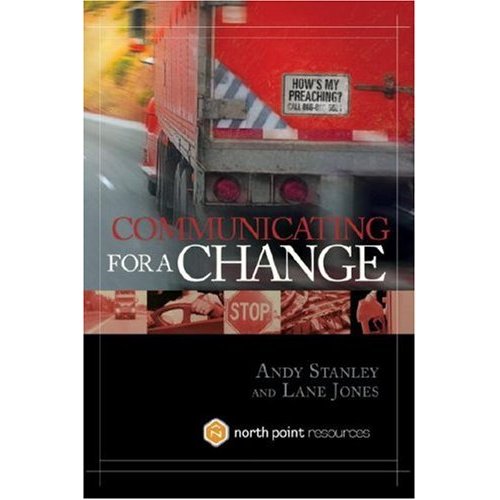
I appreciate the analogy Andy Stanley uses in his book, Communicating for a Change. He writes (p177):

In the past four years we have experienced a big influx of adults in their late fifties and sixties. Do you know why they come? Because we have reached their young adult children. Our “style” is not necessarily their “style,” but they are willing to make adjustments in order to be in church with their kids; kids they weren’t sure would ever engage with a church. They have adjusted their style in order to worship with their kids. Shouldn’t we be willing to adjust ours to reach their kids? Boring, confusing, complicated, scattered, and dry are all communication styles. But they are not styles worth defending. They are styles that should be abandoned.

Eyes May Be Looking, But Are Ears Listening?

Who’s responsible for the attentiveness of listeners?  Is it the listeners?  After all, they choose to come to church, they should be able to focus on what is happening.  Or is it the sound technician?  That individual plays a huge role in removing certain distractions, but they cannot engineer attentiveness.  What about life circumstances of the listeners?  Surely God could make it so there was nothing going on in their lives in the days leading up to a Sunday?  Of course we can point to the important role of sound technicians and the parents of crying children, but these can only remove distractions.  Attentiveness is almost entirely up to the preacher.

Howard Hendricks, prof at Dallas Seminary, was devoted to the fact that the attention of his students was his responsibility.  He would go to whatever lengths he could to arrest and maintain the attention of those in his class.  He had ways of making you listen!  Perhaps we should be the same?  If so, this has several implications:

We must plan a message for attention – as well as planning a message that is biblical and clear, we must also endeavor to be interesting and relevant throughout.  

We must be aware of our listeners – preaching is a form of two-way communication.  Usually only one party ever speaks, us, but there is still continual feedback through body language, facial expression and so on.  We must be careful never to get into a mode that is all about us.

We must be responsive to the situation – if there is an interruption or distraction, consider how best to overcome it. Sometimes ignoring it is the best or most sensitive approach, but often not.  If others are aware of it but think you’re not, that is distracting.

Are they listening?  That’s up to you.

Preaching Camera Angles

You might get the impression from this site that I watch a lot of television.  Truth is I don’t own one.  I watch DVDs now and then, but don’t have a TV.  Anyway, the analogy of film or TV is helpful as we consider ways to improve our communication of God’s Word.  Let me suggest one issue worth considering – perspective.

If you ever watch an old show or movie from the fifties, it will feel quite stilted and unreal now.  The fixed position camera observed all the action and conversation in the room, but essentially didn’t move very much.  Today camera work is so different.  Moving positions, wide and narrow lenses, changing speeds, even filming within the consciousness of characters (dreams, memories, fears, etc.)  Human consciousness is much more complex than the old fixed camera angle allowed.

Whether the contemporary approach merely reflects the complexity of human consciousness or a if actually it reflects changes in human consciousness (in an age where a fixed perspective on the world is shunned), well, that can be a discussion starter to keep up your sleeve in case you need it.  But a point to ponder right now is this – do we as preachers communicate in a way that feels stilted, stuck and so 1950’s?  Or are we able to adapt our presentation to vary the perspective, delve into various realms of human consciousness, intriguing and engaging as we go?  The Bible provides great variety of perspective, emotion, awareness, intrigue, and so on.  Do we do justice to that, or do we stultify it into a predictably unchanging perspective?

Review: Communicating for a Change, by Andy Stanley and Lane Jones.

stanley.jpg

Let me be honest. I love studying the subject of preaching. I want to be a lifelong student of the subject. But if I’m honest, a lot of books about preaching are somewhat dull, tedious, repetitive and unengaging. Not this book. Engaging. Compelling. Motivating. Intriguing. Is it perfect? No. But, I think you should read it.

The book reflects a highly pragmatic authorship. Stanley writes, “I’ve listened to dozens of preachers and teachers whose stated purpose for communicating is changed lives but whose style of communication doesn’t support their purpose. If you are not willing to make adjustments for the sake of your goal then one thing is clear: Your goal is something other than changed lives. Your goal is to keep doing what you’ve always done, to do what’s comfortable.”

What does it take to preach for changed lives? According to Stanley and Jones it involves clear, engaging, relevant and applied truth from God’s Word. This book advocates strongly for one-point sermons. That one point is combination of textual idea, sermonic big idea and sermon purpose. The very slight confusion that comes from combining distinct elements of sermon preparation is worth forgiving for the clarity created in this model.

The book is in two parts. The first part, by Lane Jones, is an extended metaphor that teaches the concepts of the book. A frustrated fictional preacher gets the best preaching education of his life from an unlikely mentor. This narrative is well written, compelling and regularly convicting as well. The agenda is clear in this narrative, but since the agenda is practical skill training rather than a theological hobbyhorse (as in similar books in recent years), I thoroughly enjoyed it.

The second part is Andy Stanley working through the seven principles of the book. I found myself agreeing with so much here. Strong emphasis on the connection built by speaker to listeners, and on surfacing need and interest in the message, and on having a unity in the whole by the use of a main idea (the one point), and application driving every aspect of the message rather than being tacked at the end, and on and on. I found this book interesting, more than that, challenging and motivating.

Reservations about the book? Just one. I wish there was another chapter or two on the Biblical part of the message. I understand Stanley’s five-part progression through a message, and he states that the middle stage, the “God” or Bible presentation stage is the longest one. But what does that look like? He explains that we shouldn’t be superficial, or overwhelm with too much information. But what should we do in that part? This omission could be taken in a couple of different ways. Someone with a strong commitment to the Bible and exposition might try the Stanley model with a solid biblical core. Someone without that same commitment may preach a biblically weak idea birthed out of their own experience. The book allows for both. I wish it were stronger on the former. I’m left wondering . . . on the one hand I know who his Dad is, and I know where he studied, both clues lead me to expect a very biblical tendency. On the other hand the book is inconclusive. I am left looking for an opportunity to watch some of his messages on the internet to see how the theory works out in practice. In fact, I am highly motivated to do that. And I suspect I might be very pleased by what I see. If you read the book, do the same and let me know what you think.

The reservation is not a really a critique, it’s more of a yearning for more. This book is well worth reading. It will breathe new life into your preaching and your motivation for preaching. I honestly think that all of us would improve as preachers by reading and implementing at least some of what this book teaches.

Preach Like It May Their Last

If you are preaching today, it is tempting to be caught up in your own world.  Concerned about your presentation, the details of the sermon, even the peripheral details that you didn’t delegate to someone more passionate about them.  But know this – today’s sermon may be the last some of those people ever hear.

The tired teenager who is gaining the freedom to not have to come to church, but has not yet gained a sense of need for church.  Today may be their last.  The person who’s been coming for a while, but only fits in on the outside, by dressing right, yet on the inside is wracked with doubts and is tired of pretending.  Today may be their last.  The couple whose marriage is seconds away from complete train wreck and can’t keep up the show any longer.  Today may be their last.  The guy struggling with significant temptation who feels like he’ll cave in any day, but is currently painfully unaware of the waves of guilt that will follow.  Today may be his last.

Today may be the last time some people in your congregation hear you preach.  It may be their last sermon, their last Sunday morning at church.  We’ve all heard evangelistic messages that point out the urgency of the occasion.  “You may step out of here and be hit by a bus.  Do not delay!”  Let’s turn that urgency on ourselves for a moment.  Some of them may die before next Sunday.  But there are dozens of other reasons why you may not see them again.  The reasons are important, but so is this sermon.  How much more direct should it be?  How much more relevant?  How much more real should you be?  How much more urgent?

This may be their last.  Preach in a way that will make this sermon count.

Urgent Needs in the Pew, Urgent Changes in the Pulpit?

As I wrote my post yesterday, a package arrived. Having made a guess at how Andy Stanley views preaching, I received his book on preaching. I will soon post a review of the book. But let me share something from the book today. In fact, let me share one point that underlies his instruction throughout the book. Here it is – since there is such an urgent need in our listeners, will we do anything we can to effectively connect their lives to God’s Word?Let me quote a bit for you:

“Every single person who sits politely and listens to you on Sunday is one decision away from moral, financial, and marital ruin. Every one of ‘em. Many are considering options with consequences that will follow them the remainder of their lives. [He describes several examples] . . . There they sit. Silent. Waiting. Hoping. Doubting. Anticipating. What are we going to do? What are you going to do? What are you going to say?

“This is the world we have been called to address. These are the issues we have been called to confront. There is much at stake. There are many at risk. The great news is the pages of Scripture are filled with principles, narratives, and truth that address each of those needs The question you must answer is, to what extreme are you willing to go to create a delivery system that will connect with the heart of your audience? Are you willing to abandon a style, an approach, a system that was designed in another era for a culture that no longer exists? Are you willing to step out of your comfort zone in order to step into the lives God has placed in your care? . . . Will you communicate for life change?”

Stanley’s urgency is stirring. What is he advocating? What kind of delivery system does he suggest? Should we be making urgent changes in our preaching? I’ll finish the book and give you my thoughts.

Quote from Communicating for a Change, by Andy Stanley and Lane Jones, pp88-89.

Lazy Preaching?

Andy Stanley, pastor of North Point Community Church, made a passing comment about lazy preaching in an interview with Preaching magazine.  He was talking about his desire to come up with a statement, a takeaway point in a sermon.  His stated goal was that a listener could come back to the same passage of Scripture later and say, “I know what that means.  I know what that’s about.”  Because of that goal he does not like to say, “Paul said” and “John said that again” and so on.  Here are his words, reprinted in Preaching with Power edited by Michael Duduit:

I hate sermons like that.  When I listen to them, I just turn them off.  I think just one passage that says it is all we need.  Just help me understand the one passage – please don’t proof text every point with a verse.  I think that’s lazy preaching.  It would be easy to develop sermons like that.

I tend to agree.  There are reasons to go to other passages, but far fewer legitimate reasons than many of us think.  When we have the opportunity to preach a passage, let’s do the hard work and really preach that passage.  It’s easy to skip all over the canon, but if there isn’t a genuine reason for doing so, it’s lazy preaching.

Surrogate Sermons – Part 2

Continuing on with Dwight Stevenson’s list from yesterday . . . “surrogate sermons” we should be avoiding:

Palace propaganda – Catering to the specific audience in a church by giving exactly and only what they want to hear (often determined by their socio-economic class, race, etc.)

Theological lecture – We must be able to give reason for our faith, but that does not mean we substitute dogma for faith in preaching.  Preaching can be doctrinal without sounding doctrinaire.  Preach the inspired text, not only a system.

Argumentation and debate – We are called to be Christ’s witnesses, not his lawyers.  It is easy to level our guns at a theological position, or a moral concern, but let us be careful not to breed counterattack, controversy and division.

Eulogy – A syrupy diet of simplistic non-answers to life’s realities that sound acceptable because they elevate Christ continuously.

Ecclesiastical commercial – The promotional work for the programs of the church can be done effectively and creatively outside of the sermon.

Monologue and soliloquy – Communication that is effectively the act of hearing one’s own voice, because the preacher is unaware of the internal and explicit reactions of the listeners.