Bible Story: Read or Tell?

Let’s assume that the reading is taken care of, and as I suggested yesterday this might not mean the reading of the text itself.  Now, what to do with the telling of the story?  Should we just read it, or should we tell it?  I say we should tell it, and we should tell it well (and typically in the telling of it we may add detail not included in the text).  Typically we will tell it with certain sections, or even the whole text, read along the way.  Why tell and not just read?

1. The preacher’s task is to present the text by way of explanation.  A big part of the explanation of the story is the effective telling of the story, and the effective telling of the story requires the preacher to describe the action, the scene, the situation in vivid colour so that the image can form in the hearts of the listeners.

2. The preacher’s task includes applying the story with contemporary relevance emphasized.  A big part of the application of the story is helping listeners inhabit the tension of the story, identifying with the characters as they wrestle with life in response to the Word of God.  A well told story carries a significant proportion of the explanation and the application of the message.

3. The preacher’s task includes not only saying what the text says, but doing what the text does.  To put it another way, we need to honour the genre inspired by God’s Spirit.  By telling story, we honour story as the genre of God’s own choosing.

4. The Bible text tends to be both lean and distant.  It is lean in that every detail counts and every detail carries significance in the telling of the story.  It is distant in that the original writers could assume awareness of culture, politics, history, geography, flora/fauna, etc.  To simply read the text is, in some cases, to dishonour the inspired story by not allowing it to hit home in the imaginations and hearts of the listeners.

I could probably offer more reasons to tell the story and to tell it well, but I’ve gone long enough for today!

Add to FacebookAdd to DiggAdd to Del.icio.usAdd to StumbleuponAdd to RedditAdd to BlinklistAdd to TwitterAdd to TechnoratiAdd to Yahoo BuzzAdd to NewsvineLike This!

Bible Story and the Reading

There are reasons why some churches have the reading of the text prior to the message or at the start of the message.  There are reasons why I don’t like to do this when I’m preaching a narrative.

The reasons in favour of the reading include convention (it’s ‘cos we do!), declaration of the priority of the Word, trust in the public reading of the Word, etc.

The main reason against it, in my opinion, is that a story consists in the resolution of tension, so why give that away at the start?  Even if people know the end, surely the re-presentation of the story is the place for the satisfaction of experiencing tension resolved?

When preaching narrative I tend to have a related reading to satisfy the hunger for a formal reading, but I prefer to keep this separate from the message.  When the message begins, my goal is to win people to the text, rather than assuming they are ready for it and launching straight into the reading.

What do I mean by a related reading?  It could be the preceding context in the flow of the book, perhaps ending with the introduction to the story.  It could be a passage offering “informing theology” – a prior passage that in some way shaped the writer of the text.  It could be a safe reading, such as a Psalm, that has more to do with the sung worship at that point in the service than in the message to follow.

I absolutely believe in the importance of the public reading of God’s Word.  I’m not convinced we are obligated to the read our text then preach it though.

Tomorrow a related issue – should we tell the story, or should we just read it?

Add to FacebookAdd to DiggAdd to Del.icio.usAdd to StumbleuponAdd to RedditAdd to BlinklistAdd to TwitterAdd to TechnoratiAdd to Yahoo BuzzAdd to NewsvineLike This!

Preaching Story to Children and Adults

As I was sharing about preaching Bible stories recently a friend jumped in and exclaimed their encouragement.  “What you are describing as an approach to preaching to adults is what we do in the school ministry with the children!”  What I had suggested was a basic outline from which to build.  Here’s the outline:

  1. Tell the Story
  2. Make the Main Idea Clear
  3. Apply the Main Idea

In a bit more detail, here’s my suggested “default” starter outline:

Introduction – whatever is needed to make people want to listen to you and to the passage and message.

  1. Tell the story – tell the story so people can imagine it happening.  Tell it accurately, tell it engagingly, tell it with energy.
  2. Main Idea – make it clear what we are supposed to learn from this story. What is the main point the author is trying to communicate?
  3. Application – take some time to describe the difference this idea could make, should make, to our lives.  Be specific.

Conclusion – review the main point, encourage application, stop.

So here’s a question from Philip on this site the other day: What differences should their be when preaching narrative passages to an audience of children as opposed to an audience of adults?  Will the differences be in the manner the story is told or taught?  Or only in the truths the story teaches?

Difference in Manner?  I would say not especially.  While we might feel the need to be more exaggerated and “hyped” to keep the attention of children, I suspect they can be gripped by a well told story minus excessive clowning from us.  On the other hand, perhaps we need to utilize more energy and motion in our story telling to adults!?

Difference in Truth?  I would say not especially.  We might state the truth more simply to children, but a story has one main idea.  That is the main idea whoever the audience.  A story isn’t theologically loaded for adults, but a simple moral instruction for children.  What changes is how we present and apply that specific truth.

Difference in Application?  Yes, this would be different.  We don’t need to help children imagine trusting God’s goodness in the face of employment challenges.  But the same truth is needed in their school and home experiences.

Difference in Awareness?  Yes, this is the main thing that comes to my mind.  Children don’t have the same historical and geographical/spatial awareness that adults tend to have.  We need to beware of assuming too much knowledge with adults too (in an increasingly biblically illiterate society), but I think details in a text that may be fascinating to adults can be confusing to children.

Same passage, same truth, but differing levels of detail, and differing specifics of application.

What do you think?

Add to FacebookAdd to DiggAdd to Del.icio.usAdd to StumbleuponAdd to RedditAdd to BlinklistAdd to TwitterAdd to TechnoratiAdd to Yahoo BuzzAdd to NewsvineLike This!

Saturday Short Thought: What Do Stories Do?

This week I have been sleeplessly enjoying Daddy-daughter time with Kaylah.  It won’t be long before a well told story will engage her imagination, captivate her attention and shape her life.  What begins in the toddler years doesn’t end.  Stories are not just for children, but can continue to transform lives of all ages.

Steve Mathewson explains what good stories do:

Proclaiming a well-studied story in a well-prepared way will do what good stories intend to do: sneak past the listener’s defenses to penetrate the heart.

And I suppose this is painfully obvious, so please excuse my fatigued new-Dad-again state, but what we need to do as preachers is understand the stories we preach as well as possible, shape our messages as well as possible and then present our messages (including telling the stories) as well as possible.

Let’s hear a bit more from Steve Mathewson’s great book on preaching Old Testament Narrative (p157):

“Stories move.  They have tension, movement, interaction, emotion.  We cannot tell a story while standing like a four-storey building.  We need to consider motion, body language, and emotion in voice, face and gesture.  Consider how to physically and subtly represent the movement of the story on the platform.  Don’t get stuck behind the pulpit (Spurgeon called it a “coward’s castle!”)  Always point to Goliath in the same direction, generally let time flow from left to right from their perspective, etc.  Stories move.  Good storytellers generally do too.  And the best storytellers move physically, in large gesture and with clear expressions in a way that is consistently natural!  Being natural takes work!

Next week I want to probe preaching narrative a bit more.  For the most profuse genre in the Bible, my sense is that it doesn’t get the attention it deserves in many pulpit ministries.

Add to FacebookAdd to DiggAdd to Del.icio.usAdd to StumbleuponAdd to RedditAdd to BlinklistAdd to TwitterAdd to TechnoratiAdd to Yahoo BuzzAdd to NewsvineLike This!

The Bible Story – Preached with Power

The Bible story you are looking at was inspired by God.  Not only did He inspire the content, but He also inspired the form.  God felt that having that truth clothed in the genre of story was the best option.  Now you have the opportunity to preach it.  How can you preach that story with maximum power?

1. Be sure to grasp and preach the main point.  A story does not consist of details collected together to offer you numerous launch points for vaguely connected ideas and insights.  The story consists of details deliberately chosen to help make the story work, to make the main point effective.  Be sure to grapple with the main point more than you hunt for “preaching points.”

2. Be careful to honour the form as well as the content.  Why chop it up and preach it as discourse when God made it a story?  This means that the bulk of your message should involve the best retelling of the story that you can manage.  Speaking of which, two critical elements of powerful story preaching:

3. Put your energy into effective description.  Study hard so you can describe well.  Build your sensory descriptive vocabulary so you can describe effectively.  Read C.S.Lewis or another great fiction writer to get a taste of compelling description.  Turn on your imagination again, because if you can see it, they will see it.  Take enough time for your descriptions to form on the screens in the listeners’ minds.  And pour similar energy into describing the application of your message too.  Speaking of energy…

4. Present with energy through engaging dynamism.  To be blunt, people don’t listen to dull stories.  To be honest, we rarely tell dull stories in normal life.  Ask me about my littlest girl’s birth last week and I’ll be engagingly dynamic.  I need to let that version of me show when I preach a Bible story.  When you preach a Bible story, remember that if you really care so it shows, they will care too.

I think these four suggestions are the very essence of powerfully preaching a Bible story.  What would you add?

Add to FacebookAdd to DiggAdd to Del.icio.usAdd to StumbleuponAdd to RedditAdd to BlinklistAdd to TwitterAdd to TechnoratiAdd to Yahoo BuzzAdd to NewsvineLike This!

Eco-Preaching: Recycling and Plagiarism

We live in an age of unprecedented access to information.  Cut and Paste was a hassle until a few years ago.  Now there is endless resource online just sitting there ready to be plagiarized.  At the same time, preachers face the pressure of busy lives.  And then there’s the pressure to live up to the impressive and often carefully edited sermons of the superstar preachers that everyone can listen to all week.  It’s a recipe for plagiarism.

There’s plenty on this subject online already, so I’ll just offer a few thoughts on recycling content that is not our own:

1. As ministers of God’s Word, we should have higher standards than academics and journalists (and they can lose their jobs over it).  Sadly, some act as if everything is fair game for cutting, pasting and preaching as if it is personal work.

2. Oral communication doesn’t require, and cannot support, the tedious footnoting needed in academic work.  But it does need integrity.  If I’m quoting the words of someone else, I mustn’t give the sense that they are my own.  Last Sunday, for several reasons, I quoted “a great figure from church history” (and was fully prepared for people to ask who that was after the message).

3. Appropriately using a well-turned phrase or a helpful illustration as part of a message that is unequivocally yours is not the same thing as lifting a whole outline or sermon and preaching it as if it were your own.  The latter is stealing intellectual property, it is deceitful toward your listeners, and it is cheating both yourself and others due to your lack of time in prayerful biblical preparation.

4. First person illustrations from someone else should not be shared in the first person.  If it didn’t happen to you, and you give the impression that it did, you are lying.

5. Inasmuch as I’ve tried to be clear here, we need wisdom since there is so much that is unclear in this issue.  May our wisdom be thoroughly shaped by the good character of the God we represent as we preach!

Add to FacebookAdd to DiggAdd to Del.icio.usAdd to StumbleuponAdd to RedditAdd to BlinklistAdd to TwitterAdd to TechnoratiAdd to Yahoo BuzzAdd to NewsvineLike This!

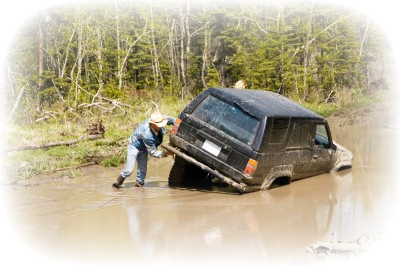
Stuck in the Mud

Some sermons seem to get stuck.

Some that I preach.  Some that others preach.  The sermon is moving along well, perhaps moving at a decent pace through a text, engaging and interesting, then suddenly, the sermon seems to go into thick mud.  Suddenly the momentum is lost and the experience for preacher and listener alike changes significantly.

Why does this happen?  The message is following the standard guidelines for sermons.  The text is being explained, the relevance is being emphasized, illustrative material is helping listeners see the message clearly, etc.  But momentum drains away and progress becomes elusive and there is a struggle on for the next ten to fifteen minutes as the sermon simply seems to stand still.

I was observing this recently from the listener’s side.  It seemed that at a certain point in the journey through the message, the momentum stopped and we felt like we were spinning our wheels.  Restatement.  Repetition.  Illustration.  Repetition.  Illustration.  But no progress.

Have you experienced this phenomena?  What would you suggest to avoid it happening?  I’d suggest we look at the outline or manuscript and prayerfully evaluate it for progress and momentum, as well as for content and clarity.  While a third illustration under the same point may compound the clarity, it might also feel like an anchor keeping the sermon from arriving at its destination.

I’d also suggest prayerfully preaching through a sermon to experience it through your own ears.  Sometimes sermons look perfect on paper, but in reality simply don’t “come out well.”

One more suggestion – when it happens, take the time to evaluate why it happened and try to learn from you (or someone else’s) mistake.  The tendency is to flee the scene of what feels like a sermonic flop, but perhaps there is more to learn there than when a sermon’s momentum was faultless.

How do you make sure your message keeps moving?

Add to FacebookAdd to DiggAdd to Del.icio.usAdd to StumbleuponAdd to RedditAdd to BlinklistAdd to TwitterAdd to TechnoratiAdd to Yahoo BuzzAdd to NewsvineLike This!

Why I’m Not Rushing to Two-Person Preaching – Part 2

If our churches follow cultural trends, which they tend to, does this mean we are facing the prospect of “sanctified banter preaching?” After all, it seems like everywhere we look in the media, there are now two presenters, two DJ’s, two hosts. So do we have to consider having two preachers simul-preaching? I suspect not…

I remember sitting at a big Christian convention where three speakers rotated through the morning session in soundbites. The blessing of hearing one was only frustrated by the ranting of another, it felt bitty and unprepared. But what if it were done well?

I’m not convinced. There are venues where it could work and it could work well. But I’d lean more toward it in a teaching situation than in a preaching situation.

As with some powerpoint/media intensive preachers, I get the sense that the preparation would be radically changed. Instead of time spent with God in prayer, the powerpointer sometimes seems to spend hours in mouse-clicking creativity. Actually, (in many cases they seem to end up not spending enough time with God, or in preparing the powerpoint fully, but that is another issue.)

So the collaborationist preaching pair might spend hours in scripting transitions and dialogue, hopefully without the tacky banter that seems so plastic on some TV shows, yet not have anywhere near the depth of time spent in God’s presence.

The change in preparation would mean a potential loss of profundity. There is something about a preacher spending time with God in the text praying for the people, and then coming to speak to the people. I would love to hear this done by a pair of preachers who have really pursued God, His Word, His heart for these people, etc.

I fear that profundity would disappear if the 2-person preaching were seen as a contemporary solution to a contemporary problem (like the acetate and the powerpoint were also seen as ways to fix poor preaching in recent years).

Somehow the core has to be kept in place, and done well. Then there may be benefits to supplemental approaches like this. I’m not opposed, I’m just not convinced.

Add to FacebookAdd to DiggAdd to Del.icio.usAdd to StumbleuponAdd to RedditAdd to BlinklistAdd to TwitterAdd to TechnoratiAdd to Yahoo BuzzAdd to NewsvineLike This!

Why I Am Not Rushing to Two-Person Preaching

Whether we admit it or not, our churches are shaped by our culture.  When overhead projectors became the thing in business meetings, so suddenly preachers wondered how Wesley had survived without acetates.  Then preachers pondered the problems Spurgeon must have faced without powerpoint and projectors.

As well as technological influence, there are others too.  How regularly do we hear and see another “study” indicating people have shockingly short attention spans so we should keep our messages to less than 35 seconds?  It’s amazing how these “studies” seem to selectively focus on the criteria that make the point of the person writing – not exactly solid science in many cases.

So here’s one that surely must be coming . . . two-person preaching.  If I think back to the TV I saw in the 1980’s, I tend to think of individuals – film reviews?  Barry Norman sat in a black chair and looking at the camera.  Satire?  Clive James on his own with the occasional guest.  Now everything is done in pairs.  Presenters have their sidekicks for painfully choreographed repartee in some cases, or side-splinting banter in others.  Radio shows rely on the bouncing back and forth between DJs, and if one DJ is dominant, the other acts as a foil.  So should we expect to see more 2-person preaching?

There are positives that come to mind here.  Some of the best educational experience I had involved two professors co-teaching contemporaneously.  In Cor Deo we have deliberately adopted a two-mentor teaching model, and I delight in the advantages of that approach.  It offers the benefit of added perspective in discussion environments.  It offers the possibility of variation in voice and presentation.  It offers a tangible relational approach that fits for an inherently relational faith.

But when it comes to preaching, there are also negatives.  And I’ll share my thoughts on this tomorrow.  I’d love to hear other perspectives on this . . .

Add to FacebookAdd to DiggAdd to Del.icio.usAdd to StumbleuponAdd to RedditAdd to BlinklistAdd to TwitterAdd to TechnoratiAdd to Yahoo BuzzAdd to NewsvineLike This!

Let Man Not Separate Holy Spirit and Sermon Delivery

Yesterday I urged the preacher to not abdicate the role of text explainer, or text applier, but rather to do both in full prayerful reliance on the Holy Spirit.  Apart from Christ we can do nothing, but we are not asked to do nothing.  Now a third danger of illegitimate separation of Spirit and ministry in preaching, the issue of delivery:

3. The idea that any overt attempt at effective communication is somehow a slight on the Holy Spirit, who would much rather the preacher was completely ineffective so it could be “all of God.”  Another strange one, and again, quite inconsistent.  While it would be ridiculous to make the presentation all about the preacher’s ability to perform, leaving God out (and we’ve probably all sensed that now and then with some), surely it is equally ridiculous to try to abdicate our role as communicators.

The Holy Spirit is preeminently concerned with effective heart to heart communication (that is the ongoing ingredient in almost all His roles in Scripture, it seems).  We don’t honour the Spirit by communicating as poorly as possible.  Equally, we are inconsistent if we make any effort to be loud enough to be heard, or if we at least speak with coherent and distinct words – why bother at all?  Just mumble quietly.  No, in reality the Spirit is the One who is at work in peoples’ hearts and lives, yet for some reason He also works through us as we preach.  Preacher, lean fully on God’s strength and pray continually for the Spirit to be at work, and communicate as effectively as you can, that’s part of your role.

Add to FacebookAdd to DiggAdd to Del.icio.usAdd to StumbleuponAdd to RedditAdd to BlinklistAdd to TwitterAdd to TechnoratiAdd to Yahoo BuzzAdd to NewsvineLike This!