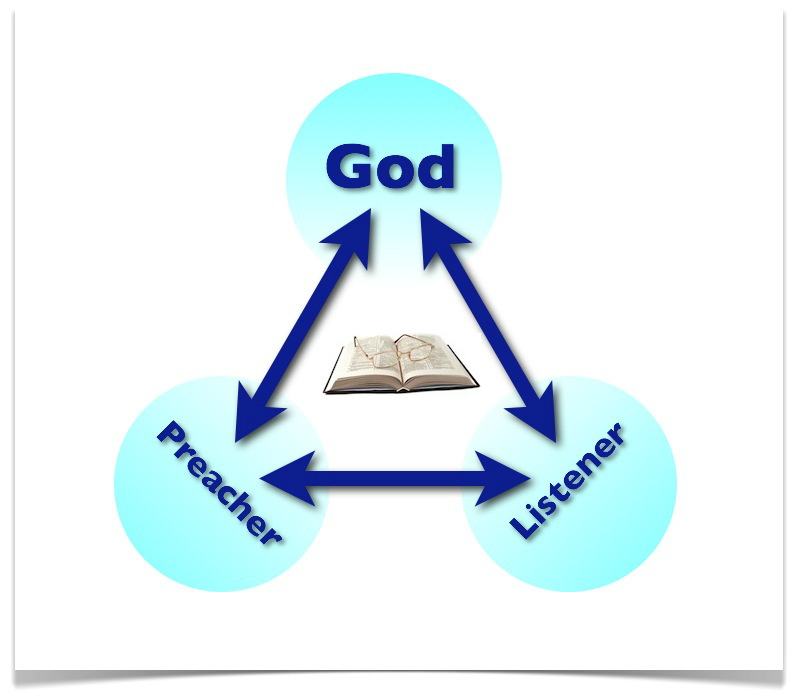
The Preaching Triangle – Omissions 3 and 4

Yesterday I pondered the possibility of effectively losing God and / or the preacher from the preaching event.  Today I’ll complete the scene by pondering the potential omission of the listener, as well as the critical fourth element of the Preaching Triangle.

3. Listener.  God speaks through His Word and through the preacher, empowered by the Spirit, making much of Christ, but the heart of the listener is always free to respond or reject Him.  It is naïve to assume that the listener is always ready and motivated to hear the message of God’s Word – hence the need for demonstration of relevance in order to salt the thirst of the listener for God’s Word.  Well-handled Scripture effectively communicated in dependence on God will transform lives and churches, but the condition of the soil into which the seed falls is always a key factor (i.e. some won’t respond no matter what!)

And when we fail to emphasize relevance to the listener?  Then we have an historical lecture, a pulpit performance to impress God (it doesn’t), or a demonstration of the preacher’s theological acumen, but we do not have transformational Christian biblical ministry.

But there is also the fourth element, the Bible:

Bible.  The Bible is the self-revelation of a wonderful communicator.  God inspired every word, every choice of genre, etc., and so we should seek to honour His work by doing our best to understand His Word and re-present it to others.  The Bible should not be an end in itself, but the means by which we can know the heart of God: His personality, His loveliness, His values, His concerns, His delight.

And when we omit the Bible?  Then we have personal opinion, or implied direct revelation (highly questionable), but we do not have authoritative Christian biblical ministry.

Why might the preacher fail to pay attention to the listener in the preaching event?  Perhaps too much self-focus, perhaps a lack of understanding that communication needs to be aimed to fully arrive, or perhaps a lack of concern for others.  And why might the Bible get lost in the mix?  Again, numerous possible reasons: a faulty view of direct revelation, an elevated view of one’s own wisdom or spirituality, an inadequate view of the Bible, or even a lack of care for the listener’s real needs.

Tomorrow I’d like to start considering the relationships implied by this Preaching Triangle.

Add to FacebookAdd to DiggAdd to Del.icio.usAdd to StumbleuponAdd to RedditAdd to BlinklistAdd to TwitterAdd to TechnoratiAdd to Yahoo BuzzAdd to NewsvineLike This!

The Preaching Triangle – Omissions 1 and 2

Yesterday I suggested that every participant matters in the preaching triangle.  What happens when we leave one out?

1. God.  The goal of all biblical ministry in the church is to know the God who reveals His heart in His Word.  The Spirit who inspired the biblical authors also empowers the biblical communicator to point to the Son, that through Him, the Father might be known.  God is at work in both the preacher and the listeners, and both need to be responsive to Him.

And when we somehow leave God out?  Then we have an informed presentation, or a human-level exhortation, or a religious performance for a distant deity, but we do not have Christian biblical ministry.

2. Preacher.  God has chosen to use inadequate communicators to enable others to hear His Word and respond.  We also form a connection with the listeners (either good or bad) and communicate with our lives as well as with our words.  Effective communication involves the heart to heart connection of the preacher with the listener, as well as both with God.  This means that as well as the verbal content (the words), the preacher must also effectively communicate by means of the vocal and visual elements (use of voice, plus posture, gesture, expression and movement).

And when we downplay the role of the preacher?  Then we lose the incarnational nature of God’s self-revelation, we lose the privilege of hearing God’s Word spoken with power.  We might be able to affirm a strange view of “reliance on God” (based on a hope that He might work around us and despite us), but we do not have incarnational or effective Christian biblical ministry.

Why would someone leave out either of these participants in their approach to preaching?  I suppose a view that God is distant and disconnected, or excessive confidence in one’s own intellectual ability might lead to the first omission.  A highly “spiritual” view of God’s work despite the preacher, combined with a potentially confused view of humility might lead to the second omission.

Tomorrow I’ll consider the implications of leaving out the other two…

Add to FacebookAdd to DiggAdd to Del.icio.usAdd to StumbleuponAdd to RedditAdd to BlinklistAdd to TwitterAdd to TechnoratiAdd to Yahoo BuzzAdd to NewsvineLike This!

The Preaching Triangle – Introduction

Preaching is not about performance, nor ritual.  It is a communication event.  Like most things, how you understand it flows out of how you view God.

If you see God as a distant power broker, a singularity focused exclusively on his own self-absorption, that will influence the way you preach.  I suspect you’ll be torn between making much of Him because you should, and making much of self because that is the logical conclusion of being made in His image.  The Bible will function as a code of instruction to decipher and disseminate that others might know how to satisfy the distant One.

But if you see God as the eternal fellowship of the trinity who is always others-centred, so that His love has reached out to us to bring us into fellowship with Him by His grace, then that will also influence the way you preach.  And it seems to me that preaching will consequently be a much more relationally-charged event.

In the next days I’d like to probe the notion of preaching being essentially about three relationships, between three ‘participants,’ centred around the inspired Word of God.  The participants are all required:

1. God.  Without whom preaching is an exercise in human performance.  I wonder whether we might sometimes tip our hat to the importance of God’s role in our preaching, but then pray and preach as if our dependence is only token?  Truly, apart from me, you can do nothing.  Surely preaching without God’s involvement is an exercise in abject futility?  But what does it mean for God to be involved?  Just that we pray to Him?  If we pray to Him and then preach about Him, is that enough?  What if Christianity is much more participatively relational than we have realized?

2. Listener.  Without whom preaching makes no sense, since it is not about us or our desire to impress God with our rituals and performance.  Again, I wonder if our preaching is genuinely marked by an awareness of those to whom we preach?  More than that, do we really consider the connection between us and those to whom we preach?  It is easy to tip our hat to the importance of knowing the listener, but then preach as if they are a generic gathering of folks.  But the listeners matter precisely because of the kind of God that we have.  He knows, He loves, He cares.  Consequently He expects those preaching His Word to also know, love and care.

3. Preacher.  Without whom the conversation would be about something other than preaching, but really, does the preacher matter?  I say yes.  There is a vital role for the preacher precisely because of the kind of God that we have.  He is a communicator, He cares, He incarnates.  Consequently He values the human speaker, who also should care, who in some way is an enfleshed presentation of the Word.

All three participants matter greatly in the preaching triangle.  Tomorrow I’d like to drill down a bit more on why each one matters, before we then start to probe the relationships in this triangle.

Add to FacebookAdd to DiggAdd to Del.icio.usAdd to StumbleuponAdd to RedditAdd to BlinklistAdd to TwitterAdd to TechnoratiAdd to Yahoo BuzzAdd to NewsvineLike This!

Overqualified! Heart, Head.

Just one more post to finish off the series.  As preachers there are various areas where we can fall into the trap of adding comments or thoughts or meaning or clarification or balance or just plain error to what the Bible says.  When we overqualify, we under-preach.  There’s one more example I want to highlight.

Preaching through a text we come across a reference to the heart.  What is the tendency?  “Ah, the word is really mind, not heart, its about thinking, not feeling, ah, uh, next verse…”

If you do this you are not alone.  But the Bible shouldn’t be interpreted via a democracy.  Many have the tendency to impose a stoic anthropology onto the biblical text that is simply not there, and most do so without knowing they are doing it.  That is, any reference to the heart, affections, desires, wants, responses, etc., are filtered out based on the presupposition that such features of humanity are ignoble and untrustworthy.  (This also means that negatives like lust tend to get left in, since the negative fruit makes sense to a stoic mindset.)

A pre-commitment to the ideal of our being thinking, choosing individuals overrides what the text might be saying.  A slightly more sophisticated fudge comes in the form of, “the word here is not heart, but guts, kidneys, etc.”  Implication?  Since it isn’t “heart” it cannot have meant what we mean when we refer to the heart.  Oops again.  We tend to speak of the heart due to its physiological response to external stimuli – to attractive beauty, to fear, to anger, etc.  Other cultures might speak of the stomach or guts for the same reason.

This is only scratching the surface of a much deeper issue, no pun intended.  But we need to beware lest we talk the text out of speaking of deeply felt inner responsiveness as the driver of human faculties.  We might be strongly committed to a notion such as our decisions being determined by a partnership between our thought processes and our will, in alliance against the dangerous and untrustworthy affections.  We may believe that with good information and disciplined wills, right decisions will be the outcome.  But our commitment and belief, along with that of many others over the past years, may be profoundly wrong.

What if the Bible is right in pushing us to a more profound issue, namely, that the heart is the source, the wellspring, the chief inner faculty?  What if it isn’t out of the overflow of my education and discipline that my mouth speaks?  What if my reflection of the image of God is not determined by my efforts to suppress affection in order to think and choose freely?  What if love determines everything?  And what if love isn’t really an act of a free will?

I’ve run out of words, but if you’d like to hear more on this subject, click here.

Add to FacebookAdd to DiggAdd to Del.icio.usAdd to StumbleuponAdd to RedditAdd to BlinklistAdd to TwitterAdd to TechnoratiAdd to Yahoo BuzzAdd to NewsvineLike This!

Overqualified! Says, Means.

From a more specific, to a more general post.  Preachers have a tendency to overqualify some things.  For instance, going beyond the plain meaning of the text is a common, but often unhelpful strategy.

The text says this, but it actually means that.  There are many variations on this, some speculative and bizarre, others that appear thoroughly orthodox and sound.  Yet we must always think twice before going beyond the plain meaning of a text.

By all means show how the text fits in the larger flow of progressive revelation.  By all means show how God’s plans are worked out in the fullness of the canon.  But beware of making a leap from what it says to what it means so that listeners are left staring at the text in confusion, or at the preacher in awe.

Typically this doesn’t happen out of some sinister motivation to twist the text and promote heresy (some certainly do this, but I suspect they won’t be allowed to read this site).  Typically this error occurs out of good motivation.

Perhaps the preacher fears that the plain meaning is just too, well, plain.  Their job is to add some fizz to the water of God’s Word?

Perhaps the preacher wants to give a more complete biblical message, but fails to show the linkages to the “greater” content offered.  This leaves the listener without clear sense of where the meaning is supposed to be found in a text.

Perhaps the preacher feels the text at hand is just a little too basic, too obvious, too simple to count as a rich feast of biblical truth, and so unpacks the text to reveal rich truths never before discovered in that corner of the canon.  Oops.  Trust God’s intent in the Bible – maybe the people need to hear that passage clearly explained and applied, rather than the whole canon squeezed in for good measure.

I am not suggesting there is no complexity in Scripture, there certainly is.  But as we preach, let’s try to make it so that listeners looking at the text will see where we are coming from.  What benefit is there in leaving them staring at the text in confusion, or at the preacher in awe?

Add to FacebookAdd to DiggAdd to Del.icio.usAdd to StumbleuponAdd to RedditAdd to BlinklistAdd to TwitterAdd to TechnoratiAdd to Yahoo BuzzAdd to NewsvineLike This!

Overqualified! Go, Stay.

Ok, I can’t help throwing this one into the mix.  How often do we drain the impact of a text by immediate overqualification?  For example, in the area of response to the great commission.

God is a missionary God.  What if the Son had responded to the Father as many preachers respond to texts that assume and expect missionary momentum from lives transformed by the gospel?  What if the Son had insisted that He could be a missionary-messiah right there, in heaven?  What if the Son had pulled out Acts 1:8 and spoken of the need to minister in “His Jerusalem” first?  This does seem bizarre.

But I have to say that as a speaker sometimes asked to preach on “missionary” type texts and at “missions” events, it can get frustrating to see others overqualify and undercut the thrust of a message.  Let’s say I preach a text and in the preaching suggest that it would be a natural response for some of us to respond by seeking to take the message of God’s love to other cultures and lands.  What happens?  The service leader or worship leader then stands up and thanks me for my message, then prays about how “we can all be missionaries right here in our own neighbourhood!”

That’s nice, very inclusive, now everyone can feel involved.  Or, to put it another way, now the potential impact of the message is dissipated and any self-focused listeners can remain comfortably, well, comfortable.

I’ve heard preachers do it too.  They preach on the giving and going and sacrificing nature of God.  Then they preach a passage where the followers of Christ are urged to give and go and sacrifice.  Then they immediately qualify so that all can feel included, and none need feel too stirred.

“Go isn’t an imperative in Matthew 28, it is just ‘as you are going’ – that is, wherever you find yourself.”  (Uh, maybe…or perhaps more accurately, go isn’t in itself an imperative verb, but as an attendant circumstance participle it does carry the force of the verb it goes with – in this case an imperatival force.  Ok, don’t quote the Greek grammar, but be right if you’re going to use Greek to support your explanation.  Jesus is assuming and urging a “go” in this passage!)

“Remember that Acts 1:8 starts with Jerusalem, that’s where we have to start!”  (Uh, ok, but the momentum in that verse is leaning towards the ends of the earth, and if you keep reading you’ll see how God used persecution to get them moving!)

I could go on, but my point applies in lots of areas.  We have a tendency to read one thing, then by unthinking qualification end up preaching something else.  We do it with grace, we do it with Trinity, we do it with missions passages.  Any others you’d add?

Add to FacebookAdd to DiggAdd to Del.icio.usAdd to StumbleuponAdd to RedditAdd to BlinklistAdd to TwitterAdd to TechnoratiAdd to Yahoo BuzzAdd to NewsvineLike This!

Overqualified! Grace, But.

Here’s a quote to start the week.  It’s a quote I found very encouraging last night.  Yesterday morning I preached the first message in a series on Galatians.  Paul pulled no punches and I reflected that somewhat in my message.  So this morning I’ve woken up pondering this quote from Andy Stanley:

“The church, or I should say, church people, must quit adding the word “but” to the end of our sentences about grace. Grace plus is no longer grace. Grace minus is no longer grace. We are afraid people will abuse grace if presented in its purest form. We need not fear that, we should assume that. Religious people crucified grace personified. Of course grace will be abused. But grace is a powerful dynamic. Grace wins out in the end. It is not our responsibility to qualify it. It is our responsibility to proclaim it and model it.”

I wonder what proportion of gospel preachers really preach the radical message of God’s grace, and how many feel the need to qualify it and augment it and protect it?  How do we over-qualify grace?

1. We preach grace, but insist on human commitment and responsibility in our gospel preaching.  It’s so easy to preach of God’s wonderful, amazing, life-transforming, gaze-transfixing, heart-captivating grace.  And then in the same breath speak of our need to make a personal commitment, to be diligent, to conform to standards, etc.  Either God’s grace is as good as we say it is, or it is lacking and needs human supply.

2. We preach grace, but quickly shift to focusing on our legal obligations as humans.  Grace plus works is not grace.  Grace minus relational freedom and delight is not grace.  Grace with a good dose of law is not more, but less.  People might abuse grace?  Indeed, so let’s put more effort into communicating how good God’s grace is, rather than feeling obliged to supply qualifiers that are somehow meant to stop people gratuitously sinning in light of the message of the gospel.  When a heart is truly gripped by God’s grace, then it is truly free to live a life of love for God and others – will such preaching lead to licentiousness and abuse?   Certainly not as much as preaching law will lead to rebellion and the fruit of the flesh.

All that I say here applies to both evangelistic and to edificatory preaching.  If the text speaks of our response in some way, or offers guidance on the difference this gospel will make, then of course we must preach the text.  But let’s not automatically feel the need to over qualify and potentially lose the impact of the message if the inspired author didn’t add qualification.

Preaching grace is dangerous.  It is dangerous because unlike overqualified human-centred preaching, it might actually stir a heart to be captivated by the abundant grace of God and lead to radical transformation!

Add to FacebookAdd to DiggAdd to Del.icio.usAdd to StumbleuponAdd to RedditAdd to BlinklistAdd to TwitterAdd to TechnoratiAdd to Yahoo BuzzAdd to NewsvineLike This!

Lessons from Bible Storying

In Cor Deo we have been enjoying the benefits of an approach to engaging biblical story known as “storying.”  Coming from the study of oral cultures and the field of orality, storying is a mine of ministerial potential currently somewhat restricted to missiologists in non-literate cultures.

Forgive my brevity in description, but storying involves bringing a group of people into the experience of a story through the process of telling the story and having them re-tell it so as to enter in to it.  In our setting we have found the Cor Deo participants discovering the interpretational value of extended exposure through the re-telling process.  We hear it, re-tell it, critique and correct together, then repeat the process.

What does this have to do with preaching?  Well, for one thing, it re-affirms the challenge we have when we seek to communicate a story to listeners and we only tell it once.  A cursory overview of a story is simply not enough.  People may get the bare bones, but storying tells us that a group needs greater exposure to a story before they are engaging it fully.  As preachers we may not be able to go through the group interaction of re-telling story, but we must tell story well enough, in sufficient detail, with enough time, so that listeners have a hope of the story forming in their hearts.

But maybe there’s more than a subtle reinforcement of my “please tell the story and tell it well” theme.  Perhaps we need to consider how to help listeners inhabit the experience of a specific character?  Perhaps one idea might be to re-tell a story within a sermon, inviting listeners to imagine the events from a different perspective.  Perhaps there is potential in this idea of re-telling stories within a sermon.  Perhaps there is scope for listeners being less passive in the re-telling process, even within a sermon.

You might enjoy chasing the various approaches to storying and orality-based ministries – not only as a prompt to prayer for the pioneer mission fields, not even just as a source of potential ministry ideas for outreach to certain subcultures on the fringe of your church, but also as a potential nuancing of approach and nudging toward creative effectiveness in your own preaching of narratives in the church.

Add to FacebookAdd to DiggAdd to Del.icio.usAdd to StumbleuponAdd to RedditAdd to BlinklistAdd to TwitterAdd to TechnoratiAdd to Yahoo BuzzAdd to NewsvineLike This!

Top 10 Mistakes Preachers Make Preaching Story – Part 2

Yesterday I offered five common mistakes made in the preaching of Bible story, let’s finish the list:

6. They come up with a list of “principles.”  A story isn’t given in Scripture to make masses of points (some preachers see launch points for pet thoughts throughout a story).  To nuance this error further, stories aren’t given in Scripture in order to offer seven principles for a successful business venture, successful pet ownership or successful anything else.  This is not some ancient text currently in vogue because of its timeless wisdom for living life.  It is a story about people living under the question mark of God’s Word to a fallen world – will they trust Him, or not?  Will we?

7. They make it into a human level story – be good, be better, be like.  Don’t be blind!  The Bible is not just about humanity.  There’s a constant theocentric, christotelic, eternal and heavenly dimension.  Whether God is overtly stated or not, the Bible story you are reading is written with at least an implicit assumption that these characters are living their lives, making their choices, facing their struggles in the context of response to God.  Preach the story theocentrically, not anthropocentrically (i.e. it is God that is the main character, not just a human). 

8. They treat it as a context-less moral lesson.  Okay, I’m repeating the moral lesson bit to make a point, but actually the error here is to miss the context of the story.  Not only does it have a historical context, which the preacher must plumb to make sense of it and preach it well, but it also has a written context.  Why did the author choose to put it here in this sequence?   It is both historically accurate and artistically presented to convey a theological point.  You typically need to observe context to spot this.

9. They don’t apply the main idea of the story.  Either they apply every sub-idea along the way, or they don’t apply at all.  Stories mark and change lives.  Help listeners to see what that might look like as the story preached is translated into their life lived.  Never assume people will take general truths and apply them specifically.  Never assume that application is automatic.  Never believe that positive statements of gratitude from listeners equate to application.  Instead, be overt and be specific.

10. They avoid preaching it altogether and stick in discourse sections.  This is a mistake.  Maybe they think stories are for children, or they think stories aren’t theologically rich enough, or they think that churches only need to be fed the food of epistolary discourse, or they think that they aren’t any good at preaching story, or for whatever reason, they avoid preaching story.  This means somewhere between 50-70% of the Bible will remain unpreached in their ministry.  I think it was Tozer who said that nothing less than a whole Bible can make a whole Christian.

There are lots of other things that could probably be listed, some of which are specific to certain sections of narrative.  But let me make the unstated assumption stated – stories are good for preaching, good for listeners and good for the church.  Go for it, preach stories and preach them well!

Add to FacebookAdd to DiggAdd to Del.icio.usAdd to StumbleuponAdd to RedditAdd to BlinklistAdd to TwitterAdd to TechnoratiAdd to Yahoo BuzzAdd to NewsvineLike This!

Top 10 Mistakes Preachers Make Preaching Story

As we come toward the end of this series of posts on preaching Biblical narratives, let’s have a list post (they’re always popular!)  How about the top 10 mistakes preachers make when preaching stories?

1. They don’t tell the story!  They refer to it, they draw lessons from it, they theologize all over it, but they omit to actually tell the story.  Big oops!  The story is not there to be exhibit A in your demonstration of your theological acumen.  The story is there to change lives, so tell it!

2. They don’t tell it well.  I don’t like adding to the sin lists already in existence, but making God’s Word boring or telling a story poorly must surely qualify as a transgression or iniquity on some level.  God has given us everything necessary for a compelling message – tension, characters, movement, progression, illustrative materials, interest, etc.  To tell it poorly is to miss an open goal with the ball placed carefully at our feet and thirty minutes to take a shot!

3. They think their thoughts are better than God’s inspired text.  I’ve blogged before about the nightmare I suffered when a preacher read the story of Jesus turning water into wine, then said, “you know the story, so I won’t tell it again…” then proceeded to offer us his fanciful imposition of a theological superstructure all over the text.  The text is inspired, it is great, God is a great communicator (so please don’t think God is desperate for you to add a good dose of your ideas to His – please preach the Word!)

4. They spiritualise details into new-fangled meanings.  Suddenly listeners start thinking to themselves, “I never would have seen that!”  or “I never would have made that connection – the donkey represents midweek ministries, brilliant!”  Actually, they never would have seen it without you, not because you are God’s gift to the church, but because your fanciful insertion simply isn’t there.  Preach the text in such a way as to honour it, not abuse it.  And can I be provocative?  Sometimes people force Christ into passages in ways that seem to undermine the whole richness of the text in its context – just because it is Christ doesn’t make it right.

5. They don’t let every detail feed into the powerful point of the main idea.  Every detail counts, but it counts as part of the writer’s strategy to communicate the main point of the story.  A story doesn’t make lots of points, it makes one point.  Develop a sensitivity to the role of details in the communication of the single plot point.

Tomorrow I’ll finish the list with another five…

Add to FacebookAdd to DiggAdd to Del.icio.usAdd to StumbleuponAdd to RedditAdd to BlinklistAdd to TwitterAdd to TechnoratiAdd to Yahoo BuzzAdd to NewsvineLike This!