At Work in His Word

As we enter February, there will be many new year Bible reading plans that are fading away.  Perhaps the challenge of a full work schedule, combined with dark mornings, drains the motivation to be in God’s Word.  Or maybe the second half of Exodus and Leviticus is proving too great a challenge.  Whatever the reason, many will settle into a rhythm marked more by guilt than regular enjoyment of the Bible.

It is hard to relate to a God we cannot see, hear, or touch.  And while we know that the Bible is his glorious gift of communication to us, it can often feel distant and disconnected from our everyday lives.  How can we find motivation for a relationship with God that has the Bible at the centre?

The critical issue is right in the question itself.  Do we experience the Bible in the context of a relationship?  Or have we let the relational aspect drain away, leaving the Bible as an optional tool or merely an interesting document for our fascination with religious history?

In 2 Timothy 3:14-17, Paul gives us a critical passage on the nature of Scripture.  In these verses, Paul points to the role of Scripture in our salvation and our growth to maturity.  In these verses, Paul clarifies what Scripture is and how it works in us.  Let’s look again at these verses and remind ourselves that God lovingly works in us as we are in his Word.  To put it differently, the Bible is not just a “past tense” book for our studies.  It is a “present tense” gift for our relationship with God.  God lovingly works (present tense) in us as we are in his Word and as his Word gets into us.

Entering into a relationship with God, 2 Tim. 3:14-15.  As Paul wrote to Timothy to encourage him in the challenges he would face, he wanted him to remember where his ministry all started.  It started by coming to know salvation in the first place.  Timothy had learned and came to believe in the sacred writings of Scripture from his grandmother, his mother, and Paul himself.  His Bible exposure taught him about the wonder of salvation through faith in Christ Jesus.  Without the Bible, we would only be guessing about God, and our guesswork would never have led us into a relationship with him.  God has taken the initiative in our salvation, revealing his character, plans, and great gift.  There is no relationship with God if there were no Bible.  But since there is, let us not lose the relational nature of our connection to him!

So, what is Scripture? 2 Tim. 3:16a.  “All Scripture is God-breathed.”  What a way to describe it!  It comes from the very core of God’s being.  He made sure that the authors wrote exactly what God wanted to be written.  All Scripture, every last Word, was as he intended.  On a human level, the Bible is astonishing – so many authors, different languages, different types of literature, and yet an incredibly coherent and consistent collection of documents.  But the Bible is not written just on a human level – it is “God-breathed!”  That means it is unique – no other book is in the same category.  It also means it is a loving gift – God wanted it written for his people.  It is a purposeful gift – God intended it to achieve something in us.

Based on what we know of God, what might we assume his Scriptures would do?  Would God give us a mindless distraction to pass some time?  I don’t think so.  That does not fit what we know of his character. Indeed, he would want to work in our hearts since that is the core of who we are and the heart of all our problems.  Surely, he would want to instruct our minds since God made us incredible thinking beings.  And he would want to guide us in how to live since God had a good plan and we have so profoundly rebelled against him.  Is it a living communication designed to work in our hearts, heads, and hands?  That seems about right.

How does God work in us through Scripture? 2 Tim. 3:16b. Regarding our beliefs, the Bible is profitable for teaching and rebuking.  We need instruction to understand God, the world, and ourselves.  And since we don’t always think well, we must be rebuked, lest we persist in error and come to harm.  How many newcomers to Christianity put information together and end up with errant thinking, only to be corrected as they read the Bible?  For example, many think they have solved the complexity of the Trinity by assuming there must be one God who dresses up in three different outfits to suit the occasion.  Sometimes, he is a father, but other times, he shows up as a man, and sometimes, what we need is a more empowering Holy Spirit.  But then they might read about the baptism of Jesus, and suddenly, they are confronted by all three persons involved distinctly and simultaneously.  Oh dear.  Rebuked by Scripture.  Taught the truth.  This correcting rebuke might happen with logical ideas about salvation, eternal judgment, or whatever.  If we want “to overcome error and grow in truth … we must turn to the Scriptures!” (John Stott)

Regarding our actions, the Bible is profitable for correcting and training in righteousness.  We need to be set straight at times.  Perhaps we have drifted into an area of compromise and the Scriptures confront us as a mirror.  Or perhaps we have drifted from God and run up against Jesus’ letter to the church at Ephesus.  Maybe you have already been corrected by that passage?  So much about that church is so impressive, but “this I have against you: that you have left your first love!”  It can stop you dead in your tracks.  And then, it instructs you to repent and do the things you did at first.  A way back to the healthy reality of a real relationship with God.  The Scriptures train us in righteousness – growing us up in all areas of character, endurance, maturity, etc.  Do we hope “to overcome evil and grow in holiness?  Then it is to Scripture we must turn, for it is profitable for these things.” (John Stott).

What is God’s goal as he works in us through the Scriptures? 2 Tim. 3:17.  The goal is clear: you will be complete or mature, thoroughly equipped for every good work.  We know that God has good works for us in every stage of life.  But how can we be ready for them?  The answer is easy.  Get your nose in the Bible and get the Bible into you, relationally, so that God’s work will be done in your life.

Two Errors to Avoid.  Some Christians will come from a background that might be labelled “text-optional” – it is a divine-hotline approach to living, with an eager expectation that God will speak through my thoughts, feelings, and circumstances.  The Bible may be sitting there, but so is the red flashing phone that offers direct encouragement along the way.  If this is your background, then be sure to recognize that along with all the perceived blessings comes a tendency to leave the Bible sitting there.  But the Bible Ais not optional.  For a healthy relationship with God, we need to be soaking and swimming in his Word, enjoying the wonder of God at work in us passage by passage, day by day.

Other Christians will come from a background that might be labelled “text-only” – it is the intellectual curiosity approach to living with a Bible.  There may be an eagerness to study the Bible and a hunger to learn more and more, but often, there is too little expectation that God will speak to me as I read and study.  The Bible is open, and the study is focused, but somehow God is not expected to be at work.  If this is your background, then be sure to recognize that along with the blessing of study, there is also a tendency to stop studying before fully responding to God’s Word.  We should look at the text and learn what it says and means and consider how it is stirring us to love God and live for God in this world.  Engaging relationally is not optional. Again, for a healthy relationship with God, we need to be soaking and swimming in his Word, enjoying the wonder of God at work in us passage by passage, day by day.

Let’s move beyond “what is God saying to me through my thoughts and feelings” and “what is this text saying” to the relational reality of “what is God saying to me as I read or study this text?” 

God is at work in us as we are in his Word.  What a privilege.  A present tense, today, privilege.

______________________________________

The Least Resolution for 2024

January does not just bring a new page on the calendar but a whole new calendar.  And with the new year, we tend to generate renewed commitments.  Maybe you have already determined what 2024 will mean for you.  Perhaps your mind has already pondered daily step counts, gym visits, dietary changes, or other healthy habits.  Or maybe you are thinking about Bible reading, daily prayer routines, or other spiritual goals.  May your resolutions last and bear good fruit!  But perhaps the resolution we need for 2024 is more foundational than healthy habits and more straightforward than spiritual practices.

As I write this, I am in Budapest, where I have just visited a museum of the political terror of the twentieth century.  As you can imagine, it is a sobering experience to see the vast walls of victims, the displays focused on the political prisoners, a room commemorating the persecution of the religious leaders, the torture chambers, the prison cells, and the gallows.  But perhaps the lingering memory for me will be the final room.  With red walls and hundreds of pictures, it felt like yet another presentation of victims.  But it was not.  It was a room of “victimizers” – ordinary people who were merely doing their job, simply following orders, just playing along, and thereby facilitating the evil machine.  We can remember the victims, and we must.  Yet we must also face the uncomfortable reality that most cogs in the cruel machine of death were ordinary people.

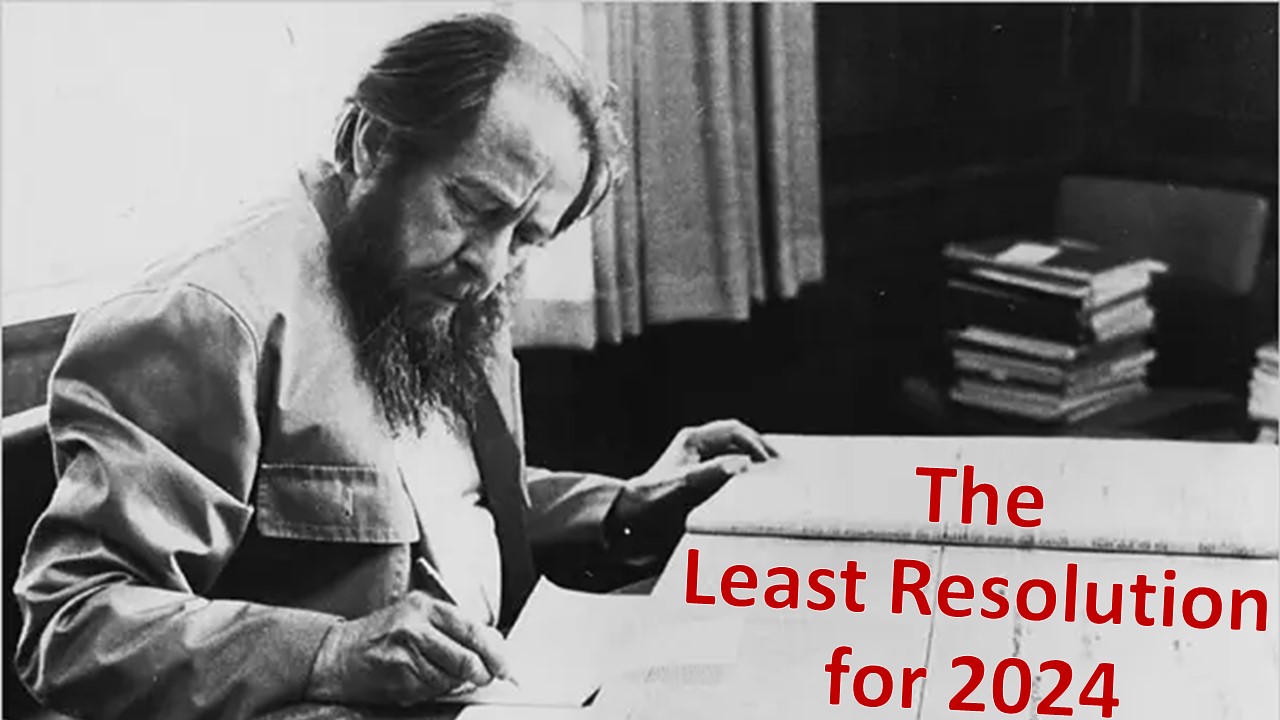
Fifty years ago, in February 1974, Alexander Solzhenitsyn was arrested in the Soviet Union and exiled to the West.  There, he was welcomed as a hero.  On the day of his arrest, he released a document entitled “Live Not by Lies.”  He knew the power of an ideology that sought to reshape society.  He also knew the power of individuals who simply refuse to lie (and the even greater power of a crowd joining together in this conviction).  He knew that the ideological system would totter and collapse when it ran up against the brick wall of reality, exemplified by many individuals refusing to play along with the evil fantasy.
Fifty years later, perhaps it is time for us to revisit this document.  Are we living in times where some, on behalf of all, have determined what society should look like?  Do we see a mounting pressure to conform with what ‘they say’ is acceptable human thought and belief? Indeed, we should not be so naïve as to assume that the absence of marching military on our streets means we face no ideological threat. 

The pressure is growing for everyone quietly to conform.  More than that, the pressure is growing to affirm openly and celebrate what we know to be false.  Surely, it would be better to speak the truth now instead of growing our tendency to fit in and play it safe as the stakes mount.

Truth and Lies – Choosing not to lie was not an original idea for Solzhenitsyn.  Paul urged the Colossians not to lie to one another.  Not only had they put off their old self, but they had put on the new self to reflect their creator’s image (Colossians 3:9-10).  He told the Ephesian believers to speak the truth to one another since they were no longer defined by the lie (Ephesians 4:25).

In the Sermon on the Mount, Jesus addresses the anger underneath murder, the lust underneath adultery, and the daily consistency of speech beneath more flamboyant oaths (Matthew 5:21-37).  There is plenty of Old Testament support for the expectation that God’s people should be consistent speakers of truth (Exodus 20:16; Leviticus 19:11; Proverbs 14:5).  God does not lie, and his people represent him.

Fear and Lies – Solzhenitsyn knew the impact of fear on a population.  He wrote of the great threat facing humanity in his day, which was “about to flare up and engulf us.”  And he described the fear: “While we continue to smile sheepishly and babble; ‘But what can we do to stop it? We haven’t the strength.’”

God asked Isaiah’s listeners, “Whom did you dread and fear, so that you lied, and did not remember me, did not lay it to heart?” (Isaiah 57:11).  Their fear led to lies, as they forgot who was really in charge.

Our world seems to be changing at a frightening rate.  Trying to keep up with the latest adjustments to sense and morality can be tiring.  And it is increasingly revealing how much fear lies within most of us, who are so prone to play along with society’s expectations rather than speak what is true.  It is concerning how easily we fear and perhaps lie while forgetting who is really in charge. 

Some will capitulate completely and speak what is false.  Others hide behind a cloak of not wanting to “sound political” and speak out about the reducing set of acceptable Christian declarations.  Fear of being labelled and criticized leads many to hold back from speaking the simple truth.  After all, it is much easier to quote a Bible verse on social media or avoid the hot topics in conversation rather than offer the most minor form of resistance.

Solzhenitsyn wrote that the fear his people felt was not primarily a fear of nuclear death or a third world war.  The fear was of taking a “civic stance.”  He wrote, “We hope only not to stray from the herd, not to set out on our own, and risk suddenly having to make do without the white bread, the hot water heater, a Moscow residency permit.”  The penalty for a civic stance may have changed, but the fear of the herd has not.

History has never smiled on the timid, and yet each fearful choice always makes sense at the time.  How often do I justify timidity when society needs me to show courage and speak the truth?  We have almost constant opportunities to speak the truth about marriage, gender, sexuality, race, free speech, bodily autonomy, science, medical ethics, corruption, or whatever other prescribed view is being pushed at any given moment.

We cannot simply wait for an ideology to fall apart.  We must be part of the brick wall of reality into which it must crash.  And yet, it is always easier to “continue to acknowledge, glorify, and strengthen” that which we want to see collapse.  At the very least, we must not “recoil from its most vulnerable point.  From lies.”

Violence and Lies – Solzhenitsyn described how violence bursts into peaceful situations with great self-assurance.  “But violence ages swiftly, a few years pass—and it is no longer sure of itself.  To prop itself up, to appear decent, it will without fail call forth its ally—Lies.  For violence has nothing to cover itself with but lies.”

So, even under overt tyranny, people do not have to experience violence at all times.  The demand is only of a “daily participation in deceit” – the tribute paid to maintain one’s position under the power of the oppressive system.  Just play along, it is safer.

The connection between violence and lies is also not a discovery made under the rule of twentieth-century totalitarianism.  Micah wrote to the city in his day, “Your rich men are full of violence, your inhabitants speak lies and their tongue is deceitful in their mouth” (Micah 6:12).

We may not have to stand and fight against violence.  We may not even have to step out publicly and boldly declare the truth. “But let us at least refuse to say what we do not think!”

The Consequences of No Lies – In the Soviet Union, there was a cost to this most simple of stands.  It could cost your job and complicate life.  It could cost your success in education and impoverish your future.  But Solzhenitsyn was clear:

“And as for him who lacks the courage to defend even his own soul: Let him not brag of his progressive views, boast of his status as an academician or a recognized artist, a distinguished citizen or general.  Let him say to himself plainly: I am cattle, I am a coward, I seek only warmth and to eat my fill.”

To choose not to lie was not an easy choice in his day.  It will increasingly not be an easy choice for social standing, or even for physical wellbeing, in our day.  But the choice not to lie is “the only one for the soul.”

The implication of no lies is worthy of note. “The more of us set out together, the thicker our ranks, the easier and shorter will this path be for us all!  If we become thousands—they will not cope, they will be unable to touch us.  If we will grow to tens of thousands—we will not recognize our country!”

As we head into a new year, may we not simply play along with the world.  Instead, let us graciously, prayerfully, and wisely determine that whatever else may happen, we will not participate in the lies expected of us in society.  As representatives of God in this world, this is the least we must do!

(Source of AS quotes: https://www.solzhenitsyncenter.org/live-not-by-lies)

We Do Not Face Sin Alone

The genealogy in Matthew 1:1-17 points to the fulfilment of the promises to Abraham and David. It also gets the reader thinking about the troubled reputation of several women in earlier days. In Matthew 1:18-25, we see another couple troubled by apparent sexual sin.

Joseph’s Gracious Plan (vv18-19)

Couples married young, and this young couple had their lives before them. The young carpenter and his younger bride-to-be. But then the ultimate slap in the face: Joseph discovers that Mary is expecting a child. It is not hard to imagine the shattered dreams, repulsive images, and emotional turmoil that Joseph endured.

Not only did this crisis mean their forthcoming wedding was a sham, but Joseph also now faced the shame of suspicion. The obvious pathway forward was to save face for himself by publically disgracing her and distancing himself. If he could be sufficiently indignant and distance himself, then maybe his honour could be saved. But Joseph did not choose the obvious path.

Public disgrace for Mary might have meant some sort of public execution by stoning, but even without that, public disgrace is too painful to describe in a shame and honour society. Joseph chose an incredibly gracious option: he would divorce her, and he would do so quietly. What would people say about him? The cloud of suspicion would linger, but Joseph looked out for the best interests of the girl whom he thought had sinned. Joseph’s selflessness is worthy of reflection, not least because we know what he didn’t – the identity of the baby inside her!

God’s Greater Plan (vv20-21)

During the agonizing turmoil of Joseph’s deliberation, new information was introduced. Perhaps he tossed and turned on his bed. The thoughts, the images, the options, the consequences. But the troubled young man must have slept, for an angel of the Lord appeared in a dream.

He was told not to fear taking Mary into his home. He was told that the baby was in her from the Holy Spirit. He was told to name the boy Jesus. And he was told why.

Jesus. The Hebrew name Joshua. Yeshua in Aramaic. However we might pronounce it, this was a name of significance. Actually, it was not unusual. There were lots of little Jesuses running around the neighbourhood for it was one of the most common boys’ names in Palestine at that time. But the angel didn’t just give the name choice, he also gave the reason. This boy would live up to His name – He would save people from their sins.

God’s Great Plan Predicted (vv22-23)

Matthew adds some theological commentary for the sake of the reader. Going back to Isaiah 7:14, Matthew quotes the prophet’s anticipation of a virgin giving birth to a special child with a special name. Ahaz may have been a king with all sorts of issues, but God was not out of touch with his struggling people. In fact, an unmarried woman was soon to give birth to a son of significance, and the significance was God’s presence with the people.

What was true in Ahaz’s day proved to be infinitely truer still with Mary. She was a virgin, unmarried, but with child. This time it was not a matter of sequencing prediction and then fulfilment by normal means. This time she truly bore a miracle child, a child whose significance could not be greater. Immanuel – God with us!

So what would Joseph do? Seems obvious: obey the angel. But not so fast. So he had insider information concerning the child inside her. The boy Jesus was to save the people from their sins and He would be God with us, Immanuel. All very well and perhaps worthy of some Christmas carols, but what about Joseph and Mary?

You can imagine his thinking. Two men come into his carpenter’s shop and request a bid on a certain job. Joseph tells them a price. They look impressed but concerned. Joseph adds a comment about how they could trust his word. Little boy Jesus runs in and starts playing with some wood blocks. They look at the child and whisper to each other. Joseph hears a snippet of a comment about an angel in a dream. They laugh and press him further for assurance on whether he can follow through on his bid. Joseph knows what they are thinking. They leave and go looking for another carpenter, one they can trust.

The stigma of the sinful reputation would linger for years. It could cost them on so many levels. How would he provide for them? How would Mary cope with the dagger comments in the market? How long until the child sensed what everyone thought? It wasn’t that nobody sinned in Nazareth, that was all too common. But when a couple perceived to be different turns out to be the same as everyone else, well, they don’t get treated the same as everyone else. And what about family? What would they say? Family, friends, work, and just about every aspect of life would be stained by the reputation of sinful infidelity.

Joseph’s Immediate Obedience (vv24-25)

Matthew leaves us with no doubt what kind of man Joseph was. He had been kind to Mary, even when he thought she had been unfaithful. And now he proved faithful to God when the days ahead looked so uncertain.

He took Mary into his home, thereby offering the protection and security she needed. A quick wedding was the best thing for all involved. Then he had no marital union with her until after she had the boy. And Joseph named the boy Jesus.

Three times Matthew points to the name of the child. Indeed, the significance of the birth story here is wrapped up in that name. Everyone thought they saw just a normal couple getting married in a hurry for the ‘normal’ reason and later giving birth to a son with a common name. But this was not normal in any way.

How could they face the uncertainties, the knowing looks, the suspicious smiles from family members, or worse, the rejection that may come their way? They could face the stigma of sin because this child was Jesus, the One who would save His people from their sin. This child was Immanuel, God with us.

___________________

This post is adapted from chapter 9, Pleased to Dwell: A Biblical Introduction to the Incarnation (Christian Focus, 2014), 83-87.

Join us on a journey to Christmas this December. A new video every day walking through Pleased to Dwell (follow along with the book, or just the videos).

The Heart of Hermeneutics – Part 4

A Relational Responsive Heart Check

The process of Bible study must begin “back then.”  We need to look carefully at the text to see what was actually written.  And we need to learn diligently what the author intended to communicate.  Then we need to appreciate the intended impact of the text “for today.”  That means a careful consideration of the love response that the text should stir in us, as well as the appropriate transformation in how we live our lives.


After studying a passage and seeking to interpret it as well as possible, consider the following facets of a relational responsive heart check:

1. God himself.  Since every biblical text is ultimately a revelation of a personal God, ask yourself what this text has revealed about God?  Is it revealing his nature, his character, his heart, his values?  Is it revealing his Son in some way that you can ponder?  The answer is yes.  Every biblical text is a revelation of a personal God, so there will always be value in considering what that revelation should stir in your heart as you read it.

2. The Biblical characters. The Bible is much more incarnated theological truth than it is written code.  That is to say, there are real people on the page.  Theological teaching is usually wrapped up in real people, living in real situations.  There is more narrative than any other type of text, which means lots of characters living out their response to God’s word.  But every text has a narrative nature to it.  Poetry offers a glimpse into a narratival setting, even if you don’t know the details.  Direct communication like speeches and letters were not written in a vacuum.  There was a situation and we are given the glimpse offered by an epistle penned purposefully for the recipients at one moment in their story.  The Bible is ultimately a revelation of God.  And that revelation is wrapped up in the people on the page.  Be mentored by them.  Learn from them.  Allow your heart to engage with them as you watch how they responded to God.

3. The original recipients.  The original author of each book wrote with relational intent.  He wanted to do more than just transfer information.  Each book was written to stir the hearts of the original recipients.  Why not consider them?  What did Moses want Israel to feel as they read his great foundational collection?  What did Paul want to stir in the believers in Galatia, or in his representative Timothy serving in Ephesus?  The text is ultimately about God, it presents itself with characters on the page, and it was written to real people in real situations.  Ponder the intended impact on their hearts as you consider the impact on yours

4. Me.  The original author of each book could not have known about me, but the divine Author has preserved the Scriptures, superintended the collection of the Scriptures, sovereignly overseen the translation of the Scriptures, and graciously provided the opportunity for me to own the Scriptures.  He has given me if I am his child, a new heart that relishes the goodness of God in Christ.  And so, I should look at the Scriptures to see my God, as well as be mentored by the people on the page, considering the impact for the original recipients, and overtly considering how the text should stir my heart as I read it.

5. Others.  As I study the biblical text and consider how it should be stirring my heart, the result will not just be a Godward response.  Yes, there should be wonder, awe, worship, praise, gratitude, devotion, and so on.  But also, a God-stirred heart will be a heart that reflects God’s other-centred heart.  How can what I am seeing in the text, which is stirring my heart in response to God’s revelation, be carried to others evangelistically or pastorally?  At this stage, there might well be a stirring of prayer for others, even if the action of sharing remains in the future from the time I am studying the text.  A truly relational response to the Bible will not just be Godward, but it will also spill over to others because we are relational beings.

Perhaps this five-point checklist can be helpful as we seek to more overtly recognize the role of the heart in the Bible study process.  Look, learn, love, live.

The Heart of Hermeneutics – Part 3

How Does Hermeneutics Require Love?

Last time we looked at John 5 and Jesus’ critique of the Jewish leadership.  They were eminent Bible scholars, but something was missing.  They could well have been an example to us in terms of observing the text, technically interpreting the text, and fastidiously applying the text.  They thought that in the Scriptures they would find life.  But they were missing the person revealed there.

For the Jewish leadership, there was apparently confidence in the inductive process.  However, their incurved hearts spelled the corruption of that process.  They did not see the person, and the reason was a heart issue.  Why is the heart so often left out of hermeneutics?

A More Complete Process

A complete approach to biblical study needs more than “look, learn, live.”  We need to put the heart back into our hermeneutics.  What does the text say?  What does the text mean?  What should the text stir?  What difference should the text make? 

Look —- Learn —- Love —- Live

When we lose the sense that the biblical text is primarily revealing a person, and that the intent of the author is to stir the reader’s heart in response, then our approach will necessarily fall short.  Even if we progress from “back then” and arrive at “for today,” we can end up with something stripped of its relational dynamic.

Principles and Morals

In a process that is blind to the significance of the heart, some will end up with just an abiding theological principle.  This statement of truth and instruction is what remains after traversing the millennia from back then to our own time.  Others will end up with a “moral of the story.” 

That’s what people do with old stories.  Since the people are all dead in history, or figments of fiction that will soon fade from memory, at least there is a lasting lesson for us all.  So, our children might enter the land of make-believe for an old tale, but what remains when the story ends and it is time to sleep?  Well, the moral of the story is that we should be like the tortoise, or don’t speak to strangers who look like wolves or witches, or whatever.  These may well be good life lessons well worth learning.

And what of the people in the pew?  After entering the world of a Bible story in the sermon, they must then re-enter normal life.  As the story fades and present reality dawns, at least they can carry an abiding theological principle into their week. 

The Bible is Not a Fable

But isn’t the Bible different?  Is not the goal of the Bible something more than divinely sanctioned and historically accurate Aesop’s fables?  It is critical that we keep clear the ultimate purpose of Scripture – to reveal the living God, his heart, his plan, his Son.

In the next post, I will suggest a relational responsive hermeneutical checklist to enliven the critical love stage of the Bible study process.

The Heart of Hermeneutics – Part 2

What Did Jesus Say About Bible Study?

In John 5, Jesus is both in trouble and on trial.  He had healed a man on the Sabbath and then made himself equal with God when confronted by the authorities.  His extended speech in verses 19-47 is actually a legal defense speech in what had quickly become a capital trial.  By the time we get near the end of the chapter, Jesus is actually turning the tables and putting the Jewish authorities on the back foot.

Jesus knew that he needed a second witness.  But as the angry leaders looked at this man from Nazareth, they could not see anyone standing with him.  However, he had the best witness of all: God himself.  The problem was on their side though, because according to Jesus, they had never heard God’s voice, nor seen God’s form, and they did not have God’s word abiding in them. 

Bible Study Experts?

Understandably these Jewish leaders would have balked at that diagnosis of their spiritual state.  They, of all people, spent the most time with their nose in the scrolls.  They were the Bible men of their day.  They could quote more of the Old Testament from memory than many Christians today have even read.  And yet, Jesus was right.  Something was missing.  And it meant that their hermeneutical approach was rendered useless.

Did they look at the text?  Every day, at length.  Did they learn what the text meant?  They would say so.  Did they follow through and consider its implications for how they lived?  Fastidiously.  These men were the eminent biblical studies professors of their time.  And yet, in Jesus’ estimation, they did not have God’s word abiding in them.  What was missing?

The Missing Piece

In the Scriptures there is a relational dynamic at play.  The text is about a person, but they did not believe in him.  They refused to come to him.  Jesus immediately drew the contrast between him and them.  He did not live for horizontal glory from people but lived with a total orientation toward his father.  However, they did live for the glory that would come from people.  Because the horizontal dimension meant everything to them, the vertical dimension was missing.  And how did Jesus phrase that vertical dimension in their case?  They did not seek the glory that comes from God.  Which meant that they did not have the love of God in them.  (John 5:37-44)

It is not possible to rightly handle God’s word if the love dimension is missing.  In the next post, we will probe that love dimension.

The Best Place to Hide in Evil Times

This world can be a sinister place.  I was recently on a missions team serving abroad, and we heard testimonies from several local believers.  One told of his times in prison – a place ordered more by the structure of the dangerous mafia than by any attempt at protecting human rights from the authorities.  Another told of his religious family – a home where this eleven-year-old boy was beaten up by his older brother every time he dared to go back to church, and that at the instruction of his parents.  Another told of his time in the military, where he discovered just how evil a totalitarian communist ideology can be in reality.

Whether it is by crime, religion, or ideology, the evil of this world is evident all around us.  If we scratch the surface of society, we will find all of this lurking today.  No country is free of crime, and the level of organization often goes way beyond what we can imagine.  Billions live under the threat of their religion, a threat that uses family members to beat any hint of turning, and ideologies that require everyone to think the same replace God with government and treat people as collateral damage in an ideological march towards utopia.  Well, they did not die out in 1990 – the same old ideas keep coming back dressed in new garb.

In Psalm 17, we find three cries to God from David’s mouth (see v1, v6, v13).  His cry was essentially: I am innocent, they are attacking me, but I am confident in God (see v1-5, v6-12, v13-15).  Let’s look at these three sections and see if this Psalm might stir us to cry out similarly.  After all, the same God is still the best refuge from wherever the threat comes!

Introduction (v1-5).  In the first verses of the Psalm, David’s cry is based on asserting his innocence.  We know from many other places that he knew of his guilt.  His cry was not for protection because he deserved it.  No, his vindication came from God’s presence, not from his own perfection.  Nevertheless, there is a place for recognizing that we may be innocent with respect to a specific threat, and it is right to cry out to God in the face of injustice.  Whether that be criminal activity, religious persecution, or ideological threats, we can and should cry out to God for his protection.

God protect me from the evil people (v6-12).  The description of the malicious threat is very vivid.  David doesn’t just say they are violent and threatening (v9); he goes on to give four descriptions.  Three descriptions use human body references; the fourth is from the animal kingdom.  Their heart lacks compassion, their mouth speaks with pride (v10), and their eyes are set on sinister plans (v11).  These verses could describe the mafia bosses running a prison, the religious family members intent on guarding family reputation, or a totalitarian regime marching towards its ideological utopia.  Whatever way evil dresses up, underneath lurks the same sinister roar – the lion.  David described his chief antagonist as a lion eager to tear.  Peter used the same imagery of Satan in 1 Peter 5:8.  There is great evil in this world, so we need a great God in whom to find refuge.

In Psalm 17, David described God in the preceding three verses.  He also uses three human body descriptions, followed by one from the animal kingdom.  Notice the description: your ear, right hand, and eye (v6-8).  As we draw near to our great God on the throne, we find him to be a wonderfully good God.  His ear inclines to hear even the weakest of whimpers.  His loving right hand has all the authority needed to protect us from every evil this world offers.  His eye is on us.  The phrase “apple of your eye” is an English figure of speech, but the original language refers to “the little person of your eye” – that tiny reflection in the pupil that reveals the whole focus of the eye.  What a gloriously intimate description – an inclined ear, the loving and full authority of the right hand, the attentive and affectionate eye.  Then the animal image?  We are hidden in the shadow of his wings!

Conclusion (v13-15).  David finishes the Psalm with one last call for God to act.  He desires deliverance.  Those who are against him are living for this world.  They want to gain power and wealth, to have something to pass on to the next generation.

In contrast, what matters to David?  His ultimate goal is not just victory but God’s visage (face).  It is not just about getting a response but about enjoying a relationship with God.  It is not about protecting his inheritance but about having intimacy with God.

God’s goodness can be celebrated in each of the three situations mentioned at the start of this article.  The prisoner may have lost the protection of the mafia leader he was close to. Still, he met a church pastor who came into the prison and told him about Jesus.  Today, he follows Jesus and visits two prisons he once occupied to tell others about Jesus too. 

The eleven-year-old boy never saw most of his family follow Jesus as he does.  Still, he pastors a church that reaches out to the marginalized of society.  He also enjoys telling others that the brother who beat him up for attending church is a believer and a missionary in a foreign land. 

The soldier serving in a communist military realized after three years just how evil the totalitarian regime was in reality.  But God allowed him to be tasked with listening to foreign radio stations to discover any plans to invade his country.  Instead, he heard the good news of Jesus broadcast in his language.  Today, he pastors a church and delights in telling others about the goodness of God!

Whatever evil is evident in your context or working away behind the scenes, seek refuge next to our good God’s throne.  When we see how good he is, we will want nothing else!

Everyone Hides, But Where?

For several generations, some of us have lived with relative stability.  Yes, our cultures have shifted and changed.  And yes, we have seen our military forces participate in conflict.  But seismic shifts that rock our world have not been so familiar to many of us.  The past few years have changed that.  If the world can change so suddenly, then maybe we would do well to be ready for significant events.  Actually, if we are involved in church leadership, we should be both preparing our people for the future and preparing ourselves for major moments that will surely come.

Recently, my wife and I enjoyed another anniversary and took some time together in Psalm 46.  This is a great passage to soak in for your own benefit.  And it is a great passage to be ready to share with others both before and when the need arises.  It is a Psalm of healthy hiding.

When the constant stream of news is suddenly shattered by something genuinely significant, where can we go?  When the normal rhythm of daily tasks grinds to a halt because something huge is happening, how can we find safety?  And when we look beyond the normal news narrative and see such significant and terrible agendas at play, who can be trusted?  Psalm 46 points us to the answer.

Psalm 46 falls neatly into three stanzas, neatly demarcated by a Selah to give us the opportunity to contemplate.  The first stanza establishes a key thought that is then picked up in a refrain at the end of stanzas two and three.  It is a clear Psalm, easy to read, and probably well worth committing to memory!

Stanza 1 serves to establish a truth that will weave through the whole Psalm.  Our refuge and strength is God himself, and our God is always accessible to us.  The result is that we will not fear.  Four situations are described to underline how secure we are in our God.  Even an earthquake, even mountains being relocated, even raging seas, even the normal secure boundaries of creation trembling – even if the whole created order should revert to utter chaos, we will not fear.  The character of God is more trustworthy than the apparently permanent mountains and boundaries of the seas?  Yes.  Selah.

Despite appearances in the first three verses, I do not think the writer is really focused on natural disasters.  He seems to be using them as descriptions of having your world rocked.  Even a hypothetical upheaval that impacts everything considered permanent and stable would not undermine the reality of God being our ever-present refuge and strength.

In the second stanza, from verses 4-7, the writer zeroes in on the threat of war.  He begins with two verses describing the tranquil city of God, the place where he reigns and is present.  And then, just as our hearts calm to ponder the hope of one day experiencing life in that city, verse 6 breaks in with a reminder that in this world everything is going crazy!  The nations are raging and tottering, like mountains falling into the seas.  When geopolitical change crashes down around us, and we might add, when the ethical foundations of society are completely turned upside-down beneath us, then we find ourselves experiencing a seismic shift from the stability we have always known. 

But the truth of the first stanza is the anchor for us.  Our God is the LORD of hosts, he is with us, and the God of Jacob is our refuge.  Selah.

Let’s pause and ponder that refrain for a moment.  The LORD is the God who makes promises and keeps them; he is faithfully committed to following through on his plans and purposes, and he will continue to care for us.  He is also so very strong.  He is the LORD of hosts – the God of angel armies.  One angel killed 185,000 Assyrian warriors in one night – presumably powerful, intimidating, physically impressive, well-armed Assyrian warriors.  Imagine two angels.  How about ten?  What if there were 100?  Now try to picture a number so big that it could not be counted – that is the army of heavenly hosts.  Our God leads that army, and that God is with us.  And since that God is our refuge, we run to hide in him.

In light of that truth, the final stanza, from verses 8-11, invites us to come and consider what God has done.  Implicitly, then, we are also to consider what he will do in the future.  God ends wars, he topples powerful foes, and he will take away every weapon.  The armies of the world – whether they fight in military uniform, or with any other costume of control –will one day be commanded to stop!  To stand still.  To be quiet.  Hush.  Know that God is God.  Know that he will be exalted above all.

This world can generate raging nations, swelling armies, plotting despots, powerful dictators, destructive terrorists, and no end of new versions of evil.  But it can never generate anything or anyone that is more powerful than our God.  He is the God of angel armies, and he is with us.  He is our fortress, and we must run to hide in him.  The refrain repeats in verse 11.  This truth needs to repeat in our hearts and drive us to him whenever this world generates the slightest hint of fear in us.

When threats rise up, everyone hides.  One option is to run to God.  We know that he is bigger than anything in creation.  We know that he wins in the end.  And yet, we often struggle to believe that he is with us, or that he will do anything when we cry out to him.  What if I have to face more than discomfort for my faith and God does not immediately show up?  What if standing for what I know is true costs me pain and suffering – is he still a fortress even then?  Psalm 46 is an anchor to the truth that God can and must be trusted in the darkest of times.

The other option that many seem to choose is to hide their heads in the sand.  Just live life pretending there is no threat.  How often does the media reinforce the distraction of this perspective?  Stories get spun so that we think the threat is coming from the opposite direction.  When we have more information than ever before, are we actually growing more numb, and maybe more dumb, the more we watch our screens?  There could be a genocide taking place all around us, and yet we are trained to have our gaze redirected to Hollywood’s latest newsflash.  Our propensity to hide our heads in the sand is supercharged by the media we lean on so heavily.

When the news stirs fear in you, do not choose distraction and pretend all is well.  Instead, hide in a healthy way – running into the fortress that is our God.  That is, our God, the God of angel armies, the God who has chosen to be with us.

__________________________________________________________

Have you seen the ABCs of application?

Love, In the Church

The most famous literary description of love is surely 1 Corinthians 13.  It has been read aloud at countless weddings, and yet, it was not written for a wedding.  It was written for a church.  Actually, it was written for a struggling and divided church in Corinth.  This was a church that was splintered by factions, by immature Christians flaunting their supposed superiority, and by a whole host of interpersonal tensions and issues.  This was the church into which Paul unleashed “the love chapter!”

The chapter sits at the heart of a section addressing the right use of spiritual gifts in the church.  It begins by underlining the necessity of love (v 1-3) and ends with the never-ending reality of love (v 8-13).  And at the heart of the chapter, in verses 4-7, we find a familiar and poetic depiction of the nature of love.  In just four verses, Paul offers fifteen descriptions of love.

Their world, like ours, was a confusing melee of ideas when it came to love.  There was romance, passion (appropriately marital and many harmful alternatives), family, and friendship.  I don’t know whether they used “love” to speak of food and sport, quite like we do in English, but let’s not imagine their culture was any less confused than ours.  In the face of that confusion, Paul offered a confrontation with God’s kind of love.

What do we do with a list like this?  Our tendency is to see it as a behavioural checklist and to consider it as a suggestion for greater effort on our part.  The problem is, not only do we all fall short of God’s perfect love, but we are unable to self-generate genuine godly love.  We can only love, John tells us, because God first loved us (1 John 4:19).  So, while it may look like a list of descriptions, actually, Paul wrote it as a list of verbs.  This is love dressed up and going to work! 

So, as we consider this love in action, we should let it confront our own areas of lack, but also point us to the only one who perfectly lived out God’s love in this world.  Let this list point you to Jesus, and then let his love flow more freely in your local church setting.  As we look to Christ’s love, it will stir Christlike love in us.  And when the body of Christ starts to look like Christ, we can pray for the church to have an impact like Christ!

1. Paul begins with a basic foundation: Love gives.  He begins his list with two positive statements: love is patient and love is kind (v 4a).  Patience here speaks of having a long-fuse with other people, giving them space and time, instead of flaring up at the first opportunity.  Patience is partnered with kindness, which gives of our own usefulness for the higher good of the other.  A loving church is a place where grace infiltrates every relationship.  Grace for the weaknesses of others, and grace that gives of ourselves to build them up.  Love gives.

2. Paul zeroes in on the Corinthian core issue: Love is not selfish.  His list shifts into a sequence of nine points, most of which are negative.  The central thought in this list of nine points is like a summary of the whole section: love is not self-seeking (v 5b).  Ever since the Garden of Eden, we humans have been largely unaware of how self-oriented our hearts now are, by nature.  Our selfishness is built-in from birth, but it is only because our nature is fallen.  It seems so normal to seek our own good, but God’s design is love that is not self-seeking.  (Look at the Trinity for the greatest example of this: how consistently does the Father lovingly honour the Son, and vice versa?  Our God is a God who lovingly and selflessly lifts up the other, and the good news is that can even include us!)

Before and after that central thought, Paul offers two sets of four descriptions of love.  When there are differences between us, love does not self-elevate (v 4b-5a).  It does not envy what others have, longing for self to be satisfied by that salary, that house, that spouse, etc.  Neither does love boast, trying to make the other person long for my ability, possessions, or strengths.  Love is not arrogant, puffing up self to push others down.  And love does not disregard accepted standards of behaviour to elevate self and so disregard and dishonour others.  Some versions have “love is not rude” at this point.  That might bring to mind inappropriate vocabulary or noises at the dining table.  But Paul’s word goes beyond the odd little social faux pas.  It is the same word used for unnatural sexual relations in Romans 1.  It is that casting off of restraint and acceptable norms, because, well, because I want to . . . so I should.  Actually, love wouldn’t.

And when there are problems between us, love does not self-protect (v 5c-6).  Love is not easily angered, that is, it is not irritable and touchy.  If we take any of Paul’s negatives and pursue the opposite, we will discover a painful loneliness.  Now, there is a place in the Bible for legitimate provocation.  Jesus was provoked by death at Lazarus’ tomb, and Paul was provoked in spirit by the idols of Athens.  Luther was provoked by a false view of God and so launched the Reformation, and Wilberforce was so provoked he sought to end the slave trade.  Maybe today many of us have grown too nice before the provocations of society, but perhaps still too easily angered at little personal slights in church life.  Love is not easily angered in church fellowship.  When people say and do wrong things, love lets the grievances go instead of inscribing them in our internal memory ledger of grudges against others.  And when those people that grate on us turn out to be sinners in some way or other, love does not rejoice in their sin.  Rather, it rejoices in what is true – God’s love for them, their position in God’s family, their gifting, and their key role in our lives. 

3. Paul points them beyond any notion of personal ability because true love relies on God (v 7).  Undoubtedly, Paul is offering a literary flourish to complete the list.  The last four descriptions add the word “always” or “all things.”  It feels good to the ear, but if you consider it carefully, it feels impossible to the heart.  How can I always protect?  The idea is to cover, like the seal on a ship that keeps all water out.  One commentator describes the idea of “throwing a blanket of silence over the failings of others.”  Obviously, there are legal and moral exceptions to this.  But as a general rule, when I am annoyed, provoked, antagonized, and bothered, love will keep that sin hidden from others who do not need to know about it.  Paul points upwards to God – love always trusts and always hopes.  That is not easy.  And back to the struggles here below again, it always perseveres.  That kind of persistent endurance of inter-church tensions can easily take us beyond ourselves. 

Paul’s great list is a bit like the Law of Sinai.  A wonderful revelation of what is right and good, but beyond our ability to keep.  And so, let 1 Corinthians 13 not only confront your struggle to love like Jesus.  Let it also point you to Jesus.  We can only love at all because God has first loved us.  May our hearts be so captivated by his love that our churches increasingly look like the body of Christ!  We can only live this life in the flesh by faith in the Son of God, who loved us and gave himself for us.

Love is patient, love is kind.

~

It does not envy, it does not boast, it is not proud. It does not dishonor others,

it is not self-seeking,

it is not easily angered, it keeps no record of wrongs. Love does not delight in evil but rejoices with the truth.

~

It always protects, always trusts, always hopes, always perseveres.

1 Corinthians 13:4–7 (NIV)

_________________________________________________________

If this playlist of videos about Bible study is helpful, please like, comment, share and subscribe – thanks!