Hear the Text Here

When we read a Bible text, do we really read it?  Do we really read it?  Two important and slightly distinguished questions…

1. Do we really read it? Everyone assumes that we read it if we run our eyes over it and notice what is there.  The reality is that most of the time we don’t really look carefully at the text and notice what is there.  We miss biblical quotations and allusions, we miss details in the text, we miss the flow of the text, we miss the mood of the text, etc.  As Gordon writes in his book, we are not in a culture that trains us to be close readers of quality texts anymore.

2. Do we really read it? That is, we have a tendency to not only not read very well, but to excuse poor reading of this text because of a wider understanding of the whole Bible.  Of course we should read every passage in its context in the Bible.  We must have a Bible wide theology, and a Bible defined theology.  Yet it is so easy to impose a theological position on a text so that the text itself is not heard.  I observed this recently when one line in a Psalm triggered a theological thought for one person, so that he argued against the surrounding text in order to underline his own theological position.  He would say he was being biblical, but his theological position was overriding his reading of this particular text.

This post is cast in a negative tone, but the goal is positive.  Let us be careful readers, and careful readers of each text.  Surely that will help us be better preachers.

Add to FacebookAdd to DiggAdd to Del.icio.usAdd to StumbleuponAdd to RedditAdd to BlinklistAdd to TwitterAdd to TechnoratiAdd to Yahoo BuzzAdd to Newsvine

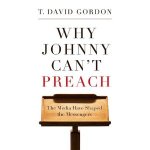
Review: Why Johnny Can’t Preach, by T.David Gordon

It’s a short book,108 pages, but it packs quite a punch.  T.David Gordon wrote Why Johnny Can’t Preach during a year of treatment for cancer.  Given only a 25% chance of survival, he found his focus clear and the desire to compromise his message absent.  The book is hard-hitting, but I found the tone entirely appropriate and not harsh despite the subject matter.

The writer is a media ecologist – that is, one who studies the effects of the change of media forms on the culture.  Taking his title from two books in the 1960’s on the growing inability of students to read and write, this book focuses on why the present state of preaching is so dire.

The first part of the book sets out his evidence for his claim that preaching is ordinarily poor.  While admitting freely that his first line of evidence is merely anecdotal, I found the presentation of evidence hard to argue with (not that I’m inclined to argue since my experience largely reflects the author’s).  Yet Gordon’s evidence is not merely subjective.  He goes to some pains to make clear that there are some objective measures of sermon quality that can be used to identify problem preaching.  It is too common to hear “that is just your opinion” if a sermon is ever questioned or critiqued.

The author’s argument culminates with the almost total absence of the annual review, not missing in any other profession, but indicative that all sides know there is an issue.  Gordon doesn’t blame seminaries for this state of affairs.  In his perspective they haven’t changed, but the calibre of incoming student certainly has.  What has changed?  Because of the change in media forms, Johnny is no longer able to read, nor write, nor discern the significant, and hence he can’t preach either.

True preaching requires close examination and study of a quality text, something non-readers have no experience of today.  People don’t study classical languages.  They don’t read literature.  They aren’t equipped to really study a text.   People read for content, but don’t learn to look at how a text communicates.

True preaching requires careful composition.  But people don’t write letters anymore.  They talk on the phone. Instead of careful composition, we live in a day of easy and cheap talk.

True preaching requires a sensibility of the significant.  But the only way to watch hours of television is to turn off such sensibility, so most do.

A once-common sensibility (close reading of texts) is now uncommon, and a once-common activity (composition) is now comparatively rare.  A once-common daily occurrence (face-to-face communication allowing us to “read” the unstated feelings of another) has been replaced by telephone conversation in which visual feedback is absent.  A once-common sensibility, the capacity to distinguish the significant from the insignificant, is becoming rare.  For a minister today to preach a basic average sermon by early-twentieth-century standards would require a lifestyle that is significantly countercultural.

The book is not solely concerned with capacity to study and compose.  The fourth chapter looks at the content of sermons and gives a fine rebuttal of four contemporary approaches – moralism, how-to, introspection and “so-called culture wars” . . . helpful content that I will come back to in other posts.

At certain points I would suggest that the author’s view of Christian preaching is a little narrow.  There is more to an inherently relational faith than merely submitting our will to God’s will.  Perhaps the Bible text, if read carefully, might present the heart of God such that our hearts might be changed in response.

Nevertheless, even taken on the author’s terms, the book’s message is important and needs to be considered.  All of us live in a fast-paced world that simply doesn’t allow for careful reading of God’s heart in His Word.  Perhaps it is time we were more counter-cultural in order to be able to read the text well.

Thankfully, T. David Gordon is still alive and serving the church through his teaching and writing.  We should be grateful for this little gem of a book.  Buy this book, perhaps even pass on a copy to someone else!

(If you are in the UK, click here to buy.)

Add to FacebookAdd to DiggAdd to Del.icio.usAdd to StumbleuponAdd to RedditAdd to BlinklistAdd to TwitterAdd to TechnoratiAdd to Yahoo BuzzAdd to Newsvine

Roast Preacher?

In a culture that is as committed to the Sunday roast dinner as it is to complaining, it isn’t surprising that people here talk about having Roast Preacher for dinner!  But as parents we are sensitive to the presence of children at our dinner table (and for the record, the absence of roast dinners on a Sunday – all who manage that feat on a Sunday are borderline miracle workers in our opinion!)  So how to discuss the sermon with the family present?  I like three questions used by the author of the book I’m not naming until next week.  I think we should try these:

1. What was the point or thrust of the sermon?

2. Was this point adequately established in the text that was read?

3. Were the applications legitimate applications of the point?

If the main point was not clear, then it will be interesting to determine together what the sum total, bottom line, distilled main idea actually was from our perspective.  (Preachers note this, if you don’t make your main point clear, others will be guessing or dismissing, and neither is good!)

If the main point was not established in the text, then we have two paths ahead of us.  One would be to guess where the main point actually did come from (danger of psycho-analysis with children present).  The more productive path would be to look at the text again and determine what the main point actually is in the text.  (Preachers note this, most people will not automatically go back to the text and hunt down a statement of the main point of it.  They will either accept what you said, or they will ignore and move on – neither is a good result.)

If the applications were not legitimate applications of the point, then again we have a couple of options.  One would be to trace out both the roots and the fruits of the false applications . . . which would hopefully lead to other Bible study and application of other biblical truth.  Or it might lead to spotting false agenda and considering the long-term fruit of sub-gospel preaching.  Depends on the sermon, I suppose.  The other option would be to chase more legitimate applications of the teaching of the text read.  (Preachers note this, most people either buy what you say or ignore it.  You probably get the pattern here by now.)

So let’s say we end up chasing down the legitimate applications of the actual main point of a text, having heard a disunited message that failed to establish its main point in the text read or provide legitimate applications.  I suspect we’d be a very rare family if we managed that over our Sunday lunch.  Preachers note this – these three questions are not unfair, let’s be sure people can answer them easily and in the affirmative.

Add to FacebookAdd to DiggAdd to Del.icio.usAdd to StumbleuponAdd to RedditAdd to BlinklistAdd to TwitterAdd to TechnoratiAdd to Yahoo BuzzAdd to Newsvine

Irrelevant?

It isn’t unusual to hear people speak of expository preaching as an irrelevant mode of communication that has no place in the contemporary church.  Outdated. Unnecessary.  Irrelevant.  Here’s a quote from a footnote in the book I just finished this morning and will review sometime soon, but will leave you in suspense for now (p79):

As long as original sin has the human race in its grasp, and as long as the conscience has the slightest awareness of guilt, declaring the competence of the sin-bearing Christ to rescue the guilty will never be irrelevant.

Absolutely.  The problem with the “irrelevance” talk is that it seems to be looking at entirely the wrong thing.

1. People don’t always know what they need. Everyone seems to be an expert in how long they can concentrate, how they learn best, how they need to be fed, etc.  As a parent I know it is possible to be most sincere about what is best, yet in my slightly advanced maturity I can see through the best laid plans of toddlers and children.  In a culture that has degenerated on so many levels, the frogs in the near boiling water are happy to announce that preaching the Bible is now irrelevant to them since they are so advanced compared to all who have come before.  It seems, at times, that the only advance is the march of sin toward judgment.

2. People don’t always know what they haven’t heard. For example, feed a church poor preaching consistently and they may moan, but they also will cling on to the scraps of good that they receive from the pulpit.  Sometimes great expository preaching can be as much of a shock to the system as a nutritious feast is a shock to a starving body.

3. People don’t always know the difference between critiquing bad examples and critiquing something as a whole. I can say that tomatoes are unnecessary for me to have an enjoyable diet because I have only tasted sour excuses for tomatoes.  But now that I have enjoyed some of the finer specimens from Italy and elsewhere, I wouldn’t be so brash in my dismissal of all tomatoes.  The same goes for expository preaching.  What may be irrelevant is the kind of pseudo-expository preaching many have grown accustomed to (lacking biblically, lacking communicationally, lacking applicationally, lacking spiritually, lacking in gospel, lacking in skill, lacking in prayer).

Baby.  Bathwater.

Add to FacebookAdd to DiggAdd to Del.icio.usAdd to StumbleuponAdd to RedditAdd to BlinklistAdd to TwitterAdd to TechnoratiAdd to Yahoo BuzzAdd to Newsvine

Life’s Too Fast To Preach

We don’t always realize just how fast our fast-paced lives are.  We live in an age of flashing images that rush by at frantic pace.  As the book I’m currently enjoying points out, “we become acclimated to distraction, to multitasking, to giving part of our attention to many things at once, while almost never devoting the entire attention of the entire soul to anything.” (p50)

But preaching a biblical text demands that we slow down and focus.  We must concentrate fully on the text.

1. Poetry – “the rhythms and cadences, the music of the language, cannot be experienced at all by scanning.” (p.50).  Indeed the dense line by line nature of poetic art demands focused reading if we are to glimpse the gold that is there.

It is not just poetry though, we must also slow for:

2. Narrative – it takes focused concentration for the imagination to engage, for the images to form, for the tension to be felt.  Characters have to be met, tension faced, resolution experienced.  Narrative will only yield superficial and petty sermon outlines if it is not engaged slowly.

3. Discourse – it takes focused concentration to follow the intricate composition of an epistle or recorded speech.  How does the thought flow?  What is the main thought?  How is it developed?  Again, discourse will preach after a superficial glimpse, but it will be poor!

Slow down.  Read the text.  Then maybe you can preach it.

Add to FacebookAdd to DiggAdd to Del.icio.usAdd to StumbleuponAdd to RedditAdd to BlinklistAdd to TwitterAdd to TechnoratiAdd to Yahoo BuzzAdd to Newsvine

Simple Idea – So Helpful

This week at Cor Deo my colleague Ron mentioned something he does in preparing for sermons.  Simple suggestion to say the least, but so helpful.  Instead of cutting and pasting the text of the passage into a document to work with, he photocopies his own Bible page.

Then he can work on the photocopy at a significant level of inductive observational detail.  Then when he comes to preach from his own Bible, he’s very familiar with the layout of the text and only needs to make minimal markings on the text since he’s just been working all week on a replica of the same.

Simple.

I could leave it there, but let me add a couple of comments:

1. Too many spend too little time really soaking in the text.  It shows in the preaching.  The message is often a decent message, but the tie to the text is tenuous.  If you have a great Christian gospel message that really is the message of another text, preach the other text!  But if you’re preaching this text, then live in it and let it live in you for a while so that you are really preaching the text you say you are preaching!

2. The more our message is tied to the text we’re preaching, the less we are reliant on extraneous notes and imposed sermonic structures.  This means the listeners perceive a more natural presentation (that’s helpful), and they are more likely to follow in their Bibles (that’s helpful), so that the focus is less on your sermonic artistry and more on the inspired revelation that came from God (that’s helpful too!)

Add to FacebookAdd to DiggAdd to Del.icio.usAdd to StumbleuponAdd to RedditAdd to BlinklistAdd to TwitterAdd to TechnoratiAdd to Yahoo BuzzAdd to Newsvine

Christian Sounding Non-Christian Preaching

He certainly looked the part.  He came in dressed like every visiting preacher we have here.  His tone was serious.  His piety was evident.  His passion for our purity was spilling over in everything he said.  He preached of the righteousness of God, and what it means to be the righteous people of God.  He spoke against some things that are a real concern of mine in the present culture.  He pointed to the text.  He referred to the Greek.  He brought that discomfort that I suspect my comfortable flesh needs now and then.  He certainly couldn’t be faulted as far as taking his Christianity seriously.  He wanted us to do the same.

Then someone I know graciously pointed out that what he preached wasn’t even Christian.

I was shocked.

Where was he preaching?  It could be your church or mine.  It could be Galatia or Philippi or Colossae in the 50’s.  The problem with legalists is that they sound so Christian.  And it feels so wrong to question their fervent presentation of truth.  And in a culture so morally lax they can feel like a breath of clear air in terms of right living that pleases God.  Yet legalism does not please God.

The gospel is not great news for those that want to be proud of their own goodness.  It isn’t good news for them before salvation and it isn’t good news for them after.  Let us raise our antenna and spot the difference between convicting Bible teaching and gospel-lite pressure sessions (and if the gospel gets so ‘lite’ it isn’t there, perhaps we should call it what it is…sub-christian…non-christian).

Add to FacebookAdd to DiggAdd to Del.icio.usAdd to StumbleuponAdd to RedditAdd to BlinklistAdd to TwitterAdd to TechnoratiAdd to Yahoo BuzzAdd to Newsvine

Committed to Authorial Intent? Remember Authorial Intent!

Many who read this blog would be committed to the notion of authorial intent.  That is, the meaning of the text is pursued in line with authorial intent.  It doesn’t mean what it could not have meant.  It doesn’t mean what the author didn’t intend to convey.

Yet while many hold to a strong conservative hermeneutic (perhaps a historic0-grammatical or some kind of christocentric variation), it seems that authorial intent often goes missing.  How so?  Well, the meaning as intended by the author is pursued and preached.  Yet the intended effect, the intended outcome, the goal of the author is often lost.

As you study a text you need to look at the context (historical and written), and at the content (what’s in the passage), and also at the intent.  This means being sensitive to stated and implicit intended outcomes in the original recipients.  It means being sensitive to the tone and attitude of the writer.  Was the writer being encouraging, or rebuking, or concerned, etc.?  Sensitivity to content and to intent is necessary if we are to really honour a text and understand it well.

Where do some preachers seem to miss this?

1. When the tone of the message bears no resemblance to the tone of the text. Maybe this is a different audience in need of a different tone, but a deliberate decision to change the tone is not the same as squeezing all texts into your shepherding mood, or your angry mood, or your bible thumping mood, or your “self-appointed prophetic voice” mood or whatever.

2. When the intended outcome of the message bears no resemblance to the intended outcome of the text. Again, it is possible to shift from what the author intended.  Yet too often the preacher has never considered the original to that extent, but rather has pursued a message from a text, rather than really wrestling with the message of the text.

Authorial intent is about more than simply affirming that my doctrine is in line with the Apostle Paul’s.  It is about growing in sensitivity to the text I am reading so that I am better able to re-present it to others when I preach.

Add to FacebookAdd to DiggAdd to Del.icio.usAdd to StumbleuponAdd to RedditAdd to BlinklistAdd to TwitterAdd to TechnoratiAdd to Yahoo BuzzAdd to Newsvine

Impositional Preaching

Some of the greatest preachers of recent history have built sermons on single verses.  I tend not to do that.  Am I saying I know better than them?

Dr Lloyd-Jones, not to mention Spurgeon, and others, have demonstrated extended sermon series that essentially preach a single text at a time.  Surely if we were to be preachers after their kind today, then we should pursue the same kind of ministry?  Actually, I think not.

First, let’s recognize what these men did. Spurgeon sometimes resorted to an allegorical exegesis of the text, but not always.  Lloyd-Jones tended to preach the Bible’s theology radiating from the impact point of a single verse.  That is, since the word “justified” is in this verse, what all could be said from the whole canon on that theme (perhaps in this message, perhaps over several).

Second, let’s recognize what wannabe’s often do. Today when I hear people building messages from single texts I tend not to hear people with the pedigree of Spurgeon or Lloyd-Jones.  I do hear some allegorical, not to mention fanciful, interpretations.  These lack credibility and authority.  I also hear some waffling messages padded with poor cross-referencing that shows neither theological acumen, nor precision in respect to recognition of biblical connections (nor genuine understanding of the theological needs of the listener).  In an era where listeners will look at the text and dismiss apparently unfounded sermonizing, we would do well to reevaluate the efficacy of many “single verse” approaches to preaching.

Third, let’s realize that imposition is not exposition. Too often the preacher has the mindset of seeking to utilize the text as a series of pegs on which to hang their thoughts.  All too often those pegs are not divinely intended to hold the weight placed on them.  The Bible is an intricate and powerful construct of divine design.  Sadly, all too often preachers take a twig from the oak tree and assume it will bear the same weight as the oak was designed to hold.  Impositional preaching is not exposition, it is a pale imitation of what some greats from church history did.

Fourth, let’s realise that exposition is about honouring God, not historical figures. I deeply respect Spurgeon and Lloyd-Jones, as well as many other preachers through church history that I do not seek to emulate every week.  My view of expository preaching is built on my understanding of the nature of God’s Word.  As I seek to explain it, to demonstrate its relevance, to say what it says and seek to somehow make the message do what it does, I am pursuing a contemporary ministry of expository preaching.  I may fall short of historical models, and yet at the same time I may at times get closer to honouring the intent of the text.  I pray that God will enable me to have a fraction of the impact of these great men.  I pray that God will equip me to be a preacher of His Word, rather than one who seeks to reproduce a historically bound model of ministry.

Add to FacebookAdd to DiggAdd to Del.icio.usAdd to StumbleuponAdd to RedditAdd to BlinklistAdd to TwitterAdd to TechnoratiAdd to Yahoo BuzzAdd to Newsvine

There It Is!

Perhaps you have sat in Bible studies where this has happened.  The text being studied might be something like Ephesians 2:21.  The next question in the booklet asks something about the term “temple.”  It also has a string of cross-references with it.  So the leader assigns references to different ones in the group.  One by one these are read out.

“Ok, I’ve got Matthew 12:6, ‘I tell you, something greater than the temple is here.’ Yep, temple, ok.”

“Ok, I’ve got Revelation 7:15, ‘They are before the throne of God and serve him day and night in the temple’ – yep, temple, there it is.”

“Ok, I’ve got Acts 2:46, ‘And day by day, attending the temple…” – ok, yep, temple!”

“Ok, I’ve got John 2:14, ‘In the temp…’ there it is!”

These may have been carefully selected cross-references to provide helpful insight into the meaning in Ephesians 2:21, but they have served no purpose other than giving people a chance to practice finding Bible references and play a game of word recognition.

Maybe, like me, you have found yourself sitting through moments like this, wondering what the point of it all is?

Where does this come from?  Let us assume for a moment that the person who wrote the Bible study questions had a plan in their selection of cross-references (this is an assumption).  Then surely the value will come from taking at least a moment or two to recognize more than just the presence of the word?  Surely it should involve some thought as to the use of the term in that context and how that might influence our understanding of the focus text for the evening?

So where does this practice come from?  Is it, perhaps, the example of preachers who use cross-references essentially as time-fillers, failing to make any sense of why they have gone to the verses or what differences they make to the understanding of the target text?

As I have written before, there are not too many reasons to go to other passages when preaching.  (Here is my low fence post, and here is part 1 and part 2 of a post on cross-referencing.)

When you do go to another text, make sure it is clear what you are looking at and why.

Add to FacebookAdd to DiggAdd to Del.icio.usAdd to StumbleuponAdd to RedditAdd to BlinklistAdd to TwitterAdd to TechnoratiAdd to Yahoo BuzzAdd to Newsvine