Profound Presentation

It is obvious that profundity should be sought in preparation and matters of explanation and application.  But what about presentation and delivery?  Here are a few suggestions:

13. There is nothing profound in being dull, discouraging, distant or disconnected – cut that out.  Some may assume that profound is the opposite of entertaining and therefore seek to be deliberately dour and detached.  Apparently then the glory goes to God and not to the preacher.  Apparently this path guarantees no manipulation.  I disagree on both counts.  I don’t think God is glorified by poor incarnational presentation of His Word.  And I do think it is possible to manipulate by a detached intellectualism.  We need to see preaching as an act of communication and recognize that communication is always more than content alone.

14. Profound impact usually requires genuine connection, so know that interpersonal aspects matter.  I often mention that I wouldn’t buy a car from someone who won’t look at me, so surely that matters even more with something important like the truth of God’s Word.  Eye contact, personal warmth, open gestures, facial expression, vocal variety, etc.  These are all part of the package when a communicator connects effectively with a listener.

15. Profound impact often comes when there is an appropriate level of personal vulnerability and heartfelt conviction.  When a passage is preached at arms length, with both the text and the message being an exhibit offered to the listeners, there will be a significant reduction in impact.  When a passage has worked in and through a preacher, then the message can come through and from the preacher, and the communication can be both vulnerable and heartfelt.

16. Conviction, passion, enthusiasm, and so on, cannot be effectively faked.  A stunning message learned verbatim and copied down to the last detail of delivery will not be the same as the original.  Why?  Because the copycat communicator cannot copy genuine conviction, and they cannot offer genuine personal passion through the mask of someone else’s message.

Tomorrow I’ll finish the series with a consideration of profound transformation – the goal in all of this.  What would you add to this list?

Add to FacebookAdd to DiggAdd to Del.icio.usAdd to StumbleuponAdd to RedditAdd to BlinklistAdd to TwitterAdd to TechnoratiAdd to Yahoo BuzzAdd to NewsvineLike This!

Profound Application

Profound preaching is not dense, complex or over peoples’ heads.  Neither is it merely historical, lacking any hint of relevance and application.  The person shaking your hand at the door may tell you “that was deep!” but really mean “that was over my head and apparently irrelevant!”  That is not our goal.  True biblical preaching should be profound in the right sense of the word – deep, weighty, serious, life-changing.  So let’s move on to matters of application:

9. Instructing conduct is probably not profound, motivating it biblically probably is.  I say probably because if your motivation method is to guilt trip listeners as you twist their arms to force them into external conformity, then that is not profound.  It is poor.  The Bible stirs life change and so should our preaching (by God’s grace, of course).  We tend to hit truth in explanation and conduct in application, but the Bible goes deeper than a behavioural model of motivating humans:

10. Application should go deeper than a to-do list, probing into thinking patterns and beliefs.  There is a place for practical to-do suggestions, but if that is the staple application of a preaching ministry, the long-term fruit will be flimsy even if numerous.  Christianity isn’t about conforming behaviour to external standards, but about response to the truth of who God is and what He has said to us.  But again, the Bible goes deeper than cognitive approaches to life change:

11. Application needs to target the affections, because the Bible does.  Discourse moves us, narratives engage us, poetry stirs us – the Bible reaches to the heart of the listener.  Sadly too many preachers assume their role is merely to pressure behavioural change, or educate for cognitive adjustment, but these approaches don’t fully present the message and method of the biblical passages.  We must wisely, honestly, carefully and prayerfully engage the hearts of our listeners with the biblical text.

12. While relevance should be a given, transformational application is rare, so pursue it.  For instance, how easy it is to preach “don’t be anxious” from the Sermon on the Mount and end up imploring people to try harder not to fret!  But the passage points listeners to how much God cares for them.  Let’s not promote a pseudo-relevance through just being strongly against something, but rather offer the text’s bigger alternative that attracts and woos.  To think of a common Old Testament example, by all means let’s smash idols, but not because we are just anti-idol, rather because God is so much better.

If explanation and application can be more profound, we are on the right track.  Tomorrow we’ll look at aspect of our presentation and delivery.

Add to FacebookAdd to DiggAdd to Del.icio.usAdd to StumbleuponAdd to RedditAdd to BlinklistAdd to TwitterAdd to TechnoratiAdd to Yahoo BuzzAdd to NewsvineLike This!

Profound Preparation

This week I’d like to ponder what it might look like to pursue a more profound preaching ministry.  While most would acknowledge that preaching should neither be dense nor inaccessible, this does not mean that shallowness and dumbing down are the order of the day.

Profound preaching must surely start with profound preparation.  Four suggestions to get a week-long list going:

1. Begin with humble recognition that you yourself need to be changed by God.  It is too easy to think of preaching preparation as being about you the preacher pursuing a message to preach to them, the needy recipients.  At this point in the process you stand very much in their shoes, needing to hear from God.  You need to encounter His heart in His Word.  You need to be marked deeply and changed by a God who communicates, who cares, who challenges and who changes.  It makes no sense to have profound faith for the sake of others, but not an openness and humility in yourself.  The preparation of a sermon will be a privilege, an opportunity for God to mark your life profoundly.

2. Study the passage to know God, not just the facts.  It is easy to treat Bible study as a pursuit of non-trivial trivia.  Don’t.  Study the passage in order to know God better.  What is His self-revelation saying of Him?  How are the characters responding to Him?  Wherever you are in the canon, the passage is theocentric, so make sure that your heart is too.

3. Don’t mix your message preparation with your Bible study.  As a preacher who cares about the congregation, or as a preacher desperate to be ready on time, it is tempting to blend passage study with message formation.  Keep the stages separate.  You have the privilege of doing some in-depth Bible study, take advantage of that!  You may not be able to help thinking of who you will be preaching to, but try to keep those thoughts until you’ve really gotten to grips with the passage (or better, until God has gotten to grips with you through the passage).

4. Saturate your preparation in prayer.  This should go without saying, but it can’t, so it won’t.  The entire preparation process should be absolutely pickled in prayer.  Prayer in passage study, prayer in personal response, prayer in “audience analysis,” prayer in message formation, prayer for delivery, prayer for life change, prayer for immediate impact, prayer for long-term fruit, etc.

Tomorrow I’ll offer a few more thoughts, this time on profound explanation in preaching.  Feel free to comment any time.

Add to FacebookAdd to DiggAdd to Del.icio.usAdd to StumbleuponAdd to RedditAdd to BlinklistAdd to TwitterAdd to TechnoratiAdd to Yahoo BuzzAdd to NewsvineLike This!

Saturday Short Thought: Year on Year

This evening I have the privilege of speaking at the 80th Anniversary celebration of a church in Surrey.  As preachers it is tempting to think that the next message we preach is the only one that matters.  But a chance to look back with friends at God’s work over eighty years will be a great chance to celebrate the long-term impact of God’s Word.

The building work of preaching – week after week, the Word of God faithfully preached to a gathering of believers will shape them.  This could be in a good direction or not, which is why it is so vital that we watch carefully the diet that the flock are being fed.  One poor message here and there may not produce tangible trouble, but diet does matter.  I am convinced that if the churches in this country received a steady diet of just plain well-handled Bible sermons – nothing spectacular, just plain, accurate, faithful and lovingly served biblical truth, then the church would be in a very healthy place!

The shaking work of preaching – some messages, or series, will shake a church.  This is good.  Just as our personal reading should shake up our theological convictions and how we live, so the Word should shake a church.  Some preachers want to create a visible shake every week, which may not prove so sustainable or helpful in the long-haul.  But looking back over the years, I suspect healthy churches can see seasons where God’s Word brought about change (usually with discomfort and tension in the process).

The cumulative work of preaching – the steady weeks and the firework weeks, the series that seemed to hit home, and those that passed by, interspersed with the messages that brought instant fruit, and perhaps a few that brought critical feedback . . . over time the diet of God’s Word does something to people, to a church, to a community.

Your sermon this Sunday may not be the talking point of this Monday, but it is part of the history of your church being written over the decades.  Preach the Word.

__________________________________

Next Week: Pursuing Profound Preaching

Add to FacebookAdd to DiggAdd to Del.icio.usAdd to StumbleuponAdd to RedditAdd to BlinklistAdd to TwitterAdd to TechnoratiAdd to Yahoo BuzzAdd to NewsvineLike This!

Representing the Gospel

When we preach, we are representing an absolutely glorious gospel!  I was just emailing with a friend in another country who made the observation that in some cultures preachers entertain people to death, while in others they bore people to death.  So true.  So wrong.

The preacher is representing a message from a communicating and wonderfully gracious God, and it is a message of great news.  Here are some ways that we might fall into a false representation:

1. Boring news.  If we ponder it for half a minute, we should repent of ever boring people with the message of the Bible.  How can we take such a magnificent message and make it boring?  If it doesn’t even keep our preaching from being dull, it can’t be that good, can it?

2. Restricting news. If we really read the New Testament carefully, we should never come across as if the gospel is the good news of life restricted.  It sets people free from slavery to sin to know life to the full.  Certainly there are costs involved, perhaps even our lives, but if the preacher looks like all life has been strangled out of them, what does that represent?

3. Angry news. If all the preacher offers is a visual representation of the wrath of God through their demeanor and expression, might that indicate that they don’t know the God they preach about as well as they should?  Christ attracted the broken, he didn’t scare them all away.

4. Silly news. If the preacher has to act like a clown to get the attention of the listeners, I suspect there may be a problem in the content of the message.  If the preacher has to be a sophisticated entertainer, then I still suspect there may be a problem in the content of the message.

5. Illogical news.  If I can be honest, some preachers almost convince me that the atheists are right.  It sounds like everything is about a petty creator judging well-meaning people for the smallest of sins with the greatest of torture, but its okay because we just need to say a magic phrase to get a ticket to paradise.  Sometimes the gospel just seems illogical, and…

6. Flimsy news. If I can continue from the previous point, sometimes the message just seems so lightweight that it doesn’t seem to stand up to listeners questions, let alone any real scrutiny.  Is the simplistic and self-centred gospel really what so many have given their lives for?  Were they burned at the stake for something so flimsy?  Surely not.

7. Tired news. If listeners are not stirred by the gospel, it should be because they are blinded by the god of this age, not because it isn’t stirring.  Christians listening should be responsive, and if they are not showing some indication of how great the news is, perhaps that shows the preacher hasn’t really represented the gospel well.

What would you add?

Add to FacebookAdd to DiggAdd to Del.icio.usAdd to StumbleuponAdd to RedditAdd to BlinklistAdd to TwitterAdd to TechnoratiAdd to Yahoo BuzzAdd to NewsvineLike This!

Listener and God

In many ways the goal of preaching is this relationship, the listener and God.  We’ve already considered God and the Preacher, the Preacher and the Listener, but now for the third relationship.  As ever, dangers and potential.

1. There is a danger that the listeners connect with the preacher, but not with God, due to the effectiveness of communication that inherently lacks the richness of biblical content.

2. There is a danger that the listeners connect with the preacher, but not with God, due to the richness of biblical content that comes from and to deficient relationships with God (i.e. the preacher’s and the listeners’), to put this differently:

3. There is a danger that God’s personal care and concern and self-revelation not get through the preacher to the listeners.

4. There is a danger that the God presented by the preacher may motivate distance rather than intimacy and thereby hinder true connection.

5. There is a danger that the preacher’s goal be an equipped and informed listener who can then become a “self-made” or “self-starting” Christian (beware of application not built on response to and relationship with God).

But what potential!

First, can there be a greater thrill than to see others growing into a deeply forged relational responsiveness to a loving God?  Does it get any better than seeing others flourish spiritually as they discover the fullness of life offered in the New Covenant where they can actually know God personally?

Second, when people have a genuine relationship growing with God, then it will mean an increase in outward spilling and spreading goodness.  Why should that not result in blessing for the preacher?  While we don’t preach for that benefit, it would make sense in a community of captivated Christians, for preaching to forge a community of mutual delight – God in them and them in God and both in the preacher, etc.  Sadly the relationship between preacher and listeners is too often fraught with the tensions of world-like political power struggles and distrust, but what if the gospel really gripped a church, surely it would be different?

Furthermore, that outward spilling goodness would also mean mutual body life as listeners naturally minister by giving of themselves to each other.

It doesn’t end there, the spill of grace would then surely also reach outward again to the community (and that without the preacher pressuring people to be witnesses!)  That’s the thing about God’s relational bond, it doesn’t end there, it just keeps on spilling outward!

Add to FacebookAdd to DiggAdd to Del.icio.usAdd to StumbleuponAdd to RedditAdd to BlinklistAdd to TwitterAdd to TechnoratiAdd to Yahoo BuzzAdd to NewsvineLike This!

Preacher and Listener

In preaching, every participant matters and every relationship matters.  Yesterday we looked at the God/Preacher bond.  Now let’s consider the Preacher and the Listener.  Again, dangers and potential!

1. There is a danger that the preacher will create too much distance through a knowledgeable authority that isn’t balanced with vulnerability and spirituality, leading to disconnect from the listener.

2. There is a danger that the preacher will collapse themselves too far into the listener’s situation by a reverse of number 1 and have nothing of value to offer from God’s Word.

3. There is a danger that the Bible will not be seen as a means of hearing God’s heart, but as a weapon to be brandished in berating the listener, or as a curio that offers mere speculation to all present (including, and led by, the preacher).

4. There is a danger that the spiritual nature of preaching will lead to the preacher failing to value the interpersonal communication at the core of preaching – the value of the smile, of eye contact, of vocal tone and variation, of gesture, etc.

5. There is a danger that the preacher will resist performance and somehow also fail to value the interpersonal connection formed in preaching – both in vulnerability and personal elements of content, and in delivery aspects such as warmth and energy.

But what potential!

The preacher has the privilege of standing in the midst of God’s people and yet leading them in responsiveness toward a God who delights to stir hearts through His self-revelation in the Word.  Sometimes a church will refer to a worship leader as the lead worshipper.  The preacher is the lead responder to God’s Word.  The preacher doesn’t stand outside the gathering of listeners, but in their midst.  Yet the preacher stands there with a word from a communicating God.  Can it get any better than this, to be playing a key role in a community of responsiveness toward a loving God?

Add to FacebookAdd to DiggAdd to Del.icio.usAdd to StumbleuponAdd to RedditAdd to BlinklistAdd to TwitterAdd to TechnoratiAdd to Yahoo BuzzAdd to NewsvineLike This!

The Preaching Triangle of Relationships

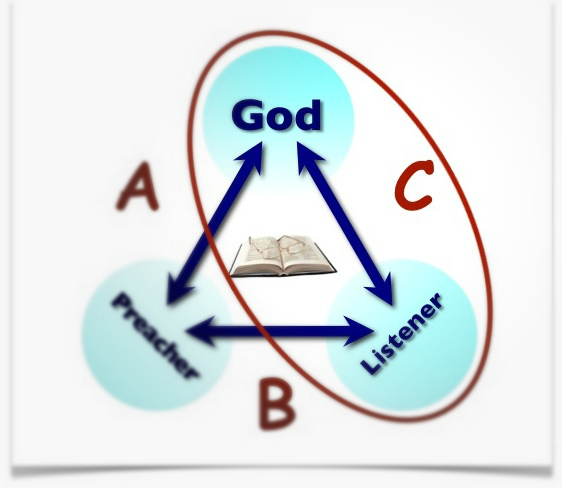
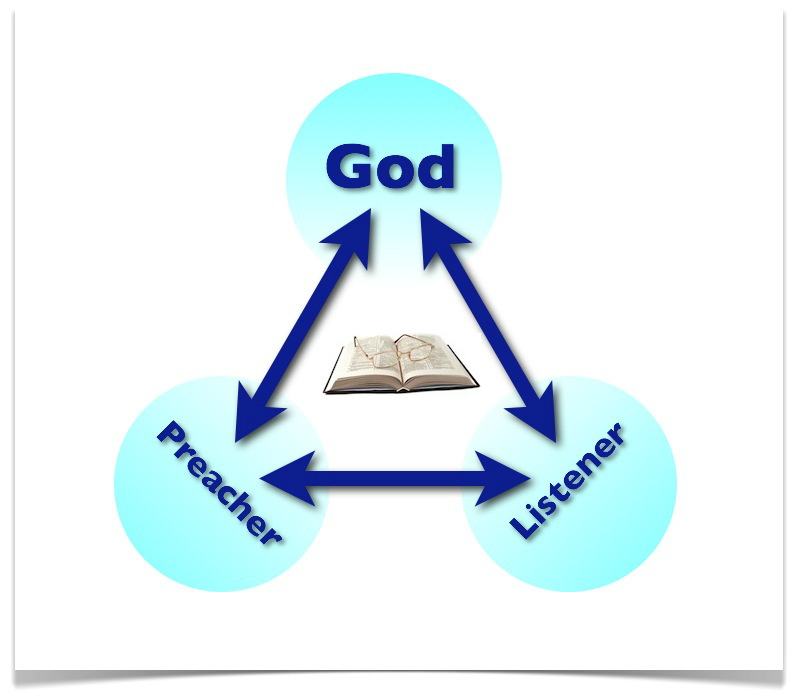
I have introduced the notion of preaching as being the combination of three participants gathered around the Bible.  But the key feature of this approach is to see the importance of the relationships.  Like an electrical circuit, what matters is the connections.  And when there is a full set of connections, then something powerful occurs!

A. God & Preacher.  The preacher doesn’t engage the Bible merely to find a message for the listener.  Rather the preacher’s primary concern is to engage with God relationally.  Out of the overflow of this relationship comes the ministry to the listener.  God doesn’t empower the preacher merely for the sake of the listeners, but loves and delights in His child.  When this relationship fades from view, the preacher will experience dullness in ministry and potentially burnout.  As the preacher engages with God personally, he/she also joins with God to form a community of carers – that is, the preacher starts to look toward the listeners with God’s loving concern.

B. Preacher & Listener.  The preacher speaks with the authority of God’s Word, yet does so as one on the same level as the listener, as a fellow responder to God’s Word.  The listener will appreciate the knowledge and spirituality of the preacher, but also will appreciate the vulnerability of a fellow believer who clearly recognizes the community of believers.  A sermon motivated by love for listeners will be better than one motivated by self-love in the preacher.  As the preacher/teacher’s heart connects with the hearts of the listeners, a community of responsiveness toward God is reinforced.

C. Listener & God.  The effective preaching of God’s Word enables the listener to relate not only, or primarily, to the preacher, but to God himself.  But more than that:  in effective biblical preaching God is giving of Himself to the listener, building the connection between them.  In this connection both God and the listener become a community of listeners, joining together to delight in each other, and even in the preacher as he/she makes much of the grace of God in His Son.  (When preaching offers a non-biblical portrait of God, or leaves Him out altogether, then both God and listener will be grieved or burdened.)

So whatever opportunity you have, be sure to view the teaching opportunity as primarily a relational opportunity – between God and you, then between you and them, for the sake of them and God!

Add to FacebookAdd to DiggAdd to Del.icio.usAdd to StumbleuponAdd to RedditAdd to BlinklistAdd to TwitterAdd to TechnoratiAdd to Yahoo BuzzAdd to NewsvineLike This!

The Preaching Triangle – Omissions 3 and 4

Yesterday I pondered the possibility of effectively losing God and / or the preacher from the preaching event.  Today I’ll complete the scene by pondering the potential omission of the listener, as well as the critical fourth element of the Preaching Triangle.

3. Listener.  God speaks through His Word and through the preacher, empowered by the Spirit, making much of Christ, but the heart of the listener is always free to respond or reject Him.  It is naïve to assume that the listener is always ready and motivated to hear the message of God’s Word – hence the need for demonstration of relevance in order to salt the thirst of the listener for God’s Word.  Well-handled Scripture effectively communicated in dependence on God will transform lives and churches, but the condition of the soil into which the seed falls is always a key factor (i.e. some won’t respond no matter what!)

And when we fail to emphasize relevance to the listener?  Then we have an historical lecture, a pulpit performance to impress God (it doesn’t), or a demonstration of the preacher’s theological acumen, but we do not have transformational Christian biblical ministry.

But there is also the fourth element, the Bible:

Bible.  The Bible is the self-revelation of a wonderful communicator.  God inspired every word, every choice of genre, etc., and so we should seek to honour His work by doing our best to understand His Word and re-present it to others.  The Bible should not be an end in itself, but the means by which we can know the heart of God: His personality, His loveliness, His values, His concerns, His delight.

And when we omit the Bible?  Then we have personal opinion, or implied direct revelation (highly questionable), but we do not have authoritative Christian biblical ministry.

Why might the preacher fail to pay attention to the listener in the preaching event?  Perhaps too much self-focus, perhaps a lack of understanding that communication needs to be aimed to fully arrive, or perhaps a lack of concern for others.  And why might the Bible get lost in the mix?  Again, numerous possible reasons: a faulty view of direct revelation, an elevated view of one’s own wisdom or spirituality, an inadequate view of the Bible, or even a lack of care for the listener’s real needs.

Tomorrow I’d like to start considering the relationships implied by this Preaching Triangle.

Add to FacebookAdd to DiggAdd to Del.icio.usAdd to StumbleuponAdd to RedditAdd to BlinklistAdd to TwitterAdd to TechnoratiAdd to Yahoo BuzzAdd to NewsvineLike This!

The Preaching Triangle – Introduction

Preaching is not about performance, nor ritual.  It is a communication event.  Like most things, how you understand it flows out of how you view God.

If you see God as a distant power broker, a singularity focused exclusively on his own self-absorption, that will influence the way you preach.  I suspect you’ll be torn between making much of Him because you should, and making much of self because that is the logical conclusion of being made in His image.  The Bible will function as a code of instruction to decipher and disseminate that others might know how to satisfy the distant One.

But if you see God as the eternal fellowship of the trinity who is always others-centred, so that His love has reached out to us to bring us into fellowship with Him by His grace, then that will also influence the way you preach.  And it seems to me that preaching will consequently be a much more relationally-charged event.

In the next days I’d like to probe the notion of preaching being essentially about three relationships, between three ‘participants,’ centred around the inspired Word of God.  The participants are all required:

1. God.  Without whom preaching is an exercise in human performance.  I wonder whether we might sometimes tip our hat to the importance of God’s role in our preaching, but then pray and preach as if our dependence is only token?  Truly, apart from me, you can do nothing.  Surely preaching without God’s involvement is an exercise in abject futility?  But what does it mean for God to be involved?  Just that we pray to Him?  If we pray to Him and then preach about Him, is that enough?  What if Christianity is much more participatively relational than we have realized?

2. Listener.  Without whom preaching makes no sense, since it is not about us or our desire to impress God with our rituals and performance.  Again, I wonder if our preaching is genuinely marked by an awareness of those to whom we preach?  More than that, do we really consider the connection between us and those to whom we preach?  It is easy to tip our hat to the importance of knowing the listener, but then preach as if they are a generic gathering of folks.  But the listeners matter precisely because of the kind of God that we have.  He knows, He loves, He cares.  Consequently He expects those preaching His Word to also know, love and care.

3. Preacher.  Without whom the conversation would be about something other than preaching, but really, does the preacher matter?  I say yes.  There is a vital role for the preacher precisely because of the kind of God that we have.  He is a communicator, He cares, He incarnates.  Consequently He values the human speaker, who also should care, who in some way is an enfleshed presentation of the Word.

All three participants matter greatly in the preaching triangle.  Tomorrow I’d like to drill down a bit more on why each one matters, before we then start to probe the relationships in this triangle.

Add to FacebookAdd to DiggAdd to Del.icio.usAdd to StumbleuponAdd to RedditAdd to BlinklistAdd to TwitterAdd to TechnoratiAdd to Yahoo BuzzAdd to NewsvineLike This!