Preaching Myths #2 – Cool Preaching

myth2Here’s another idea that bounces around in various forms, but I think should be probed a bit:

“Cool preaching attracts people.”

This could be the thinking of church leaders who decide to go with a “cool preaching” option in order to seek growth.  Or it could be the critique of traditional church folks who are looking sideways at a different church which has a perceived “cool factor” and is growing faster than their church is.  When used as a critique, it tends to carry with it the implication that such a church must be dumbing down, softening, weakening, diluting or corrupting the gospel in some way.

Before critiquing the myth, I suppose both thoughts can be affirmed.  Some churches do make superficial style issues a driving factor in their growth strategies and in some cases it does seem to attract people (although any style may well put others off coming in the first place, even a contemporary style).

And indeed, some contemporary styled churches have weakened the gospel leading to shallow conversions and poor discipleship.  But let’s be fair here, some traditional styled churches have weakened the gospel leading to shallow conversions and poor discipleship too!  Sweeping generalizations about contemporary versus traditional are very naive.

So, does cool preaching attract people?  I would say that it might, but probably not.  The primary people who tend to be attracted to “cool Christianity” may well be Christians whose tradition store has become overstocked and they want to try something different.

Three thoughts:

1. Christ attracts people.  Re-read the gospels and notice how normal and broken people were so drawn to Jesus.

2. Christlike communities attract people.  If people are not drawn to Jesus today, it is probably because their exposure to his body is cluttered by other baggage and distraction.  A community being transformed by the love of God so that they love each other (like Christ) will spill outwards in love to the community (like Christ) and thereby be a magnet to broken people (like Christ).

3. Effective preaching engagingly communicates what matters.  Cool preaching without biblical substance is see through.  People may well see through “cool-empty” just as they may see through “traditional-empty” (although sadly there will be those who don’t see through one or the other).  So what then for our preaching?

 A. We must seek to get the substance right: the Bible offered engagingly, the gospel full and clear, and the presentation of God in Christ as clear as the incarnation requires.

B. We must seek to remove unnecessary obstacles: issues of delivery, packaging, presentation, and content need to be carefully evaluated to make sure that people are not choosing to walk away from the gospel because of something other than the gospel.

Being cool is not the goal in preaching, unless you are wanting to temporarily attract young disenchanted Christians.  Cool is really not the issue at all, but recognize that in your pursuit of best substance, obstacle-light preaching, you will probably be critiqued for being “cool” but shallow.  Make sure you’re not.

Ten Top Testimony Tips

microphoneOnWhite2Testimonies can be so powerful, but there is an inherent risk that is not often mentioned: testimonies are often given by people who are not used to public speaking.  I believe anyone giving a testimony should be given instruction, but especially someone unused to the situation and what is expected.  Most testimonies that I have heard where things didn’t quite go according to the hopes of the organizers were testimonies where the person giving it was not instructed properly.  So here are my top tips:

1. Don’t teach.  Simple.  Don’t see this as your chance to teach. It is not the desire of the organizers that you teach.  Giving teaching in place of testimony is unhelpful, and giving teaching based on testimony is often ineffective.  Keep it clean and just give testimony.  You may be asked to teach another time.

2. Don’t turn experience into lessons for others, let God do that.  It is so easy to finish what happened to you with a lesson for them.  It rarely works.  Better leave that to God’s Spirit in this case.

3. Only refer to Bible verses if significant to your testimony.  Again, this isn’t the time for teaching or biblical exposition.  If it made a difference to you in your life story, great, otherwise save it for when you’re asked to preach.

4. Keep to time.  If you are given ten minutes, work hard to get it to ten minutes, don’t just free-wheel and drift to 15 minutes.  I remember hearing a trio of testimonies back to back and the first chap spoke for longer than was allotted for all three.  Everything fell flat after that.

5. Keep it simple.  Don’t start elaborating with extensive back story.  What was the situation before, what changed, what now?  Christ changed your life, tell that story.  Don’t tell random other life stories too.  And typically don’t pray, just do the testimony and leave prayer, exhortation, application, etc., to the meeting host.

6. Get stuck in, don’t waffle in the introduction.  Plan your testimony and really plan your launch.  Get stuck in, otherwise minutes will pass before you’ve even begun and then you are already in a losing battle.  Many testimonies could be told in the time taken for their own introductions!

7. Be humble.  Point to Christ, not to yourself.  In fact, point to Christ, not to books, preachers, ministries, etc.  If they were significant, make reference in passing, but keep the spotlight on Jesus.

8. Don’t get theologically out of your depth.  Plan it so you don’t wade into issues you don’t understand yet.  Nothing worse that the awkwardness created by somebody still uninformed making declarations about something currently beyond their reach.

9. Don’t declare things are unexplainable just because you don’t understand them yet.  This could be the “you can’t explain it, just believe it . . . leap in the dark” kind of confusion often offered by new believers freezing in front of informed folk.  Or it could be the “nobody can explain the end-times/predestination/creation/Trinity” type of theological assertions.

10. Don’t worry about your nerves, everyone expects you to be nervous.  They want to hear you and will probably listen better to you than the more assured preacher.

And last of all, remember this – when a testimony doesn’t work as planned, it is probably because the organizers failed to make expectations crystal clear.  Testimonies are so powerful, let’s use them well!

Static vs Dynamic Position Principle

Static DynamicLast week I enjoyed a very pleasant afternoon discussion in the summer sunshine by the river in Bath.  Our conversation meandered through many gospel vistas and theological considerations.  Along the way we were talking about youth ministry, but the point I’d like to share here applies to us all.

Typically when churches are looking for a youth minister they will try to find somebody who is more spiritually mature than the youth in the church, but close enough in age to engage in all the requisite activities.  So the person is found and appointed, the programs are designed and the action begins.  Often the church wants pizza and programs so that the youth are happy, but whether or not there is any real spiritual growth is another matter.

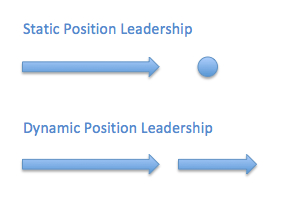
Part of the problem here is the implementation of Static Position Leadership thinking.  I doubt you’ll find that term anywhere as I just made it up, but the principle is not rocket science.  The youth minister is represented by the dot, and the youth are the arrow.  The assumption is that since he is further along than they are, he can help them grow in the right direction.  But does it work like that?

What happens when one of the young folks suddenly comes alive spiritually and is praying fervently and reading the Bible voraciously and chasing God with a passion?  Does that teen simply move along the maturity arrow quicker than others, still moving towards the more mature youth leader?  Not if the youth leader is spiritually static.  It doesn’t take long for someone to overtake the “leader” when the leader is not really leading.

For true spiritual leadership to occur, surely the Dynamic Position Principle must apply.  That is, you can only lead others forward as you yourself are also currently moving forward.  A church that gets a youth minister who lacks personal genuine growth in their walk with God will be directly harming the youth in the church.  It won’t take much for one to surpass the leader in current spiritual momentum.  And it won’t take much for the static leader to squash the life out of those who might show him up if they continue.

If this is true for youth ministry, surely it is also true for whole church ministry.  Moving the dot to the right for an elder or pastor does not guarantee any sort of health in the church.  What is needed is mature and growing godly leaders if they are to infect others with forward momentum in their walk with Christ.

Summer Sermon Series

Summer Beach2If you are in a church that plans its series intentionally throughout the year, then summer is always a funny time.  After all, people are missing every week, but different people.  And if you happen to have nice weather, then people seem slightly distracted even if they are there.  Actually, ignore the weather, when children are out of school and life is not in its normal routine, then somehow everything seems to take on a summer lethargy.  I suspect this post is too late for this summer (I wasn’t thinking of this issue six months ago!)  Nonetheless, a few thoughts:

1. Preach a series with less interdependence between messages.  Don’t build a series that assumes people have heard last week and the week before.  That typically means that an epistle is probably not the way to go, or a tight sequence through a narrative (like Ruth or a section of a Gospel).  Instead preach so that even in a series, each message really does stand alone with minimal required awareness of other messages.

2. Preach a series with high encouragement factor.  If people are potentially coming in mid-series, or were missing last week and next, take the chance to encourage them.  Summer is probably not the season for high level calls to radical commitment or significant life change.  September may be a different story, but tap into the summer vibe and you may find that what you do try to achieve connects more effectively than a January Resolutions series in balmy August.

3. Preach a series from a section of the Bible you tend to miss.  Some churches tend to spend a lot of time in Gospels, or epistles, or even OT narratives.  Why not put in a series from the Psalms, perhaps a few of the Songs of Ascent, or a selection from the 50’s, or wherever.  Perhaps consider a series from Proverbs, a topic per week (these are unlikely to require awareness of last week’s message).

What are you preaching this summer?  What have you found to work, or to fail, in previous years?

Gospel Dimensions 3

TapeMeasuresIn the last two days I have made some suggestions as to how a limited view of God and humanity will tend to undermine our preaching.  What about our view of sin?

1. When we see the problem as partial rather than total.  How often have we heard, or said, that if God’s pass mark is 50, then even a 49 is still falling short of the glory of God?  Therefore even the most “perfect” performer of self-righteousness can be caught out because they must have at least stolen a biscuit when they were small or a paperclip from work in recent years.  Perhaps we say imagine a perfect white sheet of paper, then put a dot of ink on it . . . no longer perfect.  Heaven is perfect, etc.  This is all true, but dangerously untrue at the same time.  Hypothetically a person could be a 49/50 performer, but in reality, nobody is.  To put it another way, we are all zero out of 50 because self-righteousness is not the goal.  Sin is not about independent performance according to a standard.  The standard reveals our independent performance and abject failure.  The independence is a huge part of the issue, so our paper is not mostly white, it is completely covered in blotched ink.  And that ink comes in two colours:

2. When we see the problem as naughtiness.  Naughtiness is like blue ink.  It is the colour of the younger son’s track record as he crawls back wearing swine deodorant from the far country.  But naughtiness is not the extent of sin.  It is one manifestation, but it is not the whole deal.  The Bible does not say we have all been naughty and fallen short of the performance levels of God.  Independent self-righteousness is red ink.  You may prefer red, but it still covers the white of the page when splashed liberally onto it.  Our righteousness is like filthy rags before a God who longs for hearts to not be far from Him.  Some human sheets are mostly blue.  Some are mostly red.  None have any white showing.  I am trying different ways to say the same thing: our sin is far worse than we realise!

3. When we see the problem as a hindrance rather than death.  Broken will?  Clouded uninformed mind?  Slightly marred record?  Sin goes deeper than all of this.  The heart of the human sin problem is the human heart.  That is where we are dead toward God, dead in our self-love, dead because life is found in relationship with God.  And we cannot fix our own hearts.  Fully dead in sin, and fully unable to do a thing about it.

If we present sin as petty naughtiness, then we will preach the good news that a petty God is willing to put up with our paperclip theft.  Hardly the gospel.  And if we preach a shallow or superficial portrait of sin, then we can very easily offer a gospel of heavenly benefits to people whose hearts remain far from Him.  Is this not an anti-gospel?

Gospel Dimensions 2

TapeMeasuresYesterday we pondered how small thinking about God will negatively shape our preaching.  What about our dimension estimates of humanity?  Again, this can really make a difference to our preaching.

1. When we see humanity as too elevated.  I suspect everything I will write in this post about humanity will really be leaning toward tomorrow’s post about sin.  I’m convinced that we simply don’t grasp how profound our problems actually are.  We swim in the brine of a post-Genesis 3 world and we are saturated to the core of our being, but don’t realize it.  Consequently our view of humanity can easily get too elevated, while losing sight of how special we are.  The issue is God’s image.  What does it mean to be made in God’s image?  When we corrupt the image language of Genesis 1 with notions of autonomy, authority and rule apart from relationality, then we end up with a mis-measured humanity.  The wonder of humanity is that we are made in the image of a relational God and we are made for relationship with Him.  Too much of our gospel-vision lacks a real grasp of how deep that design goes.  Instead we fall for a mis-measured human vision of autonomy, rule and authority.  Suddenly the image of God is about god-like qualities of abstract thinking and self-definition and self-determination and dominion over others and rule over creation . . . and our thinking about Genesis 1 (image) sounds and smells like Genesis 3 (hiss).

2. When we see humanity too individually.  This is another way of saying essentially the same thing.  I suspect many of us are better at spotting individuality in our reading of the New Testament than we are at spotting it in our reading of humanity.  That is to say, I suspect many of us know that the “you” of the epistles is usually “you all” rather than “you and you and you and you.”  It makes a difference.  Especially for us English speakers who don’t distinguish you singular from you plural.  We are saved into a corporate entity called the church, not given separate and distinct individual memberships for our own benefit.  So we hopefully see that on a horizontal level, but I suspect we still fall into seeing humans as stand-alone creatures.  It is the world that measures life and success by the items listed on a curriculum vitae or resume.  Our identity does not consist in our collection of capacities (education, experience, skills, references), but rather in the fabric of relationships with which we are enriched.  If we don’t grasp the difference, we will preach a gospel that tends toward personal benefits and relational disconnection.

3. When we see humanity as inherently good, but hindered.  I am out of words, but this can lead into tomorrow.  How bad is our problem?  Do we have a broken will that needs enabling?  Do we have a clouded mind that needs clearing?  Or is the problem much deeper and more devastating?

Gospel Dimensions

TapeMeasuresWhen our view of the gospel is too small, then our preaching will always fall short.  Here are some gospel dimensions to pursue:

1. How good is your God?

2. How needy are your listeners?

3. How bad is our sin?

4. How transformative is God’s grace?

When our view of God is too small, our view of humanity is too elevated, our view of our sin is too shallow and our view of God’s grace as too weak, then our preaching of the Bible will always be inadequate.  Let me take the first one and suggest a couple of ways our view of God can fall short of the biblical teaching:

1. When we see God as a split personality held in internal dynamic tension.  You know how this one goes, God is loving, but he is also something else.  It is sort of an endorsement of love, but balanced with holiness, or power, or something.  Where does the Bible promote a 50:50 balance in God?  I would suggest that we need to read our Bibles more and start to see how God’s “balancing” attributes actually only make sense in the context of who He is.  God is not holy in an isolated separation.  God is set apart in the perfection of His intra-trinitarian perfect love.  This is not to say that God is somehow pro-sin, of course He isn’t.  Our minds go there because we have not grasped how relational reality actually is.  When justice and love become conflicted perspectives, then we will always hold back slightly on our belief in and presentation of the good news that God so loved that He gave . . .

2. When we see God as a powerful benefactor/butler who needs convincing to act.  This is another common perspective.  It is about taking a shallow awareness of God’s goodness and combining it with a self-centred perspective on reality.  Unless the sin issue is engaged and addressed, then God’s goodness can become corrupted by our preaching into a celestial vending machine for which we need the magic technique.  Put the money in the slot, request A7, then smack it on the side and give it a bump.  Voila – blessings.  This view of God is a corruption of His self-giving goodness . . . it was never intended so that we can be better served in our self-absorption!

3. When we see God as essentially selfish.  This is also a common perspective.  When our view of God’s glory is not framed in the relational wonder of the self-giving Trinity, then God can become inherently selfish.  An inherently selfish God may demand glory from us, but no matter how we dress it up and mix in the fanfare, this will always fall short of the radically different God who gives Himself to us in His Word.  We don’t want a sanctified version of all the other gods, we need to know God as He really is.

The Why Behind The Instruction

WhyThe Bible contains plenty of instruction.  There are the instructional sections of epistles.  Jesus gave more than a few.  There are the instructions implicit in the wisdom literature.  Then there are obvious implications with built-in instructions when we look at narratives.

So our job is to explain and apply, and the apply part is relatively easy when we are dealing with instruction, right?  Yes and no.  Certainly it is helpful when the text pushes us toward something that will be helpful and relevant to communicate to listeners.  And for the most part, people appreciate being told what is expected of them.  But there is an issue to watch out for . . .

How do we avoid moralizing?  That is, how do we avoid simply turning the Bible into instructions for good clean living?  You may think there is nothing wrong with that, but I beg to differ.  The problem of sin is far more profound than mere ignorance or lack of instruction.  The sin problem facing humanity is far more profound than we tend to recognize, and consequently a lot of sermons don’t even scratch the surface of the issue.  In fact, some actually exacerbate the issue!

How can a sermon make the sin problem worse?  Surely good preaching helps people live less sinful lives?  Good preaching does, but not by moralizing.  Simply pressuring people to clean up their act and perform more like good clean Christians is not gospel work.  It is what Tim Keller refers to as turning younger brothers into older brothers.  Cleaner, supposedly better and certainly more religious, but no more Christian than a fence post.  Behaviour modification is not the intention of the Bible.  Independent pride promotion is the antithesis of Biblical intent.

So am I going against Scripture to argue against moralizing, especially when there is so much instruction there?  I don’t think so.  The Scripture assumes things to which we have grown blind.  Knowing God brings life change, there are instructions relevant for those who are in communion with Him, but the process is never one of behaviour modification first, internal realities second.  And growth as a Christian is not a different set of rules, it continues to be by faith from first to last.  So what does this mean?

In a nutshell, it means that we can’t simply be the older brother patrol out to instruct people toward a pseudo-godliness.  When you preach an instructive section, be sure to put it in its full gospel context.  Specifically, seek to answer the “why?” question.  Why does that command make sense in light of the Bible’s teaching about God and sin and life?  How you answer the why question will reveal your theology.  That you ask the why question will reveal your awareness that instruction alone is never enough.