Book Review: How to Like Paul Again, by Conrad Gempf

41eLcj9NQOLThe front cover of this book (published by Authentic, 2013) has a snippet of an endorsement that states, “The best thing on Paul written for non-academics I have ever read.”  I agree, although I can’t list a whole lot of other books on Paul written for non-academics, to be honest.

Gempf is engaging and witty, his style draws you in and keeps you hooked.  His concern is that Paul has gotten a bad rap and so people judge him without knowing him.  I don’t have a negative view of Paul at all, but by the end of this book I liked him and his letters even more than when I started.

This book is like a crash course in hermeneutics, but a genuinely enjoyable course . . . the kind taught by a master teacher who so captures your attention that you don’t realise it is a course in hermeneutics.  Each chapter builds on what has gone before and Gempf seems to enjoy a Paul-like rhetorical conversation with his readers.

His method is to select three epistles and work with each one for a few chapters.  He starts with Galatians, then moves onto 1 Corinthians.  He contrasts the two.  Different audiences, different letters.  A church in need of 1 Corinthians could be harmed by a slap-dash misapplication of Galatians, and vice versa.  I loved the letter to the Galatians from the other side – a helpful feature of a section that gives a clear sense of the danger churches today face in respect to the Law and Christian spirituality.

Throughout the author is convincing the reader of the importance of understanding what it meant back then before pondering what it might mean for us today.  A wonderful dose of healthy hermeneutical teaching in a book that reads more like a good novel or biography than a biblical studies text book.

After Galatians and 1 Corinthians, I did put the book down.  Busy schedule and a family Christmas.  And, to be honest, I thought Philemon might be a weak end to a great book.  I was wrong.  Philemon was a great place to add another set of dimensions to Paul and his apostolic writing.

This is a great book for new Christians and long-term preachers alike.  Maybe you went to Bible school and have preached through Paul’s letters many times.  I still think you should read this book.  It is refreshing and it will stir your appreciation for the epistles again.

Perhaps your Christmas presents were wonderful, but lacked a gripping book.  Why not buy yourself a late gift.  In fact, buy two or three because you will be thinking of people to whom you must give a copy.  Thanks Conrad, a wonderful book!

To order this book in the UK, click here.

Read Your Bible in 2014? Part 2

BookIt has been a couple of years since I suggested that the famous reading plan of a certain famous Christian was not a good idea.  (If you want to see that post, click here.)  That plan, and many that have copied it, involves reading a small handful of chapters each day.  The chapters are from different places in the canon.  I know some people swear by this approach, but I am unconvinced.  Here’s why:

1. Why treat the Bible chapters as vitamin pills rather than part of a coherent feast?  Why pursue “balance” with a passion, but sacrifice the divine design?  God gave us books, not an assortment of random chapters.

2. Why choose to not read chapters in their context?  Esther is hard to put down, so is Ephesians, and Hebrews always grips me, and there are over 60 other books, most of which are an awesome read in flow.  Why take a bit of one meal and then a bite of another?

3. Why miss out on the delight of noise-free reading?  For the first minutes of our Bible reading, perhaps 10-15, we have a mental noise in the background: things to do, don’t forget this, remember that, what about…  Once that clears, we zero in and enjoy what we are reading.  Read for ten minutes and you will be ready to stop.  Read for 30-40 and you will struggle to put it down.  Most reading plans cater to 10-12 minute reading loads.  So you could struggle year after year with these disciplined approaches, but absolutely thrive on the simple approach of reading a decent chunk in flow.  Really?  People who struggle to read the Bible through in a year may find it easier and more enjoyable to read it 2 or 3 times in a year?  Yes.

4. Why take a checklist approach to the most important relationship?  I don’t have to force myself to read sports news, or eat three meals a day, and certainly don’t require a checklist to remember to interact with my wife each day.  I don’t tend to be impressed with reticent disciplined Bible readers.  But those who delight in God tend to be people who devour the Bible.  That may look like discipline, love usually does, but discipline is not the way to get there.

Perhaps it is worth pondering how to encourage people by enthusiastic invitation, rather than by affirming the “difficulty” and “trudgery” of “getting through the Bible” in a year or three.  Here is a link to my friend Ron’s article on Bible reading – as “Bible presenters” lets be sure to be genuine Bible enthusiasts that do more than try to fire up the so-called disciplined wills of our listeners!

Read Your Bible in 2014?

BookTwo years ago I wrote a post that seemed to polarize readers.  I suggested that the famous reading plan of a certain famous Christian was not a good idea.  If you want to see that post, click here.  Let me offer some thoughts on this as we head toward a new year and probably a fair few resolutions for preachers and non-preachers alike.

I am a huge fan of getting people to read the Bible.  While there are numerous ways to walk devotionally with our God, every other option surely must be undergirded and shot through with exposure to the Bible – God’s primary means of self-revelation and input into our lives.

If a reading plan is the only way to motivate someone, fine, so be it.  But I am concerned whenever I sense a lack of motivation in myself or in others.  I think that too often we treat a lack of motivation as a normal emotional problem to be overcome by diligence, accountability and determination.

I would suggest that we treat a lack of motivation as a flashing light on the dashboard of our lives.  When the oil light flashes I don’t obey it and choose not to drive the car.  Equally I don’t disregard it and press on.  I address the issue.  Same with a lack of motivation for Bible reading . . . don’t simply obey it, nor ignore it, but address it.  The best way I have found is to talk to God about that lack of motivation.  Be honest.  Out loud.  Tell him what is more attractive to you than His self-revelation.  That should prove to be convicting and bring us back in humility with a brokenness and renewed, albeit weak, hunger to hear from Him that we might respond as we should.

The best motivation for Bible reading is a hunger to know God more.  Therefore the best motivator for stirring others to read their Bibles is to know God more and be infectious with it.  When you are captured by a person, others will want to know Him too.  This is a far cry from language of diligence and discipline and so on.

I don’t ask my friends to hold me accountable to pretend to love my wife and listen to her.  I may ask them to point out if they see me rationalizing a drift from healthy relationships though.  Same with the Bible reading.  I don’t need someone to crack the whip to make me do it, but I am wide open to hearing from a friend that I seem touchy or less excited about God than is normal.

So next time I will come back to the reading plan issue and share some thoughts.  None of this is intended to stir up the hornets nest again, just to stir our thinking as we head toward a New Year and probably a lot of renewed motivation to be consistent in Bible reading . . .

Felt Relevance

UserManual2People want relevant preaching, but there are various ways to be relevant.

One way is to make the Bible a resource for advising listeners on how to be more successful in their attempts to live their lives.  This statement is loaded with theological concerns, but the approach is popular and for many, the end justifies the means.  So since people will respond positively to tips for life, and that will multiply attendees at church, then all is well.  But what if we find ourselves uncomfortable with offering this kind of preaching?  Are we forced to give up on relevance and instead switch to a heady theological and doctrinal type of preaching?

I don’t think so.

Another approach to relevance is to recognize the implicit relevance in inspired Scripture.  It is God-breathed and it is useful.  Our task as preachers is not to add relevance, but to make the relevance clear and felt.  When the Scriptures are not treated as a flat data bank from which to pluck truth statements or instructions or whatever, but instead as fully dimensioned interpersonal communication, then we are on the right track.  What I mean is that we need to make the Scripture clear, engaging with it in its historical and literary context so that its uniqueness is not only evident and clear, but also vivid and felt.  Not only should we invite listeners into the world of the text so that the narrative or poem or discourse is felt and experienced, but also we should be inviting listeners to engage with the God who is revealing Himself in the text.

The combination of vivid text and personal revelation of God makes for powerful and felt relevance.  Of course, some may not appreciate this approach.  For one thing, God’s self-disclosure can be offensive to those who hunger more for instructions for independent living.  But this should not put us off.

When we preach the Bible, let’s not settle for a tips-for-life kind of relevance.  Let’s instead be Bible preachers who give our very best to help listeners experience the full meaning of the text and encounter the self-revelation of God.

True biblical preaching is relevant, because the Bible is relevant.  True biblical preaching does not just use the Bible, or start with the Bible, instead it brings together two worlds, so that the God who is over all history can work glorious transformation in the world of the contemporary listener.

Responsiveness 2

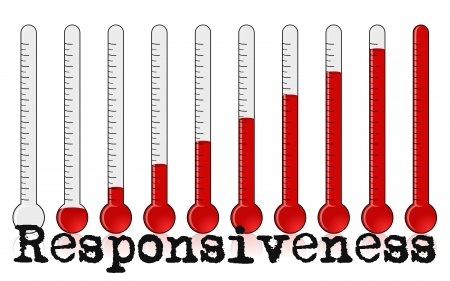
Thermometers2Continuing the list of factors that influence the responsiveness of a congregation.  Some you can influence, some you just live with.  Actually, today they are all things to influence:

5. Subject – Some subjects will be more engaging than others.  If the subject seems less engaging, don’t settle for low engagement . . . what can you do to engage the listeners?  Is there a way to bring a narrative aspect to the message, either in organisation, in setting of biblical scene (i.e. preach the narrative setting of an epistle section), or at least in illustrative content.  A good preacher can make a dull subject engaging.  In fact, a good preacher will do so without hesitation, since only listening listeners will typically be touched by a message.

6. Level – Engaging content preached over the heads of listeners, or patronisingly offered, will not actually engage.  Too heady and people feel intimated and drift.  Too patronizing and people get frustrated and feel like their time is being stolen. Make sure you pitch things at an appropriate level.  Just because you have read technical material in your preparation does not mean that people need to know that.  Aim to communicate, not to impress.

7. Proxemics – Are you elevated above the listeners, are you on the same level, or are they looking down at you?  How far away are they?  Is there furniture separating you from them?  These things can all make a huge difference.  Sometimes something as small as standing beside the lectern instead of behind it can make a huge difference.

8. Spiritual Maturity – Perhaps this is the overall goal, but if you are preaching to a church over a period of time, then hopefully this will increase.  As maturity increases, people should be leaning in more to biblical preaching that offers Christ and engages hearts.  (Bear in mind that when temperatures increased in some, the New Testament always seems to show others that became harder . . . response will not be universally positive!)

What other factors would you add to the list?

Responsiveness

Thermometers2Every congregation is unique.  If you have ever preached in a different church, you will know what I mean.  What are some of the factors that influence how responsive a congregation will be?  Let me list a few.  Some of these will just reassure you that you are not going mad.  Some may suggest things that you might be able to change.

1. Culture – Different national groups respond in different ways.  I remember preaching in a country that had just come out of a brutal civil war.  The listeners seemed so hard to me, as if nothing could move them.  Actually they were not as internally hard as they were externally, but it took some getting used to for me as the preacher.  At the same time, it isn’t fair, or even possible, to simply use broad brush strokes for describing responsiveness.  There may be a more typically British congregation, but each British congregation is still unique.  The same is true for American, or Italian, or Kenyan, etc.

2. Church Culture – Each church is different.  Different personalities will affect the tone of a church congregation.  It could be a person with a hearty laugh, or it could be an immature person with showy spirituality.  The leadership will affect the tone of a church: corporate culture is their responsibility, whether they recognize it or not.  A church with clear vision and momentum will react to a preacher differently than a church without direction left to personal preferences and a social club mentality.  Everyone makes a difference to a church culture, especially those in official or unofficial leadership.

3. Age – If there is a typical age in a group, it will influence responsiveness.  Compare and contrast talking to children, to teens, to young adults, to middle-aged folk, and to the elderly.  For one thing, if they don’t catch what you are saying, they won’t respond as you might expect them to respond.  Seems obvious, but be sure to preach appropriately to the ages present.

4. Speaker – Just in case we are starting to think that it is all about the congregation, here’s a big factor in their responsiveness – the speaker!  Is the speaker engaging?  Warm?  Flippant?  Friendly?  Upset?  Easy to listen to?  Distant? Is there lots of eye contact?  What about a smile?  Is the body language suggestive of an approachable person, or one who is aloof and disengaged?  Do the listeners get the sense that the speaker likes them, that the speaker cares about what is being preached, that the speaker wants to be there?  The same congregation can be warm and responsive, then with another speaker seem cold and uninterested.  They aren’t being fickle!

How to Preach Less Than Christian – Part 4

microphoneflat2Preacher, Bible, sermon, sorted.  Christian preaching.  Perhaps.  In this series I have been nudging us to consider whether our preaching is genuinely and fully Christian.  We have considered issues of which God we preach, what it means to be made in His image, the full extent and nature of sin, and let’s finish with one more area of focus – God’s solution to the sin problem.

4. Fail to recognize the relational and transformative nature of God’s grace.

Grace is a tricky word.  To read of sin and grace was standard fare in the past, but today there is often a push back against the notion of grace.  I think this comes from a misrepresentation of God’s grace that goes soft on sin in some circles.  This is so unfortunate.  Grace is not just a reference to God’s goodness toward us in all the biblical dimensions, it is also used as a theological label to stand for God’s provision to overcome the sin problem.  Here are a couple of thoughts on the solution to our sin problem:

A. God’s solution to our problem fully addresses our problem.  We are sinners who stand condemned legally.  Grace has to take care of that, and it does as we are justified and not under condemnation, it is by grace we are saved.  And we are also sinners relationally – our hearts are dead toward God and we lack God’s Spirit as we are separated from the life of God.  God’s solution to our sin problem is not merely to offer legal status change, wonderful and foundational as that is, He also transforms the heart and gives the Spirit (regeneration and reconciliation as well as justification!)

B. God’s solution to our problem results in genuine life change.  When people focus only on the legal change brought about by God’s grace in justification, there is a tendency to fear the potential for that grace being abused.  With good reason!  If salvation were only status change, but no heart transformation, then the flesh would still rule in every situation.  But the gospel brings change to the very motives and values of the heart.  If people are inclined to abuse grace, the solution is not balancing grace with some sort of burden and coercion, but to do a better job of presenting grace in all its fullness (and clarifying that grace does not equate to nice-ness or lax-ness – God’s love and grace are written in the crimson red of Jesus’ blood).

C. God’s solution to our problem is not merely the plan for initiating the Christian life.  Grace upon grace.  By faith from first to last.  Gaze fixed on Jesus.  The Christian life is not about turning our focus back onto our own efforts, but about growing in our love for and response to the God who loved us first.

Preaching the gospel is a wonderful privilege.  Let’s be sure to preach it both simply, and in all its fullness, with relevance to both the lost and to believers.

How To Preach Less Than Christian – Part 3

microphoneflat2Preacher in a pulpit with a Bible and some thoughts . . . Christian preaching?  Maybe.  Here is another warning sign that our preaching may be offering something less than the gospel.

3. Fail to recognize the gravity of sin.

To much Christian theology and evangelistic preaching assumes that everyone knows what sin is.  Sin is sins, right?  Stealing, lying, murder, adultery, etc.  So obvious that there is no need to probe the issue, just be sure to make lots of noise about it.  But what if our view of sin is altogether too shallow?

A. It is easy to make a lot of noise about half of sin.  Everyone is inclined to hand pick which sins are their personal target and then make noise about such things.  But the list of sins is typically truncated.  It tends to be the ones that I don’t struggle with.  But what about the deep sin coming to the surface in other ways?  More on the root versus the fruit in a moment, but at the fruit level, what about the acceptable sins?  Why don’t we hear so much on the sins that tend to be an issue within the church?  Too easily we aim our guns at people who haven’t even engaged us in our dialogue.

B. It is easy to rage against society, but what does that achieve?  I know that theologically the world is clearly in opposition to God and His values.  But at the same time, simple raging against people not present doesn’t achieve much.  For one thing, if a non-church person happens to visit, they might feel like the church is a place for complaining and arguing with straw-man enemy figures.  For instance, I wonder if people would be so bold in statements about outspoken opponents of religion if they were present?  So someone might hear and that might actually paint an unhelpful picture of the church.  Furthermore, church folk might hear and grow in their fleshly inclination to compare with others, thereby losing sight of the sin that is their own greatest problem.  Fanning the flames of fleshly pride is not helpful.

C. In our noisy preaching about half of sin, we may be understating the issue altogether.  Even if we add older brother behaviours to younger brother behaviours and make our sin lists more complete, we are still addressing the issue at the level of fruit rather than root and sap.  When we treat sin as what comes out, we make it sound behavioural by definition.  But the Bible treats sin as a heart-level issue.  The heart of the human problem is the human heart.  Out of the heart spews all types of sin: the drunken orgy rebellion type, and the prideful religious churchy type . . . both from a heart dead toward God.  The behaviours weren’t the ultimate issue with those two sons, it was their hearts – despising relationship with father and loving self.  The manifestation was different, but the hearts were equally lost.

Sin is to important to treat as a given.  We have to diagnose the depths of the human problem if our gospel preaching is to offer an appropriately radical cure.

How to Preach Less Than Christian – Part 2

microphoneflat2Christian preaching is easy to spot: preacher with Bible in a church.  But maybe it is not so easy?  Continuing this series on warning signs that your preaching may be slightly less than Christian.

2. Fail to hear the hiss of serpent-like independence in the way you view people.

We live in a culture that esteems and values and assumes the independence of individuals.  Parents are pressured to raise independent children.  Counselors seek to get people to a state of “healthy” independence.  Advertisers promise us the fulfillment of wealthy independence.  We are individuals and we will fight for our independence.  The language of freedom and inalienable rights sounds as solid as biblical truth itself.

In the sixth century a certain Boethius defined a person essentially as a “thinking-choosing individual” . . . all three elements may be true of us, but is this the sum of personhood?  Ever since Genesis 3, it has seemed to be, but it is not the original design.  What is more, the original design is still in operation, albeit broken on so many levels.  Let me explain.

A. We experience life as thinker-choosers.  I am presented with three options (three cookies or three jobs, whatever), and I think and I choose.  Simple.  But why do I think what I think?  Why do I choose what I choose?  Where are the values coming from that enable me to prefer chocolate chip over peanut butter . . . many people would argue that my preference for the former is irrational, but that just shows they have differing values.  Where do they come from?  And I do make choices, but why is it that I always choose what I want to choose?  Why is it, as sales people know, that we actually seem to buy based on what we love and then rationalize and justify our preferences?

B. We experience life as individuals.  I have my own private thoughts and desires and dreams.  I have my own private thought processes and struggles and difficulties.  I make my own choices.  There is a disconnect between me and others.  Yet I also experience that my life is not really truly independent.  My choices make a mark on family and friends.  And often in my private independence, there is a loneliness and apparent lack.  A beautiful sunset does little for me if I feel genuinely alone in that moment.

C. We were created as heart-driven relational responders.  Our thinking is informed by our heart values.  Our choices are driven by our wants.  Our inherent design is profoundly relational.  We will choose what we want, but we cannot choose what it is that we want.  Our wants are free to roam around the gravity centre of our heart-orientation, and in our sinful dead state, we are dead toward God as an alternative gravity centre to our self-world.

Implication for preaching?  If we are treating people as thinking-choosing individuals, we may be saying Bible truth to them, but our preaching will be less than Christian.  We cannot simply educate people or pressure people into social conformity and call that gospel ministry.  The gospel works not from the outside-in, but from the inside-out – it brings heart change that leads to life change.  Boethius didn’t get that, let’s be sure we do.