Continuing our walk through twelve points of advice from John Wesley. So far we’ve looked at numbers 1-2, and numbers 3-5. Let’s move on…
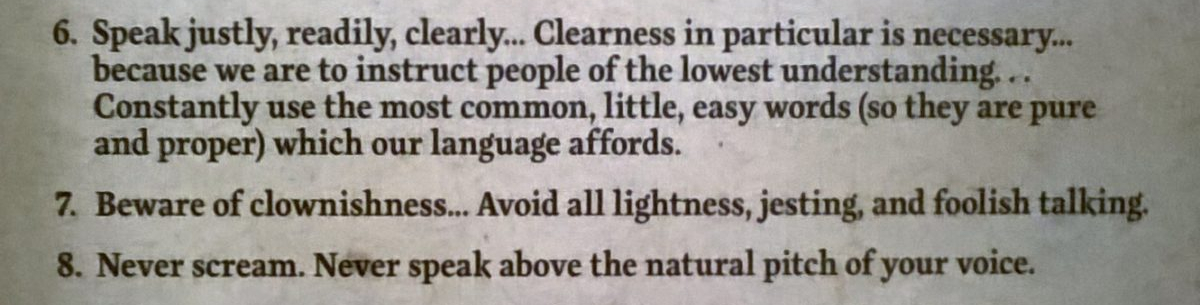
6. Speak justly, readily, clearly… Clearness in particular is necessary…because we are to instruct people of the lowest understanding… Constantly use the most common, little, easy words (so they are pure and proper) which our language affords. Most of us are not preaching to uneducated miners like Wesley did, but don’t let out-of-date phrasing obscure the point he is making. Our job as preachers is to communicate, not to show off. If you don’t have a theological and grammatical terminology that is higher than your preaching vocabulary, then you are either aiming too high with your words, or you are too weak in your study. Say the profound things that the Bible says. And say those things in the simplest way possible. Even if ten PhD’s walk into your church, you still need to preach so that people with the least understanding (by means of their education, church being an alien environment, English not being their first language, or whatever) will be able to understand what you are saying. Be clear. Simple.
7. Beware of clownishness… Avoid all lightness, jesting, and foolish talking. Again, good advice. There is a place for humour in preaching, but we do need to be very wary of entertaining or making the sermon about us. I suspect that if we avoid jesting and foolish talk, as well as clownishness, then we are on safe ground. We don’t have to come across as sombre in every moment, but we should speak as if we have a very important message to convey – which we do if we are preaching the text properly. We need to be wary of inappropriate formality. Just as wearing a tuxedo can feel out of place, so can a strange and affected formal tone or a presentational gravitas that is not consistent with our personality and natural demeanour. In our fear of jesting, let’s not come across as unloving, lacking in warmth, or out of touch with the room.
8. Never scream. Never speak above the natural pitch of your voice. This was probably a greater concern before amplification equipment. Nevertheless, this point still applies. There is a natural upper limit to your pitch, your power, and even your pace. Don’t go above that level to achieve some kind of emphasis. The screamer seldom communicates anything other than a loss of control. In fact, it is good to consciously work on going down instead of up for emphasis. Down in pitch. Down in power. Slow down the pace. Emphasis sounds very natural in the opposite direction, but it takes unnatural work to develop the skill! And even more foundationally, your emphasis and impact is not ultimately determined by your vocal delivery, but by God’s Spirit bringing conviction to your listeners.
So last time we started this list of 12 points of advice to preachers from John Wesley. Let’s keep going!
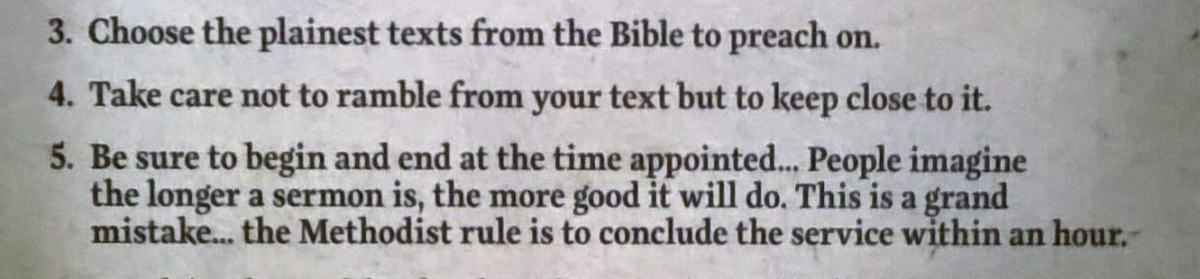
3. Choose the plainest texts from the Bible to preach on. Again, if I were purely speaking to non-believers then I would completely concur. However, in a typical church setting, we will be speaking to both Christians and non-Christians. A steady diet of the same evangelistically oriented passages will lead to some malnourishment among God’s people. I think it is good to help our churches experience the full breadth and scope of God’s Word. You might preach more from the New Testament than the Old, but if they never hear the Old Testament preached, why would they read it? And if they don’t read it, what a vast vista of theological truth is lost. Different types of text are also important for the health of the church.
So on the one hand, I would agree that every passage has a redemptive force that should be brought out because believers never move beyond the need to hear the gospel being applied to their lives. On the other hand, while every passage is useful, not every passage is equally useful on every occasion. Don’t be stubbornly preaching through Jeremiah when people are coming for a Christmas Carol Service. Bottom line? Be selective and choose what you are going to preach appropriately for the listeners and the occasion, but in a church choose from the whole Bible because people need more than your favourite five passages.
4. Take care not to ramble from your text but to keep close to it. Can I just say I agree and move on? Of course not, otherwise this would be a “Quote” rather than a “Blog!” It is quite remarkable how little weight the Bible passage will have in some sermons. Some will leave it behind to ramble into excessive personal anecdotes and humorous illustrations. Others will leave it behind to ramble into theological presentations that resemble explosions in a concordance factory! (Hyper cross-referencing is very common in some circles!) Few seem to recognize that this passage is uniquely powerful and should not be missed by superficial coverage in the sermon. Your church may not be back in that passage for several years. Keep close to it, do it justice, allow time for clarity to emerge and its impact to be felt.
5. Be sure to begin and end at the time appointed… People imagine the longer a sermon is, the more good it will do. This is a grand mistake… the Methodist rule is to conclude the service within an hour. Several points in this one. Let’s go one-by-one – (1) begin and end on time. I understand that different cultures have different expectations in terms of time. But the point still applies. Abide by the expectations of the culture. Once we break the general expectation, then we distract attention from the sermon. If we go 10 minutes over, parents are concerned about children in kids’ groups, volunteers in kids’ groups start to lose their joy in serving, and others are concerned about their plans, their lift home, etc. Generally speaking, stick to time. Seems fairly simple.
(2) Longer is not necessarily better. Again, agreed. Haddon Robinson was captivated by how some preachers preach for ten minutes and it feels like an hour, while others preach for an hour and it feels like ten minutes. Length tends to become the key focus when too little attention is given to clear, engaging and relevant content and delivery. Generally speaking, longer sermons could be sharpened into shorter sermons. But shorter is not automatically better either. Some things take time. Just as an illustration might be lost in two sentences, but really capture hearts in two minutes, in the same way, a sermon can be technically precise in a shorter timeframe, but more vivid and engaging with enough time given to let the listeners’ imagination flourish. There is no right length of sermon. It depends on preacher’s skill; listener’s background, expectations and focus; and the occasion too.
(3) Service length should be less than one hour. That feels quite arbitrary and culturally bound. I imagine that didn’t translate effectively in some other global contexts! But, service length should be considered for the sake of church attendees, as well as their perception of service length for potential guests they might invite in the future.
Solomon wrote thousands of proverbs. So when he writes, “Above all else…” – that should get our attention. What is “above all else” from Solomon’s perspective? In Proverbs 4:23, he tells us: “guard your heart.” That is huge. He recognized that the heart is the governor of all our activity, but strangely he did not simply say, “control your heart.” If we could just control our innermost desires, then we would have no problem living holy lives (or even being successful in any other pursuit of our choosing). Perhaps at the core of our being, we are responsive to external stimuli and not simply responsible free agents who can consistently choose whatever is best. The wise advice in this section of Proverbs is profoundly important for us as we head into another year.
In Proverbs 4:20-27, Solomon urges the reader to pay attention to his wise words – looking at them and keeping them in our hearts (v. 20-21). He underlines the critical role of the heart and the need to guard it (v. 23). He urges the reader to protect themselves from careless speech or from letting their eyes get drawn aside so that they should step away from their path (v. 24-27). Above all else, in 2023, we need to guard our hearts. I believe a great place to begin is with a prayerful eye evaluation.
I have been pondering a scale to help me take stock of what is getting through my eyes and influencing my heart. It is a scale that runs from -2 to +3.
Distractedly Entertained – Level 0? Long ago, this might have involved some children playing a game in the town square or an animal behaving amusingly. It was a break from the norm. Nowadays, we have entire industries actively targeting you with entertaining distractions. Scrolling through Facebook or Instagram, watching random YouTube videos about cats, men throwing CDs into a CD player, the most bizarre incidents in professional sports, and this list is designed never to end. Then there are video games, an endless Twitter stream, etc. Distracted entertainment has become a staple part of our cultural diet in recent years.
I think we can make a case for calling it Eye Level 0 entertainment because there is implicit moral neutrality to some of what distracts us. But once we consider all factors, is there really moral neutrality? Could we be hurting ourselves by believing that we can stand still in a world that is relentlessly moving away from God? Perhaps we would do well to call this entertainment Eye Level -1. The Bible does warn us about time-wasting, which can involve things that are not wrong in themselves. The average weekly consumption of distracted entertainment in our culture is stunning. Perhaps we have become more entangled than we realize. Let’s confess that entanglement and prayerfully take steps away from Eye Level -1 and the regret of lost time as we head into this new year.
So we have Distractedly Entertained – Eye Level -1.
Sinfully Entertained – Eye Level -2. Any of the above activities can easily slide into sinful entertainment – where we seek satisfaction for sinful desires through what we watch. The classic example is pornography, an industry that has made its content far easier to access than ever before. But even without the things that a good filter will stop on your device, we can also fall into “pornographying” non-pornographic content. Perhaps we think of it as a more sanctified type of lust that does not rely on overtly provocative material – on social media, TV shows, movies, etc. And then there is envious window shopping or jealously obsessing over what the rich and famous wear and drive. There are so many contemporary forms of idolatry. “Search me and try me, O Lord…” – prayerfully ask God to show you where your distracted entertainment has morphed into something even more harmful than time-wasting.
Let’s get back to the positive end of the scale:
Intentionally Entertained – Eye Level +1. There are legitimate uses of entertainment media. We need to evaluate prayerfully so that we don’t get sucked in by what our world is pushing us to think. However, there is a place for finding a TV show refreshing, a favourite movie can be restful, a shared football game can be social, a good book can be helpfully engrossing, etc. Where Eye Levels -2 and -1 leave us guilty, ashamed, worn down, frustrated, and empty, Eye Level +1 entertainment can be good for us.
Informed – Eye Level +2. In the old days, this might be found by listening to a report from a friend who has been travelling, reading the newspaper over breakfast, or watching a helpful documentary on the television. The rarity of access to information placed a premium on this commodity, but today, the situation has changed. We are bombarded with information. A well-chosen news subscription, a select list of Twitter accounts to follow, some helpful YouTube subscriptions, or a select set of blogs, etc., can be beneficial. The key seems to be planning rather than scrolling, or else we end up back in Eye Level +1 intentional entertainment, or even more likely, in Eye Level -1 distracted entertainment, or worse.
We are bombarded with the enticement to fritter away hours in Eye Levels -2, -1, +1 and +2. As we get used to and dependent on technology and social media, we may even start to think that our mental health, knowledge and spirituality are to be found somewhere in Eye Levels -1, +1 and +2. Perhaps we even think that our ministry is helped and built up in Eye Levels +1 and, especially, +2. But let’s remember that there is another level.
Enriched – Eye Level +3. There is something different about Eye Level +3. In the old days, time spent in the Book or good books was an obvious option in a world with a relatively limited range of alternatives. The significance of good reading was especially true for a serious-minded Christian, and even more so for a minister of the Word. Nowadays, this can be so easily lost. We live in a tidal wave of evil, distractions, entertainment, and information. But even if we avoid the worst of that flood, there is still a qualitative difference between being informed by a screen and being enriched by the page. Personally, I find that even reading the same author on a blog does less for my soul than spending time reading their book – is that just me?
We live in an age of hyper-distracted, entertained, and even a few well-informed, but largely unenriched people. It shows in our world today. Are we also living in a time of well-entertained and sometimes well-informed but largely unenriched believers? It shows in our churches and pulpits. So let’s do something radical. Let’s value that which enriches our souls and takes our relationship with God and others to someplace deeper than the norm.
As we head into 2023, let’s take stock of how God would want us to use our eyes this year. After all, they are an essential gateway by which we can guard our hearts.
________________________________________
In 2023 I am planning to release short videos related to Bible study. God has given us a great treasure. How can we read and study it for maximum understanding, enrichment and life impact? Please subscribe to this playlist to see the videos as they are released. Please like, comment, and share any that might be helpful to others. Thank you!
As we come to the end of another year, the finish line is in sight. Christmas plans are in place, and all those events will soon be over. Before you know it, we will be into 2023 with all the familiarity of a New Year and the uncertainties of a new year. We know people will join the gym and try to read through their Bible, but we never know what is about to happen.
Between the Christmas events finishing and the launch of 2023, let’s take a moment to take the pulse, actually, several pulses. If you are involved in church ministry, then here are some pulses you need to be checking:
1. God. How does God feel about your church? How does God’s heart beat for all that matters to you? God’s heart is your ultimate concern. Knowing God’s heart doesn’t require mystical guesswork. It requires time in the Bible and time in prayer. We should prayerfully prepare every sermon we preach, and I think it is wise to seek God’s heart for each passage and how it should land in the hearts of your listeners. But why not take the year-end as an opportunity to seek God’s heart about your church, your ministry, and your part in His plans?
2. Society. Are you aware of what is going on in society? There is a whole edifice presented by the media, the news, and the current catalogue of acceptable issues and concerns. We need to have our finger on the pulse of society, whether we agree with all of it or not. That sense of what is normal will throb in the veins of the people you encounter daily.
3. Reality. Are you in touch with what you are not supposed to think? There will usually be significant parts of society that are not convenient for reality as presented in the media. It is good to have a sense of what people are thinking but not saying. Or what they are saying but you are not allowed to hear. It is good to know what is happening, and sometimes others will need you to point beyond the cultural narrative they are constantly hearing.
4. Congregation. Your congregation is not a perfect representation of your society. The culture is pushed along by sophisticated ideas and/or unsophisticated entertainment. Still, your congregation is a specific group in a particular location. The country could be thriving while your part of town is economically depressed, or vice versa. The nation could be gripped by avant-garde notions, while your congregation may seem to be living a generation behind. Who is in your church? What are their concerns? How are they doing? The culture may be focused on saving the planet, but your people may be more worried about staying warm and paying their bills this winter.
5. Future Congregation. It is understandable that we tend to focus on the flock God gave us. But it is also wise to ponder what the future may look like for your church. If you have a very established congregation, you still need to preach to people new to the church. They may not even be coming yet, but preach to them anyway. Your congregation will not feel comfortable bringing them along if you don’t make it a suitable environment. So, what kind of people might God want to add to your church in the coming years? Why not prayerfully think about preaching as if they are already attending so the church is ready to receive them when they do?
6. Co-Workers. If your church program gives you room to breathe, be sure to prayerfully consider the health of your coworkers. You know that your church is not your church. You cannot do everything yourself and your church would be in dire straits if all your coworkers were to quit or burnout. Whether they are paid staff members, or busy volunteers who give sacrificially of their “spare” time, how are they doing? Pray for them. Reach out to them. Write them a note to thank them. Make sure that you do not head into 2023 unaware of warning signs from those around you.
7. Me. Ministry can take its toll. How are you doing? Are you in a good place with God? How much has your ministry depleted your energy reserves? Are any situations weighing heavily on you and setting off warning lights? Are you letting yourself slide in any areas, succumbing to temptation, or developing unhealthy habits? The end of the year is an excellent time to take your pulse before launching into another year. Take your pulse spiritually, physically, mentally, and emotionally. How is your walk with Christ? Are you looking after yourself properly? Do you have the relationships you need to thrive? Is someone mentoring you? Are you mentoring someone? Who can you be open with as a peer? Who is looking out for your heart? Are you proactively meeting people outside of church circles? Oh, and don’t trust yourself to self-evaluate. Ask God to search you and try you, and ask those close to you for their perspective as well.
8. Family. Ministry can take its toll. How is your family? It is easy to sacrifice your family on the altar of ministry, but is God honoured when you do that? Suppose you have a child who is not thriving spiritually. Would it make sense to devote more time to your primary responsibility of parenting? You might even do well to consider a sabbatical or taking a step back to pursue their heart for a season. I know it is complicated if you depend on ministry for your income, but many readers are not receiving a salary. And whether you are or not, it could be a significant example to others to see you put family first and seek to win the hearts closest to home. It is not a simple decision. Nevertheless, I raise it because too many of us would not even consider stepping back from the ministry that gives us too much of our identity to care for the people God has most entrusted to us. Nobody else can be your spouse’s spouse, and you only get a limited window with that child still under your roof. Of course, you may find such drastic changes are not needed. But perhaps you need to tweak some things at home so that your church ministry can flow out of greater strength at the family level?
I know we are taking a deep breath before the chaos of Christmas. I pray that your Christmas events will proclaim the peace that only Christ can bring into this desperately needy world. And I also pray that we will all get the opportunity to take a deep breath after it is all over. May we all take the opportunity to check the pulse in these areas and head into the New Year looking to Christ for each of the needs we discover!
________________________________
This year’s video quest through the Psalms will soon reach the finish line. Here is Psalm 139:
How is the church you preach to supposed to be different?
1. Not naïve, but alert & hopeful. How easily we can lose our bearings as believers. Especially as relatively comfortable believers. It is so easy to get caught up in the hype of our society and fall into the naïve trap of thinking, “there is peace and security.” After all, our country has been free and secure for generations. And the everyday stuff of life is carrying on as it has for as long as we can remember: the sports calendar, the TV series, the progression of seasons, the endless cycle of monotonous news, etc. Yes, our world is declaring certain destruction of the planet and will pat itself on the back for every effort to rescue our future from its terrible fate. Meanwhile, some of the loudest voices continue to buy their beachfront properties while proclaiming the scientific certainty of destructively rising sea levels. And so we must all play along with their panic. But despite all the shouts, most people still have a naïve confidence that nothing will actually change. The news is just noise. There is no credible threat to my safety and sense of peace.
And yet, 1 Thessalonians 5:1-11 seems to expect Christians to be different. Christians are supposed to be marked by alertness, discernment, sobriety, readiness and hope. Our faith, hope and love are not typical of humanity in any age. We do not stand apart by pretending all is well or spouting nice Christian platitudes. This world is heading for sudden destruction and wrath. And amid a society that tinkers as the empire heats up, we know our salvation is in Christ, so we encourage and build one another up.
2. Not self-absorbed, but purposeful. How easily we can reflect the relational dynamics of our fallen world. When selfish materialism gripped society, it was easy for Christians to play that game with a smug sense of sanctification (God is blessing me!) What if society is now becoming enchanted by a new, but still self-serving, moral ideology? Well, it will also be easy for Christians to play that game. Many already are. We only need to learn hypersensitivity to certain moral trigger concepts and remember to celebrate brand-new self-defined and unquestionable identities. The morality of intersectional identity politics is replacing the ethics of liberal democracy. However, Christians will still simply add a Bible verse to their version of it and fit right in.
And yet, 1 Thessalonians 5:12-14 seems to expect Christians to be different. Like many in the New Testament, this passage describes a community gripped by a counter-cultural perspective that shapes a more purposeful and selfless set of relational dynamics. Instead of a subtle rebellion against leadership, there is to be respect, esteem and love. Instead of interpersonal squabbling, whether the garden fence gossiping of yesteryear or the proactive and unfiltered taking of offence and wholesale interpersonal condemnation of today, Paul’s language of living at peace is radically different. And instead of using the community for my selfish goals (think classic networking in strategic gatherings or contemporary social narcissism on the media platform of your choice), the Christian community differentiates need among people so it can selflessly address each need. A loving Christian community should feel radically different.
3. Not worldly, but distinctly His. How easily we can lose our distinctness as followers of Jesus. We are like fish swimming in a spiritually fallen fish tank and still assume what we experience is normal. And since our experience defines normality, our conduct will tend to reflect it. We compete. We get our own back. We moan. We can be prayerless, thankless, and unspiritual. We can live only by what we see. We can indulge.
And yet, 1 Thessalonians 5:15-28 seems to be urging us to be different. There are instructions that counter the list of normal behaviours listed above. And there is the closing benediction, where Paul prays that the God of peace will sanctify, set apart, make holy, transform, and distinguish. How much? Completely. How blameless? Every aspect of our being. And is that transformation down to us? No, God is faithful and will surely do it. The Christian church should be radically and progressively more different because we are not called to fix ourselves, but we are called by the One who can bring about the necessary change in us.
1. Young believers need to be prepared for suffering. Paul understood their context. They were in a city and a society that would react antagonistically to their newfound faith. So Paul had prepared them for suffering, and as time passed, Paul knew that they needed to be supported in their struggle. He knew the enemy would be on the attack against these new believers. Maybe we need 3:1-5 to direct our path more in our ministry? Do we understand our context? Our believers are in a culture that is increasingly antagonistic to their faith. The enemy is very much prowling around today seeking to pick off vulnerable believers. As much as ever, and perhaps more than ever, we need to prepare believers for suffering. There is the immediate and usually subtle antagonism of our time. And surely we can’t be so naive as to think that our cultures can undergo such radical shifts as we have seen in recent years, and yet remain essentially unchanged in the coming years? Are our people prepared for living in a society that may bear more resemblance to countries we used to pray for than the countries we used to live in?
2. Don’t just let vulnerable believers drift. Paul’s team adjusted to offer support to the Thessalonian believers. Timothy was sent back and returned with an encouraging report. Let Paul’s statement bounce around your heart for a moment, “For now we live, if you are standing fast in the Lord.” (3:8) For now we live . . . I wonder how often I hold back from this kind of concern for the sheep under my care? It is true that life change is God’s business and I can’t force it; and it is true that sometimes people need to drift in order to become sensitized to their need for Jesus; and it is true that with limited ministerial resources we will inevitably prioritize the sheep that are leaning in to be fed and cared for, etc. However, with all the practical wisdom of real-life ministry acknowledged, let us never grow calloused and comfortable with people drifting away from Christ.
3. Is there a more important ministry than prayer? Remember Acts 6:4 – the apostles didn’t want to get dragged into serving tables (which included negotiating inter-racial tensions within the new church: a significant and important role!) But what did they not want to be dragged away from? The ministry of the Word and prayer. And prayer! Is there a more important ministry than prayer? For many in ministry, it can appear that the priorities are preaching and leadership. Or preaching and organisation. Or preaching and publishing. May we all gain a secret reputation before God for the priority of prayer in our ministry. And somehow, let’s also encourage our whole church to be prayerful. Look at the Paul-team and how they prayed in 3:10-13. “Most earnestly night and day” and, “may the Lord make you increase and abound in love for one another and for all,” and “that he may establish your hearts blameless in holiness before our God…” Earnest prayer for growing love and established holiness. What believer would not want to be the beneficiary of that kind of concern?
The book of Psalms tends to become a favourite for people who have faced some challenges in life. Perhaps you have experienced grief over the loss of a loved one, discouragement during a dark season of life, or any other challenges that set the Psalms into vivid colour in our hearts. Once we know of the soul food kept in that storehouse, we tend to find ourselves returning again and again.
Sometimes the Psalm writer has found words for the ache in my heart. Other times the psalmist points my heart to where it needs to be looking. The book of Psalms is a real treasure – a refreshing spring for the weary times we all have to endure.
The book of Psalms sits at the centre of our Bibles for the times we are just reading through. Maybe there is no experienced crisis that leads us to this vast collection of Hebrew poetry. Sometimes, we will find ourselves reading it simply because it comes next in our Bible reading. It can be a great experience to read it through with fresh eyes and notice the uniqueness of each Psalm and the recurring themes.
Let’s look at the first Psalm of book five – Psalm 107. This Psalm sets the tone for the section that will follow. It begins as you might expect, with a call to thank our good God for his enduring, steadfast love. This call goes out to all who have been redeemed and rescued by God (v1-3).
Then we find ourselves walking through four examples of challenging circumstances from which God rescues his people:
First, we read of the weary wilderness wanderers failing to find a place of sanctuary (v4-9). They cried to the LORD, and he delivered them. (Those words will come up again.) So, with stomachs full and souls satisfied, the psalmist encourages them to thank the LORD for his steadfast love.
Second, we read of the helpless prisoners, tired and broken by hard labour (v10-16). They cried to the LORD, and he delivered them. With their bonds broken and bodies set free, they are called to thank the LORD for his steadfast love.
Third, we read of the afflicted starving to death, suffering for their sin and facing their demise (v17-22). They cried to the LORD, and he delivered them. With healed bodies and joyful hearts, they are invited to thank the LORD for his steadfast love.
Fourth, we read of the fear-filled seafarers, tossed to and fro by the raging seas, despairing and at their wit’s end (v23-32). This example gives more vivid detail, but again, they cried to the LORD, and he delivered them (see v 6, 13, 19 and 28). With the storm stilled and safely brought back to the fellowship of humans on shore, they are encouraged to thank the LORD for his steadfast love (see v8, 15, 21, 31)
The final section of the Psalm underlines some of the points made throughout. God is in charge. Just as he can bring about change in nature (v33-38), he can reverse his people’s fortunes (v39-42). And so, the final verse ensures we have not missed the point. If we are wise, we will ponder what this Psalm says. Indeed, if we are wise, we will ponder, contemplate, consider and meditate on the steadfast love of the LORD (v43).
The Psalm begins and ends with the spotlight on the steadfast love of God. The Psalm invites us to consider four examples of people in dire straits who called out to God and discovered why they should thank God for that steadfast love.
Perhaps Psalm 107 is the food for thought that we need. It could be that we feel like we are close to death or tossed in every direction and despairing of life itself. Or it could be that we are calmly moving through the second half of 2022, thankful for God’s blessing and a season of tranquillity and peace. Whatever may be going on around us, Psalm 107 suggests what should be happening inside us. We should be considering the steadfast love of God. Honestly, it is hard to think of a wiser thing to do.
I remember sitting high up in the Royal Albert Hall for a schools concert some years ago. Impressive venue, electric atmosphere, and stunning music. All of the music was very good, but there is something unique about the 1812 Overture once the cannons are fired up in the rafters – it was so fun to watch the children’s faces (they didn’t know it was coming!) I am no classical music fan, but that always feels like a high point in any concert.
The thing is, music can’t all be a thrilling crescendo. And the musical impact is not all achieved by crescendo. There are variations of melodic themes woven together, changes from major to minor key to influence the mood, variations in rhythmic intensity, and so much more. It would not make for great music to simply string together and elongate every possible crescendo (or add cannons to every piece)!
The same principle is true in preaching. There are various ways in which we can start to lean on a powerful crescendo too much, and thereby weaken our preaching. Here are a few examples:
Your Voice – Undoubtedly you can run into a crowded room and get everyone’s attention by screaming. That doesn’t mean you should scream your way through a sermon. Naturally, when we are excited about what we have to say, our voice will tend to climb upwards. It will go up in pitch, up in volume, and up in pace. And the ability to pause meaningfully? That will go up in smoke! As a preacher, you will do well to learn the benefit, and the skill, of going down for emphasis too. You can go down in pitch, down in volume, and down in pace – all for a non-crescendo variation on emphasis. And bring the skill of pause back down to earth too, it really can help!
Your Points – It is so easy to find a formula that works for a point in a message and then find yourself repeating that same formula for each point. Perhaps the flow moves from stating the point to explaining it textually and then applying it with an exhortational forcefulness that works well in point 1. That does not mean that point 2 must also have the same crescendo at the point of application. Be sure to look at how your points serve each other. Sometimes a point works better without forcefulness – let it fulfil its function in the message.
Your Support Material – It is always tempting to think that a certain type of “illustration” will always work well because one particular example did. Maybe your sermon seemed to soar when you recounted the moving story, shared the humourous anecdote, or let rip with the fiery rebuke (you know your tendency in terms of preferred “illustrations!”) Great. Be thankful that it worked. But don’t start to lean on that type of material to the exclusion of others. People grow tired of perfectly placed emotional stories, side-splitting humour, or repeated rebuke. The repetition will not achieve greater impact but will move listeners to start to see your preaching as manipulative, your goal as to entertain, or your pastoral concern as haranguing.
Your Series – Last Sunday I was preaching the passage after God rescued Isaac on Mount Moriah. That had been a crescendo message in an Abraham series stretching back for many weeks. People commented and appreciated and responded to the emotional impact of that sermon. So what to do the week after? It was tempting to try to continue the crescendo. Why not keep up the same emotional pitch for maximum personal impact? Instead, I chose to deliberately preach in a much more relaxed “teaching” style that allowed us to consider the new passage before us. I think it was the right choice. There was still some emotional impact, but it was not through the perpetuation of the crescendo. The message was in a different key, the music made its own impact, and it didn’t try to roll out the cannons again.
Where else can we find ourselves leaning on crescendo to the exclusion of other helpful options?
Sometimes changing the label for something can make a big difference. A couple of examples before I introduce the one that I want to focus on in this post:
Example 1 – Teaching preaching over the years, I have shifted from talking about “illustrations” to explicitly describing what is needed: “explanations/proofs/applications.” Identifying what you are trying to do helps you avoid filler material that has the vibe of an illustration but doesn’t achieve anything specific. Why not call it what we want it to achieve? Even in our thinking, this can help our precision as communicators.
Example 2 – As parents, we want our children to learn to serve and contribute to the functioning of our home. It is good for the family, and it is good for them too. But the standard label used is “chores.” Oh dear. Who would want to do a chore? So, we grabbed a label we saw someone else using. “Contributions.” You have to do a chore, but you get to make a contribution. It is just a label, but it does make a difference.
Ok, so what terminology tweak am I thinking about in this post? Well, it is the strange world of Christian “disciplines.”
The language of disciplines gets used in quite different wings of the Christian church. There are the dutiful disciplines of the more intellectually shaped branches of the church. The disciplines here tend to relate to attendance, reading, learning, etc. Then there are the ascetic disciplines of the more experientially shaped branches of the church. Here you will find more focus on the disciplines that relate to self-denial, solitude, fasting, etc.
In reality, much can be said in favour of all the disciplines on both sides of the church. This is why much is said in their favour. But can we stop and question the label for a moment? “Discipline” is the language of the exercise class, the language of the academy, and the language of performance in work, sport or the arts … but is it really the language of relationship?
Discipline and Relationship
Undoubtedly, much effort is expended in a relationship, and that effort will look disciplined. If you were to spy on my marriage, you would see disciplined actions on my part. There are specific jobs in the home that I repeatedly do: locking the doors, putting out the garbage, etc. And yet, if you asked me about my practising of the marital disciplines, I would wonder what you are saying. I put the garbage out in a disciplined manner, but I don’t see it as a discipline. I spend time on dates with my wife, but I don’t see that as a chore.
Many spiritual disciplines are good things: reading the Bible, spending time with God, fasting in order to pray, getting away from the busy distractions of this world, etc. I don’t want to question these things, but I do question the label. Would you promote them as “Christian chores” in your church? (If you would, perhaps that says something about your view of the Christian life!) I would not. I prefer to remove the overtones of duty and effort from the label so that the label is free actually to describe the goal.
The Goal of Disciplines
What is the goal in performing a discipline? Relationships do require disciplined effort, but they rarely thrive under the language of discipline and effort. For instance, your spouse will not feel so warm towards you if you hand over the flowers or chocolate, while referencing your effort and discipline. “I hope you like roses. I needed to do my weekly thoughtful-gift-discipline, so I got you these.” Please don’t say that; it won’t help. And if you do say that, it will shape how you view the giving of future gifts. The goal of the “discipline” is not a have-to but a get-to. The goal is not your successful accomplishment of the “discipline” but the communication of love to your significant other. And as you lean toward this other person, you will find your heart warmed and drawn towards them.
So, what can we call the spiritual disciplines that will remove the overtones of “chore,” the focus on “self,” and the assumption that it is my performance that will lead to life change? What can we call the spiritual disciplines if we are actually talking about growing in a relationship?
Finding An Alternative Label
It can be hard to choose an appropriate alternative label to replace a well-established one. My mind goes to several possibilities. Are we talking about spiritual reminders, encounters, re-introductions, heart-warmers, match-making, or exposures? I am seeking a term that makes it clear that the activity is not an end in itself, but a way of inclining my heart towards Christ in such a way that my heart might respond in faith and love towards him. I cannot control my heart’s responses, but the Bible does speak of guarding the heart from negative influences and inclining the heart towards God’s good influence. Each term listed could have unhelpful connotations. How about for now, until we agree on a better term, we use “spiritual heart inclination”?
I need spiritual heart inclinations in my life because when I spend time in God’s Word, worshipping, praying, or with God’s people, I am leaning into the relationship that I have with the Father, through the Son, by the Spirit. This “leaning in” will not be successful because I am responsible and repeat the exercise. It will be successful because my heart is warmed by the wonderful one I am exposed to in the process.
Instead of starting my Bible reading with the thought, “I need to be responsible and get through my chapters for today,” I can start with the prayer, “I need to respond to a glimpse of your heart as I incline my heart toward you, O my God, and I so need to see you in your Son today – I want to see you, please….” The first is the self-concerned declaration of disciplined intent. The second is the inclining of the heart towards the One who can inspire that inside-out transformation I so desperately need.
It is not the discipline of reading a certain number of chapters that will change me any more than the regularity of simply visiting a restaurant that will achieve connection in my marriage. The inclination of my heart toward Christ in his Word (or my wife in the restaurant) will allow a response to be stirred within me.
May our lives be disciplined in our responsiveness to Christ, but may the label of discipline never again feel appropriate for our connection with Him. Spiritual heart inclinations, or a better label you suggest in the comments, that’s what we need. Because it is not about me but him. It is not about my responsible effort but my response to Him. And spending time with the lover of our souls is no chore but a privilege.
During 2022 I have been enjoying a slow walk through the book of Psalms. I have been working through the book one Psalm at a time. I have shared the journey via YouTube and sought to convey a detail and a point of application from each Psalm to help others enjoy reading the Psalm. I will attach the playlist below this post.
As we are now at the halfway point in the year, I thought I would pull together some reflections:
Slowing down and pondering a Psalm allows you to appreciate the artistic crafting contained within a Psalm. For instance, if I look at the short five verses of Psalm 70, I notice the key terms repeated in the first and last verses: haste, O God, deliver me; O LORD, help me. Actually, while I knew that Psalms can give a sense of completion by using similar terminology at the beginning and end, I have been surprised by how often that occurs. And the use of inclusio, or “bookends”, is only one of many types of artistry to be found in the Psalms.
Scribbling on the text of a Psalm allows you to notice the flow of thought more easily. Again, sticking with Psalm 70 as a simple example, there are two movements within the body of the Psalm. In verses 2-3, the repetition of “Let them…” shows David’s concern regarding those opposing him. He wants God to deal with them. Then verse 4 has the repetition of “May…”, which points to the positive request and anticipation. David knows that seeking God leads to good for his people. Judgment of them; the blessing for us.
Study intensity does not preclude devotional impact. I remember Gordon Fee writing about the need for exegesis and devotion. He noted that just as a church does not need an exegetically precise pastor who is lacking in devotional warmth as he studies his Bible in sermon preparation, the people in the pew should not be devotionally warm while being exegetically imprecise in their personal Bible times. Sometimes we fall into the trap of separating technical study from devotional reading. But when I scribble on a printout of a Psalm, note the structure, the parallelisms, the imagery, and even when I turn to a technical commentary to probe a specific issue, none of this precludes the devotional impact of the Psalm. The end goal should be that the Psalm speaks to my heart, affects my life, and potentially gets shared as an encouragement to someone else.
Simplicity in Psalm study is sometimes where we find the treasure. Some of us set the bar very high for our Bible engagement. We think we have to plumb the depths and find high-level technical insights in every study. But in Psalm 70, the bottom line is straightforward. David starts the final verse with an extra line before returning to the terms that bring the Psalm full circle as they repeat the opening ideas from verse 1. What is the additional line? “But I am poor and needy.” The enemies of David need to be judged. God’s people have reason to rejoice in God. David is poor and needy. So, hasten, O God, deliver and help me. The bottom line that we can take away? “I need God.” It is not high-level original thought, and I will not get a PhD for noticing it, but it might be just the thought I need as I walk with God today.
Short Psalms do not have to mean brief study. Psalm 70 is just five verses long. It is essentially a repetition of the final verses of Psalm 40. So, with it being brief and recently studied, does that make it a quick cursory study? It does not have to mean that at all! God’s Word can always be a fruitful chew! I understand the benefits of a quick read and simple study – we all need those too. But there is nothing to say that a brief Psalm must not linger longer than a few minutes in our minds and hearts. Meditate on God’s Word, day and night – that even sounds like a healthy Psalms idea!
Some Psalms point overtly to Jesus; every Psalm points to God’s character. Some Psalms clearly point beyond themselves to the coming greater son of David. In other Psalms, the connection to the coming Messiah is less overt. But every Psalm points to God’s character, which is an excellent focus for your heart. It is never too big a step from God’s goodness, grace, mercy, and blessing to the fulfilment of God’s great plan in the coming of Jesus. You don’t have to force a detail to make the link explicit. But do make sure you are enjoying the God who is revealing himself through this beautiful book.
Say what you see – the Psalms ask to be prayed or sung. As you read through Psalms, you may find a tune already in your mind. For example, Psalm 34 and Psalm 68 seem to strike up several songs because of songs sung in my church growing up or today. Other Psalms may feel very unfamiliar in their wording. Yet, often they offer the very words my heart wants to be praying to God. That feeling of profound contemporary relevance is not rare when spending time in Psalms. So let the words work in your heart and then let the words work on your lips, whether you are singing God’s praise or crying out to God in prayer.
Share what you see – the Psalms are asking to be passed along. There is something incredibly transferable about the blessing of Psalms. The simplicity of application, the power of the imagery, the brevity of the written context – it all means you have something to share with others in conversation or with friends via text message. Psalms is a book that joins you in the most secret place of suffering or struggle, and yet it is a book that can spill out to others in the everyday activities of life. Share what you are blessed to see.
What do you appreciate about the book of Psalms? What have I missed?








 Biblical Preaching