When You Cannot Keep Going, Can You Go Again?

Speaking truth in a world of lies is not easy.  Serving God in a world that hates Him is not comfortable.  Standing for what is right in a world hell-bent on evil is anything but pleasant.  We all know this.  We all feel it.  And there are times when we feel it more vividly. 

What causes discouragement?  Of course, there is the insidious work of the enemy to tear down our resolve and distract our hearts.  Then there are the people who stand opposed, with their ideologies, threats, and apparent power to harm.  But perhaps the greatest discouragement comes from those who should know better.  As the years pass, I see time and again the difficulty posed by other Christians and their reasons why we shouldn’t speak truth, serve God, and stand for what is right quite so boldly. 

I have been encouraged by reading through Jeremiah again in recent days.  God called him to speak God’s message to God’s people.  What could be difficult about that?  In Jeremiah 11:18-23, we see the men of his own hometown conspiring to kill him because he spoke for God.  In Jeremiah 26, he speaks God’s message in the temple courts.  Surely there, the people of God would be responsive to the truth?  No, the prophets, the priests and all the people wanted to kill Jeremiah.  Is it possible to imagine a time when speaking the truth brings condemnation and calls for elimination and death?

In Jeremiah 37-38, we see the prophet being lied about, beaten, imprisoned, and thrown into a cistern to die.  And yet, Jeremiah continued to speak truth, to serve God, to stand for what was right.  Yes, his message was controversial; it was unpopular, as it went against the prevailing narrative, and he knew the consequences of continuing to speak.  And still, he continued to talk about truth, to serve God, and to stand for what was right.

The passage that grips my heart and lifts me to speak again is Jeremiah 20.  In this passage, it was also a priest who opposed Jeremiah.  Pashhur the priest beat the prophet and humiliated him at the gate.  And yet, Jeremiah continued to speak the truth, for God, boldly.  From verse 7, we get a glimpse into the suffering heart of the weeping prophet.  It was not easy to speak God’s truth and to stand for what is right.  We read his cry to God as he is humiliated.  We read his despair as the words he speaks don’t land in the hearts of his listeners, but seem only to rain down blows on his own soul.  Jeremiah seems worn down, his reserves gone, his motivation in tatters.  Later in the lament, he is cursing the day he was born, even the man who came out and announced the news of his birth to his father.  Sometimes the despair can be so vivid that you despise the fact that you were even born at all.  And yet . . .

And yet, there is verse 9.  If it is so hard to speak the truth and stand for what is right, serving God amidst the hostility of the enemy, and even of God’s own people, then maybe it is not worth it?  Perhaps lying spent on the ground, his fuel tank emptied, his inner drive stalling, his motivation poured out in his tears, maybe he should stop speaking?  And yet . . . “there is in my heart as it were a burning fire shut up in my bones, and I am weary of holding it in, and I cannot.” 

The tears soak the ground.  Tears of grief, of anger, of hurt.  Tears not just at the evil of the enemy, but at the blindness and unwillingness to see among those who are supposedly on the same side.  Tears of loss, tears filled with fear for the future, anger at injustice, weariness from the fight.  The tears may soak the ground, and our energy may be all spent.  And yet, is there not a burning fire still burning in our hearts and shut up in our bones?  We cannot hold it in.

And so, like the weeping prophet of old, we rise to our knees, prayerfully resolute.  We stand again.  We take a breath.  And we speak.  We speak the truth, we serve God, we stand for what is right.  Will those who should be with us change course and start to agree?  Maybe.  They can be won, one heart at a time.  But perhaps they will continue to whisper and plot against us.  Is it worth it?  Can we, like Jeremiah, go again?  We can if we remember who is with us.  “The LORD is with me as a dread warrior.”  (Jeremiah 20:11)

Are you wearied from the battle?  That may be because of opposition from our spiritual enemy, or human forces arrayed against God’s truth, or even from “friendly fire” that sucks the motivation from you.   Pour out all the angst that is built up inside.  Pour it out until there is nothing left.  And then ask yourself, is the fire still burning in my heart and shut up in my bones?  “Alright then, Lord, if you will go with me, I will climb back onto my feet and go again.  I will speak the truth.  I will serve my God.  I will stand for what is right.  The LORD is with me as a dread warrior.”

_____________________________________________________________

Preaching to a Mixed Crowd – Part 3

So we have covered five principles for preaching to a mixed crowd in part 1, and in part 2.  Now, I’d like to share a starter guide to evaluating the mix that makes up your congregation.  Take this list and prayerfully think through it, making notes about the different groups in your church.  Consider which groups are bigger, and which are smaller but still present.  Then, perhaps share your thoughts with someone else involved in the leadership of your church.  Together, you will be able to pray for your church and preach more effectively to your church.

1. Believers and not-yet-believers – what is the mix?  How would you describe the believers?  How would you describe the not-yet-believers?

2. Bible literate and Bible unaware – what is the range of biblical awareness in your church?  Where do the majority currently stand on that continuum?

3. Churched and unchurched (guests/newcomers) – how often do you get visitors coming to the church?  Do people feel confident to bring guests along? 

4. Mix of ages in the church – what is the proportion of children, youth, students, young adults, established adults, older working-aged adults, retirees, and older seniors?

5. Lifestages in the church – as you consider the ages, how would you describe the life stages?  Are people out of work, jumping between jobs, established in their careers?  Are the empty nesters settled or struggling?  What is the nature of the life experience of the seniors in the church?

6. The gender mix in the church – there are two options, but what do you observe about numbers?  In couples where only one is a believer, which gender is typically a believer? 

7. Education and employment – what type and level of education do people have in the church?  How many had no higher education?  What about university educated?  What about vocationally trained?  Or higher degrees?  What type of employment do people have?  How financially stable and secure are the households in the congregation?

8. Family dynamics – consider the make-up of the church in terms of married and single.  Are the married couples doing well relationally?  And what about the single people?  How many are content long-term single, disappointed long-term single, young adults, newly single by divorce, etc.?  And what about parents?  Parents of young, of teens, of adults?  Broken marriages?  Blended families?  What about those with responsibilities for elderly parents?

9. Nationality and culture – how many of the church are local first language speakers?  What about non-local first-language speakers?  And non-local second language speakers?  Are internationals newly arrived or more settled? Are the internationals from various nations, or are there larger groups from specific countries? What are the dynamics within those groups and between the groups?

10. Is the congregation typical of the locality, or is the congregation “travelling in” to a central hub?  Do people live in the community the church is trying to reach?  Where do guests come from?  Are guests able to connect with church regulars?

11. What other factors come to mind as you evaluate your congregation?

If you haven’t seen it yet, please check out our discussion about preaching to a mixed crowd on The Biblical Preaching Podcast.

Preaching to a Mixed Crowd – Part 1

We always preach to a mixed crowd.  The mix may differ, but the one thing we can be sure of is that there will be a mix.  Older and younger, male and female, biblically aware, newcomers to the Bible, church regulars and guests, and so on.  In fact, in the latest episode of The Biblical Preaching Podcast, we work through six types of mix that we often have in our churches.

In this series of posts, I will share five principles to think through as preachers:

1. We must believe the Bible can be effectively presented to mixed groups simultaneously.  Traditionally, many churches have targeted their preaching at either believers or not-yet-believers.  So you might have an evangelistic event and a Bible study separately.  However, it is possible to preach the Bible to believers and non-believers simultaneously.  And if we do that, we might avoid some of the mistakes that come from assuming Christians have moved past the gospel (see Galatians 3:1-3 for a strong warning on this!)

2. We should assume a greater mix than we can see in a congregation.  There are two reasons for this.  First, because there is a greater mix than we can see.  People may look similar on the outside but be very different in reality.  And second, we should assume a greater mix because we want a greater mix than we can see.  For example, how will people in a small church that often has no guests present be confident to bring guests in?  One way will be for the preacher to consistently preach as if guests are present so that church members grow in confidence that they can bring a guest and it won’t feel awkward.  Preach to the mix you have, and preach for the mix you want.

Click here to see the episode on YouTube.  Come back tomorrow for the rest of the principles in this series.

7 Defining Moments in Your Sermon

As you preach, there are numerous defining moments.  That is, pivotal decisions or moments that will multiply the impact of the sermon.  The whole sermon matters, of course.  You can’t expect one great line to do great work when it is packaged in fluff.  But while you work on the whole sermon, remember that there are some defining moments that could make or break it.

1. The unseen preparation (yours and theirs!) – Whatever happens during the sermon itself is really just the final part of a process.  There has been a whole lot of unseen preparation before the moment of delivery.  Of course, there have been the ups and downs of sermon preparation for you, the preacher.  The prayer, the study, the wrestling with word choices, the hunting for illustrative material, the interruptions, the storm, and the calm inside you and in your study.  The journey to the pulpit may have been arduous, or somehow serene, but hopefully God has been at work in you before he will work through you. And I am only describing the last few days, but God has been at work for years.  However, the sermon is not just about the preacher.  How has God been stirring the listeners?  Providential circumstances, carefully timed conversations, quiet questions inside, or overwhelming challenges without.  It is not unusual for a sermon to touch a nerve that was only sensitized in the preceding days.  “How did the preacher know that about me?”  Often, the preacher didn’t.  But someone did.  It is helpful to remember that a lifetime of preparation is brought into the sermon from all sides, and only God can be aware of that, let alone influential in it!

2. The first moments of the introduction – It is hard to overstate the importance of the first moments.  I don’t mean the introduction.  I mean the first impressions.  Do you seem comfortable, or nervous, or indifferent, or agitated?  Will listeners get the sense that you have something to say that is worth their focus and time to listen?  Will people who have never heard you before feel welcomed and engaged?  Will regular listeners sense that you are well prepared, or will they get the sense that you are somehow “off” this week?  Remember, humans are wired relationally.  When you sit at a table in a restaurant, you know whether you like the server before you have a chance to evaluate your first interaction.  Sometime, watch a video of yourself.  Watch up until your first word.  Prayerfully and conversationally evaluate (that is, ask God what he thinks, and ask someone else what they notice – don’t just trust your own perspective).  Then watch the first couple of sentences, and evaluate again. 

We will continue this list of defining moments in your sermon next time, but feel warmly invited to comment with any that are on your mind!

7 Defining Moments in Your Sermon Preparation – Part Two

While the whole preparation process will shape your message, some defining moments will fundamentally change the outcome of the process. We started with two related to starting preparation. Now let’s think about two that tie into the transition between passage study and message formation:

3. The decision to transition from passage study to message formation.  The first half of the preparation process focuses on understanding the passage.  The second half involves formulating and writing a message.  The shift between these two phases is critically important.  If you shift too early, then you will be working on the message without really grasping the meaning of the passage.  If you shift too late, then you will have plenty of exegetical insight to share, but little time to craft a message that lands in real life.  Do you tend to fall in one direction or the other?  It is hard to see a lack of understanding in the mirror – we all tend to think we have a good grip on a passage when it may only be a superficial sense of the meaning.  Or you may be in a rut of sharing exegetical nuggets without crafting a message that is shaped to speak into real life.  And some, sad to say, neither know the joy of being gripped by a passage, nor the pleasure of crafting a sermon that hits home – they just use a passage as a launch point for some standard favourite content.  If that could be you, then it may be time for some candid conversations with some listeners, and for radical surgery on your ministry.  It will be worth it.

4. The realization of who will be listening.  At one level, this moment is fairly straightforward, as long as it happens.  That is to say, after studying the passage to understand the author’s meaning as accurately as possible, then you consciously introduce your listeners into your thinking as you move to crafting the sermon for their benefit.  You don’t want to be thinking too much about your listeners when you are studying the passage, because your concern is the original audience of the text.  Neither do you want to not be thinking about your listeners when shaping the message, because your concern has to be for them as the audience of the sermon.  That moment of introducing conscious consideration of your listeners should be a standard point in the process every time (and essentially the same moment as number 3 above).  But then there will be some sermon-specific moments in this category too.  You might realise how the message could hit very close to home for someone in your congregation.  You might be told that a certain person is going to be present.  You might be at church when someone walks in that you were not expecting (and you realise your message requires some tweaking for their sake – either to be more accessible, less provocative, or whatever.)

As this list continues to build, what defining moments do you recognize in your sermon preparation?

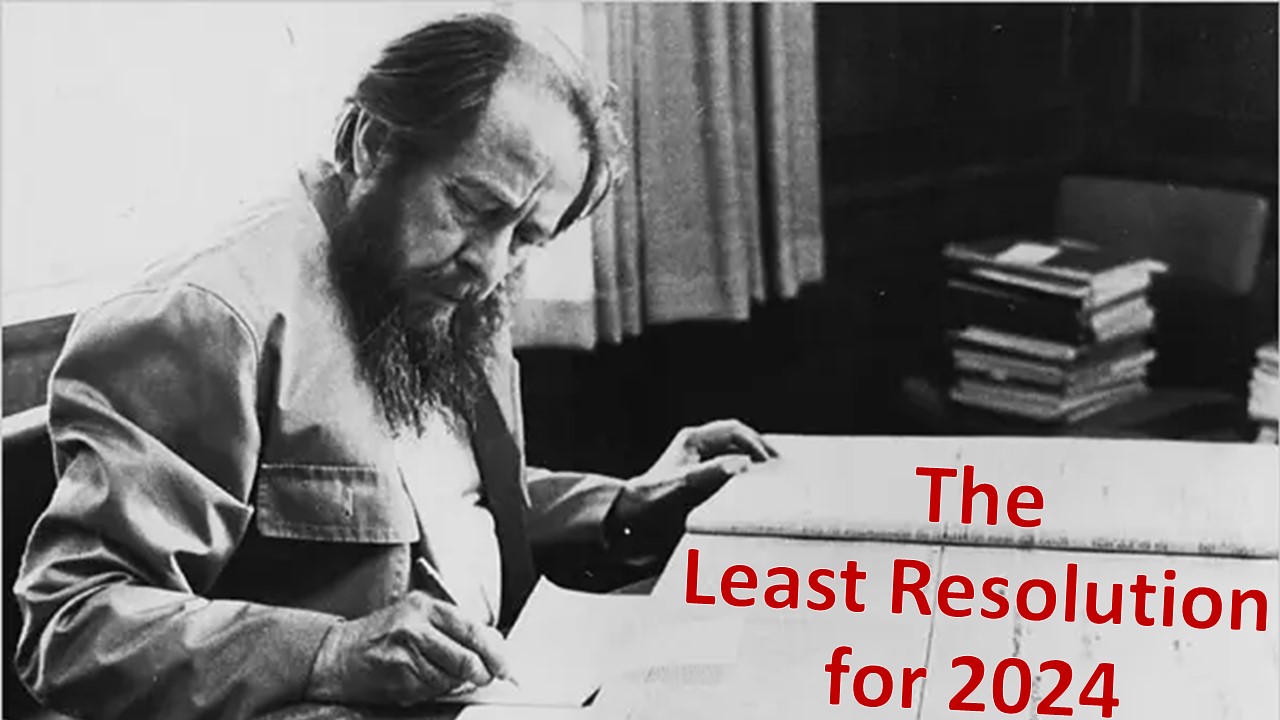
The Least Resolution for 2024

January does not just bring a new page on the calendar but a whole new calendar.  And with the new year, we tend to generate renewed commitments.  Maybe you have already determined what 2024 will mean for you.  Perhaps your mind has already pondered daily step counts, gym visits, dietary changes, or other healthy habits.  Or maybe you are thinking about Bible reading, daily prayer routines, or other spiritual goals.  May your resolutions last and bear good fruit!  But perhaps the resolution we need for 2024 is more foundational than healthy habits and more straightforward than spiritual practices.

As I write this, I am in Budapest, where I have just visited a museum of the political terror of the twentieth century.  As you can imagine, it is a sobering experience to see the vast walls of victims, the displays focused on the political prisoners, a room commemorating the persecution of the religious leaders, the torture chambers, the prison cells, and the gallows.  But perhaps the lingering memory for me will be the final room.  With red walls and hundreds of pictures, it felt like yet another presentation of victims.  But it was not.  It was a room of “victimizers” – ordinary people who were merely doing their job, simply following orders, just playing along, and thereby facilitating the evil machine.  We can remember the victims, and we must.  Yet we must also face the uncomfortable reality that most cogs in the cruel machine of death were ordinary people.

Fifty years ago, in February 1974, Alexander Solzhenitsyn was arrested in the Soviet Union and exiled to the West.  There, he was welcomed as a hero.  On the day of his arrest, he released a document entitled “Live Not by Lies.”  He knew the power of an ideology that sought to reshape society.  He also knew the power of individuals who simply refuse to lie (and the even greater power of a crowd joining together in this conviction).  He knew that the ideological system would totter and collapse when it ran up against the brick wall of reality, exemplified by many individuals refusing to play along with the evil fantasy.

Fifty years later, perhaps it is time for us to revisit this document.  Are we living in times where some, on behalf of all, have determined what society should look like?  Do we see a mounting pressure to conform with what ‘they say’ is acceptable human thought and belief? Indeed, we should not be so naïve as to assume that the absence of marching military on our streets means we face no ideological threat. 

The pressure is growing for everyone quietly to conform.  More than that, the pressure is growing to affirm openly and celebrate what we know to be false.  Surely, it would be better to speak the truth now instead of growing our tendency to fit in and play it safe as the stakes mount.

Truth and Lies – Choosing not to lie was not an original idea for Solzhenitsyn.  Paul urged the Colossians not to lie to one another.  Not only had they put off their old self, but they had put on the new self to reflect their creator’s image (Colossians 3:9-10).  He told the Ephesian believers to speak the truth to one another since they were no longer defined by the lie (Ephesians 4:25).

In the Sermon on the Mount, Jesus addresses the anger underneath murder, the lust underneath adultery, and the daily consistency of speech beneath more flamboyant oaths (Matthew 5:21-37).  There is plenty of Old Testament support for the expectation that God’s people should be consistent speakers of truth (Exodus 20:16; Leviticus 19:11; Proverbs 14:5).  God does not lie, and his people represent him.

Fear and Lies – Solzhenitsyn knew the impact of fear on a population.  He wrote of the great threat facing humanity in his day, which was “about to flare up and engulf us.”  And he described the fear: “While we continue to smile sheepishly and babble; ‘But what can we do to stop it? We haven’t the strength.’”

God asked Isaiah’s listeners, “Whom did you dread and fear, so that you lied, and did not remember me, did not lay it to heart?” (Isaiah 57:11).  Their fear led to lies, as they forgot who was really in charge.

Our world seems to be changing at a frightening rate.  Trying to keep up with the latest adjustments to sense and morality can be tiring.  And it is increasingly revealing how much fear lies within most of us, who are so prone to play along with society’s expectations rather than speak what is true.  It is concerning how easily we fear and perhaps lie while forgetting who is really in charge. 

Some will capitulate completely and speak what is false.  Others hide behind a cloak of not wanting to “sound political” and speak out about the reducing set of acceptable Christian declarations.  Fear of being labelled and criticized leads many to hold back from speaking the simple truth.  After all, it is much easier to quote a Bible verse on social media or avoid the hot topics in conversation rather than offer the most minor form of resistance.

Solzhenitsyn wrote that the fear his people felt was not primarily a fear of nuclear death or a third world war.  The fear was of taking a “civic stance.”  He wrote, “We hope only not to stray from the herd, not to set out on our own, and risk suddenly having to make do without the white bread, the hot water heater, a Moscow residency permit.”  The penalty for a civic stance may have changed, but the fear of the herd has not.

History has never smiled on the timid, and yet each fearful choice always makes sense at the time.  How often do I justify timidity when society needs me to show courage and speak the truth?  We have almost constant opportunities to speak the truth about marriage, gender, sexuality, race, free speech, bodily autonomy, science, medical ethics, corruption, or whatever other prescribed view is being pushed at any given moment.

We cannot simply wait for an ideology to fall apart.  We must be part of the brick wall of reality into which it must crash.  And yet, it is always easier to “continue to acknowledge, glorify, and strengthen” that which we want to see collapse.  At the very least, we must not “recoil from its most vulnerable point.  From lies.”

Violence and Lies – Solzhenitsyn described how violence bursts into peaceful situations with great self-assurance.  “But violence ages swiftly, a few years pass—and it is no longer sure of itself.  To prop itself up, to appear decent, it will without fail call forth its ally—Lies.  For violence has nothing to cover itself with but lies.”

So, even under overt tyranny, people do not have to experience violence at all times.  The demand is only of a “daily participation in deceit” – the tribute paid to maintain one’s position under the power of the oppressive system.  Just play along, it is safer.

The connection between violence and lies is also not a discovery made under the rule of twentieth-century totalitarianism.  Micah wrote to the city in his day, “Your rich men are full of violence, your inhabitants speak lies and their tongue is deceitful in their mouth” (Micah 6:12).

We may not have to stand and fight against violence.  We may not even have to step out publicly and boldly declare the truth. “But let us at least refuse to say what we do not think!”

The Consequences of No Lies – In the Soviet Union, there was a cost to this most simple of stands.  It could cost your job and complicate life.  It could cost your success in education and impoverish your future.  But Solzhenitsyn was clear:

“And as for him who lacks the courage to defend even his own soul: Let him not brag of his progressive views, boast of his status as an academician or a recognized artist, a distinguished citizen or general.  Let him say to himself plainly: I am cattle, I am a coward, I seek only warmth and to eat my fill.”

To choose not to lie was not an easy choice in his day.  It will increasingly not be an easy choice for social standing, or even for physical wellbeing, in our day.  But the choice not to lie is “the only one for the soul.”

The implication of no lies is worthy of note. “The more of us set out together, the thicker our ranks, the easier and shorter will this path be for us all!  If we become thousands—they will not cope, they will be unable to touch us.  If we will grow to tens of thousands—we will not recognize our country!”

As we head into a new year, may we not simply play along with the world.  Instead, let us graciously, prayerfully, and wisely determine that whatever else may happen, we will not participate in the lies expected of us in society.  As representatives of God in this world, this is the least we must do!

(Source of AS quotes: https://www.solzhenitsyncenter.org/live-not-by-lies)

Applicational Preaching

So many people seem to want to listen to preaching that is “applicational.” I understand the impulse. After all, who would want to listen to non-applicational preaching? That sounds like preaching that is not relevant to my life and will not make a difference.

Actually, if we are talking about preaching that is relevant to life and genuinely transformative, then I am completely on board with that desire. The problem is that when we talk about “applicational preaching” it can fall short of what we really need. Here are some of the potential weaknesses:

1. Applicational preaching can place emphasis on action points and to-do lists. Now, there is certainly a place for knowing what is expected of us at the end of a sermon. If a passage gives an instruction that applies to us, then we should certainly note it and look to obey it. However, is the Bible primarily an instruction list for life? Some sermons give that impression, but perhaps that is missing something of the richness and purposefulness of God’s revelation.

2. Applicational preaching can point the listener in the wrong direction. When our preaching emphasizes what we must do, then the focus will tend to move toward our own willpower. Sermons that point the listener to their own discipline, their own choices, their own efforts, etc., are not the best sermons. And I don’t just mean they are not the most theologically impressive sermons. I also mean they are not the most effective sermons. Lives are not transformed by to-do lists. They can help, but they remain mostly on the surface. God is in the business of transforming lives from the inside out.

In order to see the full potential of any preaching or teaching ministry, I would encourage you to think about the ABCs of Application. Here is a brief explanation:

What’s the Big Deal with Worship?

What does gathered worship do?  Sometimes it can make our souls soar.  Other times not so much.  It is easy to understand why non-believers scratch their heads at Christian worship.  If I saw a small group of people awkwardly singing, listening to someone talk about an old book, and sharing a tiny amount of bread and wine, I’d scratch my head too.

As I anticipate returning to Poland for the European Leadership Forum, I am reminded of the sacrifices made by so many during the Communist era.  Russian Baptist pastor, Yuri Sipko, remembers Christians who were sent to prison camps or lost their jobs or their children. “Without being willing to suffer, even die for Christ, it’s just hypocrisy.  It’s just a search for comfort.”  Challenging words, but ponder this thought: “You need to confess him and worship him in such a way that people can see this world is a lie.”

What does gathered worship do?  It declares that this world is a lie.

At the end of Revelation 3, we find that famous verse about Jesus standing at the door and knocking.  He was knocking on the door of the church at Laodicea, but would they open the door and let him in?  They thought they had everything they needed, but actually, they desperately needed Jesus.  As we turn to chapter 4 and John’s great vision from Jesus continues, we find the heavenly door is open for John to come up and participate in the ultimate worship gathering.

In Revelation chapters 4-5, we get to glimpse the ultimate worship gathering, and it reminds us what gathered worship does.  Here are five things that gathered worship does:

1. Worship centres us around God’s throne. (4:1-2)  In worship, we are invited, by Jesus, to gather at the throne of God.  In Eugene Peterson’s Reversed Thunder, he points out how we live in a world that feels like a storm-tossed sea.  We are thrown all over the place by every wind, every wave, every advert, every news story, every problem, and every threat.  But as Christians, we have an anchor that holds us firm, gives us a circumference, and centres us.  God is on the throne, so there can be a constant source of stability in my heart and life. Gathering with God’s people to sing his praise is an anchor point in the frenetic chaos of life.

2. Worship gathers God’s people around his throne. (4:3-11)  In this glorious vision, there is layer upon layer of rich meaning.  The vibrant colours seem to reflect God’s holiness and justice, as well as his life-giving nature as the Creator.  The 24 elders probably represent the twelve tribes of Israel and the twelve apostles of the Church (there is debate on all these details, of course).  Perhaps they represent God’s great work through the centuries to reveal his plan and rescue people for himself.  Then there are the four living creatures – a picture of God’s creation (noble, strong, wise, and swift), and some have seen here four glimpses into the person of Jesus Christ.  God’s people, God’s creation, all falling down and worshipping God on the throne.  In worship, we are united together, not only with one another but also with God himself, in the uniquely trinitarian worship we find in the Bible.

3. Worship points us to Christ and his payment. (5:1-7) At the start of chapter 5, John is struck by the disconnect between God’s greatness and the need of humanity.  The sealed scroll, Earth’s title deed, God’s plan of judgment – its existence underlines that no human is worthy to open the seals.  Even apart from the judgment context of Revelation, our gathered worship cannot be satisfied with just lauding God the Creator for his power and majesty.  Christian worship always points us to Christ and his payment.  John turned to see the Lion of the Tribe of Judah and was confronted by the slain Lamb.

4. The Lion/Lamb Redeemer stirs greater songs of worship. (5:8-13)  When God’s people encounter God’s goodness and grace, they sing.  Moses, Miriam, Deborah, David, Mary, Angels, Jesus and the Disciples, Paul and Silas – they all sang.  When we become aware of who he is and what he has done, then we will sing too.  In chapter four, there were two songs to the Creator (4:8, 4:11).  Now the singing swells as more voices join in and more richness is reflected in two songs to the Redeemer (5:9-10, 5:12).  Finally, there is one song to both the Creator and the Redeemer combined (5:13).

5. Worship finishes with a great Amen! – the ultimate reality of God’s person and plan is definitively affirmed!  (5:14)  If you think about it, we humans have a history of saying no to God.  We are all quite adept at saying no.  But Revelation 4-5 underlines that in the end God’s great yes will overcome every one of our noes.  In worship, we are confronted by the reality of God the Creator King on his throne, and of God the Redeeming Lion/Lamb, and we cry out, “Yes!”  When we worship together, we get a pre-taste of what is to come.  “Your kingdom come, your will be done, on earth as it is in heaven.”  Gathered worship is like an anchor to both the future, when all our questions will be answered, and to the ultimate reality in the present – that God is on the throne and he has redeemed us.

So what does gathered worship do?  It declares that this world is a lie.  More than that, it centres us around the throne of God – for God is on the throne whatever we may be facing down here.  It gathers God’s people around his throne – for God is worthy of every note of praise that can be uttered by any part of his creation.  It points us to Christ and his payment – for we worship not only in response to the majesty on the throne but also to the scars on that Lamb.  It stirs us to sing greater songs of worship – for God the Creator and our Lion/Lamb Redeemer.  It definitively affirms the ultimate reality of God’s person and plan – for in the end we will cry out our great “Yes!” and “Amen!” to God.

Whether we are gathering in a great crowd at a Christian event, or with a handful of dear saints on a Sunday, let us appreciate the privilege of gathered worship and declare with joy that this world is a lie.

_________________________________

Sipko quote from Live Not By Lies, by Rod Dreher, p185-6.

______________________________________________

When Lies and Treachery Take Root – Part 4

In part 1, we set the scene and considered how a crisis can be used to wrest control, but the tyrants taking charge may not be impressive to all.  In part 2, the thin veneer of tyranny does not protect subjects from the harsh realities of the suffering that always follows.  In part 3, we scratched at the religious veneer to see that the biggest question in life is the right question at any time of change.  However, asking the right questions will not be welcomed, but oppressed.  Thus, the truth matters, even if everyone seems to be buying into the lies.  This brings us to this final post.  Surely the truth will set society free?  Ultimately, yes.  But we should not be shocked when a hypnotized people choose to stay under the spell.

20. Revealing the lie does not automatically break the spell.  “The light is dawning, the lie broken.”  It seems so simple.  Show everyone how they have been lied to and everything will be alright.  Well, not necessarily.  After defeating some captors, the king cried, “Now, Dwarfs, you are free.  Tomorrow I will lead you to free all Narnia.  Three cheers for Aslan!”  But, Lewis goes on, “the result which followed was simply wretched.” If everyone rallied to the side of the king, there was hope.  But not “if half the Narnians – including all the Dwarfs – just sat and looked on?  or even fought against him.”  Would the German population have rallied to the side of truth if there had been time for it to be revealed?  How many might have been saved if the populations of the communist soviet countries had revolted sooner?  And what if our own population does not react when lies are revealed?  The result of apathy to truth will be simply wretched.

21. When a lie is revealed, there may well be more sinister aforethought than previously realised.  By chapter 9, Jewel recognizes how much planning had taken place.  “We see that the Ape’s plans were laid deeper than we dreamed of.  Doubtless he has been long in secret traffic with The Tisroc.”  It is hard to fathom the depths of evil conspiratorial planning that may exist, but where is the benefit in believing everything is driven by good intentions and some accident?  Will we look back and wonder why we were so naively accepting of the lines we were fed? Perhaps we would do well to ask questions sooner, rather than just having to take stock of the damage once it is done.

22. When a lie is revealed, the evil tyrants will continue to spin yet more lies.  It is the most infuriating plot twist, but it is repeated time and again.  When the lie is revealed, it is met with yet more lies.  The Ape explained how a beast had dressed up and pretended to be Aslan.  “Jill wondered for a moment if the Ape had gone mad.  Was he going to tell the whole truth? . . . It was seen last night, but it got away.  It’s a Donkey!  A common, miserable Ass!  If any of you see that Ass—”  The Ape lied to cover his lies, and so retained control of the population!  “Jill looked at the King: his mouth was open and his face was full of horror.  And then she understood the devilish cunning of the enemies’ plan.  By mixing a little truth with it they had made their lie far stronger.”

It is a story that has been told again and again.  The Ape in its glory.  So much harm is done along the way, but eventually, every dressed-up Ape will be brought down.  May we learn from the story before we live unnecessarily through another chapter of the same old tale.  May we never accept any self-declared-wise old ape who sets himself up as the better leader to take us toward utopia.  The world does not need a year zero, a new beginning, a great leap forward, or a reset, no matter how great it might sound, or how urgently the need is portrayed.  What the world needs is truth, as well as humble leaders ready to serve the people, and for those who have met Aslan to make sure they are never fooled by a doddery donkey dressed up as divine.