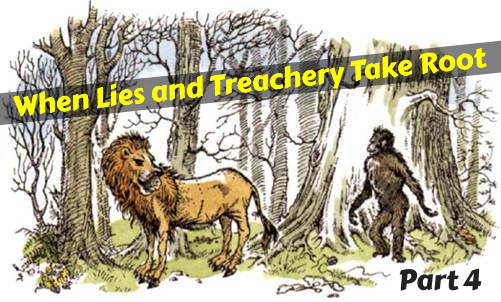
When Lies and Treachery Take Root – Part 4

In part 1, we set the scene and considered how a crisis can be used to wrest control, but the tyrants taking charge may not be impressive to all.  In part 2, the thin veneer of tyranny does not protect subjects from the harsh realities of the suffering that always follows.  In part 3, we scratched at the religious veneer to see that the biggest question in life is the right question at any time of change.  However, asking the right questions will not be welcomed, but oppressed.  Thus, the truth matters, even if everyone seems to be buying into the lies.  This brings us to this final post.  Surely the truth will set society free?  Ultimately, yes.  But we should not be shocked when a hypnotized people choose to stay under the spell.

20. Revealing the lie does not automatically break the spell.  “The light is dawning, the lie broken.”  It seems so simple.  Show everyone how they have been lied to and everything will be alright.  Well, not necessarily.  After defeating some captors, the king cried, “Now, Dwarfs, you are free.  Tomorrow I will lead you to free all Narnia.  Three cheers for Aslan!”  But, Lewis goes on, “the result which followed was simply wretched.” If everyone rallied to the side of the king, there was hope.  But not “if half the Narnians – including all the Dwarfs – just sat and looked on?  or even fought against him.”  Would the German population have rallied to the side of truth if there had been time for it to be revealed?  How many might have been saved if the populations of the communist soviet countries had revolted sooner?  And what if our own population does not react when lies are revealed?  The result of apathy to truth will be simply wretched.

21. When a lie is revealed, there may well be more sinister aforethought than previously realised.  By chapter 9, Jewel recognizes how much planning had taken place.  “We see that the Ape’s plans were laid deeper than we dreamed of.  Doubtless he has been long in secret traffic with The Tisroc.”  It is hard to fathom the depths of evil conspiratorial planning that may exist, but where is the benefit in believing everything is driven by good intentions and some accident?  Will we look back and wonder why we were so naively accepting of the lines we were fed? Perhaps we would do well to ask questions sooner, rather than just having to take stock of the damage once it is done.

22. When a lie is revealed, the evil tyrants will continue to spin yet more lies.  It is the most infuriating plot twist, but it is repeated time and again.  When the lie is revealed, it is met with yet more lies.  The Ape explained how a beast had dressed up and pretended to be Aslan.  “Jill wondered for a moment if the Ape had gone mad.  Was he going to tell the whole truth? . . . It was seen last night, but it got away.  It’s a Donkey!  A common, miserable Ass!  If any of you see that Ass—”  The Ape lied to cover his lies, and so retained control of the population!  “Jill looked at the King: his mouth was open and his face was full of horror.  And then she understood the devilish cunning of the enemies’ plan.  By mixing a little truth with it they had made their lie far stronger.”

It is a story that has been told again and again.  The Ape in its glory.  So much harm is done along the way, but eventually, every dressed-up Ape will be brought down.  May we learn from the story before we live unnecessarily through another chapter of the same old tale.  May we never accept any self-declared-wise old ape who sets himself up as the better leader to take us toward utopia.  The world does not need a year zero, a new beginning, a great leap forward, or a reset, no matter how great it might sound, or how urgently the need is portrayed.  What the world needs is truth, as well as humble leaders ready to serve the people, and for those who have met Aslan to make sure they are never fooled by a doddery donkey dressed up as divine.

When Lies and Treachery Take Root – Part 3

In part 1 we were introduced to the thin veneer of tyranny, and then in part 2, we noted how subjects will suffer nonetheless.  Now, let’s dig below the surface and ponder some of the religious aspects of the imposed new normal.

14. Different gods are treated as one.  A Lamb spoke up, “Please, I can’t understand. What have we to do with the Calormenes? We belong to Aslan. They belong to Tash.  They have a god called Tash.  They say he has four arms and the head of a vulture.  They kill Men on his altar.  I don’t believe there’s any such person as Tash. But if there was, how could Aslan be friends with him?”  The underlying impulse of tyrants is always a collective uniformity.  There is no space for diversity of thought or diversity of religion.  And so, like a recurring refrain, the religions are pushed together and effectively true religion is pushed out.  It was true in Narnia.  It was true in Nazi Germany.  It was true in the Soviet Union.  It is true in China.  It is always the same.  There is always one version of religious thought allowed, and the new leaders get to define it.

15.  The God question is the best question to ask.  Once the Lamb had spoken, we are told that they knew this was the best question anyone had asked yet.  It always is.  In a world where the boundaries are blurred and the gods are blended together, the most important question is always to ask about the true God.  After all, He will always be different, and better, than their imposed amalgam deity.

16. Good questions incite aggressive answers.  The Ape jumped up and spat at the Lamb.  “Baby!” he hissed. “Silly little bleater!  Go home to your mother and drink milk.  What do you understand of such things?”  The subjects are ridiculed if they dare to question.  The experts know best.  They always do.  If you question them, then you discover that you are questioning “The Science” itself.  Abusive relationships do not always require shouting and overt aggression.  However, the presence of shouting and overt aggression tends to be a good indicator of an abusive relationship.

17. The blending of gods will always mean the diminishing of the true God.  The Ape declared, “Tash is only another name for Aslan.  All that old idea of us being right and the Calormenes wrong is silly.  We know better now.  The Calormenes use different words but we all mean the same thing.  Tash and Aslan are only two different names for you know Who. . . . Tash is Aslan: Aslan is Tash.”  The true God always seems to be reduced when the proud claim to have new insight.  They know what is best and they should be trusted with the future.  But Lewis described how every tail was down, and every whisker drooped.  Except one.  The Ginger Cat asked a clarifying question – “Aslan means no more than Tash? . . . I think I am beginning to understand.”  When we add another god to the true God, the true God becomes nothing more than that other so-called god.  You can add nothing to the true God and make him better.  Some might use the ecumenical impulse for their own gain, but the Narnian beasts were right in their downed tails and drooped whiskers.

18. Silencing of contrary voices is always required for a tyrannical coup.  King Tirian cried with a loud voice and was silenced.  “If he had been allowed to speak, the rule of the Ape might have ended that day; the Beasts might have seen the truth and thrown the Ape down.”  Instead, with violence, the Ape put down the truth-crier.  “Take him where he cannot hear us, nor we hear him.”  Which is more important, that he not hear their lies?  Or that they do not hear his truth?  Since tyranny is always a fragile house of cards, it must surely be the latter.  Therefore, there will be ruthless silencing, censoring, cancelling and de-platforming of any counter-opinions.  After all, it is for the good of the people.  The destruction of free speech should always be a big red flag to thinking people.

19.  The pantomime leader is ridiculous, but you may be tempted to believe that he is real until you remember the truth.  In the next chapter, the Beasts are crying out to Aslan as he is paraded in front of them, briefly.  King Tirian looked on from a distance, “He had not expected Aslan to look like that stiff thing which stood and said nothing.  But how could he be sure? For a moment horrible thoughts went through his mind: then he remembered the nonsense about Tash and Aslan being the same and knew that the whole thing must be a cheat.”  The doddery old donkey in fancy dress almost fooled him, but the truth won out.

There is one more post to come . . . next time.

When Lies and Treachery Take Root – Part 2

In part 1, we introduced the sinister situation in The Last Battle – the created crisis, the prevailing atmosphere and the thin veneer of tyranny.  Now let’s continue our list of thoughts and ponder matters of authority, tyrants and how subjects are treated.

7. True authority is always kept out of reach.  A Boar asked the Ape about seeing Aslan properly and talking to him.  But it was not allowed.  In a truly free modern society, the authorities serve at the pleasure of the citizenry.  Ultimate power lies with the people, not in a palace, nor a secret government discussion.  In a dictatorship there is really no access for thinking subjects, only a carefully staged presentation that will have an impact on the crowds.  The Roman Caesars would go into hiding and then appear in a spectacular show of splendour.  “He is a god!”  The crowd would cry. But it was all staged. 

8. Tyrannical authority always knows better than you.  Accused of being an Ape, the Ape declares,   “I’m not.  I’m a man.  If I look like an Ape, that’s because I’m so very old: hundreds and hundreds of years old.  And it’s because I’m so old that I’m so wise.  And it’s because I’m so wise that I’m the only one Aslan is ever going to speak to.  He can’t be bothered speaking to a lot of stupid animals.  He’ll tell me what you’ve got to do, and I’ll tell the rest of you.  And take my advice, and see you do it in double quick time, for he doesn’t mean to stand any nonsense.”  Notice there is no reasoning, no discussion, no debate.  The tyrant knows better than you and so you must obey.

9. The subjects of tyranny are always necessarily treated as stupid.  Since the authoritative council of stakeholders is made up of experts, it means those under their rule must necessarily be treated as stupid.  “Stupid animals!”  They are to take what they are given and do as they are told.  It has always been true in every dictatorship down through history.  When you can smell disdain from on high, know that tyranny approaches again.

10. Freedom is turned into slavery.  Some of the horses were speaking about getting the work done quickly, in order to return to freedom.  “Well, you can get that idea out of your heads at once.  And not only the Horses either.  Everybody who can work is going to be made to work in future.  Aslan has it all settled with the King of Calormen – The Tisroc . . . All you Horses and Bulls and Donkeys are to be sent down into Calormen to work for your living – pulling and carrying the way horses and such-like do in other countries.  And all you digging animals . . .”  The Ape had no intention of releasing control and letting the Beasts run free again.  When freedoms are taken away, they are seldom returned without a struggle.

11. Slavery is described as for the common good, but it isn’t.  When the Beasts howled about being sold into slavery, the Ape snarled back, “None of that! Hold your noise!  Who said anything about slavery? You won’t be slaves.  You’ll be paid – very good wages too. That is to say, your pay will be paid into Aslan’s treasury and he will use it for everybody’s good.”  The repeated commonality in coups across the globe is the utopian vision of the betterment of society.  It is for your benefit!  Yes, there will be some work involved.  There must be, to make things better.  But your slavery, that is, your work, will make you free!  The Ape made promises to the Beasts of Narnia.  The Nazis put that assertion over the gates at Auschwitz.  The Communist Party always promises a collective utopia beyond the struggle.  And yet, who benefits?  It is never the common man and woman.  It is always the ruling elite.

12. The goal of the common good is described as a form of utopia, but the cover always slips.  The Ape described the goal of their newly imposed future.  “And all for your own good. We’ll be able, with the money you earn, to make Narnia a country worth living in.  There’ll be oranges and bananas pouring in – and roads and big cities and schools and offices and whips and muzzles and saddles and cages and kennels and prisons – Oh, everything.”  Actually, Narnia was pretty good before slavery was imposed.  The future only seemed to mean added restrictions and silencing for the subjects, but luxuries and control for the ruling elite.  Oh, you will own nothing, and you won’t be able to go too far, but you will be happy.  Utopian dreams with revealing slips.

13. The new and false freedom is defined by the tyrant.  “You think freedom means doing what you like.  Well, you’re wrong.  That isn’t true freedom.  True freedom means doing what I tell you.”  A truly free society is a rare commodity on this earth.  Even in Narnia it seemed easily lost.  When tyrants take over, they get to set the rules.  And when they do, the people suffer.

Next time, we will continue our list. . .

When Lies and Treachery Take Root – Part 1

I feel sorry for the last book in a collection.  While many may enjoy the first, and probably the next couple too, not all readers will complete a series.  This was certainly true in my case.  It is only now, with my last pair of children, that I have finally cracked open The Last Battle and journeyed back into Narnia one last time.  What I discovered felt like a commentary on devilish and despotic democracide.  I had to check the publication date.  Was this written in 2023?  Obviously not, for it treads on far too many sensibilities for our day!

However, The Last Battle, the final chronicle of Narnia, remains eerily relevant.  I am sure it was to its own day, a day of reflection on the atrocities of National Socialism (Nazi-ism) in Germany, and a day of growing suspicion of the murderous evil of International Socialism (Communism) in the East.  Like all great stories, The Last Battle remains eerily relevant today, too.  “Narnia faced its fiercest challenge,” the back cover explains, “not an invader from without but an enemy from within.”  Indeed, so often the greatest threat to society lies within its own ranks.  And that threat does not always come from the most intelligent enemies of the state.  Often the mind behind the evil is devilish, while the actors used are less than impressive.  His antagonism to all that is good lies behind the puppet leaders used to enact the sinister effort to transform a safe society into something so much more malevolent.

By the time we reach the third chapter of The Last Battle, we already know that a self-serving Ape and his hapless Donkey have stitched up a lion’s pelt for some nefarious purpose.  We also join King Tirian and his Unicorn, Jewel, as they discover that Aslan has returned and ordered the felling of the holy trees and the murder of their dryads.  Arriving at the newly cut gash in the Narnian landscape, they discover Calormenes who are mistreating a Narnian talking horse.  It is all too much and they kill the two foreigners in a fit of rage. 

Struck by their noble consciences, they determine to surrender their fate to the justice of Aslan.  Whereupon we encounter “The Ape in its glory.”

I know that this is not directly related to biblical studies or preaching. But if you will indulge me as I share a brief series of reflections on a prescient work of fiction, here are twenty-two eerie parallels to ponder – parallels between Narnia, C.S.Lewis’ day, and even perhaps, our own.

1. A crisis was created and used by the leader of the coup.  The felling of trees, the gash in the landscape, the sale of noble tree trunks to the Calormenes, the profound upset of Narnian peace – it was all created by the one who now used that same crisis to wrest control of the territory and to serve his heinous purposes.

2. Death is in the air.  In the first chapter Shift cunningly manipulates Puzzle with the notion that he “shall probably die” if he tries to fetch the lion pelt from the pool.  Puzzle retrieves it and is “almost tired to death.”  In the second chapter the dryad is killed, then two Calormenes.  This is a story of death after death so that by the end, all the characters are dead.  Multiple characters state that it would have been better to be dead than…, and later on, we see Cair Paravel “filled with dead Narnians.”  Death becomes an everyday conversation when societies are taken over by tyrannical forces.  Lewis may not have known how accurate his picture was in the Communist east.  We may not know all that is swirling in our world today, but it does feel like the subject of death is hanging in the air.

3. Everyone is saying the same thing.  The King is struck by the fact that “the Horse said it was by Aslan’s orders. The Rat said the same.  They all say Aslan is here.”  Even though he had been warned that this was a lie, everyone was repeating the same message.  There is a strange power in a common story.  It will grow its own legs and generate its own credibility.  Sometimes a coup will take over a land by force, but not always.  Sometimes it is by stealth and the subjects will carry the tale of their own downfall willingly as if what they say is true.

4. For those that see clearly, it was clearly a charade.  There in the clearing, at the peak of the hill, “there was a little hut like a stable, with a thatched roof.”  But for those who could not see clearly this charade became their focal point.  “On the grass in front of the door there sat an Ape.  Tirian and Jewel, who had been expecting to see Aslan and had heard nothing about an Ape yet, were very bewildered when they saw it.”  As readers we can see through the whole charade – don’t believe what he says, he is a fancy-dress ape with a dressed-up donkey prop!  It is frustrating when others cannot see what is plainly before them.

5. Tyrants always look silly.  When the Ape, chewing his supply of nuts, was handed the king’s sword with its belt, “he hung it around his own neck: it made him look sillier than ever.”  Did the German population wonder about the short, shouting Austrian tyrant?  Did the bigger moustache of Stalin command the respect he may have thought it should?  And what of the potential tyrants in our day?  If you look carefully, they always look silly.

6. Tyrants are always self-serving.  “Now listen to me, everyone.  The first thing I want to say is about nuts. . . . I want – I mean, Aslan wants – some more nuts.”  The squirrels had already given the Ape more than they could spare.  That’s the thing about tyrants: they take everything from the people and lavish luxuries on themselves.  Beachfront villas, fine foods, private jets.

Next time we will continue our list . . .

(Illustration by Pauline Baynes)

5 Easter Lessons from the Trials of Jesus

As we come to another Easter, our minds and hearts will be drawn back to the cross and the empty tomb.  This is the central hinge of human history, and ground zero of our faith.  As followers of Christ, we should never stray too far from his passion if we are going to follow him well, do good theology, or seek to offer hope in this world.  We are a people birthed, marked, shaped, and transformed by the cross and the empty tomb.

God gave us four Gospels, and all four essentially offer a preparatory retelling of the ministry years of Jesus, followed by a slower and more detailed account of the Passion Week.  That means we have many column inches given to other aspects of that first Easter.  As well as the crucifixion and the resurrection, we also have a lot of details about Jesus’ clashes with the authorities, the Last Supper and Upper Room, Gethsemane, and the arrest and trials of Jesus.  Let’s take just the trials, in particular.  What might we notice as we move towards another Easter?

1. The trials did not all happen in one night.  There are six trial hearings that occur between the arrest of Jesus and his crucifixion.  However, the Jewish authorities had long determined that he was guilty and deserved to die.  As we read through the Gospels we find their growing animus, their utter rejection of his authority, and their determination to put him to death.  This final night of trials was the end of a process, it was not the beginning.

2. The trials are divided between the religious and the Roman.  Jesus was arrested by a group of temple guards, with some Roman soldiers added to the posse.  He was taken first to Annas for what is effectively a pre-trial hearing, then to Caiaphas and the Sanhedrin during the night, and then for a brief ratification of their decision at first light.  The focus of these religious trials was Jesus’ teaching and identity.  Then the Jewish leaders took him to Pontius Pilate, the governor of Judea, for the Roman trial.  Here the focus was his threat to Roman rule, and the emphasis had to shift to political concerns.  Pilate offered a political peace offering to King Herod, a Roman-installed Tetrarch who had previously sent a complaint about Pilate to Caesar.  Herod had wanted to meet Jesus but soon sent him back to Pilate for the sixth and final trial of that night/morning.  Three religious trials.  Three Roman trials.

3. The trials feel rushed and disorganized.  The Jewish authorities had planned to arrest Jesus and deal with him before he could slip away from Jerusalem, but not during the feast.  And then, during the Last Supper, Jesus revealed to Judas that he knew about the planned betrayal.  Their secret was out, and so they rushed a plan into action.  The rush resulted in them struggling to find two witnesses that would agree in front of the defendant during the night trial, and then coming to Pilate without a clearly defined charge in the morning.  It all seems so chaotic and rushed – because it was.  They were not planning to execute Jesus on that particular day.  We can see that God’s plan for the timing required crucifixion on that particular day.  The authorities were not in control.

4. The trials helpfully point us to other key characters.  As we read through the trial accounts, we come across a number of incidental characters.  There are soldiers mistreating Jesus (quite likely to have been Samaritan conscripts, since the Jews would not have joined the Roman ranks).  There are the members of the Sanhedrin gathering in the shadows.  There is Pilate’s wife, whose dream only increases Pilate’s superstitious nervousness around this decision.  And there are some major characters too – Pilate was the most powerful man in the region.  He was used to criminals cowering and begging for mercy but was amazed at the silent strength of Jesus.  Peter had promised to die for Jesus, tried to kill for him in the garden, and then found himself in a series of mini-trials by the fire in the courtyard.  Peter wept bitterly at his failure, but Judas’ grief was different.  He was confronted by the deathly darkness of despair and plunged to his death that night.  As you read the trial accounts, notice everyone who is mentioned.

5. The trials shine a glorious light on Jesus.  And as you read the trial accounts, be sure to focus particularly on Jesus himself.  The arresting party wasn’t in control.  The mafia don of Jerusalem, Annas, was not in control.  The High Priest was not in control.  Nor Pilate the governor.  Certainly not Herod the visiting King.  No, the only one showing control, dignity, clarity of purpose, and strength of character, was Jesus himself.  Watch for when he remains silent.  Take note of what he says when he speaks.  See how he supplies the Old Testament quotes that the High Priest needed to seal the decision.  Recognize his gravitas before Pilate.  Just as Jesus’ words from the cross help to shape our theology, so should his words in these trials.  Jesus came to rescue us at such a great cost.  And Jesus came to reveal the heart of his Father with such great clarity. 

As we head into another Easter, let’s be sure to watch Jesus closely in the biblical text.  He is our humble and regal Redeemer, rescuing us and revealing God to us.  Thank God for Jesus, and thank God for the beautiful way he navigated those last hours before the cross.

_______________________________________

Join us for a mini-series that show how to study the Bible:

8 Reflections on Preaching Through 1 Peter

In our church, we have just completed an eight-week series in 1 Peter. Here are some brief reflections that may be helpful:

1. This epistle is relevant. I know that is not breaking news to you, but it bears underlining. 1 Peter speaks to people that felt like oppressed outsiders in the society in which they lived. It did then, and it does now.

2. Suffering may be necessary. We have lived through decades of relatively little suffering, but times seem to be changing. Suffering is not permanent, “now for a little while.” And suffering may be part of the plan, “if necessary.” In 1 Peter 1:6 we are introduced to the possibility that suffering is not the result of bad luck, but divine providence. As we come towards Easter we have the ultimate example of deliberate and planned suffering.

3. Biblical background helps. There is the situational background of the readers, forcibly moved from Rome and repatriated to these five regions of modern Turkey. There is the historical background of Peter’s life and experience. Keeping that in mind, as he would have done, is helpful to shine a light on his call to be prepared (3:15), to stay humble and to resist the devil (5:6-9), etc. Then there is the textual background of Peter’s biblical awareness as he wrote. For instance, the situation behind Psalm 34 seems to be shining a light on much of Peter’s writing in this epistle.

4. Difficult texts still have simple points. Preaching the end of 1 Peter 3 and the start of 1 Peter 4 is not easy territory to navigate. There is the timing, location and content of Jesus’ preaching in 3:19; then the reference to Noah in 3:20; followed by the awkward reference to baptism in 3:21. It is exegetical difficulty piled on exegetical difficulty. I chose to give some minutes to explain that complexity, but not before I emphasised the simple point of this section: Jesus suffered and Jesus was victorious. It helps to keep a clear picture in mind when trying to make sense of the complex.

5. The letter has a strong DNA. God’s pattern is for suffering now to be followed by glory later. It was true for Jesus, it was true for Peter’s readers then, and it is true for Peter’s readers now. Suffering and then glory: this idea works its way through the entire letter.

6. Variation can help a series work well. We had a team of preachers on this series. One of the messages was preached in first-person. It came in the middle of the series and really helped the series to not feel monotonous in style. Different preachers helped the series, although it was important to make sure we were preaching a coherent series.

7. Non-Suffering forms of Christianity lead to harm. We seem to live between two extremes. One is the fatalistic idea that disaster is coming no matter what. The other is the idealistic idea that we should always be healthy, and wealthy and travel in a private jet. What is the healthy middle ground? It is not a gentle form of health and wealth – that is, things should generally go well for us if we simply trust, pray and obey. Many Christians seem to want to live with their basic orientation towards good circumstances. No, the reality is that we live in a fallen world filled with suffering. So let’s turn from gentle forms of health and wealth, and let’s engage a fallen and sin-marred world with our hope reaching out beyond this suffering to the glory to come. Our hope is not in our experience but in the character of our good God and his plan.

8. 1 Peter should prepare us for difficulty, but stir us to trust! Every problem we face in this world is a problem that exists within creation. 1 Peter urges us to look beyond this realm to the eternal realities. We look outside of this realm to the God who is so much bigger, the God who cares for us. “The dog bit me,” ~ yes, but God is bigger. “But it was a big dog,” ~ so what, God is bigger. “But it was a lion,” ~ it doesn’t matter, God is bigger. “Actually it was a killer whale.” ~ Ok, but God is still bigger than any problem we can face in this realm. What’s more, he already came and suffered, and is now sitting in victory. So we can be humble, be watchful, and be hopeful. We get to stand in the true grace of God whatever may come our way.

There are plenty more thoughts generated by two months in 1 Peter. But hopefully this list is a motivational starter for now…

____________________________

I have a series of videos on 1 Peter 2:1-10 that focus on the interpretation phase of Bible study. You can find them in this playlist:

Studying the Bible – Learn!

I have completed a series of videos that detail the Learn phase of the Bible study process. Using 1 Peter 2:1-10, I look at the kind of thinking that goes into learning what a passage means. Good observation of the details in a passage will set us up to accurately learn what the text means as we study to determine the original author’s intended meaning. So, what goes into interpreting a Bible passage?

First, Look! We need to take time to notice what is in our passage. Here is a one-video summary of the Look! stage for this passage. So, onto the Learn stage:

1. Context: Historic – When was the passage written? What was happening at the time? What prompted the author to write it? What can we understand about the relevant cultures, the occasion for the writing, the situation at the time? (Click here for the video.)

2. Context: Written – The passage you are looking at sits within a book and therefore there is a written context to consider. What has come before your passage? What flows out from it? To understand a passage, you have to wrestle with the flow of the whole document. (Click here for the video.)

3. & 4. Content: Details – Remember all the details that we spotted in the Look stage of our study? Now we need to seek to understand them in light of the context of the passage. (Click here for the first video and click here for the second video on details!)

5. Content: Flow – How do the details work together in the flow of thought in this passage? It is so important to not only understand details, but to understand them in their most immediate context! (Click here for the video.)

6. Intent – What did the author intend to achieve through writing this passage? Are there clues within the passage, and are there indications within the book as a whole? (Click here for the video.)

After the Look! and the Learn! stage of Bible study, we will then move on to the Love/Live response (what should the text stir?) Here is a one-video summary of the Love/Live phase for this passage.

I will release another series that uses a different passage but focuses on the Love/Live phase instead of the Learn phase as I have this time. Hopefully, that makes sense! Please subscribe to the YouTube channel so that you can see the new videos as they are released.

7 Ways to Mishandle a Bible Story

The Bible is full of stories.  And we preachers are full of ways to mishandle them.  God has richly blessed us with the stories in the Bible.  Each one reveals God’s heart and character. Each story is designed to point our hearts to Him and to stir our faith in His word and character. So, how can we go wrong?

Here are seven ways to mishandle a Bible story:

1. Skip – This is the assume-and-ignore approach.  We can easily assume that everyone knows the story and so we skip the chance to tell the story.  Instead, we put our homiletical energy into preaching about the theological ponderings triggered by the story.  Why do we assume that everyone knows the story?  Actually, why do we assume that what we have to say about it is of more value than what it actually says?  Even if people do know the story, tell it anyway, and let God’s word work in your listeners.

2. Flip – This is the heretical approach.  We can easily misdirect our listeners and end up preaching heresy inadvertently.  Take the story of Zaccheus in Luke 19:1-10 for an example.  It is easy to put all the initiative in Zaccheus’ commitment in verse 8.  Then his salvation is affirmed by Jesus in verse 9.  Voila, we are saved by our own commitment to Christ!  Except, we are not.  Jesus had already taken the initiative in verse 5.  Jesus had already rescued Zaccheus.  The exuberant generosity of verse 8 is a response to God’s grace, not a prerequisite for it.

3. Moralise – This is the fleshly approach.  Since everyone naturally tends toward the notion of earning something with God, we can always and easily jump to what Bryan Chapell calls the “Deadly Be’s” – be like, be good, be disciplined.  So with Zaccheus’ story?  In verse 7 the crowd grumbled.  Let’s not be like them, let’s not grumble.  That verse is in the passage for a reason, but that little life lesson is not the reason.  It is there to emphasize the wonder of what Jesus did for Zaccheus.  It is not there to nudge us towards better behaviour.

4. Lecture – This is the historical-and-cultural-lecture approach.  Use cultural and historical insights to bring the story to life, not to cut the story to death.  How did the tax system work at that time?  How might middle eastern hospitality respond to Jesus’ passing through the town?  Where were sycamore-fig trees in relation to Jericho?  Shine a light on the story and keep telling it, don’t end up giving a series of historical lectures trigged by the details in the story.

5. Over-reveal – This is the punchline-first approach.  So with Zaccheus, you might state the first point as, “Jesus came to save the lost, verses 1-4.”  Oops.  In the passage, verse 10 comes as a surprise.  The whole text has worked to point the reader to Zaccheus’ efforts to see Jesus.  Then in the end it turns out Jesus was the one doing the seeking and the saving.  Why give it away at the start?  Do what the text does.  Don’t “tell the punchline before the joke.”

6. Flatten – This is the lifeless-outline approach.  Again, with the Zaccheus story, your points could be mind-numbingly flat: Jesus seeks the lost, Jesus rescues the lost, and Jesus reassures the lost.  Honestly, I’m bored just writing that outline, even if it is fairly accurate.  While it is true that the story develops in movements, it does not mean that the sermon has to sound like a logical progression through completely parallel points. That outline could work, but it needs a serious injection of energy.

7. Lose – This is the too-many-stories-along-the-way approach.  The story of Zaccheus is a gripping little narrative if it is told well.  But if you use every trigger point to tell another story, you will lose it.  I once knew a tax collector . . . I had a short friend once . . . I have a fun tree-climbing story . . . I remember a grumbling crowd in 1987, etc.  Let other illustrative materials be fairly succinct so that the focus remains on the main narrative of the sermon.

How else might we mishandle a Bible story? Biblical narratives are a dream for us preachers – let’s learn to handle them well so that they can do their mighty work in our hearts and those who will hear us!

________________________

Click on this image to see the YouTube playlist of videos on Bible handling:

7 Ways to Cultivate a Church Culture for Gospel Growth

When churches think about sharing the gospel with visitors, we can easily jump straight to outreach strategies and event planning.  But here are seven ways to cultivate a culture for greater gospel growth in the church – foundational pieces that need to be put in place:

1. Gospel Clarity – Make sure your church is clear on the gospel, consistently clear.  We can easily fall into using Christian language in a sloppy way.  The gospel is good news, not vague news.  So do not settle for a gathering of people that are united by church tradition, or who know how to behave a certain way and dress like they belong.  Speak about the transforming power of meeting Jesus and following Jesus.  Present the good news of who Jesus is and what Jesus did for us on the cross.  Feature the importance of the resurrection as a historical fact and the basis of genuine faith.  Explain what it means to respond, to repent, to receive, etc.  Do not assume a vague gospel agreement in preaching, or in conversation.  Too many churches rely on a specific event and a specific speaker to give a gospel message.  There is a place for special events and overtly evangelistic speakers, but the church should have the good news of Jesus in its DNA, permeating its culture.

2. Loving Community – The church is not just another social club in a society full of social clubs.  The church is a family that does not make sense.  Why do these people love each other like this?  There should be a level of love, concern, practical support, patience, graciousness, and warmth that is genuine and profoundly different from any social club in society.  A healthy church will grow in diversity.  Everyone will not be the same.  Obviously, if a town is full of very similar people, then that will impact the church.  But few towns are!  There should be diversity of race, of class background, of education level, etc.  Then the unity of believers in a church community will be magnetically attractive to visitors who don’t experience that kind of family warmth anywhere else – in many cases, not even at home.  This takes more than labeling to be genuine.  It is not enough to say from the front, “we are a church family.”  It has to be true.  Live it out at the leadership level and encourage mutual care wherever you can. For example, don’t overcrowd the schedule with meetings so that people don’t have space in the week to connect relationally.

3. Obstacle Removal – Will visitors feel awkward?  The church is a very different subculture than the world around.  It will feel different, but it does not need to feel unnecessarily awkward.  In our church, we have often said that we only want visitors stumbling over the gospel and Christians loving one another.  We do not want them feeling like they do not know where to go, what is happening, if their children are safe, if they will be embarrassed, if they are welcome, etc.  When I was in seminary, in one class, we were required to attend a religious service of a different religion.  The benefit was huge.  Most of us had always gone to church so it just felt normal.  But thrown into a different subculture, we became profoundly self-conscious.  It taught us to try and imagine coming to church as an outsider.  What could we do to make that experience warm and welcoming, rather than starkly awkward?

4. Whole Experience – What does a visitor experience when they park their car or arrive at the venue?  Do they know where to go?  Are they welcomed and introduced to children’s workers if they have children, or helped into conversation with someone who will be sensitive to their being first timers?  Will the service itself be explained in non-jargon terms?  Will they know if they are supposed to stand for singing and when?  Will there perhaps be a simple explanation of why Christians sing at all?  Will the location of Bible readings be given in Bible code, or will there be a page number given if people are using the church Bibles?  Will “normal people” who are not officially welcoming guests be genuinely friendly too? 

5. Assume Visitors – When we started our church, we had a period of several months where we were learning how this new church was going to function.  We did not actively promote the church at that time.  There was no website, no signage, etc.  People were welcome, but our focus was on getting used to functioning in a new way.  Every week we opened the service as if guests were present.  The small number of believers would sometimes look around with a grin, fully aware that there were no guests present.  Why would we do that?  Because they needed to grow in confidence that when they did bring someone along, it would be a safe environment.  We don’t want our people hesitant to invite others to church.  It can be risky to a friendship if you invite a colleague and their experience is poor.  So, the experience has to be consistently trustworthy.  A number of people in our church had past church experiences where some weeks the preaching was guest sensitive, but other weeks when you would hope no guests were present.  We had to work to earn trust and cultivate a culture where guests could come any week.

6. Every Service – Every service is a gospel service.  Obviously, there are sometimes church business meetings that are restricted to members.  But a normal church gathering on a Sunday (presumably) has the potential to attract visitors.  They could be there because they are visiting family members.  They could have found the church online.  They could be looking for a church, or passing a couple of hours in a one-off visit.  But the point is, we should not be wishing they would come back in four weeks’ time when there is a special guest-friendly gospel service.  It is possible to make every gathering guest friendly, and it is possible to make every sermon relevant to everyone.

7. Driving Values – Is the church driven by tradition, by the preferences of influential people, or by defined values?  If the church is driven by denominational tradition, then there will be plenty of opportunity for what is normal to actually be strange to first-time visitors.  At least explain it but consider changing it if necessary.  If the church is driven by the preferences of influential people, then there will be plenty of ways in which the church is quirky for guests.  It is harder to explain an eclectic set of church features when they are present because of someone sitting in row three.  Changing this internal power dynamic will be necessary for genuine gospel growth!  As much as possible, seek to define the values of the church and aspire to be a church that God will trust with newcomers and new believers.  The whole congregation may find it uncomfortable to be consistently and genuinely welcoming to others.  By identifying its value, the leadership can then model buy-in and help the whole church take the steps necessary to live out that church value.

God may bless outreach strategies and special events whenever you implement them.  But my sense is that deliberately cultivating a church culture ready for gospel growth in these seven ways will prepare the church for greater fruit from outreach and special events.  What would you add to the list?

_______________________________________________

Click on this image to find the playlist of Enjoying the Word videos from Cor Deo:

Studying the Bible – Look!

I have completed a series of videos that detail the Look phase of the Bible study process. Using the triumphal entry passage in John 12, I look at the kind of details that we need to notice as we look at a Bible passage. The more closely we look at and observe the text, the easier it will be to accurately learn what the text means in the next phase of our study. So, what type of details are we noticing?

1. Who? – Who is being referred to in the passage? How are they being described? Who do the pronouns refer to? This is the first and, in some ways, the most important detail to notice. Why? Because the entire Bible is primarily a revelation of God and so noticing who is in the passage should get us thinking about God from the very beginning. (Click here for the video.)

2. When? – Are there any time references in the passage? Perhaps a time of day, or a point on the calendar. But it is not just about explicit time references, there is also the whole issue of tenses. Is something written with a tense that stands out – perhaps a reference to the past or the future. (Click here for the video.)

3. Where? – Does the passage refer to any locations? These could be geographic (i.e. Jerusalem), or circumstantial (sitting on a donkey), or they could be out of this world (God’s throne). Notice any details to places or locations in the passage. Do you need to check a map to note a specific location? (Click here for the video.)

4. What? – This is a catch-all question! What is repeated? What seems to be significant? What other details are you seeing in the passage? What key terms are being used? (Click here for the video.)

5. Which? – Which other passages are feeding into the passage you are looking at? These could be earlier Biblical content that is being quoted or alluded to in the passage you are studying. Or it could be earlier passages in the same book that are influencing our understanding of the passage we are studying. (Click here for the video.)

6. How? – How did the writer choose to write the passage? Is it a narrative, poetry, or discourse? At the Look stage, we don’t need to conclude why they did it, but we do need to notice how it was written. (Click here for the video.)

After the Look! stage of Bible study, we will then move on to Learn (what does the text mean?) Here is a one-video summary of the Learn phase for this passage. And then there is the Love/Live response (what should the text stir?) Here is a one-video summary of the Love/Live phase for this passage. I will release another series that uses a different passage but focuses on the Learn phase instead of the Look phase as I have this time. Then another focusing on Love/Live. Hopefully, that makes sense! Please subscribe to the YouTube channel so that you can see the new videos as they are released.