Needed: Expository Preaching Promoters – Part 1

Expository preaching is a label that comes with baggage. In many churches there is a negative vibe associated with the term. Yet we live in a day that needs true expository preaching as much as ever! Who will provide the positive PR for this vital aspect of church ministry? In part 2, we’ll consider how to strategically promote expository preaching in our churches. Today we’ll consider where the negative vibe comes from and what it is that we should be promoting.

Know Where the Vibe Comes From – Many who are resistant to the notion of expository preaching have never heard a really good example of it. It makes them think of irrelevant and tedious historical lectures that they’ve had to suffer through in the past. If that is what we’re talking about, I’m with them! Try to discern the reason for any negativity toward “expository preaching” in your context – is it a bad example from a preacher past or present, enforced pew pain in childhood, the perception of irrelevance, boredom with a standard “form,” a perceived restrictiveness?

Know What You’re Promoting – Expository preaching is not a certain form of preaching, it is a philosophy of preaching. It is not a form of preaching in contrast to topical, textual, narrative or whatever. It is not a form at all. It is not defined by length of passage, number of points, type of structure. Expository preaching is about a commitment to the effective communication of the true meaning and contemporary relevance of biblical text(s). If the label “expository preaching” carries too much baggage, then switch over to “biblical preaching” – I often do.

For a fuller explanation of philosophy rather than form, click on the tab “This Site” at the top of the page. For some thoughts on your strategic promotion plan, come back for part 2. As ever, we all benefit from your comments too!
Listening to Others

One of the challenges of a regular preaching ministry is finding opportunity to listen to others.  There are ways to make it happen though – give your pulpit to someone else sometimes, create a preaching team if your church doesn’t have one, listen to sermons online, listen to Christian radio at the right time if you have the option to do so, attend a conference periodically.  Listening to others is worth the effort for several reasons:

You are a part of the body of Christ too.  It would be inconsistent to believe strongly in the need for believers to hear the Word preached, but separate yourself from that category!  Of course you learn in your study and often preparing and preaching a sermon makes far more impact than merely hearing it.  But the nature of the body of Christ indicates that you need to receive from the gifting of others, for they are gifted to build you up.

Different preaching can stimulate freshness in yours.  A different way of structuring the message.  A creative introduction.  An exemplary use of words.  A different style of illustration.  I’m not suggesting you listen to sermons only to pack your bag with goodies like a petty thief in a rich mansion (although Haddon Robinson does say “if you are going to steal from sermons, then go to a rich neighborhood”)  I am not suggesting you listen in order to emulate their preaching.  I am suggesting that listening can stimulate your preaching.

Hearing good and bad preaching can be highly motivating.  Hearing good preaching is motivating.  It is a delight to hear an expositor doing it well!  But also hearing poor preaching is motivating.  For instance, last spring I attended a three-day preaching congress.  Preacher after preacher.  Big names.  From big churches.  Several were absolutely excellent.  Very motivating.  Others were surprisingly or even shockingly poor.  Very motivating.  I came away charged up to be the best expository preacher I can be.  It is easy to start assuming everyone is handling the text as best they can and preaching expository sermons.  They’re not.  And when you are reminded of that, at a conference, or reading sermons online, you may find your engines fired to press on!

Mapping Your Thought

Some people think in a very linear and text-oriented way.  Others don’t.  I find the use of mind maps or concept maps to be helpful in my Bible study.  Somewhere between analysis of details and synthesis of discourse using a conventional outline, I often find myself doodling a map or diagram on paper.  For instance, when trying to define the relationships between the major themes in Hebrews, I started to map out my thoughts.  Suddenly I have a piece of paper with major and minor themes, circles, linking lines, arrows and so on.  I wouldn’t show this paper to my congregation, but it helps me process the mass of information into a more coherent and dynamic understanding of what is there.

Typically I will take appropriate elements of that thought and convert back to an outline form (and if possible, a full manuscript), but there are also possibilities in respect to replacing outlines and notes with sermon maps.  Perhaps I’ll address that another day.  At this stage I am merely suggesting that some may be helped by free doodling of the themes, ideas, flow and theology of a book or section of book during stage 2 – passage study.

There are software tools available, some free to download.  I haven’t explored those possibilities yet, but if you know of one that is easy to learn and use, let us know about it!

Happy New Year! Resolution Anyone?

To be honest I am not a huge advocate of resolutions.  But this year I have been inspired.  I have one that is very fresh in my thinking right now.  Of course, as preachers, there are many possible resolutions.

Do You Have One?  Perhaps to pray more specifically and fervently, to apply more directly, to call for response more overtly, to preach from a book you’ve never touched before, to continue to develop by reading a preaching book, or maybe one each quarter, to attend a conference or training event for further equipping, to take a formal class or distance learning course, to get specific feedback or pre-sermon input every other month, to begin the process of mentoring another preacher during the year, to get more involved in your church small group program so as to get to know your people more fully, to read through the Bible in English once, twice, more, to read the New Testament through in Greek, to approach someone and request their input as a mentor, to preach first person properly for the first time, to preach from a difficult genre, to refresh or stretch yourself in exegetical skills, theology or some other area of “divinity” studies.  Do you have one?  Maybe one of these, or maybe another of your own, feel free to share a comment as it may motivate others to follow your lead.

Here’s Mine!  All of the above are good ideas.  But the one that is really burning in me at the moment is not new to me.  It’s not about turning over a new leaf.  It’s about continuing to do what I always try to do, but with even more conviction.  Brief story:  The other day I finished preparation for my Sunday evening sermon on Hebrews 13:20-21.  I had some spare time and was curious what other preachers have done with the text since it is not a typical epistle paragraph.  So I did a search and a quick skim through about ten sermons on the text.  I entered the process with a small amount of interest, I finished with a large amount of concern.  Some of the sermons had good content, very orthodox, theologically solid, but why was it that none of the examples I looked at seemed to be trying to preach what the author intended?  Why did they feel like Bible truths strung together by passing reference to these two verses, rather than actually preaching the intended truth of these verses?

My resolution for 2008 is to strive always, passionately and prayerfully, to actually preach the text I claim to be preaching.  You?

A Low Fence

When you have a single text for a sermon, you also need a fence.  The fence is there to keep you from wandering too far away from your focus.  

Erect a fence for the passage – last night my preaching text was Hebrews 13:20-21, the final benediction.  I erected a fence around the book of Hebrews.  That fence meant that I kept my study in Hebrews and my presentation in Hebrews.  

Study inside the fence – So what did the writer mean by the reference to “Shepherd,” “the will of God,” and “pleasing”?  While naturally my mind might jump to Psalm 23, John 10 and other passages all over the canon, I tried to stay within the fence.  The best evidence of authorial intent would be found in Hebrews.  By staying there I discovered the unity of 13:1-21 as a follow-on to 12:28, which shed light on “pleasing.”  By staying there I discovered the unity of the final section with parallels to the end of chapter 10, which shed light on “the will of God.”  Staying within the fence kept the focus for study.

Preach inside the fence – It is always tempting to present the sermon in the terms you prefer.  I tried to preach in Hebrews terminology.  Instead of talking about our “vertical spirituality” as loving God (as I would by default, very Johannine), I instead spoke of worshipping God – very Hebrews.  References to a pilgrimage of faith, toward a heavenly city, not shrinking back, shame, the joy set before, Jesus’ being led up from the dead, and so on.  All terminology appropriate for a sermon on Hebrews.  I also tried to refer to the writer as the preacher to the Hebrews rather than the standard writer to the Hebrews.

You only need a low fence – I am not suggesting that you study or preach a book in complete isolation from the other inspired texts.  I am suggesting you honor the author of the book in both your study and presentation.  So to understand “Shepherd” I had to be aware of at least Isaiah 63:11 in the LXX, although the addition of “Great” is very much a Hebrews idea.  And to see that God is pleased with the two-part sacrifice of vertical and horizontal spirituality naturally sets up a brief comment about the greatest commandment(s), John’s first epistle, etc.  The fence does not preclude very helpful study in Old Testament quotes and allusions, nor the opportunity to point out the consistency of idea across New Testament books.  The low fence is there to honor the author, thereby helping you study better, and present more faithfully.

The Blessing of New Year

It’s the last Sunday of the year.  It’s the season of gym-joining, diet-starting, habit-kicking and so on.  As I come to the end of the year I tend to do my personal review in November.  I ask myself two questions to kick-start my thinking process.  1 – Am I doing the most strategic ministry open to me?  2 – Am I growing?  I find these two questions help me review, evaluate and reconfigure ministry for the next year.

But there is something about the end of a year.  It’s good to look back and work through the year. Recall the highlights and lowlights, the challenges, the surprises, the encouragements.  As a preacher think back to favorite series or sermons, critical moments in the pulpit and out, evidence of lives being changed that may have been stark or subtle.  Give thanks.  It is too easy to march on to the drum beat of urgency and not take the time to give thanks to the God who has made every breath possible.

There is also something about the first of the first of a new year.  Look ahead to 2008 as you currently see it.  Pray for the year, for the ministry, for the people.  Be specific wherever you can.  This will be a critical year for some people.  This could be a vital year for the church.  This is a vital year for the church worldwide, just as every second is a vital moment (two people die every second, most go to a lost eternity).  Pray for a renewed passion for preaching, for ministry, for global missions.  God has put you where you are to make a difference in your corner of the harvest field and to make a difference in the harvest field.

And today, as we preach, we have perhaps a unique opportunity to stir reflection and gratitude for the year now ending, and also infuse passion for the year ahead!

Bible Read Through

It’s that time of year when resolutions are made, and often it is about 3-7 weeks from when they are broken! But reading through the Bible in a year is a very healthy idea for both the preacher and the congregation. Perhaps this Sunday would be the best time to mention it? Here are a handful of resources and ideas:

1. Once Through – Steve Mathewson has done the math and shares helpful ideas in his latest blog entry. Remember that many in your congregation will have tried, but failed to read through the whole Bible. Many more probably have never tried. Any help to make it acheivable can only be a good thing!

2. A Voluntary Once Through – It may be too short notice for tomorrow, but perhaps the idea could be mentioned tomorrow and presented the following Sunday. Since people often quit when trying on their own, add the support of others through a voluntary Bible Read Thru program. If people sign up to the program, they will get an encouragement partner with whom will check in once a week and mutually enourage each other to press on (they can bring their own or be assigned one, and incidentally, if they want to, they could get together and share highlights from their reading too). Perhaps the program leader could send an email or letter to participants once every six weeks to encourage them to press on. Perhaps the whole group could come together once a quarter to share both highlights and struggles of the read through. Then at the end of the year have a celebration meal together – for some it will be a massive achievement! All you need is a program coordinator . . . who knows what it might start in peoples’ lives?! (I’d love to hear of churches that try something like this!)

3. Which Order? – It is popular to mix up the Bible and read a couple of chapters from here and a couple from there. Matthewson helpfully suggests a couple of options. I would also strongly suggest simply going cover to cover (less complicated, more context). Some might like to try the Hebrew order for the Old Testament, an author ordering for the New, or a chronological ordering for the whole.

4. How About More Than Once? – I would be careful about this idea with the whole church since it may intimidate some, but there are some people who need the prod the read through several times in a year. Through in six months (7 chapters per day), every four months (10 chapters), every three months (13 chapters), in two months (20 chapters). Before dismissing these timescales, take a look at this article by Ron Frost.

5. A Bible Marathon Once in a While? – Perhap you could use the turning of the New Year to give a first mention to a Bible Marathon later in the year? A Bible Marathon is a great way to soak in the Bible for a few hours for dedicated volunteers. Perhaps going for Hebrews to Revelation (less than three hours) would be a good way to help people finish the read through next winter, or maybe Judges to 2Kings (roughly ten hours) would be a good push through the historical section in late spring? For guidelines from Garry Friesen, leader of dozens of successful Bible marathons, click here.

So how about it? Suggest reading through the Bible to the church . . . and go for it yourself?

Preaching Outside the Safety Zone?

As we approach the new year and are thinking through the possibilities in 2008, let us think about possibilities for ministry outside the safety zone of our own pulpits.  Depending on what country you live in, and your network of contacts, there may be possibilities to serve in other strategic settings as well as your own.

You probably have not been invited to be chaplain to the US Senate recently, but perhaps push some doors in the local government?  Then if you are outside the US, what about local schools?  In the UK there are many Religious Education teachers more than happy to let others teach class for them!  What about prisons, retirement communities, hospitals, etc?

Now we should temper any zeal with wisdom.  It may be that you would do more harm than good in some settings – ask those who know you and love you enough to tell you if that might be the case!  Some chaplains get specialized training for a reason.  However, there are community ministry opportunities that may be begging for the input of a sensitive, yet bold, minister of the Word.  Perhaps we should consider pushing some doors and stepping out of the safety zone once or twice in 2008?  Your network of contacts includes the ultimate One, the One who can open doors and use us beyond our wildest imaginations! Pray about it, and if you see an opportunity then push the door, our Lord can always close it if He prefers.

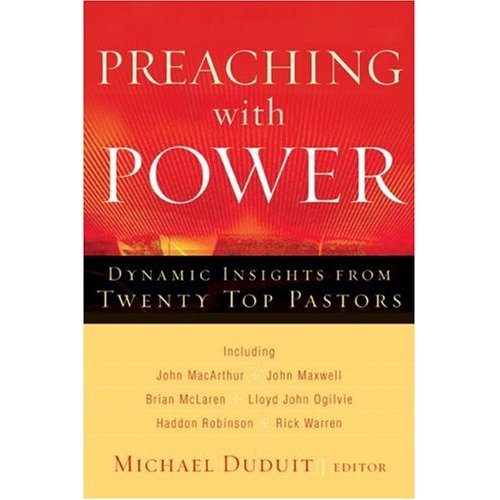
Review: Preaching with Power, edited by Michael Duduit

Subtitle: Dynamic Insights from Twenty Top Pastors (2006)

duduitpower.jpg

As editor of Preaching Magazine, Michael Duduit is able to take good content from that magazine and publish it in book form. This is exactly what this book is. Twenty interviews with top preachers that have appeared in Preaching Magazine and now appear in this book from Baker.

There are some very helpful interviews here. I would particularly note Haddon Robinson on expository preaching in a narrative world, David Jeremiah on preaching through pain, Andy Stanley on preaching without fear and Bryan Chapell on expository preaching.

Other contributors range from John MacArthur and Jerry Falwell to Dan Kimball and Brian MacLaren. From Erwin Lutzer and Lloyd John Ogilvie to T D Jakes and Adrian Rogers. From Jerry Vines to Rick Warren. The contribution is varied and the subjects span a spectrum of related interests.

I won’t extend this review by sharing specific insights from the interviews, I simply want to explain the nature of the book. If you’ve read the magazine for a decade or two then you will have read it all before. If you haven’t been a subscriber to Preaching, then this book might tempt you. This is a worthwhile book to read, or just to pick at when you have spare ten minute chunks of time.

(This book does not break into the top ten must read’s for preachers.)