Last Sunday I preached in a small church not far from us. I was assigned a passage that I would never choose for myself, at least not as a one-off message. The raising of the Shunammite’s son by Elisha (2Kings 4:8-37). There are always short-cuts when preaching an Old Testament narrative, but I’m not comfortable with them. For example it is easy to tell a story and then jump to Jesus (and preach a New Testament message). But the story stood as inspired long before the New Testament was added. Or it is easy to tell the story, ignore the theological context/content and then draw out some human-level moral principle – “so let’s be like person X.” Again, that usually is not the point of the narrative. The challenge is to avoid the short-cuts and preach the intended truth of the passage in its context with the full theological implication, but to also be sure to apply the message specifically to the listener today. On one hand, it is easy to do a historical lecture, but leave your listeners untouched by the truth of the passage. On the other hand, it is easy to springboard from a story to all sorts of possible applications that do not honor the meaning and purpose of the passage. And if there can be a third hand, then it is also relatively easy to force Jesus and the New Testament back into the Old Testament and end up preaching a different passage. So how to avoid the easy options and instead preach the passage itself?
Month: May 2007
Review: Biblical Preaching, by Haddon Robinson (2nd ed.)
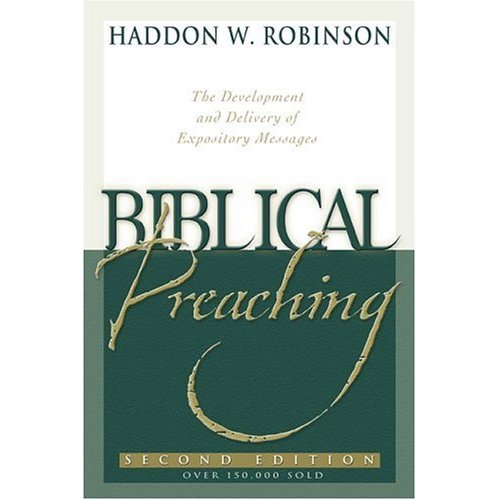
In England this book is sold under the title of “Expository Preaching,” but if you get it online, I would go for the American title so you are sure to get the 2nd edition.
This is Robinson’s highly revered “how to” preaching textbook. He presents a ten-stage process of sermon preparation in his typically precise style. No word is wasted. In many respects numerous other books on preaching are building on this one, trying to offer some clarification or slight adjustment. That is certainly not true of all, but of many.
The emphasis throughout is on preaching a thoroughly Biblical message, through effective communication, in a way that is entirely relevant to the specific contemporary audience. The “Big Idea” is central to the philosophy and the procedure of preaching. So the ten steps move from understanding the text to the point of an accurate and clearly defined exegetical idea, through the process of developing the homiletical idea with clear purpose, to the practical matters of sermon shape and effective content. Although there are other books that deal in detail with issues of delivery, Robinson’s brief section on delivery is helpfully succinct.
I think it is fair to say that anyone interested in the subject of preaching should have this book. Robinson’s combination of Biblical commitment, expertise in communication theory, and renown as a teacher of preaching, effectively blend to make this a very effective book. It seems wrong to review another book before this one!
Welcome to the blog
This is a simple concept – a blog for discussing anything related to preaching. We hope to generate discussion of how to preach specific Biblical passages, aspects of delivery, preaching theory and also book reviews. The goal is to stimulate better Biblical preaching. Let’s see where this goes . . .
 Biblical Preaching