Easter is Coming – The Power of Identification

I know Easter is still a couple of months away, but as a preacher it is never too early to think about Easter.  In fact, there is a sense in which commemoration of Easter is never more than six days away – the Lord’s Day is a weekly gathering because of His resurrection.  So here’s a thought regarding Easter (whether you’re planning for April or preparing for tomorrow’s message).

In preaching any narrative section, we need to consider whom listeners will gravitate toward, with whom they will identify.  We should consider how to encourage that or redirect that through our preaching.  In the case of the passion narratives, this tendency to identify can be powerfully used in our preaching.  Luther pointed to this when he wrote:

“Although Christians will identify themselves with Judas, Caiaphas, and Pilate; sinful, condemned actors in the Gospel story – there is another who took the sins of humanity on himself when they were hung around his neck.”

When it comes to the story of the crucifixion we find ourselves identifying with so many characters: Judas, Peter, fleeing disciples, Caiaphas, Pilate, Roman soldiers, Simon from Cyrene, mocking executioners, mocking crowds, mocking thief, repentant thief, followers standing at a distance, followers standing close by, even the Centurion.  Yet the wonder of it all is that we are invited to identify with the perfect One hanging on that cross, for in that act He was most wondrously identifying with us.

Consider how the natural function of narrative – to spark identification – can be utilized to communicate the wondrous truth of Calvary this Easter, or even this Sunday.
Say It Separate From the Sermon

I was just reading a list of rules for preaching by Rolf Jacobson of Luther Seminary.  I was intrigued by number 3, which I share here.  My own preaching tends to be in churches where the liturgical calendar is largely ignored, but I know that for many churches the opposite is true.  Either way, here’s Rolf’s thought:

3. You shall not proclaim the season of the church year. What does this mean? Do not use the text as a point of departure for talking about Advent, Epiphany, Lent, Pentecost, All Saints, Mothers’ Day, Fishing Opener, or the Commemoration of St. NOBODY CARES! Easter and Christmas are okay to mention frequently, but do not trump the biblical text with the liturgical day. Let the rest of the liturgy be the place where the movements of the liturgical season shape the community of faith. I am not against the liturgical year. In fact I fully embrace it. But preach the text! If the preacher constantly refers to the liturgical season, the season becomes the de facto text for the sermon. That is not biblical preaching.

As well as the specific point about preaching the text rather than using it to get to the liturgical calendar, I like an implied point here.  There are other elements in a service that can be used for certain things.  The choice of songs, the introdauction to songs, prayers, other elements in the service.  Let’s not think that anything that could or should be said on Sunday has to be said in the sermon.  We can use the rest of the service for the rest of the agenda, but let’s keep the message time for the message of the text.

Adjust Agenda?

Yesterday I quoted from JI Packer’s chapter on Charles Simeon in Preach the Word.  I wanted to finish quoting the paragraph since it is provocative and perhaps helpful:

The motive behind his almost obsessive outbursts against Calvinistic and Arminian “system-Christians,” as he called them, was his belief that, through reading Scripture in light of their systems, both sides would be kept from doing justice to all the texts that were there.  Be “Bible-Christians” rather than slaves to a system, he argued, and so let the whole Bible have its way with you all the time.  Whether or not we agree that such speaking is the wise way to make that point, we must at least endorse Simeon’s “invariable rule . . . to endeavour to give to every portion of the word of God its full and proper force.” (Packer, in Preach the Word, 147-148.)

Perhaps you might substitute a different theological label into his quote, but still I think the point is helpful.  It is naive to think that we can simply preach the Bible in a theology-neutral way.  However, there is a great difference between reading every text in light of your system and constantly adjusting your system in light of the biblical text.  In that sense, let’s preach as, and let’s preach to motivate, “Bible-Christians.”

Abort Sermon! Abort Sermon?

On one level it is a feeling that can come for any reason.  A little moment of doubt.  An unexpected event, or listener, or conversation, or comment . . . and suddenly the temptation is there to give up on the planned message.  Some may have this feeling every time they preach.  Others may never get it at all.  But is there a genuine reason to abort the message and switch to something else?

In his excellent chapter on Charles Simeon in Preach the Word, J.I. Packer states the following:

Simeon would go on to remind us that expository preaching should be textual in character.  The preacher’s task, according to him, was not imposition, giving texts meaning the do not bear; nor was it juxtaposition, using texts merely as pegs on which to hand general reflections imported from elsewhere (“preachments of this kind are extremely disgustful”); it was, precisely, exposition, bringing out of teh texts what God had put in them  “I never preach,” said Simeon, “unless I feel satisfied that I have the mind of God as regards the sense of the passage.” (Preach the Word, 147)

There may be more than one reason to abort a sermon, but this one alone is worth pondering.  If we are not satisfied that we have the mind of God as regards the sense of a passage . . . we should not preach it!  Better to preach an unprepared sermon at a moment’s notice on a text we do understand, than to preach a prepared sermon built on shaking exegesis.  If you really don’t get, don’t preach it.  Abort sermon!

The Non-Academic Preacher Compliment

Last week I spoke to a friend who had asked to borrow my master’s thesis.  He was positive about it, but mentioned that he’d had to look up some terms I’d used.  He was a bit surprised since he doesn’t have that challenge when I preach.  That’s an encouraging compliment in my eyes!

Here’s a quick quote that is somewhat related in Phillip Jensen’s chapter, “Preaching the Word Today” in Preach the Word, the book of essays in honor of Kent Hughes:

With the discriminating eye of the cynic, the modern scholar can deconstruct the author’s writings so as to explain what he “really” meant.  Only the expert – never the ploughboy – can know what was meant.  The priesthood of all believers is no longer replaced by the sacerdotalism of the sacramentalists but by the arrogance of the academy.

We need to be so careful.  I think it is good to get the best academic training possible (a matter of good stewardship), but we need to be very careful not to develop the easily associated arrogance that comes with training, nor to carry that arrogance into the pulpit.  We serve the priesthood of all believers; we are not the priesthood for all other believers.

Let’s make sure we open up the Bible in peoples’ laps, rather than moving it further away from them.  Let’s make sure we communicate well, rather than impress with lofty language that the ploughboy doesn’t understand.  Let’s make sure we prepare for ministry and prepare for a message as fully as we are able, but not let that show in any way that will hinder our listeners.

Monday: Renewing Vision Day

Monday is a good day to take stock, take a deep breath and recommit ourselves to God’s work.  That doesn’t just mean being willing to ever preach again, although for some that might be a good step on a Monday morning!  It means recommitting to really do the work of biblical preaching, rather than just going through the motions.  A couple of quotes from Philip Ryken’s chapter “Preaching that Reforms” in Preach the Word:

If we are living in an age of relativism and narcissism, what are the implications for preaching?  Obviously, Bible teaching will be out of favor.  As sinners, we generally do not like to have our selfishness exposed; but this is one of the primary purposes of preaching the Bible.  In a post-Christian culture, the last thing people want to hear is the truth about their self-centeredness.  What preaching there is, therefore, tends to be therapeutic rather than prophetic.  It aims to make people feel better about who they are rather than to challenge them to become, by God’s grace, what they are not. (p192)

How tempting it is to preach messages that are therapeutic, rather than prophetic.  It’s hard to choose to preach the Word when its message is uncomfortable, unpopular, “unsophisticated” or somehow might offend somebody.  Later in the chapter, Ryken addresses the issue of evangelism:

This kind of proclamation requires boldness, a virtue that is sadly lacking in the contemporary church.  One of the reasons evangelicalism is in decline is because Christians have lost their nerve.  In these post-Christian times, we tend to be a subculture rather than a counterculture. (p198 )

I am not encouraging insensitive brash proclamation, or unnecessarily offensive preaching.  I am just taking stock of my own ministry again this morning and renewing my vision to preach the Word.  It’s the greatest privilege, but it demands an appropriate level of boldness too.  Let’s set our sights on our Lord afresh in order to renew our vision of Him, His Word, His building of His church, His mission to the world … and our privilege of participation in that.

A Patient Ministry

It is generally obvious that life transformation generally happens gradually.  While God might give a breakthrough epiphany moment from time to time, He does His patient work of building the church all the time.  This is true on multiple levels.

We need patience with the congregation. That’s not to suggest we preach without an edge of expectancy, encouragement and even exhortation.  It is to suggest that we pray for breakthroughs, but trust God to work out His plans in each life in His timing.

We need patience with ourselves. It’s easy to respond to a small bit of negative feedback, or a feeling of failure last time we preached, and suddenly have a list of personal weaknesses that need to be fixed.  We need to patiently serve faithfully.  Seeking to improve out of good stewardship of our ministry, but trusting God to continue working in our lives at His pace.

We need patience with key people. It could be a “well-intentioned dragon” – a constructive critic in the church.  It could be a person of influence with unclear motives.  It could be an individual that requires far more energy than we feel able to give.  We must pray for wisdom, for strength, for patience to not make rash moves at our speed that miss what God is doing at His.

I am by no means affirming ministry weakened by low expectation, unimproved by lack of personal growth or unnecessarily hindered by a motivation-drain unaddressed.  I am simply reminding myself and us all of something I was told fifteen years ago: “God walks at 3mph.”  Let’s keep our gaze on Him and serve, even live, with prayerful patience.

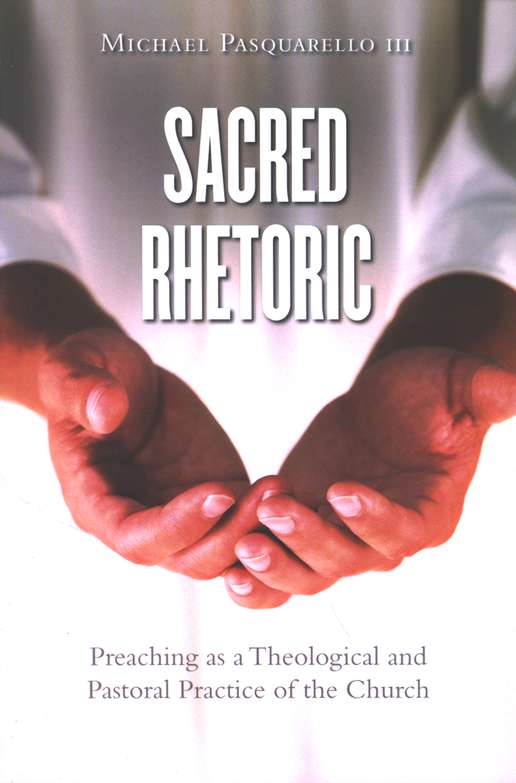
Review: Sacred Rhetoric, by Michael Pasquarello III

Subtitle: Preaching as a Theological and Pastoral Practice of the Church (2006)

pasq-sacred-rhetoric

Pasquarello is concerned by modern approaches to preaching.  He sees contemporary approaches as being obsessed with “how-to’s” at the cost of having lost the divine-human conversation – we’ve mistakenly traded in communion for consumption.  The field of homiletics, by establishing itself in distinction from the related fields of theology, exegesis, spirituality and worship, has somehow lost its moorings and become merely a technical field of somewhat sanctified communication.

This book offers nothing new, but rather seeks to reconnect us to the past.  It seeks to offer the possibility of engaging with ten esteemed mentors in the field of preaching, ten mentors from church history.  From them we can reignite a passion for true preaching – that which is “a theological and pastoral activity [of the church] that locates us in God’s story, drawing the world with us toward our true end: peace and friendship, communion with the Triune God.” As Steinmetz suggests in a quote in the conclusion, “Only when we have regained our identity from the past can we undertake our mission in the present.” (Both quotes on p135.)

The majority of the book is not a critique of present practice, but rather a presentation of ten preachers from the past.  Beginning with a slightly more lengthy treatment of Augustine, the book moves on to consider such esteemed names as Gregory the Great, Benedict, Bernard of Clairvaux, Bonaventure, Aquinas, Erasmus, Latimer, Luther and Calvin.

I do not feel adequately prepared to make judgment on whether the presentation of these men is either accurate or rightly balanced in terms of historical detail.  What I do know about church history suggested the presentations were on track.  However, as a reader I can say that this book stirred my heart for the privilege of preaching – participating in the central action of God’s story in this age.

Although short (139pp), this is not a quick read.  It takes time to ponder the presentation of each preacher.  It takes time to digest the relative benefits from conversation with each one.  It takes time, but it is worth it, for we are surely not participating in something new in our generation.  We stand as preachers, as those engaged in the glorious calling to sacred rhetoric.  Whether or not you are a regular reader of church history, this book is well worth reading as we seek to participate in God’s ongoing story.

Points on Picking Passages – Part 2

Yesterday we saw that God is sovereign and all Scripture is “useful” (which sounds like an understatement when separated from 2Tim.3:16!)  So when there is freedom to choose a passage for a message, consider:

Consider the people. Who are they?  What do they need?  What issues are they facing in life, both individually and corporately? Sometimes a prayerful consideration of the applicational needs of the people will prompt your thinking toward a specific passage or kind of passage.

Consider the program. What teaching have they had recently?  What is coming up after your message?  Sometimes the program might suggest a helpful place to go for your message.  Perhaps a helpful OT background passage for the subsequent series in a NT book.  Perhaps a passage with a similar idea to reinforce teaching they’ve recently heard.  Perhaps something very different to bring balance to the program.

Consider your preference. There is nothing unspiritual about asking yourself, what do I want to study and preach?  If you are personally motivated to be in a specific book or passage,  then it will enliven both your study and delivery.  Often such a choice leads to more work, not less, because when the heart engages with the opportunity, the preacher will give more in the preparation stage.

Consider your personal ability. Some passages are harder to interpret than others.  Some are harder to preach than others.  Is the study time available before you preach enough to really study the passage well (and are you capable of such study)?  Is the time available for the message long enough to really preach a long narrative with all the necessary description and narration?  There’s nothing spiritual about biting off more than you can chew.  Lives are changed by simple and the familiar passages preached well.

Careful of excessive delay in decision. However you choose, it is important to choose.  It is much better to spend hours wrestling with the text in prayerful preparation, than it is to spend hours wrestling with what passage to preach.  The sooner you make a decision, the sooner the text can start working in your life (a prerequisite to effectively preaching it to others).

Any other considerations that you would add to the mix?