Appeal To All Senses

Just a quick quote today, again taken from Jay Adams, Preaching With Purpose:

Most homiletics books speak about “illustrating” truth and making it “vivid.”  But those terms refer to communication by means of appeal to but a single sense: the sense of sight.  That failure, so inherent in the very single sense vocabulary of homiletics, has led to dull, lifeless preaching.  Of course, there are many dull, lifeless preachers for whom it is difficult to “paint word pictures” that appeal to the sense of sight, let alone learn to help congregations to taste, touch, smell, and even hear with the ear.

I think this is a helpful point.  Listeners have five sense and preachers can communicate to every sense by means of carefully chosen words and well-crafted delivery. I remember sitting under the teaching of David Needham, a master of using words and emotion that caused us to salivate as he described the taste, smell and sound of the golden delicious apples of his Californian childhood!

Adams goes on in the same paragraph to make the same point I want to make today.  When we appeal to the full range of human senses, we only do what the Bible does so often.  Be sure to look carefully in your preaching text for any sense appeal that is already there.  Then think carefully about your message, each detail, and how it can deliberately target various senses as you preach.
If We Believe In Preaching

If we believe in preaching then we will give our best to preaching.  We will gladly give the hours and the effort needed to preach the Word of God clearly, accurately, engagingly and hopefully effectively.  We will spend money on helpful resources.  We will look to grow as a preacher, be open to constructive feedback and looking for helpful input.  If we believe in preaching then we will give our best to preaching.  But there is something else to mention.

If we believe in preaching we will not only give the best we can to others, but we will submit ourselves to healthy preaching too.  Not as an exercise to learn preaching skills.  Not as an academic endeavor to learn about a new area of Scripture or theology.  Not for our sake as preachers, but for our sake as believers.  If we believe in preaching then we will sit under good preaching for the health of our souls.

Perhaps you only preach periodically, so most weeks you sit as a listener.  Great.  But what if you preach regularly?  It is easy to let the schedule fill and rely only on our sermon preparation for our spiritual benefit.  Certainly when we preach we probably get more from the message than our listeners do.  That’s only natural if the process is good.  But somehow it just seems healthy to carve out half an hour or so to sit as a listener to the end result of another’s preparatory work.

We live in a day of unprecedented opportunity.  I am currently choosing to sit under the preaching of a friend.  It is a series in a church you probably never heard of, but it is healthy, helpful, solid biblical preaching.  I need it.  We all do.  If we believe in preaching, we will not only give, but also look to receive.

Not As Many Churches As There Are Churches

It’s a strange statement, but in most places there are not as many churches as there are churches.  I am not referring here to the many church buildings that have been emptied, sold and converted for use as Hindu temples, car repair shops, martial arts schools or apartments (come visit the UK if you don’t believe me!)  What I am referring to here is the number of churches where people will gather today, but come out none the wiser as far as the Bible, the gospel and God is concerned.  How many churches there are that preach the fluff of well-meaning platitudes, rather than the solid substance of biblical truth.

In the city of London there are apparently something like 4000 churches.  But how many will preach the gospel clearly and accurately today?  How many will speak from the Word of God in a manner that reflects its truth, accuracy, historicity and relevance?  How many genuinely believe in a God who is at work in the world today, even during the sermon segment of the service?  As Calvin wrote, “Wherever we see the Word of God purely preached and listened to . . . it is in now way to be doubted that a church of God exists.” Let us pray for the people sitting in a church building today, but unclear as to their spiritual state or God’s provision for them in Christ.  And let’s be sure that the church we preach in really is a church today!

Don’t Stop Short

Tomorrow’s passage is relevant for our listeners.  Hopefully by this stage in preparation we see the relevance and have a message that will present the idea of the passage, built on explanation of the details, with applications that point to the relevance.  But it is always easier to only go 75% of the way there.  Don’t stop short.

Don’t just ask a vague question when the passage is set up for a probing question.  Don’t just make a vague application.  Help people see the specific ways in which this passage can make a difference in their affections, their belief, their conduct.  Their thinking and their actions should be changed by biblical preaching.  It’s easy to keep it general, vague and maybe even nice.  But don’t stop short, push through and drive the message home (with grace, of course, but home nonetheless).

Dense Packing Doesn’t Prosper

It is commonly referred to as a mistake new preachers make, but we can all fall into the trap.  A sermon will not work well if it is too overwhelming.

Let’s say you study the passage for several hours.  You discover interesting bits of information regarding background, structure, syntax, grammar, word meanings, not to mention parallel passages, cross-references, informing theology and later use of this text in the canon.  You discover fascinating insights through archaelogical reference tools, an interesting textual critical debate concerning one word that may or may not be original, and an interpretational debate that has gone back and forth since Calvin’s commentary was published.  Plus you stumbled across some useful anecdotes, an amusing story or three in a database of illustrations and you heard a great opening remark that you’d love to fit in, somehow.  Several hours of preparation will yield a significant resource pool of information.

But then you have to pack up what you intend to carry into the pulpit.  You only have a limited time.  Listeners only have a limited capacity to take information onboard.  After all your work, you have enough to load up three large suitcases and a trunk, plus a carry-on bag and a personal item.  But you can only pack a small suitcase and take it with you into the sermon time.  Prayerfully select.  Leave some of your work neatly folded for a future journey.  Graciously drop some of it in the waste.  Pack only that which will help you achieve your message purpose and drive home your message idea with application for their lives.  And don’t mention all that you couldn’t bring with you.

When you travel into the pulpit, just take one small case.  Don’t overstuff it either, tempting as that may be.  In the preaching journey, dense packing doesn’t prosper.

How to Preach Error in a Series

Perhaps you are preaching a series of messages on a book of the Bible.  Perhaps you are one of several preachers preaching such a series.  So naturally you take the first passage of the text and study it to the best of your ability, Sunday comes and you preach it.  Next week you give your efforts to the next passage in the book.  This is how to preach error in a series.

It seems obvious, but in the busy schedule of ministry, it is so easy to forget.  A passage has to be studied in its context.  You may misrepresent the author’s intent in chapter 1 if you have not studied chapter 1 in its relation to the other three chapters.

Practically this means finding ways to do as much of the exegetical work as possible, in the whole book, before you preach message one.  If you are only preaching one message in the series, then necessarily your broader study will not be to the same level as the passage you are preaching (but perhaps this should push us in the direction of some study in teams whenever possible in multi-preacher series?)  If you are preaching the whole series, this macro view of the whole will benefit every individual message and be a blessing to your soul.

If the passages are connected to each other, as each series in a book surely is, then you cannot afford to prepare only one message and then preach it.  That’s how to preach error.

Content Differences in Preaching and Lecturing

In his book, Preaching with Purpose, Jay Adams regularly distinguishes lecturing from preaching.  One is designed to inform, the other to motivate appropriate response and change.  One is about the Bible, the other is about the listeners and God, from the Bible.  But does this mean that applicational preachers will say less about the Bible than “lecturers” in a pulpit?  Not according to Adams:

The preacher explains the text just as fully as does the lecturer; in fact, more fully.  He explains the ‘telos’ as well.  Everything of importance that the lecturer might say about the passage (and, lecturing lends itself to by-paths, discussing unimportant details, it must be remembered) the preacher can say also.  The difference is in how they handle the same material; the difference is in their orientation and use of it, and in how they say what they say.

So a Bible lecturer in a pulpit may state truth, but the listeners don’t know why they are looking at it when it is presented.  The listener to true preaching will know the why as well as the what, of that which is presented.

A call for expository preaching is neither a call for apparently irrelevant informing (even with application tacked on at the end), nor is it a call for applicational messages weak in content.

Communicate Relevantly . . . Carefully

As a preacher who desires to be firmly planted in the world of the Bible and the world of the listeners, it can be a real challenge to be appropriately specific in your preaching.  In a small church, everybody knows everyone and can easily figure out who you are referring to if you give a specific example – confidentiality undermined.  In a larger church, people may not know who you are referring to.  However, the person you are referring to can easily sense you are referring to them, and suddenly their trust can feel undermined.

Here are a few suggestions, perhaps you can add others:

Instead of defaulting to more general applications, translate away from one specific to another. Don’t refer to specific marriage problems when you’ve been counseling a couple in that area, but perhaps the application would work in terms of parenting struggles, work relationships, etc.  Remember that people will translate one specific that you preach into the specific situation of their own life experience.

Keep a record of specific observations, potential illustrations, etc., so that you can adjust them and use them at an appropriate time. Right now everyone knows that particular marriage is on the rocks.  You have an example from the situation that could be helpful, but right now is not the time to use it, even if confidentiality is protected.  So having a good record system allows you to decide when to bring in an example to your preaching.

Always review carefully before you preach, considering how it could be taken as well as how you intend it. It may be easier to become non-specific and generic, but the result is not worth it.  So keep the specificity in your preaching, but be careful to review ahead of each sermon to make sure you are aware of any potential land mines.

We Preach By Faith

Life is often hard.  Life is often deeply disappointing.  Despite what some may claim, life is not one great victory march of pain-free delight through this fallen world.  Living by faith is not a great party free of trouble and hardship.  And preaching is a lot like life.

We prepare to the best of our ability and saturate our lives and ministry in prayer.  Yet so often it falls short.  We get tired and frustrated, saddened by the lack of change in others, or even in ourselves.  We give of ourselves to people who then somehow turn and tear out our hearts.  We find ourselves seething deep inside at great failure or simply at the persistent polite feedback.  And then typically we find ourselves praying stained glass prayers about our next sermon, the kind we feel we’re supposed to pray.

But look to the examples in the Bible of the brutal honesty of God’s men in prayer.  Consider Job chapter three, David in numerous psalms, Jeremiah in chapter twenty, or Paul with his thorn in the flesh.  They poured out their emotion, their hurt, their anger to God.  They didn’t sugar-coat their prayers in sanctified clichés.  They were real, and they knew God could take it.  Yet when all their energy was spent, when all the feelings were out, when they lay totally wiped out before God . . . there was still a trust in God’s Word, still a burning in the bones, still a faith though weak and smoldering.  My grace is sufficient for you.  Will you take my hand and press on?  Do you trust me?

Real faith is not all about grand and glorious certainty.  Often it is found in the midst of total inadequacy, absolute weakness and apparently overwhelming failure and hurt.

We live by faith.  Let us also preach by faith.  Be brutally honest with God about ministry, about preaching, about the preparation that takes so much out of you, the delivery that leaves you deeply vulnerable, about the sometimes sweet agony of it all . . . and about the feelings of failure, inadequacy, discouraging results, the backhanded slap of polite platitudes with no hint of life change, the deep questions, the temptation to settle for less, or to quit altogether.  Pour it out, pour it out until there is nothing left.  Then remember that whisper from above, “my grace is sufficient for you.”  That hand outstretched to take yours and lead you on.  To prepare another sermon, to preach another sermon, to give everything you’ve got to the best of your ability, and to do it all by faith.

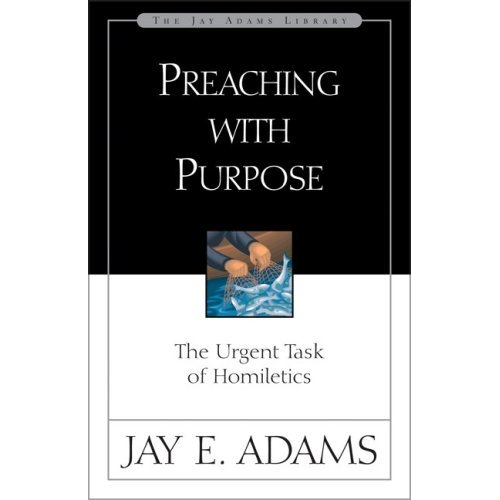
Review: Preaching with Purpose, by Jay Adams

Subtitle: The Urgent Task of Homiletics (1982)

Jay Adams is generally known as the Biblical or Nouthetic Counselling author of Competent to Counsel. Yet he would point out also his personal focus and study in the area of preaching.  Years of thought in this field went into this accessible book.  Still today, a quarter of a century later, it is well worth reading.

22 chapters in 160 pages.  The chapters are short and a quick read.  However the instruction given is worthy of considered thought and personal reflection.  For Adams, preaching should be, must be, a purposeful task.  It is not about informing, but motivating and changing listeners as the Word of God is spoken to them.  Everything in preaching should be driven by the “telic” concern (the goal/purpose of it all) . . . and that concern drives each element of the book.  What is the purpose of the illustration, the introduction, the outline, etc.

I have referred to the book several times in the last weeks because I have resonated with so much of what is written.  As in most books, there are certain positions taken with which some would disagree (such as the note on the role of the literary structure not being any influence on the sermon structure), but overall this is a little book that packs a punch.

If you haven’t read Preaching with Purpose, don’t ignore it because it has been around a while.  The content does not feel dated, and the teaching is well worth hearing for those of us that really want to preach for changed lives, rather than just lecturing for informed minds.