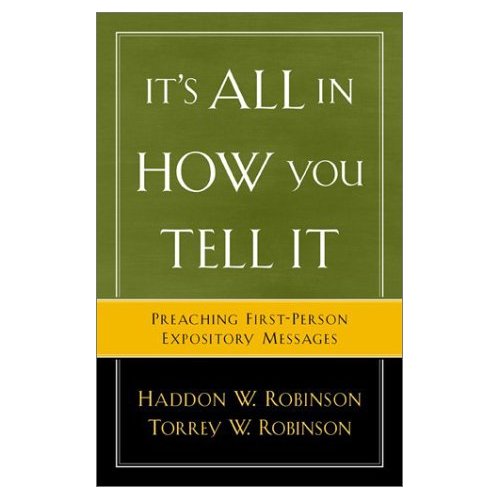
A follow-up thought to yesterday’s post. The difference between a true expository sermon and an interesting biblical lecture is often the speaker’s awareness of sermonic purpose. As Bryan Chappell wrote (Christ-Centered Preaching, p52) “Without the ‘so what?’ we preach to a ‘who cares?’” In his own way Haddon Robinson has put it like this, “Preaching [...]
Read Full Post »
In Christ-Centered Preaching (p55), Bryan Chappell makes the following distinction: “Expository preaching is not a captioned survey of a passage. By this I mean the typical: ‘1. Saul’s Contention, 2. Saul’s Conversion, 3. Saul’s Commission’ (Acts 9:1-19). In my own circles I think I have heard more sermons of this type than any other. They [...]
Read Full Post »
Posted in Homiletics, Preaching, Review on September 28, 2007 | 2 Comments »
Subtitle: Preaching First-Person Expository Messages. This book, by Robinson and son, has a clear target. The sleek and well prepared script of the book flies effortlessly to hit that target. Unhindered by extraneous information, disconnected asides or time-consuming tangents, the book achieves its purpose. Preaching first-person expository messages. The first major thrust of the book [...]
Read Full Post »
As a preacher it is important to know who you are preaching to. This takes work. Often the focus of this work is on building relationships and getting into their world. Conversations are priceless, counseling matters much, visiting homes and workplaces is all helpful, reading what they read, and entering into their world. However, sometimes [...]
Read Full Post »
As you know, on the right hand menu of this site I have seven stages of preparation for a sermon. The order is somewhat significant. There is a general order there, although aspects of stage 7 – sermon details, could be written at various points in the process. The number is not significant, I could [...]
Read Full Post »
Ramesh Richard presents a helpful angle on the variety of people listening to any sermon. He presents three attitudes that will be present at various times in a message. “An expositional ministry,” he writes, “allows you to put a weekly dent in their apathy, passivity, ignorance, or hostility to equip them for godliness and service.” [...]
Read Full Post »
Preaching can be considered a relatively simple equation. You try to get the biblical message to the people sitting in the pews. Yet we so easily give all our effort to one half of that equation. We may study the passage for hours, but give little or no thought to the listeners. So next Sunday, [...]
Read Full Post »
Pastoral ministry and family life rarely yield the full quota of hours we would like to perfectly prepare each sermon. However, there are some elements of a sermon that don’t do well with a short-cut approach. Time spent on this aspect of the sermon is always time well spent. Clarity. It doesn’t come by accident. [...]
Read Full Post »
Much of the Bible comes to us in story form. We should as familiar with the basic ingredients of a story as we are with riding a bicycle or driving our car. Sadly, many preachers are not. Rather than quickly dissecting a story into preachable points, take the time to review the basic ingredients. How [...]
Read Full Post »
The difference between writing for the eye and writing for the ear is often overlooked by preachers. We tend to be book people – we may have studied formally for more years than many others, then our work requires us to keep on reading diligently. Perhaps we even write books and articles for others to [...]
Read Full Post »
As preachers of the Bible it is important that we hold a very high view of God’s Word. Verbal plenary inspiration is the doctrine that affirms the inspiration of the specific words (verbal), every last one of them (plenary). Any position that holds to less than a fully inspired and inerrant canon is a compromise [...]
Read Full Post »
If you’re like me, you are more than happy to receive amazon.com gift vouchers for Christmas. While others may love their cars, guitars, guns or fishing rods, many preachers are in love with their libraries. If you, like me, are a closet bibliophile, this post will make you uncomfortable. Books are a real blessing and [...]
Read Full Post »
One further suggestion from Fred Craddock’s list of suggestions for a life of study is to set up your own library to function efficiently. I’ll take his prompting and share my thoughts on the subject of reading: Don’t shelve books until they have been read. Either a pile on your desk or a dedicated shelf [...]
Read Full Post »
Cross-referencing may be a waste of energy. Sunukjian rightly notes that often a move to another passage is a move in the wrong direction. Having explained the preaching text, the preacher should then move forwards into contemporary life in order to illustrate in such a way that application is visualized by the listener. Instead, when [...]
Read Full Post »
You’ve probably heard the oft-used line that “Scripture interprets Scripture.” This principle of hermeneutics seems to be the only principle for some people, but I would suggest it is one among many helpful principles. It is right to say that no passage will ultimately contradict the rest of the canon, for there is a divinely [...]
Read Full Post »
Three more suggestions from Fred Craddock on the life of study, with comments: 3. Develop the ability to use small units of time. When you only have a few minutes, redeem the time with brief journal articles, checking biblical references, assembling resources, sequencing material to be read, etc. 4. Regularly read novels, short stories and [...]
Read Full Post »
Fred Craddock, in chapter 4 of Preaching makes a series of suggestions for cultivating and guarding a life of study. I’ll share five of his ten suggestions in these two posts, with comments added: 1. Inform your congregation of your study schedule, explaining that study time is time spent with the whole congregation. It is [...]
Read Full Post »
More food for thought on the issue of topical preaching. As I wrote in part 1, it is possible to preach a sermon that is both expository and topical. Yet generally speaking I urge people to stay in one text. Why? There is always more in one passage than you can preach in one sermon. [...]
Read Full Post »
When I’ve taught preaching either in a course or a seminar, I’ve regularly encountered a certain question. “Why do you focus on preaching a single passage so much and not give instruction on preaching topically?” My response is hopefully balanced but instructive to those that ask. There is a place for topical preaching, but [...]
Read Full Post »
In part 1 we considered the importance of establishing and underlining the biblical authority of a message. We underlined the importance of a commitment to expository preaching and the need to reinforce that commitment through attitude and action throughout a sermon. Now some thoughts on reconsidering the traditional placement of the reading before or at [...]
Read Full Post »
Traditionally there are two options for when to read the Bible passage for a sermon. One is earlier in the service, the other is at the start of the sermon. Either of these may be ideal. Neither of these is required. While starting with the reading may help with establishing the authority of the sermon, [...]
Read Full Post »
Just three more areas to think about and push ourselves in: 3. Gestures – Are you naturally dependent on certain movements? You may not know, but check a video or ask a friend. Like the voice, overplanning will result in unnatural “performance.” However, evaluation and forethought may raise subconscious repetition to conscious appropriate variation. Your [...]
Read Full Post »
Earlier this week I posted a couple of times about default preaching. That is, the way we can easily settle into a routine structure or style of sermon. For the sake of our listeners, it is good to try adding variation to our sermons. Yet also for our own sake this is worthwhile. Not only [...]
Read Full Post »
We may strive for objectivity and authority in our exegetical work (although it is tentative due to our limitations). However we tend to feel very tentative when it comes to application. How do we make sure our contemporary applications of the text are in line with the passage and its theological truth? Timothy Warren, of [...]
Read Full Post »
Donald Sunukjian thinks through elements of the preaching process in fine detail. His book, An Invitation to Biblical Preaching, is full of real nuggets for the thoughtful preacher wishing to fine tune their methodology. For instance, consider his five step approach to an introduction: 1. Engage audience interest – develop a sense of need through [...]
Read Full Post »